

The UK State Pension triple lock increase is expected to deliver another above-inflation rise for millions of pensioners in April 2027, with the full new State Pension potentially reaching £250.70 per week, equivalent to £13,036.40 annually.
The increase follows the publication of the latest earnings and inflation figures used to calculate annual State Pension adjustments.
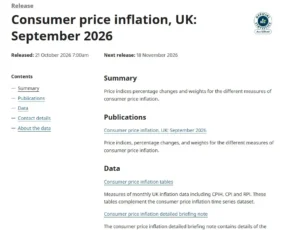
Average earnings increased by 3.9% during the relevant May-to-July 2026 period, while Consumer Prices Index (CPI) inflation reached 3.5% in September 2026.
Under the existing triple lock arrangement, the higher figure determines the annual increase. Consequently, a 3.9% rise is now expected for April 2027, subject to formal government confirmation and final payment rates.
This would give someone receiving the full new State Pension approximately £488.80 more annually than the equivalent 52-week amount at the current rate.
However, the headline increase is only part of the picture.
The government has also announced plans to reform the triple lock from April 2030, while the continued freeze on income tax thresholds creates important financial considerations for pensioners.
Understanding these developments is essential for people already receiving the State Pension, those approaching retirement and households depending on pension-related benefits.
How Much Will the UK State Pension Triple Lock Increase Be in April 2027?
The expected increase for April 2027 is 3.9%, based on the three measures that determine the triple lock.
| Triple lock measure | Relevant figure | Measurement period |
|---|---|---|
| Average earnings growth | 3.9% | May–July 2026 |
| CPI inflation | 3.5% | September 2026 |
| Guaranteed minimum increase | 2.5% | Annual policy guarantee |
| Highest figure | 3.9% | Expected April 2027 increase |
The Office for National Statistics published September’s inflation figures on 21 October 2026, completing the principal economic inputs for next year’s calculation.
Because earnings growth was higher than both inflation and the guaranteed minimum, it is expected to determine the increase.
This distinction matters because earlier pension forecasts were based on estimates that could have changed before the final inflation figures became available.
The latest figures establish a much clearer outlook, although the 2027/28 weekly rates still require formal confirmation.
The inflation data can be checked through the Office for National Statistics’ September 2026 release.
What Will the New and Basic State Pension Rates Be in 2027?

The expected 3.9% triple lock increase will affect both the full new State Pension and the full basic State Pension.
However, the amount someone receives depends on which pension system applies to them and their individual entitlement.
The following estimates show the potential changes from 6 April 2027.
| State Pension payment | 2026/27 rate | Expected 2027/28 rate |
|---|---|---|
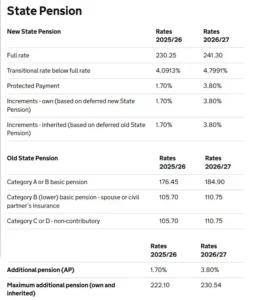
| Full new State Pension (weekly) | £241.30 | £250.70 |
| Full basic State Pension (weekly) | £184.90 | £192.10 |
| New State Pension (four weekly) | £965.20 | £1,002.80 |
| Basic State Pension (four weekly) | £739.60 | £768.40 |
| New State Pension (annual) | £12,547.60 | £13,036.40 |
| Basic State Pension (annual) | £9,614.80 | £9,989.20 |
The 2027/28 figures are projections based on the 3.9% triple lock calculation and expected rounding. They are not yet formally confirmed DWP rates.
How much extra will pensioners receive?
Someone receiving the full new State Pension could get:
| • | £9.40 more per week. |
|---|---|
| • | £37.60 more in a typical four-week payment. |
| • | £488.80 more across 52 weeks. |
A pensioner receiving the full basic State Pension could receive:
| • | £7.20 more per week. |
|---|---|
| • | £28.80 more every four weeks. |
| • | £374.40 more across 52 weeks. |
These figures represent the difference between the full-rate payments in the two years, rather than the exact amount every pensioner will receive.
For comparison, the State Pension increase in 2026/27 was 4.8%, taking the full new State Pension from £230.25 to £241.30 per week.
That earlier increase was larger in percentage terms because earnings growth had been higher during the relevant measurement period.
What Is the State Pension Triple Lock and How Does It Work?
The triple lock is a government policy introduced in 2011 to help protect the State Pension against inflation and ensure that pensioners benefit from economic growth.
Rather than increasing the State Pension by a fixed percentage every year, the government compares three measures.
The highest determines the increase applied to the basic State Pension and the full rate of the new State Pension.
These measures are:
| 1. | Inflation: The CPI inflation rate recorded in September of the preceding year. |
|---|---|
| 2. | Average earnings: The annual growth in average weekly earnings during May to July of the preceding year. |
| 3. | Minimum guarantee: A guaranteed increase of 2.5%, even when inflation and earnings growth are lower. |
For example, suppose inflation reaches 2%, average earnings grow by 3% and the guaranteed minimum remains 2.5%.
The State Pension would increase by 3% because earnings growth is the highest figure.
If inflation instead reached 5%, the increase would be 5%, even if earnings rose more slowly.
The policy is therefore designed to ensure that State Pension payments do not lose value against the selected annual inflation measure.
Nevertheless, this does not mean every pensioner experiences the same improvement in purchasing power.
A household with unusually high energy, housing or care costs may face increases in its personal expenses that exceed the national inflation rate.
Jonathan Cribb, Deputy Director at the Institute for Fiscal Studies (IFS), has also highlighted the uncertainty created by fluctuations in earnings and inflation.
In the IFS’s September 2026 analysis, he explained:
“The more volatile inflation and average earnings growth are, the higher the cost.”
His observation illustrates an important feature of the triple lock: a particularly large increase becomes part of the pension’s ongoing payment level, affecting future costs as well as current spending.
Why Is the UK State Pension Expected to Increase by 3.9% in 2027?
The anticipated increase reflects economic developments rather than a new one-off government payment.
During the relevant period, earnings growth of 3.9% exceeded September CPI inflation of 3.5%.
This means the expected uprating is approximately 0.4 percentage points above the inflation measure used in the calculation.
For someone receiving the full new State Pension, the increase would add around £489 annually at the projected weekly rate.
However, the distinction between a nominal increase and a real-terms improvement remains important.
A 3.9% increase in pension income does not necessarily translate into a 3.9% increase in spending power.
If household expenses rise by a similar percentage, much of the additional money may be absorbed by existing living costs.
Furthermore, the 3.5% inflation figure describes the change in prices over the 12 months to September 2026. It does not guarantee that inflation will remain at that level throughout the 2027/28 financial year.
This is why pension planning should account for both income adjustments and expected household expenditure.
Will the Triple Lock Be Scrapped or Changed in 2030?
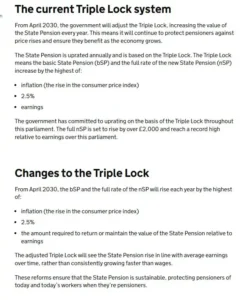
The government has announced plans to adjust the State Pension triple lock from April 2030.
The existing arrangement is expected to continue until that point, meaning the planned reform does not replace the calculation used for April 2027.
Under the proposed adjustment, pension increases would continue to protect against inflation while maintaining a longer-term connection with average earnings.
The main difference is how that earnings link would operate.
| Feature | Current triple lock | Adjusted system from April 2030 |
|---|---|---|
| Inflation protection | Yes | Yes |
| Minimum annual increase | 2.5% | 2.5% |
| Earnings protection | Annual earnings growth can determine the increase | Increase sufficient to maintain or restore the pension’s value relative to earnings |
| Guaranteed annual increase | Highest of three measures | Highest of inflation, 2.5%, or the amount needed to maintain the earnings benchmark |
| Main objective | Protect pension value and share in wage growth annually | Protect pension value while limiting long-term growth relative to earnings |
The important point is that the government is not proposing to eliminate annual State Pension increases.
Instead, the adjusted arrangement would change how earnings growth feeds into the annual calculation.
The current system can permanently increase the pension’s value relative to average earnings following a period of particularly high inflation.
The adjusted system would retain an earnings-related benchmark without necessarily matching annual wage growth every time wages rise.
Research by IFS economists Jonathan Cribb, Heidi Karjalainen and Helen Miller explains that this change would reduce the cumulative effect of the existing arrangement over time.
Their analysis indicates that government savings would initially be relatively limited but could become substantially more significant over the longer term.
The Department for Work and Pensions has provided further details in its official triple lock reform factsheet.
Will the State Pension Increase Push Pensioners Into Paying Income Tax?

The expected increase raises an important question about income tax.
The standard UK Personal Allowance is £12,570, meaning most individuals can receive income up to that amount before paying income tax.
For 2026/27, the full new State Pension is worth £12,547.60 across 52 weeks, which is £22.40 below the allowance.
If the expected 2027 increase takes the weekly payment to £250.70, its 52-week equivalent would reach £13,036.40.
That would place the headline annual amount approximately £466.40 above the standard Personal Allowance.
However, this does not automatically mean every pensioner receiving the full new State Pension will face an income tax bill.
What happens if the State Pension is your only income?
The government announced at the November 2025 Budget that pensioners whose sole income is the basic or new State Pension, without additional increments, would not have to pay small amounts of income tax through Simple Assessment from 2027/28.
The measure was intended to prevent pensioners relying solely on their State Pension from facing small tax bills as annual increases take payments above the Personal Allowance.
As of October 2026, the detailed administrative arrangements have not been fully set out.
The government’s stated protection is also narrower than a blanket exemption for every pensioner.
People receiving additional State Pension amounts, private pensions, employment income or other taxable income may be treated differently.
What if you also receive a workplace or private pension?
The tax implications become more significant when State Pension income is combined with other taxable income.
Consider an illustrative example:
| Income source | Annual amount |
|---|---|
| Expected full new State Pension | £13,036.40 |
| Workplace pension | £4,000 |
| Total annual income | £17,036.40 |
| Standard Personal Allowance | £12,570 |
| Amount above Personal Allowance | £4,466.40 |
This example uses the 52-week pension equivalent and assumes no other allowances or deductions. HMRC’s precise State Pension calculation for a tax year can differ because it takes account of the timing of the April rate change.
A pensioner in this situation may have income tax to pay on the amount above their available allowance.
Importantly, the DWP generally pays the State Pension without deducting income tax.
HMRC may instead collect tax through the person’s other pension or employment income, or through a separate assessment where appropriate. Recent HMRC State Pension income tax corrections also show why the pension figure used for tax calculations should be checked.
The practical implication is that pensioners should examine their combined taxable income, rather than assuming a State Pension increase will always translate directly into the same increase in disposable income. The wider pension tax changes for 2027 and beyond are also relevant to retirement planning.
Does the Triple Lock Increase Apply to Every State Pension Payment?
Although the basic and full new State Pension rates are covered by the triple lock, other pension components can be treated differently.
This is particularly relevant to people who reached State Pension age before 6 April 2016. Understanding the differences between the old and new State Pension systems can help explain why headline rates differ.
Under the older system, a pensioner might receive both a basic State Pension and an Additional State Pension.
The Additional State Pension could include entitlements built up through SERPS or the State Second Pension.
These additional components are generally increased in line with CPI rather than the full triple lock.
For April 2027, that points towards a 3.5% increase in eligible additional pension components, compared with the expected 3.9% increase in the full basic pension rate.
| Pension component | Expected 2027 increase basis |
|---|---|
| Full new State Pension | Triple lock: 3.9% |
| Full basic State Pension | Triple lock: 3.9% |
| Additional State Pension | CPI: 3.5% |
| Protected payment above the full new State Pension | CPI: 3.5% |
| Deferred pension increments | Generally CPI: 3.5% |
These distinctions help explain why someone’s overall State Pension payment might not increase by exactly 3.9%.
For example, a pensioner receiving both a basic pension and substantial additional pension income may see an overall increase between the two percentages.
The final amount depends on the composition of their award.
How Does the Increase Affect Women and People With Incomplete National Insurance Records?
The triple lock applies to the relevant State Pension rates regardless of whether the recipient is male or female.
However, not everyone qualifies for the full published amount.
The State Pension is normally calculated using a person’s National Insurance record, although some people can receive entitlements through a spouse or civil partner or other qualifying arrangements.
Under the new State Pension system, a minimum of 10 qualifying years is generally required to receive any pension.
People whose National Insurance record began after April 2016 generally need 35 qualifying years to receive the full new State Pension.
However, the calculation can differ for people with pre-2016 contribution histories, particularly where they were contracted out of the Additional State Pension.
Some people may require more than 35 qualifying years to receive the full amount.
This means the published figure of £250.70 per week should not be interpreted as a guaranteed payment for everyone reaching retirement age in 2027.
The relationship between contribution histories, retirement dates and individual pension entitlements is also important when considering how much State Pension a woman can receive.
Can missing National Insurance years reduce the increase?
Missing qualifying years can reduce someone’s original State Pension entitlement.
The annual uprating is then applied according to the rules governing their actual pension award.
For example, someone with a pension entitlement below the full weekly rate will generally receive a smaller cash increase than someone receiving the full amount.
People approaching retirement should therefore review their National Insurance records and pension forecasts before assuming they will receive the headline payment.
Voluntary National Insurance contributions may increase entitlement in some circumstances, but paying to fill a gap is not always financially beneficial.
It is important to confirm whether additional contributions would actually improve the State Pension before making a payment.
How Will the Triple Lock Increase Affect Pension Credit and Other Benefits?
The State Pension increase may affect households receiving means-tested financial support.
Pension Credit is particularly important because it provides additional income to eligible people who have reached State Pension age.
For 2026/27, the standard minimum guarantee under Pension Credit is:
| Household type | Weekly minimum guarantee |
|---|---|
| Single pensioner | £238.00 |
| Eligible couple | £363.25 |
These are the 2026/27 rates; the corresponding 2027/28 rates have not yet been confirmed. Additional amounts can apply depending on circumstances. The 2026/27 pension and benefit increases provide context for other payments.
Will Pension Credit increase automatically alongside the State Pension?
Pension Credit does not necessarily follow the same uprating percentage as the basic and new State Pensions.
Its rates are reviewed separately, and entitlement depends on household income and other qualifying circumstances.
An increase in State Pension income may therefore affect the means-tested Pension Credit calculation.
For example, if a pensioner’s State Pension increases, the amount of Guarantee Credit needed to bring their income up to the applicable minimum may change.
This does not automatically mean they will lose all entitlement.
However, the net improvement in their total income may differ from the State Pension increase considered in isolation.
Pensioners who receive relatively low State Pension payments should review how Pension Credit eligibility works, because qualifying can also provide access to other support. Research on Pension Credit and other unclaimed pensioner benefits illustrates why checking eligibility is worthwhile.
Depending on individual circumstances, this may include help with housing costs, Council Tax, NHS costs and other pensioner-related assistance.
The financial value of these additional entitlements can sometimes be more important to a low-income household than the annual State Pension increase itself.
When Will Pensioners Receive the Triple Lock Increase in 2027?
The expected State Pension uprating is scheduled to take effect from 6 April 2027.
Pensioners already receiving the State Pension should have the applicable revised rate incorporated into their payments without making a separate application.
However, the date someone receives the new amount depends on their individual payment schedule.
The State Pension is usually paid every four weeks rather than once per calendar month.
The payment day is generally determined by the final two digits of the recipient’s National Insurance number.
| Last two NI number digits | Normal payment day |
|---|---|
| 00–19 | Monday |
| 20–39 | Tuesday |
| 40–59 | Wednesday |
| 60–79 | Thursday |
| 80–99 | Friday |
A payment covering weeks on both sides of the uprating date may contain amounts calculated using different weekly rates.
This means the first payment after the change may not necessarily show four complete weeks at the higher rate.
The distinction between weekly entitlement and actual bank payment dates is explained further in the DWP State Pension payment schedule and bank statement guide.
Pensioners should also remember that public holidays may occasionally move scheduled payments to an earlier working day.
Will Pensioners Living Abroad Receive the 2027 Increase?
Not everyone receiving a UK State Pension overseas qualifies for annual increases.
The government pays State Pensions to eligible people living abroad, but uprating rules vary depending on the country of residence.
Pensioners living in the European Economic Area, Switzerland and certain countries with qualifying social security agreements generally receive annual increases.
However, pensioners living in some other countries have their State Pension frozen at the applicable rate.
Examples include Canada and Australia.
Consequently, a UK pensioner living in a country where annual uprating is not available should not automatically expect the 3.9% increase.
A person considering retirement overseas should check the pension arrangements for their intended country before making long-term financial plans.
This is particularly important because moving overseas can affect the value of State Pension income over many years, even when the original entitlement remains unchanged. The frozen State Pension rules for overseas residents explain which countries are affected.
Could the Triple Lock Increase Be Reduced by Future Government Policy?
The annual triple lock is a government policy, but Parliament determines the underlying legislative framework.
The government has committed to maintaining the existing triple lock through the period preceding the April 2030 reform.
Nevertheless, long-term forecasts remain sensitive to the relationship between wages, inflation and public spending.
The State Pension is one of the UK’s largest areas of government expenditure.
According to analysis by the Institute for Fiscal Studies, State Pension spending is expected to reach approximately £154 billion during 2026/27.
The same analysis estimates that the triple lock has increased annual State Pension spending by approximately £16 billion compared with a system that had consistently uprated payments in line with average earnings since 2010.
These figures highlight the competing considerations facing policymakers.
Pensioners need income protection against increases in living costs, while government spending must remain sustainable as the population ages.
The planned 2030 reform is intended to address some of these pressures without abandoning inflation protection.
For people approaching retirement, the main planning risk is assuming that future pension increases will always follow the same calculation as in 2027.
Longer-term retirement projections should allow for possible differences between annual inflation, wage growth and pension uprating. Separate think-tank proposals to reshape the UK State Pension are also being debated, but they are not the same as confirmed government policy.
What Should Pensioners Do Before the April 2027 Increase?
For most people already receiving the State Pension, no immediate action is required to secure the standard annual uprating.
However, several checks can help households understand how the increase will affect their finances.
- Check your existing entitlement. Confirm whether you receive the new State Pension, basic State Pension or a combination of basic and additional pension payments.
- Review your expected payment. Use your current pension award to estimate the increase, remembering that additional components may have different uprating rules.
- Consider income tax. Review any workplace pension, private pension or other taxable income alongside your expected State Pension.
- Check benefit entitlement. Pension Credit and other means-tested support can affect how much additional disposable income a household receives.
- Review your State Pension forecast if you have not retired. Check whether missing National Insurance years could affect your eventual entitlement.
- Monitor formal DWP confirmation. The government’s confirmed 2027/28 pension rates will establish the exact weekly amounts and rounding arrangements.
People approaching retirement must also check their State Pension age.
The legislated increase from 66 to 67 is being phased in between April 2026 and April 2028.
As a result, some people expecting to retire during this period may need to wait longer before becoming eligible for payments.
The 2026 State Pension age changes explain which birth dates fall within the transition and how retirement planning may be affected.
Frequently Asked Questions About the UK State Pension Triple Lock Increase
How Much Will the UK State Pension Increase in April 2027?
The State Pension is expected to increase by 3.9%, taking the full new State Pension to approximately £250.70 per week, subject to formal confirmation.
Will the Triple Lock Continue in 2027?
Yes. The current triple lock arrangement is expected to apply in April 2027, with government reforms planned from April 2030.
How Much Extra Will Pensioners Receive Every Four Weeks?
Someone receiving the full new State Pension could receive approximately £37.60 more per four-week payment once the full new rate applies.
Will Every Pensioner Receive an Extra £489 a Year?
No. That figure is the projected 52-week increase for someone receiving the full new State Pension. Individual increases depend on the pension entitlement.
Will the State Pension Be Taxed in 2027?
The State Pension remains taxable income, but the government has announced a measure intended to prevent people whose only income is the basic or new State Pension without increments from paying small amounts of tax via Simple Assessment.
Does the Triple Lock Apply to Additional State Pension?
Not generally. Additional State Pension components such as SERPS are usually increased in line with CPI rather than the full triple lock.
Do Pensioners Need to Apply for the April 2027 Increase?
No. Pensioners already receiving the State Pension should have the relevant annual increase applied automatically.
Will Pension Credit Also Increase by 3.9%?
Not necessarily. Pension Credit rates are set separately, and the 2027/28 rates require confirmation.

Leave a Reply