

The DWP State Pension age change 2026 marks the start of a gradual increase in the UK State Pension age from 66 to 67. The change began in 2026 and will be fully phased in by April 2028.
Importantly, this is not a newly announced DWP rule introduced in 2026. The timetable is already established in legislation.
The Pensions Act 2014 brought forward the increase to age 67, and current government rules require the State Pension age for men and women to rise gradually between 2026 and 2028.
People born between 6 April 1960 and 5 March 1961 are particularly affected because their State Pension age falls somewhere between 66 years and one month and 66 years and 11 months, depending on their exact date of birth.
People born from 6 March 1961 onwards generally have a State Pension age of at least 67 under the current timetable.
What Is Changing to the State Pension Age in 2026?
The change means that turning 66 no longer automatically means reaching State Pension age for everybody.
Before the transition began, people born between 6 October 1954 and 5 April 1960 had a State Pension age of 66. For people born from 6 April 1960, additional months begin to be added to that age.
For example, someone born between 6 April and 5 May 1960 reaches State Pension age at 66 years and one month rather than exactly 66. Someone born later in 1960 may have to wait several additional months.
The number of additional months increases progressively until the State Pension age reaches 67.
This distinction matters because reports describing a sudden “State Pension age rise to 67 in 2026” can be misleading. There is no single date in 2026 when everybody’s pension age changes from 66 to 67.
Instead, it is a phased transition based on date of birth.
State Pension Age by Date of Birth
The official timetable for people affected by the 66-to-67 transition is as follows.
| Date of birth | State Pension age |
|---|---|
| 6 April 1960 – 5 May 1960 | 66 years, 1 month |
| 6 May 1960 – 5 June 1960 | 66 years, 2 months |
| 6 June 1960 – 5 July 1960 | 66 years, 3 months |
| 6 July 1960 – 5 August 1960 | 66 years, 4 months |
| 6 August 1960 – 5 September 1960 | 66 years, 5 months |
| 6 September 1960 – 5 October 1960 | 66 years, 6 months |
| 6 October 1960 – 5 November 1960 | 66 years, 7 months |
| 6 November 1960 – 5 December 1960 | 66 years, 8 months |
| 6 December 1960 – 5 January 1961 | 66 years, 9 months |
| 6 January 1961 – 5 February 1961 | 66 years, 10 months |
| 6 February 1961 – 5 March 1961 | 66 years, 11 months |
| 6 March 1961 – 5 April 1977 | 67 |
Because exact dates can be important for pension and benefit entitlement, individuals approaching retirement should use the official GOV.UK State Pension age calculator rather than relying solely on a general age table.
The calculator determines State Pension age using the individual’s date of birth.
Check Your State Pension Age
Enter your date of birth to see how the 2026–2028 State Pension age transition may apply to you.
Real-Life Examples of the 2026 State Pension Age Change
The government’s timetable provides examples showing how the transitional rules operate.
Someone Born on 31 July 1960
A person born on 31 July 1960 reaches the age of 66 years and four months on 30 November 2026 for State Pension age purposes.
That person therefore does not become eligible for the State Pension simply upon turning 66 in July 2026.
Someone Born on 31 December 1960
A person born on 31 December 1960 is treated as reaching 66 years and nine months on 30 September 2027.
Someone Born on 31 January 1961
A person born on 31 January 1961 reaches 66 years and ten months on 30 November 2027 for the purposes of the timetable.
These examples illustrate why checking the individual’s exact State Pension date is more reliable than assuming eligibility begins on a particular birthday.
Why Is the UK State Pension Age Increasing?
The rise to 67 is the result of pension legislation developed over a number of years rather than an administrative decision made by the DWP in 2026.
The Pensions Act 2007 originally legislated for increases in State Pension age over future decades.
The Pensions Act 2014 subsequently brought forward the increase from 66 to 67 by eight years, producing the current 2026-to-2028 timetable.
The broader policy framework has considered factors including life expectancy, the sustainability of State Pension expenditure and the proportion of adult life people might spend receiving a State Pension.
However, those long-term considerations should not be confused with the rules currently in force. For people affected by the immediate change, the key fact is that the 66-to-67 timetable is already legislated.
Is the State Pension Age 66 or 67 in 2026?

Both figures can be correct depending on a person’s date of birth.
The State Pension age is in transition during 2026 and 2027.
Someone born before 6 April 1960 had a State Pension age of 66. Someone born during the transitional period from 6 April 1960 to 5 March 1961 has a State Pension age between 66 years and one month and 66 years and 11 months.
Those covered by the subsequent part of the timetable have a State Pension age of 67.
Therefore, there is no single universal State Pension age that can accurately describe everybody approaching retirement during the transition.
Who Is Most Affected by the 2026 State Pension Age Change?
People born between 6 April 1960 and 5 March 1961 need to pay particular attention to the change.
They are the transitional group whose State Pension age is calculated as 66 plus a specified number of months.
For someone who had planned retirement around a 66th birthday, this may mean there is a period between finishing work and becoming eligible to receive State Pension.
The precise financial effect will depend on personal circumstances, including employment, private or workplace pensions, savings, National Insurance history and eligibility for other benefits.
This means the age change should not be treated as personalised retirement or financial advice.
Does Reaching State Pension Age Guarantee a State Pension?
No. State Pension age and State Pension entitlement are separate issues.
Reaching the required age establishes when someone can begin receiving State Pension, but the amount they are entitled to depends mainly on their National Insurance record.
Under the new State Pension rules, a person will normally require at least 10 qualifying years on their National Insurance record to receive any new State Pension.
Qualifying years may come from National Insurance contributions, National Insurance credits or, in some circumstances, voluntary contributions.
The amount received can vary considerably depending on the individual’s record and whether transitional arrangements relating to the pre-2016 pension system apply.
Anyone approaching retirement can check the estimated amount and payment date through the official State Pension forecast service.
There is also more information on how a State Pension forecast can help people understand their expected entitlement before retirement.
Does the State Pension Start Automatically at Pension Age?

No. Reaching State Pension age does not normally cause State Pension payments to begin automatically.
The Pension Service generally sends an invitation to claim around four months before a person reaches State Pension age. People can claim online once they receive the required invitation details, while telephone and postal routes are also available.
If someone does not claim the State Pension when reaching State Pension age, the pension is normally treated as being deferred.
That makes it important for people approaching their State Pension date to check correspondence rather than assuming payments will simply appear in their bank account.
Some people deliberately choose to defer their State Pension, but whether doing so is suitable depends on individual circumstances and should not be treated as a universally beneficial strategy.
Does the State Pension Age Change Affect Pension Credit?
Yes. The Pension Credit qualifying age is linked to State Pension age.
Official DWP technical guidance confirms that Pension Credit qualifying age is increasing alongside the State Pension age from 66 to 67 during the 2026-to-2028 transition.
This means a person cannot assume that Pension Credit will become available at 66 simply because that was previously the standard State Pension age.
People close to the qualifying threshold should check their exact date rather than applying an old age rule to their circumstances.
The change does not mean everyone reaching State Pension age automatically qualifies for Pension Credit. Pension Credit has separate financial and eligibility conditions.
Does the Change Affect the Amount of State Pension?
The age increase itself does not determine the amount paid.
A person’s new State Pension is calculated mainly from their National Insurance history and applicable transitional rules.
Separate from the pension-age change, State Pension rates can be uprated from one tax year to another.
Readers looking specifically at current payment levels can see the separate explanation of the State Pension increase for 2026/27.
This distinction is important:
State Pension age determines when a person can normally start receiving the State Pension.
State Pension entitlement determines whether they qualify and how much they may receive.
They should not be treated as the same rule.
What Happens to the State Pension Age After 67?
Under current legislation, State Pension age is scheduled eventually to rise again from 67 to 68 between 2044 and 2046.
However, future State Pension ages remain subject to periodic government review.
The government launched the third State Pension age review in July 2025.
The review is considering evidence including an independent report led by Dr Suzy Morrissey and analysis from the Government Actuary’s Department based on the latest life expectancy projections.
The existence of a review does not itself change State Pension age.
Any different timetable would need the necessary government decision and, where legislation must be amended, parliamentary approval.
The current legal timetable therefore remains the appropriate basis for retirement planning unless and until the law changes.
Is the Government Bringing the Age-67 Increase Forward Again?
There is currently an important distinction between confirmed law and discussion about future pension ages.
The rise from 66 to 67 between 2026 and 2028 is confirmed and already taking place.
The longer-term timetable is subject to review. Government reviews can examine whether future State Pension age arrangements remain appropriate in light of evidence such as life expectancy and other economic and social factors.
Until a different timetable becomes law, speculation about possible future changes should not be presented as a confirmed DWP State Pension age increase.
What Should People Approaching State Pension Age Do?
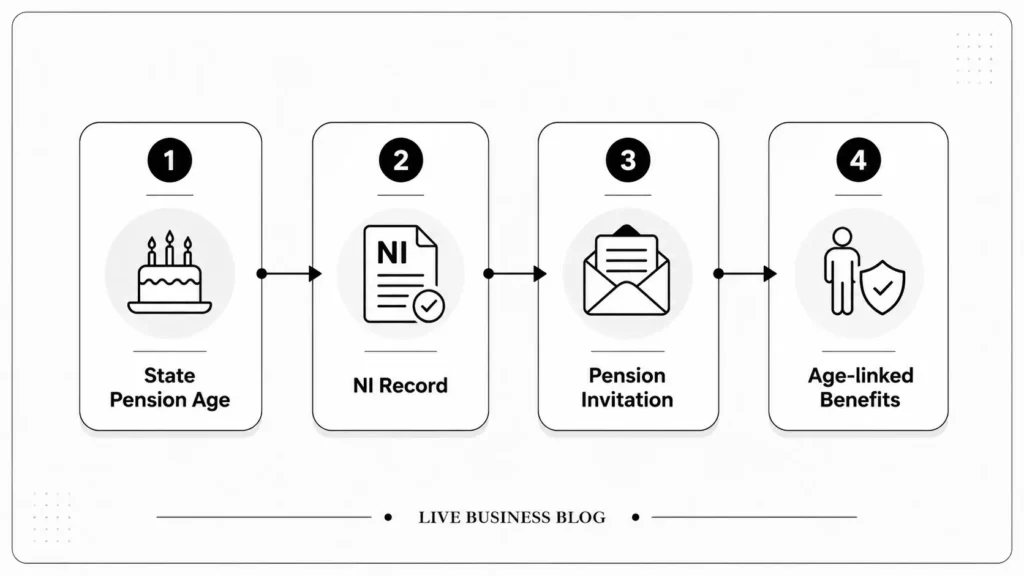
People expecting to retire during 2026, 2027 or early 2028 can reduce uncertainty by checking the official records applying to their circumstances.
Useful steps include:
- Check the exact State Pension age. The GOV.UK calculator can establish the date based on date of birth.
- Check the State Pension forecast. This shows the estimated amount, when it may become payable and information about the National Insurance record.
- Review the National Insurance record. Gaps can affect entitlement, although paying voluntary contributions is not automatically worthwhile for everybody.
- Watch for the State Pension invitation. The Pension Service normally contacts people shortly before State Pension age because the pension must generally be claimed.
- Check age-linked benefits separately. Pension Credit qualifying age, for example, follows the State Pension age transition.
Anyone making significant decisions about employment, savings, pension withdrawals or voluntary National Insurance contributions may wish to obtain regulated financial guidance or advice appropriate to their circumstances.
What the DWP State Pension Age Change 2026 Really Means
The main point is straightforward: the UK State Pension age is moving gradually from 66 to 67 between 2026 and 2028.
It is not an overnight increase affecting every 66-year-old on the same day.
People born between 6 April 1960 and 5 March 1961 fall into a transitional timetable under which State Pension age ranges from 66 years and one month to 66 years and 11 months.
People covered by the next stage reach State Pension age at 67.
The change is already part of UK law and should therefore be distinguished from proposals or speculation about later increases.
For an individual retirement date, the safest approach is to check the person’s exact date of birth using the official government State Pension age service rather than relying on a general headline saying the pension age is either 66 or 67.
FAQs About DWP State Pension Age
Is the State Pension age changing in 2026?
Yes. The phased increase from 66 to 67 is taking place between 2026 and 2028 under existing legislation.
What is the State Pension age in the UK in 2026?
There is no single answer for everyone during the transition. Depending on date of birth, a person may reach State Pension age at 66 or at 66 plus a specified number of months.
Who is affected by the State Pension age increase?
The key transitional group is people born between 6 April 1960 and 5 March 1961. Their State Pension age ranges from 66 years and one month to 66 years and 11 months.
When will the UK State Pension age become 67?
The legislated transition to age 67 is completed by April 2028.
Is the DWP increasing State Pension age to 68 in 2026?
No. The current legislated timetable places the increase from 67 to 68 between 2044 and 2046. Future arrangements remain subject to government review and possible legislation.
Does State Pension automatically start when someone reaches pension age?
No. State Pension generally has to be claimed. The Pension Service normally sends an invitation shortly before the person’s State Pension age.
How can someone find their exact State Pension age?
The official GOV.UK State Pension age calculator uses the person’s date of birth to show when they are expected to reach State Pension age under current legislation.

Leave a Reply