
Last Updated On – 17-09-2026
Pork is haram in Islam because its consumption is explicitly prohibited in the Qur’an.
For Muslims, the fundamental reason for avoiding pork is therefore religious obedience rather than simply concerns about hygiene, nutrition or the way pigs are raised.
The prohibition appears several times in the Qur’an, including Surah Al-Baqarah 2:173, Surah Al-Ma’idah 5:3, Surah Al-An’am 6:145 and Surah An-Nahl 16:115.
For restaurants, food manufacturers, retailers and catering businesses, understanding why pork is haram is important for another reason: halal compliance extends beyond simply removing bacon or pork chops from a menu.
Pork-derived ingredients can appear in processed foods, flavourings, gelatin and manufacturing inputs.
Businesses serving Muslim customers therefore need to understand sourcing, preparation, ingredient transparency and cross-contamination if they want to describe products accurately as halal.
What Does Haram Mean?
In Islam, haram means forbidden or prohibited. It is the opposite of halal, meaning lawful or permissible.
Haram does not apply only to food. Islamic teachings use the concept across areas such as personal conduct, finance, relationships and business practices.
Anyone wanting a broader explanation can read more about what is considered haram and how the term is applied in different areas of Muslim life.
When it comes to food, common examples of prohibited products include:
- Pork and pork-derived ingredients
- Blood intended for consumption
- Carrion or animals that die without permitted slaughter
- Certain meat that does not meet Islamic slaughter requirements
- Alcohol and intoxicating substances
Pork is among the clearest examples because it is specifically mentioned in the Qur’an.
Why Is Pork Haram in Islam?
The simplest answer is that Allah explicitly prohibited Muslims from consuming pork.
Islamic dietary rules are part of a wider system governing what Muslims may and may not consume. Muslims who follow these rules do not need an additional scientific explanation before accepting the prohibition.
This distinction is important.
Online explanations sometimes claim pork is haram primarily because pigs are dirty, because pork contains parasites or because pork is nutritionally unhealthy.
Those arguments may be used in wider discussions, but they are not the fundamental Islamic reason for the prohibition.
Other meats and foods can also carry health risks if they are produced, stored or cooked incorrectly.
From an Islamic perspective, pork remains prohibited regardless of whether modern farming and food-safety practices make a particular pork product hygienically safe.
What Does the Qur’an Say About Pork?

The prohibition of pork appears repeatedly in the Qur’an.
Surah Al-Baqarah 2:173 prohibits carrion, blood and the flesh of swine alongside animals dedicated to something other than Allah.
Similar prohibitions appear in:
- Surah Al-Ma’idah 5:3
- Surah Al-An’am 6:145
- Surah An-Nahl 16:115
The repetition makes the basic dietary rule unusually clear compared with religious questions where scholars must rely much more heavily on interpretation.
There is also an important principle of necessity.
The Qur’anic passages provide an exemption where a person is compelled by genuine necessity and does not deliberately seek to break the prohibition.
Islamic jurisprudence consequently recognises circumstances where preserving life can take priority over normal dietary restrictions.
That exception does not make pork generally halal. It applies to genuine necessity.
Is Pork Haram Because Pigs Are Considered Unclean?
Islamic discussions often describe pigs or pork as impure, but it is misleading to reduce the prohibition to the everyday meaning of “dirty”.
A modern pig raised under controlled agricultural conditions does not become halal simply because the animal and its environment are clean.
Similarly, improving hygiene standards, cooking pork thoroughly or producing it in a modern factory does not remove the religious prohibition.
For Muslim consumers, the distinction is important:
| Question | Islamic Consideration |
|---|---|
| Is the pork hygienically produced? | It may be, but it remains prohibited |
| Is pork thoroughly cooked? | Cooking does not make it halal |
| Is the pig organically raised? | Farming method does not change the basic prohibition |
| Is pork consumed only occasionally? | Quantity does not alter its halal status |
| Is there a genuine emergency? | Necessity can create a limited exception |
The rule is therefore fundamentally religious rather than a food-safety classification.
Are All Parts of a Pig Haram?
Muslim dietary practice generally treats the pig itself and ingredients derived from it as prohibited for consumption.
Businesses should therefore look beyond products explicitly labelled “pork”.
Potential pork-derived ingredients can include:
- Lard
- Pork fat
- Porcine gelatin
- Certain animal-derived enzymes
- Some meat flavourings
- Pork stock
- Animal shortening
- Certain processed meat ingredients
- Some capsule or confectionery ingredients
Not every gelatin, enzyme or emulsifier comes from pigs. Many can be made from cattle, fish, plants or synthetic sources.
That means businesses should verify the source rather than assuming that an unfamiliar ingredient is either halal or haram.
For halal-certified production, supplier documentation becomes particularly important.
Is Gelatin Haram if It Comes From Pork?
Porcine gelatin is a significant issue for businesses because consumers may encounter it in products that do not obviously contain meat.
Gelatin can appear in:
- Sweets
- Marshmallows
- Desserts
- Yoghurts
- Cakes
- Pharmaceutical capsules
- Supplements
- Glazes
- Confectionery
Many Muslim consumers avoid gelatin produced from pigs.
There are detailed jurisprudential discussions about whether extensive chemical transformation can alter the religious status of certain substances, and different scholars and certification organisations can apply different standards.
For a business, the practical solution is simpler: if a product is going to be marketed as halal, use ingredients accepted by the relevant halal certification standard.
Halal-certified bovine gelatin, fish gelatin, agar and other suitable alternatives can remove much of the uncertainty.
What Does Pork Being Haram Mean for Restaurants?
Restaurants serving Muslim customers need to think beyond whether the main meat ingredient is halal.
Imagine a restaurant buys halal-certified chicken but also serves bacon.
Customers may reasonably want to know:
- Where the products are stored
- Whether the same preparation surfaces are used
- Whether utensils are shared
- Whether grills are shared
- Whether fryers are shared
- Whether pork ingredients appear in sauces
- How kitchen equipment is cleaned
- Whether employees understand halal procedures
This is why questions about whether KFC is halal can depend on the specific restaurant rather than simply the brand name.
A similar issue arises when customers investigate the halal status of Nando’s, because halal arrangements can differ between locations or operating models.
Can Halal Food Be Prepared in a Kitchen That Also Handles Pork?
Potentially, but businesses must manage the situation carefully.
The presence of pork somewhere in a commercial kitchen does not automatically provide enough information to determine the status of every other product prepared there.
Storage, utensils, surfaces, cooking equipment, cleaning practices and the standards required by the relevant halal certification organisation can all matter.
For commercial operators, separation is therefore valuable both operationally and commercially.
A business may use:
- Clearly separated storage
- Labelled containers
- Dedicated utensils
- Separate preparation areas
- Separate cooking equipment where required
- Documented cleaning procedures
- Ingredient traceability
- Staff training
These processes reduce mistakes while giving customers greater confidence in halal claims.
The issue becomes particularly important for chains where menu items and kitchen arrangements vary.
Discussions around whether Popeyes is halal illustrate why Muslim customers often consider both the meat source and how food is handled in the restaurant.
What Is the Difference Between Pork-Free and Halal?
This is one of the most important distinctions for food businesses.
Pork-free does not automatically mean halal.
A meal can contain no pork whatsoever and still fail to meet halal requirements.
For example, a pork-free chicken dish may raise halal concerns if:
- The chicken is not from an acceptable halal source
- Alcohol is used in the recipe
- A sauce contains prohibited ingredients
- Non-halal animal derivatives are included
- Preparation creates unacceptable cross-contact under the applicable halal standard
Likewise, a vegetarian meal may avoid meat but still need ingredient checking if a business wants to make a formal halal claim.
Pork-Free vs Halal
| Feature | Pork-Free | Halal |
|---|---|---|
| Contains pork | No | No |
| Requires halal meat | Not necessarily | Yes, where meat is used |
| Alcohol restrictions | Not necessarily | Generally required |
| Ingredient verification | Limited | Important |
| Preparation procedures | No specific halal requirement | May need halal controls |
| Certification | Not normally required | Often used to provide assurance |
Businesses should therefore avoid using “pork-free” and “halal” interchangeably.
Why Does Halal Transparency Matter to Food Businesses?
Halal compliance is ultimately a question of consumer trust.
A customer who follows Islamic dietary requirements needs reliable information before purchasing food.
Ambiguous claims such as:
- “Halal-friendly”
- “Mostly halal”
- “Halal chicken used”
- “No pork in this item”
can raise further questions unless the business explains exactly what the statement covers.
For example, “halal chicken used” might describe the meat supplier without saying anything about other ingredients or preparation.
Businesses can build stronger trust by clearly explaining:
- Which meat is halal
- Whether the entire menu is halal
- Whether pork is handled on the premises
- Who certifies the products
- Whether alcohol is used in recipes
- How food is stored and prepared
- Whether halal and non-halal products share equipment
Clear information is usually more useful than broad marketing claims.
What Should Food Businesses Check When Buying Ingredients?
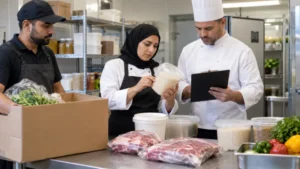
Ingredient procurement is where many halal compliance problems can begin.
A food business should know what it is buying rather than relying solely on the product name.
Check the Ingredient Specification
Read the full specification rather than simply checking the front label.
Animal derivatives may appear under technical ingredient descriptions.
Identify the Source
Find out whether animal-derived ingredients come from:
- Pork
- Beef
- Poultry
- Fish
- Plants
- Microbial sources
- Synthetic production
Request Supplier Documentation
Businesses making halal claims should maintain reliable documentation throughout their supply chain.
Monitor Recipe Changes
Manufacturers occasionally change recipes or suppliers.
An ingredient that met the required standard previously should not automatically be assumed to remain unchanged indefinitely.
Train Purchasing Staff
The employee ordering ingredients should understand the company’s halal requirements.
A purchasing error can undermine otherwise strong kitchen procedures.
Why Is Cross-Contamination Important for Halal Businesses?
Cross-contact can occur during:
- Manufacturing
- Transportation
- Storage
- Food preparation
- Cooking
- Serving
For example, halal meat placed directly beside pork products without appropriate controls can create concerns for consumers and certification organisations.
Businesses catering specifically to the halal market therefore often introduce stronger segregation practices.
These procedures can include colour-coded equipment, designated preparation areas, documented cleaning routines and clearly separated storage.
The exact requirements can depend on the halal standard being followed.
How Can Restaurants Build Trust With Muslim Customers?
Businesses do not need to make religious decisions on behalf of customers.
They need to provide accurate information that allows customers to make their own decisions.
Useful practices include:
- State exactly what is halal rather than making vague menu-wide claims.
- Display certification clearly where certification applies.
- Train customer-facing staff so customers receive consistent answers.
- Document suppliers and ingredients instead of relying on assumptions.
- Explain shared-kitchen arrangements when customers ask.
- Update menus when suppliers change.
- Avoid describing products as halal unless the business can support the claim.
Transparency can be particularly important for franchises, where customers should not automatically assume every branch operates identically.
Does Avoiding Pork Make a Business Halal?
No.
Removing pork can make a restaurant more accessible to Muslim consumers, but halal compliance can involve much more.
A halal food operation may need to consider:
- Meat sourcing
- Slaughter requirements
- Alcohol
- Animal-derived ingredients
- Food preparation
- Storage
- Cross-contact
- Cleaning procedures
- Supplier traceability
- Staff training
- Certification requirements
This is why some restaurants describe themselves only as pork-free rather than fully halal.
Being precise about the distinction protects both consumers and the business.
Why Is Understanding Pork and Halal Important for UK Businesses?
The UK’s food market serves customers from many religious and cultural backgrounds.
Restaurants, takeaways, supermarkets, manufacturers, hotels, schools, workplaces and events businesses can all encounter customers who follow halal dietary requirements.
Understanding those requirements can help businesses:
- Develop suitable products
- Avoid misleading claims
- Improve customer confidence
- Train employees correctly
- Reduce ingredient mistakes
- Build stronger relationships with Muslim consumers
- Expand into halal food markets
It is therefore not simply a theological issue. For businesses operating in food, hospitality and retail, halal knowledge can become part of product development, procurement, risk management and customer service.
Frequently Asked Questions
Why exactly is pork haram?
Pork is haram because its consumption is explicitly prohibited in the Qur’an. Muslims therefore avoid it as part of following Islamic dietary law.
Is pork haram because it is unhealthy?
Health arguments are sometimes discussed, but they are not the fundamental reason pork is prohibited. Even hygienically produced and properly cooked pork remains haram under Islamic dietary rules.
Can Muslims eat bacon?
Conventional bacon made from pork is haram. Products marketed as turkey, beef or chicken bacon need to be assessed separately based on their ingredients, meat source and preparation.
Is pork gelatin haram?
Many Muslim consumers and halal certification systems do not accept porcine gelatin. Businesses producing halal products should verify the gelatin source and follow the standard required by their certifier.
Is lard haram?
Yes. Lard is fat obtained from pigs and is therefore generally prohibited for Muslim consumption.
Is pork-free food automatically halal?
No. Pork-free simply means that pork is absent. Halal food can also involve requirements relating to meat sourcing, alcohol, other ingredients and preparation.
Can halal meat be cooked in the same kitchen as pork?
The answer depends on how the food is stored, handled, cooked and cleaned, as well as the halal standard being followed. Businesses seeking certification may be required to follow specific segregation procedures.
Can a Muslim eat pork in an emergency?
Islamic teachings recognise genuine necessity. If a person has no lawful alternative and must consume otherwise prohibited food to protect life or health, a limited exception can apply.
Do Muslims avoid all products made from pigs?
Muslim dietary practice generally avoids pork and pork-derived food ingredients.
Specific questions involving processed derivatives can involve detailed jurisprudential considerations, so businesses seeking halal certification should follow their certifier’s requirements.
Why should businesses understand why pork is haram?
Understanding the prohibition helps restaurants, manufacturers and retailers handle ingredients correctly, communicate accurately with customers and develop products that genuinely meet the needs of the halal market.

Leave a Reply