

Seeing ITF on a bank statement can be confusing because ITF is not one of the universally defined transaction abbreviations used across every UK bank.
In some banking contexts, ITF can mean “In Trust For”, particularly where an account or funds are being held by one person for the benefit of another.
However, someone should not automatically assume this is what an ITF entry means on a UK current-account statement.
UK banks use their own transaction descriptions, internal references and abbreviations.
The meaning can therefore depend on where ITF appears, which bank issued the statement and whether the wording relates to an account title, payment reference or individual transaction.
Does ITF Stand for “In Trust For”?

Yes, ITF can stand for “In Trust For”. The phrase is used when assets or money are being held for another person’s benefit.
This concept exists within UK banking.
For example, Halifax offers children’s savings accounts where an adult can save in trust for a child, while HSBC describes one of its children’s savings products as a bare trust account in which the adult acts as trustee for the named child.
HMRC also recognises arrangements where bank accounts are held for children under trust arrangements.
Its guidance explains that assets in a bare trust are legally held by a trustee while the beneficiary has the beneficial entitlement to them.
An account might therefore be described in a form similar to:
Alex Smith ITF Jamie Smith
In that context, ITF would normally be read as:
Alex Smith – In Trust For – Jamie Smith
The first person would be associated with managing the account, while the second is the beneficiary.
However, seeing the letters ITF alone beside an ordinary transaction does not establish that a trust is involved.
Is ITF an Official UK Bank Statement Code?
There is no single national dictionary that requires every UK bank to use exactly the same abbreviations on customer statements.
Individual banks can display transactions differently depending on their systems, payment networks, mobile apps and statement formats.
For comparison, common entries can include:
| Statement code | Common meaning |
|---|---|
| DD | Direct Debit |
| SO | Standing Order |
| ATM | Cash machine transaction |
| BGC | Bank Giro Credit |
| FPI | Faster Payment Incoming |
| FPO | Faster Payment Outgoing |
| INT | Interest at some banks |
| ITL | International at some banks |
| ITF | Meaning needs context and bank confirmation |
Someone trying to understand statement terminology more generally may also find it helpful to compare an unfamiliar entry with established codes such as a Bank Giro Credit.
The important distinction is that widely recognised payment abbreviations should not be confused with a label whose meaning may depend on the institution.
Why Might ITF Appear on a Bank Statement?

There are several possible reasons.
The Account May Be Held for Someone Else
The strongest reason for interpreting ITF as “In Trust For” is when it appears within an account name rather than beside a normal debit-card purchase.
A parent, grandparent or another adult may operate an account containing money that belongs beneficially to a child.
UK financial institutions do offer accounts structured this way.
Halifax, for example, specifically describes children’s savings held in trust, while HMRC guidance recognises bank accounts established under bare-trust arrangements.
It May Be Part of an Internal Banking Reference
Banks process enormous numbers of transactions and often shorten descriptions to fit statement fields or internal systems.
An acronym appearing in the description may therefore represent an internal transaction category rather than the identity of the person or business behind the payment.
This is particularly relevant when ITF appears beside:
- Another payment code;
- An account number;
- A person’s initials;
- A transfer reference;
- An abbreviated institution name; or
- Additional numbers and letters.
In such circumstances, the complete transaction description is more useful than ITF on its own.
It Could Be Connected to a Transfer
People sometimes assume any three-letter code describes the merchant. That is not necessarily the case.
Bank transfers frequently contain technical transaction descriptions. For instance, FPI on a bank statement commonly relates to an incoming Faster Payment, while FPO on a bank statement is associated with an outgoing Faster Payment.
ITF should not automatically be treated as equivalent to either of these established payment descriptions.
Does ITF Mean Money Is Coming In or Going Out?
ITF alone does not reliably indicate whether money is entering or leaving an account.
That is an important difference from codes such as FPI or FPO, where the wording itself can identify the direction of a Faster Payment.
Instead, the account holder should check:
- Whether the amount has a plus or minus sign;
- Whether it appears under debit or credit;
- The resulting account balance;
- The payment date;
- The extended transaction details; and
- Any reference displayed alongside ITF.
If £250 appears as a credit next to an ITF reference, the important information is that £250 entered the account.
ITF may provide additional context, but it should not override the debit or credit information shown by the bank.
Is an ITF Entry a Bank Transfer?

Not necessarily.
There is insufficient basis for treating ITF as a generic UK abbreviation for “internal transfer”, “international transfer” or another specific payment method without confirmation from the bank.
This distinction matters because similar-looking banking abbreviations can mean entirely different things.
NatWest, for example, uses ITL for “International” and INT for interest in its published statement glossary.
It would therefore be risky to see ITF and simply conclude that it means an international transfer.
Someone who sees transfer-related wording in mobile banking may also encounter descriptions such as Mobile Channel FT, illustrating how digital banking channels can produce their own abbreviated references.
How Can Someone Find Out Exactly What ITF Means?
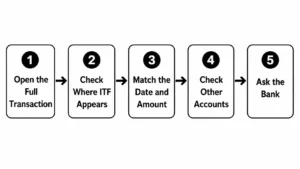
The most reliable method is to investigate the individual entry rather than searching for the abbreviation in isolation.
1. Open the Full Transaction
Mobile banking apps often show a shortened description on the main transaction screen.
Opening the transaction may reveal additional information such as:
- Payment reference;
- Merchant or recipient;
- Transaction type;
- Account details;
- Location;
- Payment method; or
- Whether the entry is pending or completed.
2. Check Where ITF Appears
The location of the abbreviation can significantly change its likely meaning.
Account title: “In Trust For” becomes a plausible interpretation.
Transaction description: It may be a bank-specific reference.
Beneficiary name: It could relate to the way the receiving account is registered.
Payment reference: It may have been entered by the sender rather than generated by the bank.
3. Match the Date and Amount
The account holder can compare the transaction with recent financial activity.
This might include:
- Transfers between accounts;
- Family payments;
- Savings transactions;
- Refunds;
- Salary or benefit payments;
- Standing orders; or
- Purchases.
The exact amount and date frequently provide a stronger clue than an abbreviated statement description.
4. Check Other Accounts
Someone who holds savings, children’s accounts or accounts on behalf of another person should check whether the amount matches activity on those accounts.
This is particularly relevant where ITF could genuinely relate to money held in trust.
5. Ask the Bank
If the transaction remains unclear, the issuing bank is the most authoritative source for the meaning of its own statement descriptor.
A customer can provide the bank with the date, amount and complete reference and ask what transaction type generated the entry.
Is an Unknown ITF Transaction Fraud?
Not automatically.
An unfamiliar statement description can result from shortened transaction names, processing references or account terminology.
However, an unexplained payment leaving the account should not simply be ignored.
The Financial Conduct Authority advises consumers to tell their bank as soon as they notice an unauthorised payment.
The FCA says customers generally need to notify their bank within 13 months of the payment, although reporting it promptly is preferable.
The FCA also advises consumers to check bank statements regularly and report suspicious activity to their bank.
A person should be particularly cautious where:
- There is no recognised purchase or transfer matching the amount;
- Several unknown transactions have appeared;
- Money has unexpectedly left the account;
- The card or banking credentials may have been compromised; or
- The transaction appeared after contact with a suspected scammer.
The safest contact route is the bank’s official app, website, branch or the telephone number printed on the card rather than a number supplied in an unexpected message.
What Should Someone Do About an Unrecognised ITF Payment?

There is a sensible order in which to investigate the entry.
First, confirm whether it is actually a payment. ITF may appear within an account description rather than representing a transaction type.
Second, determine whether the money entered or left the account. The credit/debit indicator and balance movement provide this information.
Third, inspect the full reference. Initials, names and payment references may identify what happened.
Fourth, compare the amount with known activity. Transfers, refunds and household spending are worth checking.
Finally, contact the bank if the debit remains unexplained.
If the account holder believes a payment was unauthorised, the FCA’s guidance on fraudulent payments explains the steps consumers can take.
ITF Versus Other Common Bank Statement Codes
Understanding the difference between ITF and established transaction abbreviations can prevent unnecessary confusion.
| Code | Typical interpretation | Usually identifies |
|---|---|---|
| BGC | Bank Giro Credit | Incoming credit |
| FPI | Faster Payment Incoming | Incoming bank transfer |
| FPO | Faster Payment Outgoing | Outgoing bank transfer |
| DD | Direct Debit | Authorised recurring debit |
| SO | Standing Order | Scheduled bank transfer |
| INT | Interest at some banks | Interest credit/debit |
| ITL | International at NatWest | International transaction |
| ITF | Context dependent | Trust wording or institution-specific reference |
The table should be treated as a general aid rather than a substitute for the issuing bank’s own terminology because statement formats vary between providers.
Final Takeaway
ITF can mean “In Trust For”, particularly where the wording appears as part of an account name or a savings arrangement in which money is held for another person.
That interpretation should nevertheless be applied carefully in the UK.
ITF is not a universal bank-statement transaction code with one guaranteed meaning across every UK financial institution. Different banks use different abbreviations, internal transaction labels and statement formats.
The most useful clues are therefore the position of ITF on the statement, the full transaction reference, whether the amount is a debit or credit, and the type of account involved.
Where ITF appears as part of a trust or children’s savings account, “In Trust For” may be the appropriate explanation.
Where it appears beside an unexplained payment, the account holder should check the complete transaction information and ask the issuing bank rather than relying on an assumed definition.
If money has left the account without authorisation, it should be reported to the bank promptly.
Frequently Asked Questions
Can ITF relate to a child’s bank account?
Yes. UK banks offer savings products where an adult holds or manages money in trust for a child. Halifax and HSBC both provide examples of children’s savings arrangements involving trusts.
Does ITF mean a payment is pending?
There is no universal UK rule stating that ITF means a pending payment. The banking app should separately identify whether a transaction is pending, completed or reversed.
Is ITF the same as FPI?
No. FPI commonly refers to a Faster Payment Incoming, whereas ITF does not have the same universally established UK transaction meaning.
Is ITF the same as FPO?
No. FPO is commonly associated with a Faster Payment Outgoing. ITF should not automatically be interpreted as an outgoing Faster Payment.
Should someone call the bank about an ITF transaction?
If the meaning cannot be established from the account title, transaction details, date, amount or recent financial activity, contacting the bank is sensible. The bank can explain the descriptor used on its own system.

Leave a Reply