
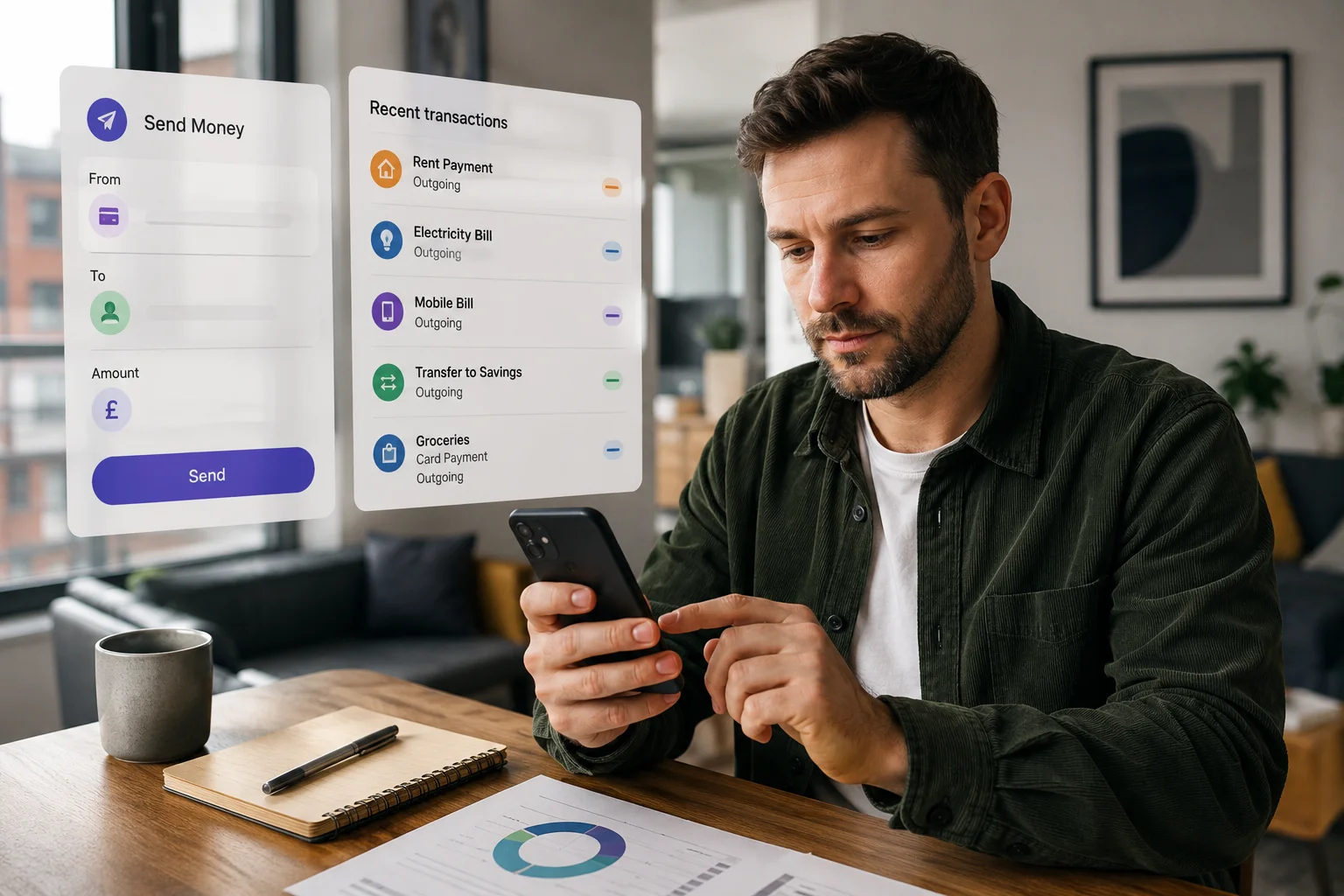
FPO on a bank statement stands for Faster Payments Outwards, which means money has been electronically transferred from a bank account to another account through the UK Faster Payments system.
These transactions are commonly linked to online banking transfers, mobile banking payments, bill payments, or one-off bank transfers initiated by the account holder. In most cases, an FPO reference is completely normal, although unfamiliar transactions should always be checked carefully.
Key Takeaways:
- FPO means Faster Payments Outwards
- It shows money leaving a bank account electronically
- Most FPO transactions are processed within minutes
- FPO payments are commonly used in online and mobile banking
- Banks use FPO references to identify transfer types
- Pending FPO transactions may require verification checks
- Unknown FPO payments should be reviewed immediately
- FPO differs from Direct Debits and Standing Orders
- UK banks use security systems to monitor Faster Payments
What Does FPO on a Bank Statement Mean?
FPO on a bank statement stands for Faster Payments Outwards. It is a banking reference used by UK financial institutions to show that money has been transferred electronically from one account to another through the Faster Payments Service. ‘
This payment system is widely used across the UK because it allows transfers to be processed quickly, often within seconds or minutes.
When customers review their bank statements, they may notice transaction labels such as:
- FPO
- FP
- Faster Payment
- Faster Payments Outwards
Although the wording may vary between banks, the meaning is generally the same. The transaction confirms that funds have left the account through a Faster Payment transfer.
FPO transactions are extremely common in modern banking because many people rely on:
- Online banking transfers
- Mobile banking apps
- Bill payments
- One-off transfers
- Payments to family or friends
- Transfers between personal accounts
Unlike older transfer systems that could take several working days, Faster Payments were designed to improve speed and convenience for UK bank customers.
Definition of Faster Payments Outwards
The Faster Payments Service was introduced in the UK banking sector to provide near-instant electronic transfers between participating banks. Before this system existed, many bank transfers required longer processing periods and could only be made during banking hours.
An FPO transaction specifically indicates the following:
- The payment was sent from the account holder’s bank account
- The transfer moved through the Faster Payments network
- The payment was processed electronically
This differs from incoming Faster Payments, which are usually labelled differently by banks because the money is entering the account rather than leaving it.
The system supports both personal and business banking transactions. Many organisations also use Faster Payments for payroll, supplier payments, and customer refunds because of the speed involved.
The table below shows how FPO compares with older payment systems used in the UK.
Payment Method Typical Processing Time Common Usage
Faster Payments (FPO) Seconds to hours Online transfers and mobile banking
BACS Transfer Up to 3 working days Salaries and Direct Debits
CHAPS Payment Same day High-value transfers
Debit Card Payment Immediate authorisation Retail purchases
This quick processing time is one reason why Faster Payments has become one of the most widely used electronic transfer systems in the UK.
How FPO Appears on Bank Statements?
Not all banks display transaction references in exactly the same format. Some banking apps provide detailed payment information, while others only display abbreviated references.
Customers may see:
- FPO
- Faster Payment Out
- Faster Payment Transfer
- FP Transfer
- Online Transfer
Some statements may also include:
- Recipient names
- Payment references
- Partial account information
- Merchant descriptions
The level of detail depends on the bank’s transaction reporting system.
For example, one bank may show:
FPO JOHN SMITH RENT
Another bank may simply display:
FPO 4583921
This difference often causes confusion because customers may not immediately recognise the shortened reference.
A banking support adviser explained this issue clearly:
“I regularly speak with customers who believe an unknown company has taken money from their account. After checking the payment details, it usually turns out to be a transfer they made themselves through online banking days earlier.”
Some transactions may also appear temporarily without complete details while processing is still underway.
Why Banks Use FPO References?
Banks rely on coded references to organise millions of transactions processed every day. The abbreviation FPO allows banking systems to identify the payment type quickly and efficiently.
These coding systems help banks:
- Categorise transfers
- Monitor payment activity
- Process statements faster
- Identify fraud risks
- Separate transfer types
Without these transaction labels, it would be much harder for financial institutions to manage large volumes of account activity.
The table below highlights the differences between common banking transaction references.
Statement Code Meaning Purpose
FPO Faster Payments Outwards Outgoing bank transfer
DD Direct Debit Automatic company collection
SO Standing Order Scheduled recurring payment
POS Point of Sale Card purchase
ATM Cash withdrawal Cash machine transaction
These abbreviations simplify internal banking operations while helping customers understand how payments were processed.
Why Is FPO Showing on a Bank Statement?

FPO appears on a bank statement whenever money has been transferred outward using the Faster Payments network. In most cases, the transaction is legitimate and linked to activity initiated by the account holder.
Many people become concerned because they do not immediately recognise the abbreviation itself rather than the payment.
Several common activities can trigger an FPO reference.
Online Banking Transfers
One of the main reasons FPO appears is because of online banking transfers. Customers often transfer money through desktop banking platforms for personal or financial reasons.
These transfers may include:
- Sending rent payments
- Paying family members
- Moving money between savings accounts
- Paying invoices
- Sending money to friends
Because Faster Payments processes rapidly, the transaction usually appears on the statement almost immediately.
Banks prefer this method because it reduces delays and improves customer convenience.
Bill Payments and One-Off Transactions
Many utility providers, landlords, and businesses now accept Faster Payments instead of traditional transfer methods.
Customers may manually send the following:
- Electricity payments
- Water bills
- Broadband payments
- Loan instalments
- Credit card repayments
Unlike Direct Debits, which are collected automatically by organisations, FPO payments are generally initiated by the customer.
This distinction is important because some customers mistake FPO payments for automatic withdrawals.
The table below compares common payment methods.
Payment Type Who Starts the Payment Recurring or One Off
FPO Account holder Usually one off
Direct Debit Company Recurring
Standing Order Account holder Recurring
Debit Card Payment Account holder Usually one-off
This difference helps explain why FPO references are frequently linked to manual banking activity.
Mobile Banking and App Payments
Mobile banking applications have increased the number of Faster Payments used throughout the UK. Many app-based transfers rely automatically on the Faster Payments infrastructure.
Examples include:
- Sending money through banking apps
- Paying shared household expenses
- Transferring funds through digital banking platforms
- Paying small businesses electronically
Customers sometimes forget these transfers because mobile banking makes transactions extremely quick and simple.
A customer service representative described this confusion clearly:
“Many customers contact us worried about FPO references, but after reviewing their recent app activity, they remember sending money through mobile banking earlier in the week.”
Because app payments are processed instantly, they often appear faster than card purchases or Direct Debit transactions.
Is an FPO Transaction the Same as a Faster Payment?
Yes, an FPO transaction is directly linked to the UK Faster Payments Service. The term FPO specifically identifies the transaction as an outward transfer from the account.
The Faster Payments network was developed to improve the following:
- Transaction speed
- Banking accessibility
- Electronic payment efficiency
- Real-time transfers
Most UK banks participate in the Faster Payments system, making it one of the most reliable transfer methods available.
Customers benefit because the following:
- Payments can be sent at any time
- Weekend transfers are possible
- Funds usually arrive quickly
- Mobile banking integration is simple
The system operates continuously throughout the year, including weekends and holidays.
This differs from older systems such as BACS, which often rely on working day schedules.
How Do FPO Payments Work in the UK Banking System?

FPO payments move through a secure electronic infrastructure connecting banks and financial institutions throughout the UK.
When a customer initiates a transfer:
- The bank receives the payment request
- Security checks are performed
- The payment is processed through Faster Payments
- Funds are transferred to the recipient bank
- Confirmation appears on the statement
Although the process sounds simple, banks use multiple security layers to monitor suspicious activity and protect customer accounts.
Payment Processing Times
Most Faster Payments are completed within seconds.
However, processing times can vary depending on:
- Bank policies
- Payment size
- Fraud checks
- Technical delays
- Recipient bank systems
The majority of transactions are completed almost instantly, but occasional delays may occur.
The table below explains typical processing expectations.
Situation Expected Processing Time
Standard transfer Seconds to minutes
New payee transfer Up to several hours
Security review Up to 24 hours
Technical disruption Variable delays
Banks may also delay unusually large payments for additional verification.
Security and Verification Checks
Security plays an important role in Faster Payments because fraudsters sometimes target instant transfer systems.
Banks monitor:
- Unusual account behaviour
- Large payment amounts
- New recipients
- Multiple rapid transactions
- Suspicious login activity
If the system detects unusual behaviour, the payment may remain pending until additional checks are completed.
A fraud prevention specialist explained the importance of these checks:
“Customers occasionally become frustrated when a payment is delayed, but these reviews exist to prevent scams and protect accounts from unauthorised transfers.”
Modern fraud monitoring systems use automated technology to identify suspicious activity within seconds.
Difference Between Pending and Completed FPO Transactions
Some customers notice that FPO payments initially appear as pending transactions before becoming fully completed.
This temporary status may occur because:
- Verification checks are ongoing
- The receiving bank has not confirmed receipt
- Internal processing is incomplete
The table below explains these statuses clearly.
Transaction Status Meaning
Pending Payment initiated but still processing
Completed Funds successfully transferred
Reversed Payment returned to sender
Failed Payment rejected before completion
Pending transactions normally update automatically after processing finishes.
Can an FPO Transaction Be a Sign of Fraud?

Most FPO transactions are completely legitimate. However, unfamiliar payments should always be reviewed carefully.
Potential warning signs include:
- Unknown recipients
- Unexpected transfer amounts
- Multiple small transactions
- Payments made overnight
- Repeated failed transfers
Fraudsters sometimes prefer Faster Payments because the speed of the system can make recovery more difficult once money reaches another account.
Customers should act quickly if they suspect unauthorised activity.
Recommended steps include:
- Checking recent banking activity
- Reviewing transaction references
- Contacting the bank immediately
- Securing online banking credentials
- Monitoring future account activity
A banking fraud investigator shared this advice:
“I always encourage customers to report suspicious FPO transactions immediately. The earlier a bank is notified, the greater the chance of tracing or freezing the transferred funds.”
Many UK banks now offer fraud support teams available around the clock.
What Should Someone Do If They Do Not Recognise an FPO Transaction?

An unfamiliar FPO transaction does not always indicate fraud. Sometimes payment references appear differently from expected, especially when businesses use abbreviated names.
Customers should first review:
- Payment dates
- Recent online purchases
- Banking app activity
- Shared account transactions
- Subscription renewals
Check Transaction References
The payment reference may contain clues about the transaction source. Some references include:
- Company initials
- Invoice numbers
- Account references
- Recipient details
Reviewing recent emails or receipts often helps identify the payment.
Contact the Merchant or Recipient
If a business name appears within the transaction reference, contacting the merchant may provide clarification.
Businesses sometimes process payments under:
- Parent company names
- Trading names
- Payment processing providers
This can make transactions appear unfamiliar at first glance.
Speak With the Bank Immediately
If the payment still cannot be identified, the bank should be contacted immediately.
Banks can:
- Trace transaction paths
- Confirm recipient details
- Freeze suspicious activity
- Begin fraud investigations
Quick action significantly improves the likelihood of resolving unauthorised payment issues.
Conclusion: Why Understanding FPO on a Bank Statement Matters?
Understanding what FPO on a bank statement means can prevent unnecessary concern when reviewing account activity.
In most cases, FPO simply refers to a Faster Payments Outwards transaction, meaning money was transferred electronically from the account through the UK Faster Payments system.
These transactions are commonly linked to online banking, mobile payments, and one-off transfers. While most FPO entries are legitimate, unfamiliar transactions should always be checked carefully to rule out fraud or unauthorised activity.
By recognising how FPO payments work, how they appear on statements, and how they differ from Direct Debits or Standing Orders, bank customers can manage their finances more confidently and respond quickly if something appears unusual.
Frequently Asked Questions About FPO on Bank Statements
Can an FPO payment fail after showing on a bank statement?
Yes. Some transactions may initially appear as pending before failing due to insufficient funds, incorrect account details, or bank security checks.
Does FPO always mean money has left the account?
Usually, yes. However, pending transactions may still be awaiting final processing.
How long do FPO transactions remain pending?
Most pending Faster Payments clear within a few minutes or hours, although security reviews can occasionally delay processing for up to 24 hours.
Can banks trace an FPO payment?
Yes. Banks can trace Faster Payments using transaction references and payment records.
Why does an FPO payment show without a company name?
Some banks only display abbreviated transaction codes or partial references depending on their statement formatting system.
Is FPO related to international bank transfers?
No. FPO generally relates to UK Faster Payments rather than international banking systems.
Can a bank refund an unauthorised FPO transaction?
Banks may refund unauthorised payments after investigating fraud claims, particularly if the issue is reported quickly.

Leave a Reply