
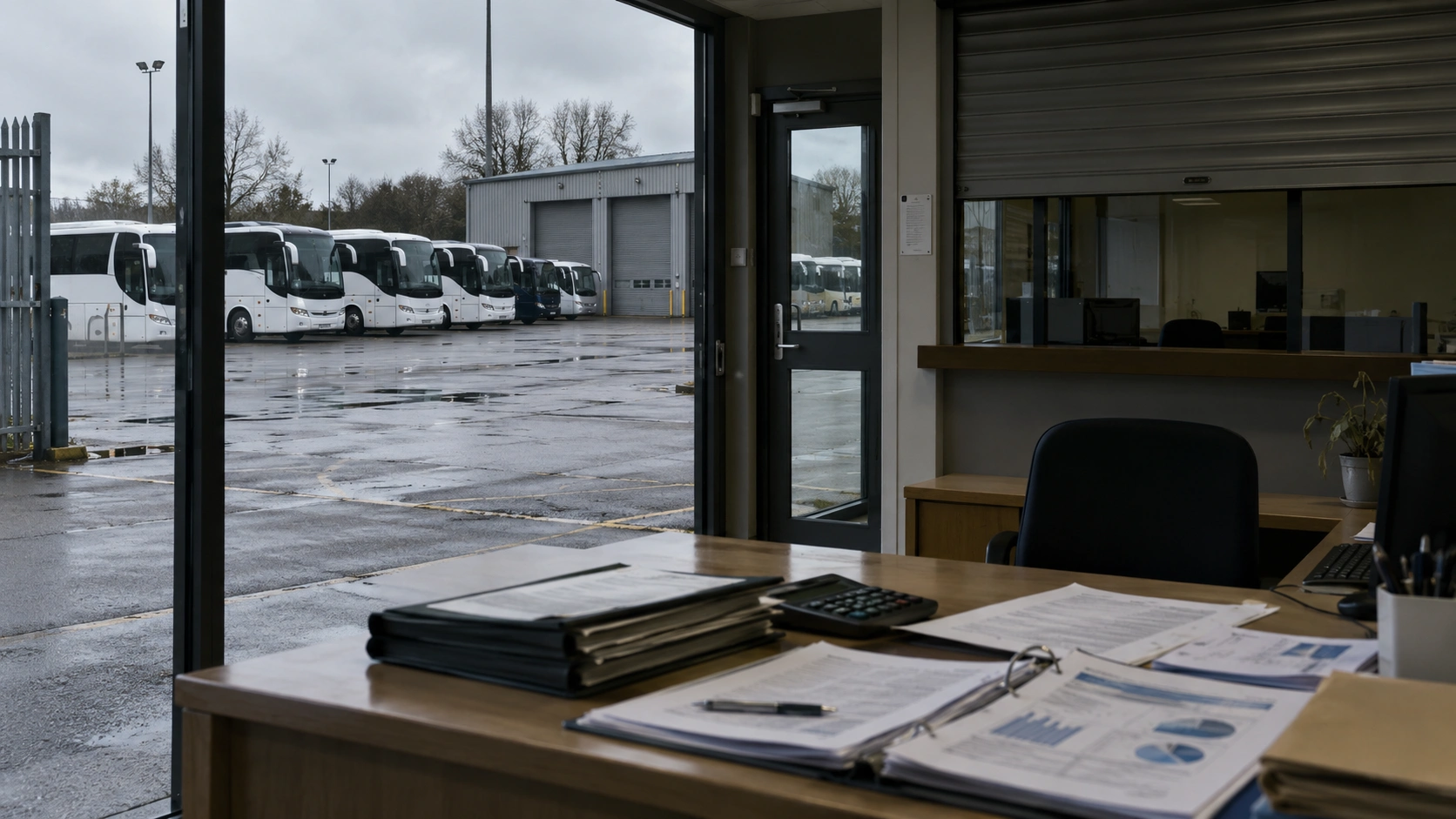
Oxfordshire Travel Limited entered creditors’ voluntary liquidation on 30 October 2025, bringing the passenger transport company’s operations to an end and leaving customers, suppliers and other creditors facing questions about unpaid money, cancelled transport and possible refunds.
The company, registered under company number 09515078, was incorporated on 27 March 2015 and operated under SIC code 49390 – Other passenger land transport.
Its liquidation is particularly important for customers because Oxfordshire Travel Limited was primarily a coach and passenger transport operator rather than a conventional package-holiday company.
That distinction affects whether ATOL, ABTOT, ABTA or other travel financial protections would have applied to individual bookings.
Reported insolvency figures indicate debts of approximately £655,642, including around £317,000 owed to HMRC and approximately £256,000 owed to trade and expense creditors.
For customers who paid deposits or full balances before the company stopped providing services, the main questions are now whether their booking had any financial protection, whether Section 75 or chargeback may apply and how a creditor claim can be submitted.
What Happened to Oxfordshire Travel Limited?
Oxfordshire Travel Limited entered creditors’ voluntary liquidation after the business became unable to meet its financial obligations.
A creditors’ voluntary liquidation, usually abbreviated to CVL, is used when an insolvent company cannot continue paying its debts and its shareholders resolve to wind it up.
Stuart Garner of Garner Advisory Limited was appointed to oversee the liquidation on 30 October 2025.
The company had operated in the passenger transport sector and had previously used an Oxfordshire registered office.
After the liquidation commenced, its registered office was changed to:
Tugby Orchards
Wood Lane
Tugby
Leicestershire
LE7 9WE
That is associated with the insolvency process and should not be interpreted as evidence that the company’s original passenger transport operations were based in Leicestershire.
Was Oxfordshire Travel Limited Really Based in Yarnton?
The original article described Oxfordshire Travel Limited as Yarnton-based.
That wording needs some precision because the company’s current registered office is in Leicestershire.
However, the company previously used a registered address in Yarnton, Kidlington, Oxfordshire, before its registered office was moved to the liquidator’s address after liquidation commenced.
It is therefore more accurate to describe Oxfordshire Travel Limited as a passenger transport company formerly registered in Yarnton, Oxfordshire, rather than implying that its current registered office remains there.
This distinction is important because there are other travel businesses with similar names operating in Oxfordshire, and customers should always check the company number shown on their booking documents.
Why Did Oxfordshire Travel Limited Go Into Liquidation?
Financial information surrounding the liquidation indicates that the company had accumulated liabilities substantially greater than the assets expected to be recovered.
Reported debts included:
- Around £317,000 owed to HMRC
- Approximately £256,000 owed to trade and expense creditors
- More than £70,000 associated with a director’s loan account
- Other liabilities involving financial institutions and creditors
The company was also reportedly owed more than £65,000 by third parties.
However, only a small proportion of that money was expected to be successfully recovered, significantly reducing the amount potentially available to creditors.
That imbalance between liabilities and recoverable assets appears to have left the company unable to continue trading.
HMRC Debt Was a Major Part of the Company’s Liabilities
The amount reportedly owed to HMRC represented a substantial proportion of Oxfordshire Travel Limited’s overall debts.
However, it would be inaccurate to simply say that all HMRC debt automatically sits at the front of the creditor queue.
Certain taxes collected by businesses on behalf of employees or customers can receive preferential treatment during insolvency.
These may include:
- VAT
- PAYE Income Tax
- Employee National Insurance contributions
- Construction Industry Scheme deductions
- Student loan deductions
Other liabilities, including some Corporation Tax and employer National Insurance debts, do not necessarily receive the same preferential ranking.
The exact recovery position therefore depends on the composition of Oxfordshire Travel Limited’s HMRC debt and the value of assets ultimately realised.
Oxfordshire Travel Limited Timeline
A timeline makes it easier to understand how the company’s position developed.
Date Event
27 March 2015 Oxfordshire Travel Limited incorporated
31 March 2024 End of latest accounts previously recorded before the later insolvency period
30 December 2024 Accounts relating to the previous financial period filed
14 January 2025 Confirmation statement recorded
30 October 2025 Creditors’ voluntary liquidation commenced
November 2025 Registered office moved from Oxfordshire to the liquidator-related Leicestershire address
31 December 2025 Later accounts deadline passed
28 January 2026 Confirmation statement deadline passed
2026 Company remained recorded as being in liquidation
The company’s later accounts and confirmation statement have been shown as overdue.
However, those overdue filing dates occurred after the liquidation had already started.
They should therefore not be described as proof that financial problems caused the collapse or as warning signs that were necessarily available to customers before October 2025.
Was Oxfordshire Travel Limited ATOL or ABTOT Protected?
This is one of the most important issues for anyone who paid Oxfordshire Travel Limited before it entered liquidation.
There is no confirmed evidence identified for this update showing that Oxfordshire Travel Limited itself held ATOL, ABTOT/Bonded Coach Holidays or ABTA financial protection.
That does not necessarily prove that no particular booking was protected.
Protection can depend on:
- What was purchased
- Which company actually took the payment
- Whether another travel organiser was involved
- Whether the service formed part of a package
- What protection certificate or paperwork was issued
Customers should therefore check the documents relating to their individual booking.
ATOL Protection
ATOL protection mainly applies to qualifying travel arrangements involving flights.
Oxfordshire Travel Limited was registered as an other passenger land transport company.
A customer simply hiring a coach for transportation would therefore not automatically receive ATOL protection.
For example, a booking might involve:
- A school hiring a coach for an educational trip
- A business booking transport for an event
- A wedding party arranging private coach travel
- A community organisation booking a vehicle
- A family arranging transport for an excursion
Those bookings involve passenger transport but are not automatically flight-inclusive package holidays.
Anyone who received an ATOL certificate should nevertheless check it because the protection may relate to another company or package organiser involved in the transaction.
ABTOT and Bonded Coach Holidays Protection
ABTOT provides financial protection arrangements for qualifying non-flight packages, including the Bonded Coach Holidays scheme.
However, there is an important difference between a protected coach holiday package and simply hiring a coach.
A typical protected coach holiday might combine transport with other travel services.
A standalone booking for a coach to take passengers between two locations is different.
Therefore, a customer should not assume that Oxfordshire Travel Limited’s use of coaches automatically means that ABTOT or Bonded Coach Holidays protection applied.
Was Oxfordshire Travel Limited an ABTA Member?
No confirmed ABTA protection for Oxfordshire Travel Limited has been identified for this update.
Even where a business is an ABTA member, it does not automatically mean that every service purchased from that business is protected against insolvency.
Customers should look for actual membership numbers, certificates and financial protection wording in their booking documents.
What Should Customers Check in Their Booking Documents?
Customers who lost money should locate as much paperwork as possible before deciding how to claim.
Useful documents include:
- Booking confirmation
- Invoice
- Receipt
- Card statement
- Bank statement
- Terms and conditions
- Emails from Oxfordshire Travel Limited
- Deposit confirmation
- ATOL certificate, if any
- ABTOT or Bonded Coach Holidays documentation
- ABTA membership information
- Travel insurance documents
- Cancellation correspondence
The most important detail is the legal company named as the supplier.
Customers should check whether the contract specifically states:
Oxfordshire Travel Limited – company number 09515078
This helps avoid confusion with businesses using similar travel-related names.
Which Oxfordshire Travel Bookings May Have Been Affected?
The company operated in the passenger transport sector, so affected bookings could potentially have included transport arranged by:
- Schools
- Businesses
- Community groups
- Sports organisations
- Clubs
- Charities
- Families
- Private groups
- Event organisers
Customers who paid for journeys scheduled after the business stopped operating may have been left needing replacement transportation.
The exact number of affected bookings has not been reliably confirmed.
For this reason, the article should avoid claiming a particular number of cancelled trips unless supported by confirmed insolvency information.
What Can Customers Do If Oxfordshire Travel Limited Owes Them Money?
Customers should normally investigate several recovery routes rather than relying entirely on the liquidation.
Possible options include:
Recovery Route When It May Help
Financial protection scheme Where the booking genuinely qualified for ATOL, ABTOT or another scheme
Section 75 Certain qualifying credit card transactions
Chargeback Certain debit or credit card payments
Travel insurance Where supplier failure or insolvency is covered
Creditor claim Money owed directly by Oxfordshire Travel Limited
The appropriate route depends on how the service was booked and paid for.
Customers dealing with travel-company insolvency may also find the issues surrounding holiday cancellations after a travel company enters liquidation useful, particularly when comparing ATOL protection, Section 75, chargeback and insurance options.
Can Customers Use Section 75?
Some customers who paid by credit card may potentially be protected by Section 75 of the Consumer Credit Act 1974.
Section 75 can normally apply where the cash price of the purchased goods or services is:
- More than £100
- No more than £30,000
There are other legal requirements, so simply using a credit card does not automatically guarantee a successful claim.
For example, complications can arise where:
- A third-party payment processor was involved
- The cardholder was not the contracting customer
- The booking was made through an intermediary
- The necessary debtor-creditor-supplier relationship does not exist
Schools, companies and other organisations should also avoid assuming that consumer credit protection works identically for every commercial booking.
Example:
Suppose a customer booked a coach service costing £850 and paid a £100 deposit using a qualifying credit card, with the remainder paid another way.
Depending on the contractual arrangement, Section 75 may potentially cover the entire qualifying purchase rather than only the amount placed on the card.
Eligibility still needs to be assessed by the card provider.
Can Customers Use Chargeback?
Chargeback may provide another route where a service was paid for but not supplied.
Unlike Section 75, chargeback is generally a card-scheme process rather than a separate statutory consumer right.
It can potentially apply to:
- Debit card payments
- Credit card payments
- Certain prepaid card transactions
Time limits can apply.
Customers should therefore contact their bank or card issuer promptly and explain that the supplier entered liquidation before providing the service.
The bank may request:
- Booking confirmation
- Invoice
- Proof of payment
- Evidence that the service was not provided
- Correspondence with the supplier
- Details of the liquidation
Customers should keep copies of everything submitted.
Could Travel Insurance Cover the Loss?
Possibly, but supplier insolvency is not included in every travel insurance policy.
Relevant wording may include:
- End supplier failure
- Supplier insolvency
- Financial failure
- Scheduled provider failure
- Travel company failure
Basic policies may exclude these risks entirely.
Customers should therefore check the exact policy terms rather than assuming that ordinary cancellation insurance covers the collapse of a coach operator.
An insurer may also require the customer to try another recovery route, such as chargeback, before paying an insurance claim.
How Can Creditors Make a Claim in the Oxfordshire Travel Limited Liquidation?
Customers, suppliers or other organisations owed money can potentially register as creditors in the liquidation.
The appointed insolvency practitioner may ask creditors to provide a proof of debt.
A creditor should normally prepare:
- Full name or company name
- Contact details
- Amount owed
- Reason the debt arose
- Invoice number
- Booking reference
- Contract
- Statement of account
- Proof of payment
- Relevant correspondence
- Information about any partial refund already received
The claim should relate to Oxfordshire Travel Limited rather than another similarly named business.

Is There a Deadline for Submitting a Creditor Claim?
Creditors should not assume that they can wait indefinitely.
A liquidator can issue a formal notice requiring proofs of debt to be submitted before a particular date when preparing to make a distribution.
Anyone owed money should therefore contact the insolvency practitioner promptly rather than waiting until the end of the liquidation.
Creditors should also make sure the liquidator has their current:
- Address
- Email address
- Telephone number
- Bank details when legitimately requested through the formal process
Will Oxfordshire Travel Creditors Get Their Money Back?
There is currently no guarantee that unsecured creditors will recover all of the money owed to them.
Reported liabilities significantly exceed the assets expected to be recovered.
That means available funds may first be reduced by:
- Costs of the liquidation
- Secured creditor claims where applicable
- Preferential claims
- Certain HMRC preferential debts
Whatever remains may then be available for unsecured creditors.
Customers with prepaid bookings could fall into the unsecured creditor category if they do not have another recovery route.
For that reason, customers should normally investigate Section 75, chargeback and insurance without waiting for the liquidation to conclude.
What Happens to Oxfordshire Travel Limited Employees?
The precise number of employees affected by the liquidation has not been reliably confirmed.
A specific job-loss figure should therefore not be published unless supported by confirmed information.
However, employees of an insolvent business may be able to claim statutory payments if money remains outstanding.
Potential claims can include:
- Statutory redundancy pay
- Unpaid wages
- Holiday pay
- Statutory notice pay
- Certain unpaid employment-related amounts
Eligibility depends on employment status, length of service, age, earnings and other statutory conditions.
Employees normally need information relating to the insolvency case before completing the relevant claims process.
What Does a Creditors’ Voluntary Liquidation Mean?
A creditors’ voluntary liquidation is a formal process used to close an insolvent company.
Despite the word voluntary, creditors do not simply agree to lose the money owed to them.
The term refers primarily to the company’s shareholders resolving that the insolvent company should be wound up rather than waiting for a creditor to obtain a court winding-up order.
Role of the Liquidator
Once appointed, the liquidator takes responsibility for dealing with the company’s affairs.
Typical responsibilities include:
- Securing company records
- Identifying assets
- Collecting outstanding debts
- Selling recoverable assets
- Reviewing creditor claims
- Investigating company transactions
- Reporting where legally required
- Paying insolvency costs
- Distributing available funds
- Completing the winding-up process
The liquidator may also investigate the conduct of directors and transactions entered into before insolvency.
What Happens to the Company’s Assets?
Assets that belong to the company may be recovered or sold.
These could potentially include:
- Vehicles
- Office equipment
- Cash
- Business bank balances
- Debts owed by customers
- Deposits
- Other business assets
However, an asset’s accounting value does not necessarily equal the amount that can be recovered during liquidation.
For example, money shown as owed to a company may be difficult or impossible to collect.
That appears particularly relevant in this case because Oxfordshire Travel Limited was reportedly owed more than £65,000 while only a small amount was expected to be recovered.
Other UK Travel and Coach Company Failures in 2025–26
Oxfordshire Travel Limited’s failure can also be viewed alongside other UK travel and passenger transport insolvencies.
However, the circumstances and customer protections differ significantly between businesses.
Company What Happened? Period Important Difference
Oxfordshire Travel Limited Creditors’ voluntary liquidation October 2025 Primarily passenger land transport
TS Travels Group Entered liquidation 2026 Another passenger transport business
Groupia Ltd Entered administration 2026 Some bookings had ABTOT-related protection arrangements
TS Travels Group
West Yorkshire-based TS Travels Group reportedly entered liquidation after around 11 years in business.
The business operated in the passenger transport sector and stopped taking new bookings.
Its failure provides a useful comparison because both companies were involved in land-based passenger transport rather than conventional airlines.
However, customers should not assume the financial protection position was identical.
Every booking depends on its own:
- Contract
- Supplier
- Payment method
- Package structure
- Protection arrangements
Groupia Ltd
Groupia Ltd entered administration after around 24 years of operating in the UK travel sector.
The circumstances differed from Oxfordshire Travel Limited because Groupia customers had certain ABTOT arrangements associated with relevant protected bookings.
Some existing bookings were supported while later departures were cancelled.
The comparison demonstrates why simply saying that a “travel company collapsed” is not enough to determine customer rights.
The legal structure of the booking and financial protection attached to it can completely change what happens next.
What Does Oxfordshire Travel Limited’s Collapse Say About the Coach Sector?
Passenger transport companies can face substantial operating costs.
These can include:
- Fuel
- Vehicle finance
- Insurance
- Maintenance
- Repairs
- Driver wages
- Compliance
- Licensing
- Depot costs
- Replacement vehicles
- Interest costs
Smaller operators can be particularly exposed where customers pay slowly but operating costs must be met immediately.
However, general pressure across the coach industry should not be presented as the confirmed cause of Oxfordshire Travel Limited’s liquidation unless the liquidator specifically identifies those factors.
The strongest available evidence in this case is the company’s substantial liabilities and limited expected asset recovery.
Were There Warning Signs Before the Liquidation?
There is a difference between information that existed before the company failed and records that became overdue afterwards.
Companies House later displayed overdue accounts and an overdue confirmation statement.
However:
- The accounts deadline of 31 December 2025 was after the October liquidation. The confirmation statement deadline of 28 January 2026 was also after liquidation commenced.
Neither should therefore be described as a warning sign that customers could necessarily have identified before the failure.
They are better described as part of the company’s current filing position. This distinction improves accuracy and avoids implying that an overdue filing caused or predicted the insolvency.
Why Customers Should Check the Exact Company Number?
The travel industry contains businesses with similar names. That creates a risk of mistakenly connecting insolvency information to an unrelated company.
Customers should therefore compare their paperwork with:
Oxfordshire Travel Limited
Company number: 09515078
Useful documents to check include:
- Invoices
- Booking confirmations
- Card receipts
- Terms and conditions
- Email footers
- Bank transaction descriptions
A similar trading name alone is not enough to establish that another business is connected with this liquidation.
Should Customers Wait for the Liquidator Before Making a Card Claim?
Usually, customers should not unnecessarily delay another legitimate recovery route.
Chargeback can have relatively short time limits.
Waiting months for the liquidation process to progress could make a card claim more difficult.
A sensible order may be:
- Identify the supplier named on the contract.
- Check whether financial protection applies.
- Contact the card provider promptly.
- Review insurance cover.
- Register the debt with the liquidator.
- Keep records of any money recovered.
Customers must not recover the same loss twice.
If one claim pays the full amount, that payment should be disclosed where relevant to any other outstanding claim.
What Should Suppliers Do?
Suppliers owed money by Oxfordshire Travel Limited should also establish their creditor position.
They should retain:
- Outstanding invoices
- Purchase orders
- Contracts
- Delivery documentation
- Statements
- Emails
- Payment history
- Credit notes
The supplier should make sure the claim is against the correct legal company.
Businesses should also update their accounting records to reflect the insolvency and consider whether professional tax or accounting advice is needed concerning any irrecoverable debt.
Is Oxfordshire Travel Limited Still Trading?
Oxfordshire Travel Limited is recorded as being in liquidation.
A company in this position should not be treated as operating normally simply because a website, social media profile, historic telephone number or business listing remains visible online.
Old company information can remain searchable long after trading has stopped.
Customers should therefore avoid sending new payments based solely on an old online listing.
FAQs
When Did Oxfordshire Travel Limited Enter Liquidation?
Oxfordshire Travel Limited entered creditors’ voluntary liquidation on 30 October 2025.
What Is Oxfordshire Travel Limited’s Company Number?
The company’s registered number is 09515078.
Who Is the Liquidator of Oxfordshire Travel Limited?
Stuart Garner of Garner Advisory Limited was appointed to oversee the liquidation.
Was Oxfordshire Travel Limited Based in Yarnton?
The company previously had a registered office in Yarnton, Oxfordshire. Its registered office was subsequently moved to the liquidator-associated address in Leicestershire after liquidation commenced.
Why Is Oxfordshire Travel Limited’s Address Now in Leicestershire?
Changing the registered office to an address associated with the insolvency practitioner is common after a liquidator is appointed.
It does not necessarily mean that the company’s previous passenger transport operations were based there.
Was Oxfordshire Travel Limited ATOL Protected?
No confirmed evidence identified for this update establishes that Oxfordshire Travel Limited itself held ATOL protection.
Standalone coach hire would not automatically qualify for ATOL protection because ATOL is primarily associated with qualifying flight-related arrangements.

Leave a Reply