

Last updated: September 26, 2026
Evri driver earnings in the UK vary considerably because there is no single salary or nationwide per-parcel rate that applies to every courier.
Evri currently advertises an average “Opportunity to Earn” of £15 to £18 an hour for self-employed couriers.
However, this is an earning opportunity rather than a guaranteed hourly wage.
A February 2026 Evri announcement went further, stating that established couriers achieve average rates of around £20 an hour.
Actual earnings depend on the delivery round, parcel volume, efficiency, local rates and individual agreement.
Third-party salary data paints a similarly varied picture. Indeed currently reports average Evri Group Delivery Driver pay of £16.43 an hour, based on 310 salary and job-posting records, with reported figures ranging from £8.25 to £24.75 an hour.
The most important distinction is therefore between advertised earning potential, gross courier income and actual take-home profit after fuel, insurance, maintenance and tax.
How Much Does Evri Say Couriers Can Earn?
According to Evri’s official courier careers information, an average courier can earn around £15 to £18 an hour under its “Opportunity to Earn” measure.
Evri states that this figure is based on competitive per-parcel rates and that hourly earnings depend heavily on delivery volume and efficiency.
The company says an average courier handles approximately 75 parcels per day and normally works around five to six hours.
However, applicants should not interpret £15–£18 as a contractual hourly wage.
Self-employed couriers are generally paid according to the work completed rather than simply for the number of hours they remain available. The rate attached to a particular round or parcel mix can vary.
Evri’s February 2026 recruitment announcement also states that established couriers average around £20 an hour, while some separate experienced self-employed driver roles within the wider Evri Group were advertised with earning opportunities reaching £1,200 a week.
Those figures describe different roles and should not be treated as one universal Evri driver pay rate.
What Is the Difference Between Evri Flex and Evri Plus?
One of the biggest changes to Evri’s courier model is the clearer distinction between Evri Flex and Evri Plus.
| Feature | Evri Flex | Evri Plus |
|---|---|---|
| Employment status | Self-employed | Self-employed |
| Main purpose | Flexible/casual delivery work | More regular courier work |
| Working commitment | Availability set through the app | 5+ days each week |
| Weekend requirement | No equivalent Plus commitment | Saturday or Sunday required |
| Paid holiday | Standard Flex terms do not provide the Plus entitlement | Up to 28 days |
| Pension contribution | No equivalent Plus arrangement stated | Courier minimum 5%; Evri contributes 3% |
| Parental leave | No equivalent Plus benefit stated | Maternity, paternity and adoption leave |
| Guaranteed earnings | Depends on available work and contract | Guaranteed above National Living Wage |
| Union arrangement | Standard courier agreement | GMB-backed arrangement |
| Additional task payments | Contract dependent | Additional GMB-agreed payments for certain non-delivery tasks |
Evri describes Flex as its adaptable model. Couriers set their availability through the app and can be matched with rounds where work is available.
This makes it suited to someone wanting to fit deliveries around another job, studies or other responsibilities.
Readers looking specifically at casual courier earnings can also see the breakdown of Evri Flex pay rates in 2026.
Evri Plus is aimed at couriers who want more regular work while retaining self-employed status. To qualify, Evri says a courier must commit to at least five days per week, including either Saturday or Sunday.
Evri Plus currently provides up to 28 days of paid holiday where appropriate cover is arranged, pension enrolment with a minimum courier contribution of 5% of invoiced earnings and an Evri contribution of 3%, parental leave, additional payments agreed with GMB for certain non-parcel tasks, optional accident and sickness insurance and guaranteed earnings above the National Living Wage.
Evri also describes the arrangement as the UK’s only union-backed self-employed courier initiative. Its relationship with GMB dates back several years, with subsequent agreements expanding benefits including sickness protection.
How Much Do Different Evri Driving Roles Pay?
It is important not to combine every Evri driving role into one average.
Indeed currently reports the following figures for Evri Group driving positions:
| Role | Current Indeed Figure |
|---|---|
| Delivery Driver | £16.43 per hour |
| Driver | £18.29 per hour |
| Truck Driver | £19.73 per hour |
| Courier | £16.45 per hour |
| Van Driver | £13.30 per hour |
| Independent Contractor Driver | £13.12 per hour |
| Driver Trainer | £42,828 per year |
| Courier Driver | £86.18 per day |
These figures come from different numbers of submissions and job postings.
For example, the Delivery Driver figure is based on 310 records, while the £86.18 Courier Driver daily average is based on only three. They should therefore be treated as indicators rather than guaranteed rates.
Indeed’s Delivery Driver data currently places the average at £16.43 per hour, with a reported low of £8.25 and high of £24.75.
That wide range reinforces why one national figure does not adequately explain Evri pay.
How Much Does Evri Pay Per Parcel?
There is no single publicly published national Evri per-parcel rate that every courier receives.
Older driver reports and previous versions of this article referred to amounts such as 38p for postable items, 47p for standard packets and higher amounts for larger parcels.
Those figures should not be presented as the current universal Evri rate card.
Evri states that courier earnings vary substantially by region and that its advertised hourly earning opportunity is produced from a competitive per-parcel model. The actual amount depends on the agreement and round being offered.
The practical calculation is therefore:
Number of successfully paid deliveries × contracted parcel rate = gross parcel earnings
A courier should obtain the specific rate for the proposed delivery round before calculating potential income.
Route density also matters. Completing 100 deliveries within a compact housing estate may involve far less fuel and driving time than delivering the same number across a large rural territory.
How Much Can Evri Drivers Earn Per Day?
Evri says its average courier handles roughly 75 parcels per day, but parcel numbers vary according to the location, season and round.
Rather than assuming a national parcel price, potential drivers can use an illustrative calculation based on the actual rate offered to them.
| Parcels Successfully Paid | Example Rate | Gross Daily Earnings |
|---|---|---|
| 60 | £0.70 | £42 |
| 75 | £0.70 | £52.50 |
| 100 | £0.70 | £70 |
| 125 | £0.70 | £87.50 |
| 150 | £0.70 | £105 |
The 70p rate above is purely an example for calculation purposes, not an Evri national rate.
A driver offered 90p per parcel would produce a very different result from someone receiving 60p. Collections, parcel categories and other contractual payments may also affect the final total.
Evri Driver Pay Calculator: How to Estimate Weekly and Monthly Earnings
A more useful way to estimate Evri earnings is to calculate them from the actual round offered rather than using an assumed national salary.
The basic calculation is:
Parcels per day × average paid rate × working days = estimated weekly gross earnings
Monthly gross income can then be estimated using:
Weekly gross earnings × 52 ÷ 12
For example, suppose a courier completes 100 paid deliveries a day at an illustrative average of 70p each.
That would generate £70 gross per day.
Working five days gives an estimated £350 gross per week.
The equivalent monthly average would be approximately:
£350 × 52 ÷ 12 = £1,516.67
However, £1,516.67 is still gross courier income, not take-home earnings.
Fuel, vehicle insurance, maintenance, tyres, depreciation, tax and other expenses must still be considered.
For a genuinely useful interactive calculator on the page, the reader should be able to enter four variables: parcels delivered per day, average rate per successful parcel, days worked per week and estimated weekly vehicle costs.
The calculator should then show daily gross earnings, weekly gross earnings, estimated monthly gross earnings and estimated earnings after vehicle costs.
Are Evri Drivers Paid Weekly or Monthly?
Evri self-employed couriers are currently paid monthly by BACS, not weekly.
Evri’s official courier FAQ confirms that courier payments are made monthly and that invoices can be accessed through the Courier Community App.
Payments are made without deductions for Income Tax because self-employed couriers remain responsible for their own tax affairs.
This corrects the previous version of this article, which stated that Evri usually paid self-employed drivers weekly.
The exact mechanics of the current pay cycle are covered separately in whether Evri pays weekly or monthly.
What Expenses Reduce an Evri Courier’s Take-Home Earnings?
Gross courier earnings are not the same as profit.
Evri confirms that self-employed couriers are responsible for costs including fuel, vehicle expenses, tax and insurance.
For example, imagine a courier generates £500 of gross delivery income during a week but spends £100 on fuel, £20 on delivery insurance, £40 on maintenance and tyre provisions and £20 on other business costs.
The business profit before personal tax would be approximately £320, rather than £500.
Actual expenses vary dramatically.
A modern economical car operating on a dense suburban route may have considerably lower costs than an older van covering long rural distances.
Evri’s careers information says couriers require appropriate third-party insurance while delivering.
Evri currently describes a Marsh top-up insurance arrangement costing £1.35 for each day on which services are provided to Evri, although couriers should confirm that the cover is suitable for their circumstances.
What Do Current Evri Drivers Say About Pay?
Recent worker reviews demonstrate why courier earnings cannot be understood from headline averages alone.
An Indeed review posted by a Delivery Driver in Croydon on 17 March 2026 said earnings depended heavily on the route and number of parcels allocated.
The reviewer also said quicker delivery could mean finishing earlier, while lighter workloads could result in disappointing income. The review confirms monthly pay.
Another Delivery Driver review from Chippenham dated 13 March 2026 argued that the work was less attractive as a casual weekend side hustle when using a personal vehicle because fuel, maintenance and the time involved could consume too much of the income.
There are positive experiences as well. More recent driver feedback on Indeed includes comments that earnings can improve when rounds are planned effectively and delivery volume is strong.
This creates an important distinction between gross earning potential and economic return after the courier’s time and operating costs are included.
Indeed’s wider salary-satisfaction data also provides useful context. At the time checked, only 23% of respondents said they felt they were paid fairly at Evri Group, based on 3,912 ratings.
This represents user-submitted sentiment rather than an objective assessment of Evri’s pay arrangements.
Is Evri Driver Pay Under Scrutiny?
Evri’s courier model attracted renewed attention following the BBC Panorama programme “Evri: Where’s My Parcel?”, broadcast on 15 December 2025.
The programme investigated working conditions within an Evri delivery unit and featured couriers who said they struggled to make a living.
Evri strongly disputed the programme’s portrayal.
In its published response, Evri said its self-employed couriers generated earnings significantly above the National Living Wage and claimed average earnings exceeded £20 an hour.
It also stated that its courier model had previously been reviewed by HMRC.
The distinction between self-employment and worker status is important here. The statutory National Living Wage does not automatically operate in exactly the same way for someone who is genuinely self-employed as it does for an employee or qualifying worker.
Evri Plus nevertheless contractually guarantees earnings above the National Living Wage.
The statutory National Living Wage itself has also changed since the Panorama programme aired. From 1 April 2026, the rate for workers aged 21 and over is £12.71 an hour, replacing the previous £12.21 rate.
Current National Living Wage rates on GOV.UK
Anyone assessing an Evri opportunity in 2026 should therefore use the current £12.71 rate when making relevant comparisons rather than the 2025 figure.
How Big Is Evri’s Courier Network?
Evri’s courier network is substantial, which helps explain why reported experiences vary so widely between locations and delivery units.
In June 2025, Evri announced 5,000 additional courier opportunities that it said would take its self-employed courier network to more than 33,000 people.
By its December 2025 response to Panorama, the company referred to approximately 34,000 self-employed couriers, around 900 million parcels annually and deliveries reaching more than 25 million households.
Following its combination with DHL eCommerce UK, Evri Group said in February 2026 that the broader group would handle more than one billion parcels annually, while the core Evri operation continued to deliver around 900 million.
At that point Evri described its network as including more than 30,000 couriers.
These figures come from different reporting dates and organisational definitions, so they should not be treated as contradictory snapshots of exactly the same workforce measurement.
How Does Evri Pay Compare With DPD?
Direct courier-company comparisons need care because companies use different employment structures.
A self-employed per-parcel Evri courier should not be compared directly with a salaried driver simply by looking at the headline annual figure.
Likewise, DPD uses several models including employed drivers, DPD Connect and self-employed Owner Driver arrangements.
Readers considering both companies can compare the structure with current figures for how much DPD drivers earn per day, week and month.
The useful comparison is not simply which headline number is higher.
Applicants should compare the payment structure, expected hours, vehicle responsibility, fuel costs, insurance, holiday arrangements, pension provision and whether the quoted amount represents salary, gross business revenue or an earning opportunity.
What Should Someone Check Before Becoming an Evri Courier?
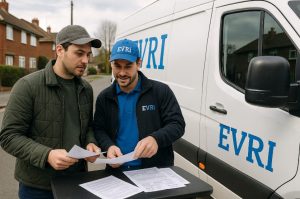
Before accepting a delivery round, a prospective courier should establish the exact parcel rates applying to that round, expected parcel volume, typical mileage, whether the work is Flex or Plus, payment dates, insurance requirements and what happens when deliveries fail or parcels need to be attempted again.
The courier should then calculate an estimated effective hourly return using:
Gross courier income − business expenses ÷ total working time
Total working time should ideally include loading, sorting, waiting at the delivery unit, driving, delivery work and necessary administration rather than counting only time spent physically handing parcels to customers.
That calculation provides a much clearer picture of whether a particular round is financially worthwhile.
FAQs About Evri Driver Earnings
How much do Evri drivers earn per hour?
Evri advertises an average Opportunity to Earn of £15–£18 an hour.
A February 2026 company announcement said established couriers average around £20 an hour, but actual earnings depend on the courier, round and parcel volume.
Is Evri pay weekly or monthly?
Self-employed Evri couriers are officially paid monthly by BACS. Invoices are available through the Courier Community App.
How much does Evri pay per parcel?
Evri does not publish one universal national per-parcel rate for every courier. Rates can vary according to the region, parcel mix, round and individual agreement.
What is Evri Plus?
Evri Plus is a self-employed courier arrangement for people committing to at least five days per week, including Saturday or Sunday.
Benefits include paid holiday, pension contributions and guaranteed earnings above the National Living Wage.
What is Evri Flex?
Evri Flex is the more flexible self-employed courier option. Couriers set their availability through the app and can take available rounds without the five-day commitment required for Evri Plus.
Do Evri couriers pay for their own fuel?
Yes. Self-employed Evri couriers are responsible for their own fuel and other vehicle costs, alongside tax and appropriate insurance.
How many parcels does an Evri courier deliver each day?
Evri says its average courier currently delivers around 75 parcels per day, although actual volumes vary by area and season.
Do Evri Plus drivers get holiday pay?
Eligible Evri Plus couriers can receive up to 28 days of paid holiday, subject to the applicable arrangement and properly planned cover.
What is the National Living Wage in 2026?
From 1 April 2026, the National Living Wage for workers aged 21 and over is £12.71 per hour.

Leave a Reply