

If you are wondering how many years for full State Pension you need in the UK, 35 qualifying years of National Insurance contributions or credits is the key figure for many people under the new State Pension system.
However, the answer is not quite as simple as saying everyone needs exactly 35 years.
If your National Insurance record started after April 2016, you normally need 35 qualifying years to receive the full new State Pension. You will generally need at least 10 qualifying years to receive any new State Pension at all.
People who built up National Insurance records before April 2016 can be treated differently because the transition from the old pension system to the new one takes previous contributions, Additional State Pension and periods of contracting out into account.
This distinction matters. Someone can have 35 qualifying years and still receive less than the headline full rate, while another person with a longer contribution history may have a different calculation because of pre-2016 pension rights.
| State Pension position | Qualifying years normally required |
|---|---|
| Minimum for any new State Pension | 10 years |
| Full new State Pension where NI record began after April 2016 | 35 years |
| Pre-April 2016 NI record | Depends on individual starting amount and contribution history |
| Full basic State Pension under the later old-system rules | Usually 30 years |
| Contracted-out history | May require more than 35 years to reach the full new rate |
Anyone comparing the old and new systems should also understand why existing pensioners can receive different State Pension amounts, because the headline rates alone do not show how individual entitlement was built.
How Many Qualifying Years Do You Need for the Full State Pension?
For someone whose National Insurance record began after 6 April 2016, the calculation is relatively straightforward: 35 qualifying years normally provide the full new State Pension.
A person normally needs at least 10 qualifying years before becoming entitled to any new State Pension. These years do not have to be consecutive.
A qualifying year can come from more than simply going to work and having National Insurance deducted from a salary.
Qualifying years can be created through:
- National Insurance contributions from employment
- National Insurance contributions through qualifying self-employment
- National Insurance credits received while claiming certain benefits
- Credits associated with caring responsibilities
- Child Benefit-related National Insurance credits in qualifying circumstances
- Voluntary National Insurance contributions
- Certain periods involving work or residence overseas
Former Pensions Minister Steve Webb made an important distinction when the 35-year structure was being developed:
“It is 35 years of contributions or credits. It is not just paid work.”
That distinction explains why someone who has spent several years outside paid employment may still have a strong National Insurance record.
For example, a parent who stopped working while caring for a young child may have received National Insurance credits during that period.
Similarly, some people claiming unemployment, sickness or caring-related benefits may have credits added to their record.
This is why someone asking whether they can receive a pension without ever personally paying National Insurance should check their actual qualifying-year record rather than assuming their entitlement is zero.
How Much State Pension Does 35 Years Give You?
The full new State Pension is £241.30 per week for the 2026/27 tax year. That is equivalent to approximately £12,547.60 over 52 weeks before any tax implications are considered.
For comparison, the full basic State Pension under the older system is £184.90 per week.
| Pension type | Weekly full rate | Approximate 52-week value |
|---|---|---|
| Full new State Pension | £241.30 | £12,547.60 |
| Full basic State Pension | £184.90 | £9,614.80 |
The State Pension is normally paid every four weeks, so the annual figures above should not be mistaken for a monthly payment calculation.
People following changes in the headline amount can also see how the State Pension increase affects the 2026/27 rates.
How Much State Pension Would You Get With Fewer Than 35 Years?
For a straightforward new State Pension record that began after April 2016, each qualifying year effectively builds 1/35 of the full rate until the maximum is reached.
Using the £241.30 full weekly rate illustrates how this works.
| Qualifying years | Illustrative weekly amount* | Approximate annual amount* |
|---|---|---|
| 10 | £68.94 | £3,585.03 |
| 15 | £103.41 | £5,377.54 |
| 20 | £137.89 | £7,170.06 |
| 25 | £172.36 | £8,962.57 |
| 30 | £206.83 | £10,755.09 |
| 34 | £234.41 | £12,189.10 |
| 35 | £241.30 | £12,547.60 |
These are illustrative calculations for someone under the straightforward post-2016 rules. Actual entitlement can differ because of an individual’s National Insurance history and transitional rules.
This table should therefore not be used as a substitute for an individual State Pension forecast.
For people with National Insurance contributions from before 6 April 2016, DWP calculates a starting amount based on their record when the new system began.
That starting amount can be below, equal to or above the standard full new State Pension because the calculation incorporates rights built under the previous system.
Why Might 35 Years Not Be Enough for the Full State Pension?
The statement that everybody automatically gets the full State Pension after 35 years is one of the biggest potential misunderstandings around the system.
If your National Insurance record began before April 2016, previous pension rules can affect your entitlement.
Contracting Out Can Change The Calculation
Before the introduction of the new State Pension, some workplace and private pension members were contracted out of the Additional State Pension.
During contracted-out periods, the employee or employer generally paid lower National Insurance towards the state system, while pension provision was instead made through a workplace or private pension arrangement.
As a result, someone who was contracted out may have 35 or more qualifying years but still initially receive less than the full new State Pension.
Official guidance specifically states that people who were contracted out before 2016 will usually need more than 35 qualifying years to reach the full rate.
However, contracted-out years themselves are not simply erased from a National Insurance record. Post-2016 qualifying years can potentially increase a person’s entitlement until they reach the applicable maximum.
What Counts as a Qualifying Year for State Pension?
A qualifying year records sufficient National Insurance contributions or credits for that tax year to count towards State Pension entitlement.
For 2026/27, official guidance says a qualifying year can arise in several ways, including employment, qualifying self-employment, voluntary contributions and National Insurance credits.
| How a year can qualify | Typical example |
|---|---|
| Employment | Working and meeting the relevant NI conditions |
| NI credits | Receiving qualifying credits while unemployed or ill |
| Parenting | Receiving qualifying Child Benefit-related credits |
| Caring | Receiving eligible carer-related NI credits |
| Self-employment | Meeting the applicable contribution conditions |
| Voluntary payments | Filling an eligible gap in the NI record |
One important point is that low-paid work does not automatically mean a year is lost.
Some employees can be treated as having paid National Insurance even when they do not actually have employee NI deducted, provided their earnings fall within the relevant thresholds.
Likewise, caring for children or another person can be valuable for pension purposes because National Insurance credits may preserve a person’s contribution history.
How Can You Check Your State Pension Qualifying Years?
The safest approach is to check your actual National Insurance record rather than estimating qualifying years from the number of years you have worked.
The online National Insurance record checker can show:
- contributions already recorded
- National Insurance credits received
- years containing contribution gaps
- whether particular gaps can potentially be filled
- whether voluntary contributions could increase your forecast
- the potential impact of paying to fill eligible gaps
You should then compare this information with your personal State Pension forecast.
The forecast can show how much State Pension you could receive, when you can receive it and whether there are opportunities to increase it.
Myrtle Lloyd, HMRC’s Chief Customer Officer, has encouraged people to check rather than wait until retirement:
“It’s never too early, or too late, to check your State Pension forecast.”
That advice is particularly relevant for anyone with career breaks, periods of self-employment, time spent overseas or unexplained gaps in their NI record.
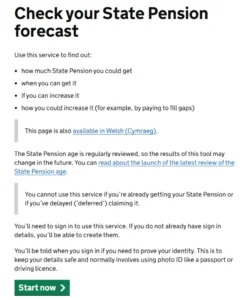
The State Pension forecast service shows your estimated entitlement and whether you may be able to increase it.
Can You Fill Gaps in Your National Insurance Record?
Yes, some gaps can be filled by making voluntary National Insurance contributions, but paying money simply because a year is incomplete is not always the right decision.
An incomplete year does not necessarily mean buying it will increase your State Pension.
Before paying, check whether:
- you already expect to reach the maximum pension through future working years
- the missing year can actually increase your pension
- you qualify for National Insurance credits instead
- the year is eligible to be filled
- your pre-2016 pension calculation affects the value of an additional year
The online services can now show whether some voluntary payments would improve a State Pension forecast. People can also contact the Future Pension Centre for individual State Pension information.
For people below State Pension age who meet the relevant conditions, some Class 3 voluntary contributions can also be paid through the online forecast service.
The practical rule is simple: check the benefit before paying for a missing year.
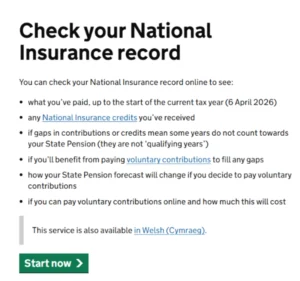
Checking the National Insurance record can identify missing qualifying years before voluntary contributions are considered.
What Happens If You Have Only 10 Years of National Insurance?
Ten qualifying years is normally the minimum requirement for the new State Pension.
Someone with fewer than 10 UK qualifying years would generally not receive the new State Pension unless special rules, such as qualifying periods from certain overseas systems, allow the minimum condition to be met.
Ten years should therefore be viewed as the entry threshold rather than the number required for the full pension.
For a straightforward post-2016 contribution history:
- Under 10 years: normally no new State Pension
- 10 to 34 years: potentially a partial State Pension
- 35 years: potentially the full rate
- Pre-2016 record: individual transitional calculation applies
Do Years Spent Abroad Count Towards the State Pension?
They sometimes can.
People who have worked in the European Economic Area, Switzerland or countries covered by certain UK social security agreements may be able to use overseas contribution periods when determining whether they satisfy the minimum qualifying requirement.
However, there is an important distinction between qualifying to receive a pension and determining how much the UK actually pays.
For example, overseas contribution periods may help someone reach the minimum 10-year threshold, while the amount ultimately paid by the UK can still be based primarily on their UK National Insurance record.
People planning retirement overseas should also understand that annual State Pension increases depend partly on the country where they live.
The issue is explained further in the guidance on frozen State Pensions for people living abroad.
How Many Years Were Needed Under the Old State Pension?
The 35-year figure applies to the new State Pension and should not automatically be applied to everyone already receiving a pension.
People who reached State Pension age before 6 April 2016 fall under the basic State Pension system.
For many people who reached State Pension age between April 2010 and April 2016, 30 qualifying years were required for the full basic State Pension. Earlier generations could have different requirements.
For example:
| Pension system | Typical full-pension requirement |
|---|---|
| New State Pension – straightforward post-2016 record | 35 qualifying years |
| Basic State Pension – many reaching pension age from 2010 to 2016 | 30 qualifying years |
| Older basic State Pension cases | Could require 39 or 44 years depending on circumstances |
The old system could also include Additional State Pension, so comparing only the £184.90 basic rate with the £241.30 new rate can give an incomplete picture.
At What Age Can You Receive the State Pension?
The UK is currently moving from a State Pension age of 66 to 67, meaning there is no longer one simple current age that applies to everyone approaching retirement.
Under the legislated timetable, people born between 6 April 1960 and 5 March 1961 reach State Pension age between 66 years and one month and 66 years and 11 months.
People born from 6 March 1961 to 5 April 1977 currently have a State Pension age of 67.
| Date of birth | State Pension age under current legislation |
|---|---|
| Before 6 April 1960 | Generally 66 or already reached |
| 6 April 1960 – 5 March 1961 | Between 66 years 1 month and 66 years 11 months |
| 6 March 1961 – 5 April 1977 | 67 |
| 6 April 1977 onwards | Later rules apply, including the legislated move towards 68 |
Current legislation provides for the State Pension age to rise from 67 to 68 between 2044 and 2046, although State Pension age is subject to periodic government review.
Qualifying for the full amount and reaching State Pension age are therefore two separate tests: building 35 qualifying years does not mean you can immediately start claiming.
Does Having More Than 35 Years Increase Your State Pension?
Not automatically.
If you are already entitled to the full standard new State Pension, additional qualifying years normally cannot take the standard element above the full rate.
There are circumstances where an individual’s total pension may exceed the headline full new State Pension, particularly where protected payments or Additional State Pension rights were carried forward from the pre-2016 system.
It is therefore more useful to ask whether another qualifying year will improve your personal forecast than simply to count how many years are listed on the NI record.
Will the Full State Pension Amount Stay at £241.30?
The £241.30 figure is the 2026/27 full new State Pension rate, rather than a permanent amount.
The new State Pension is normally uprated annually under the triple-lock mechanism using the highest of:
- average earnings growth
- Consumer Prices Index inflation
- 2.5%
As a result, reaching 35 qualifying years establishes the contribution position for the standard full pension; it does not permanently fix a person’s pension at today’s monetary amount.
The developing position for the next uprating is covered in the State Pension triple-lock increase and future pension rates.
What Should You Do If Your Record Is Short of 35 Years?
A short record does not automatically mean you should immediately purchase missing National Insurance years.
A better sequence is:
- Check your National Insurance record and count completed qualifying years.
- Check your State Pension forecast to see your current projected entitlement.
- Identify which incomplete years can still be filled.
- Check whether you qualify for missing National Insurance credits.
- Find out whether filling a particular year actually increases your pension.
- Consider voluntary contributions only after confirming the financial benefit.
This approach is particularly important for someone with pre-2016 contributions because the simple 35-year calculation may not accurately reflect their pension.
Conclusion
For most people asking how many years for full State Pension, the headline answer is 35 qualifying years, provided their National Insurance record began after April 2016.
At least 10 qualifying years are normally needed to receive any new State Pension.
However, people with pre-2016 contributions, contracted-out employment or overseas contribution histories can face different calculations.
The full new State Pension is currently £241.30 per week, but having 35 years does not guarantee that exact amount in every case.
The most reliable approach is to check both your National Insurance record and personalised State Pension forecast before making retirement or voluntary-contribution decisions.
FAQs
How many years of National Insurance do I need for a full State Pension?
You normally need 35 qualifying years for the full new State Pension if your National Insurance record began after April 2016. Pre-2016 records can be calculated differently.
Can I get a State Pension with only 10 years of contributions?
Yes. Ten qualifying years is normally the minimum needed for any new State Pension, although the amount will generally be below the full rate.
Will I get a full State Pension with 30 years of National Insurance?
Not normally under the straightforward new State Pension rules. Thirty years may provide a partial new State Pension, while 30 years was the full requirement for many people under the later basic State Pension system.
Why do I have 35 years but not qualify for the full State Pension?
Pre-2016 contribution histories and periods of contracting out can reduce the starting amount. Some people therefore need additional post-2016 qualifying years before reaching the full rate.
Do National Insurance credits count towards the 35 years?
Yes. Qualifying National Insurance credits can count in the same overall qualifying-year record as years built through paid contributions.
Can I buy missing years to get a full State Pension?
You may be able to fill eligible gaps with voluntary National Insurance contributions. Check your forecast first because paying for a missing year does not always increase your pension.
Do my 35 qualifying years have to be consecutive?
No. Qualifying years do not normally need to run consecutively. What matters is the total number of qualifying years recorded and how the pension rules apply to your contribution history.

Leave a Reply