
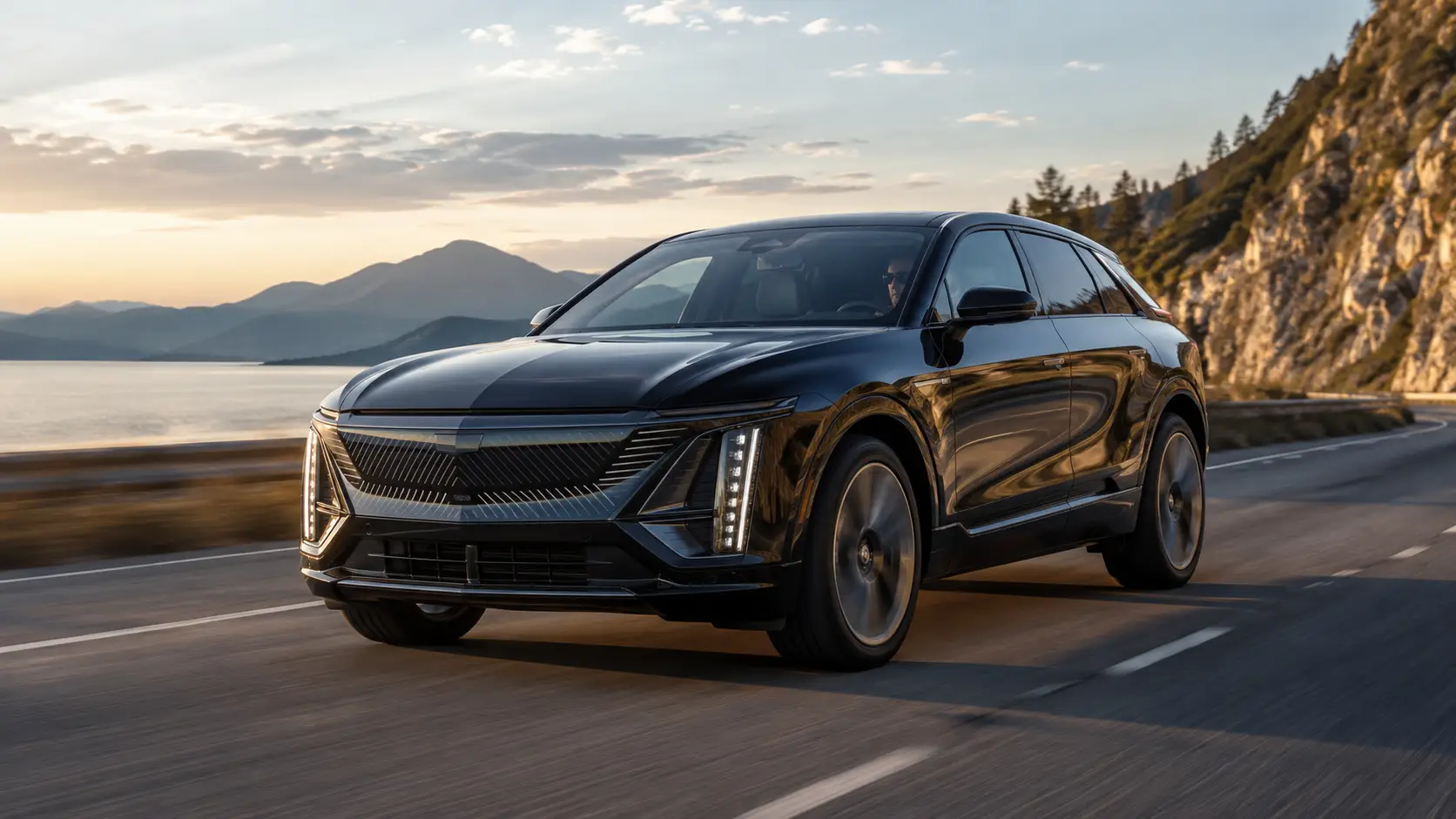
The driving modes in the Cadillac LYRIQ can influence energy consumption, but they still do not have separate official range ratings. Cadillac’s current 2027 specifications publish range figures according to drivetrain and vehicle configuration rather than Tour, Sport, Snow/Ice, My Mode or V-Mode.
The selected mode changes characteristics such as accelerator response, steering, suspension, braking feel and, where applicable, electric all-wheel-drive behaviour. That can indirectly affect battery usage because some settings encourage stronger acceleration or prioritise traction and performance.
For normal driving, Tour remains the everyday baseline, while Sport can increase consumption when its sharper responses are used aggressively. Snow/Ice prioritises traction rather than maximum efficiency, and My Mode depends on the settings chosen by the driver.
The 2027 LYRIQ-V continues to add performance-focused controls including V-Mode and Velocity Max. Cadillac currently rates the LYRIQ-V at 615 horsepower and 650 lb-ft of torque when Velocity Max is activated.
Why change it: Cadillac is now promoting the 2027 LYRIQ and 2027 LYRIQ-V, so repeatedly framing the article around the 2026 model makes it appear older even though the central explanation remains correct.
Which Driving Modes Does the Cadillac LYRIQ Actually Have?

Cadillac’s current Driver Mode Control guidance continues to include Tour, Sport, Snow/Ice and My Mode among its selectable driving settings, although the exact modes available depend on the vehicle, model year and equipment.
For the 2027 Cadillac LYRIQ-V, Cadillac continues to provide V-Series-specific driver controls, while Velocity Max remains the performance feature that unlocks the LYRIQ-V’s maximum available output.
Drivers can normally select these settings through the Drive Modes app on the infotainment display. Each mode changes particular vehicle characteristics rather than altering the battery’s physical capacity.
Tour Mode
Tour is the standard setting for normal city, suburban and motorway driving. It is designed to provide a balanced combination of comfort, steering response and everyday performance.
Because Tour generally avoids the sharper accelerator calibration associated with performance-focused settings, it is usually the most predictable mode for routine journeys.
However, Cadillac does not describe it as a dedicated economy mode or guarantee that it will always deliver the longest range.
Sport Mode
Sport mode is intended to provide more responsive acceleration and more dynamic handling on dry roads.
Depending on the vehicle’s equipment, it may adjust accelerator-pedal response, steering effort, suspension behaviour and electric-vehicle sound enhancement.
The mode itself does not automatically consume a fixed amount of extra battery power.
However, its sharper response can encourage stronger acceleration, which may increase electricity consumption and reduce the distance available from a charge.
Snow/Ice Mode
Snow/Ice mode is designed for slippery conditions. It changes accelerator-pedal tuning to provide smoother torque delivery and help reduce wheel slip.
On all-wheel-drive LYRIQ models, the setting may also change how the electric all-wheel-drive system responds. Snow/Ice is a traction and safety setting rather than an efficiency mode.
Any reduction in winter range is often caused by low temperatures, cabin heating, wet roads and battery conditioning as well as the selected mode.
My Mode
My Mode allows the driver to personalise several vehicle settings. Depending on the specification, these may include acceleration feel, steering, braking response, suspension and motor sound.
The effect on battery usage depends on how the mode is configured. A relaxed accelerator setting may encourage smoother driving, while a Sport-style response may make higher energy consumption more likely.
My Mode does not have a separate official range rating.
V-Mode
V-Mode is available on the performance-focused Cadillac LYRIQ-V. It allows the driver to save a preferred combination of performance settings, including steering, suspension, acceleration feel, braking response and electric motor sound.
Because V-Mode can be configured differently, its effect on range is not fixed. A more aggressive performance setup is likely to consume more energy when the available power is used regularly.
Velocity Max
Velocity Max is a separate LYRIQ-V performance feature designed to provide additional motor torque and maximum available output.
Cadillac states that Velocity Max changes propulsion settings, including the accelerator map, motor capability, propulsion cooling and electric all-wheel-drive behaviour.
It may not be available when the battery charge is low, and Cadillac warns that extended use can reduce vehicle range.
Some online explanations refer to an Eco mode or Tow/Haul mode as though both are standard LYRIQ settings. These are not listed as standard LYRIQ modes in Cadillac’s current owner documentation.
Owners should therefore check the handbook supplied with their exact vehicle, as equipment and mode availability can differ by model year and market.
Do the Modes Have Different Official Range Ratings?
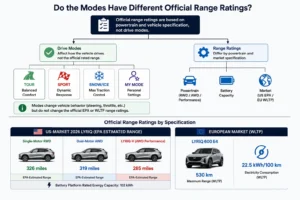
No. Cadillac’s published range figures continue to relate to vehicle configuration rather than the selected driving mode. There is no separate official EPA range for Tour, Sport, Snow/Ice or My Mode.
For the US-market 2027 Cadillac LYRIQ, the single-motor rear-wheel-drive model has an EPA-estimated range of 326 miles.
Dual-motor all-wheel-drive models are rated at 319 miles with the standard 11.5 kW charging system and 303 miles with the available 19.2 kW charging system. The 2027 LYRIQ-V has an EPA-estimated range of 285 miles.
Cadillac lists a 102 kWh battery capacity for the current LYRIQ platform. These figures distinguish different drivetrain and equipment configurations; they should not be interpreted as “Tour range”, “Sport range” or “Snow/Ice range” figures.
Why this update matters: This is the most important factual update in the article. Cadillac now publishes three distinct standard-LYRIQ figures: 326, 319 and 303 miles, plus 285 miles for LYRIQ-V.
Cadillac’s European material uses different presentation and vehicle specifications. One official European page quotes a maximum range of 530 km and electricity consumption of 22.5 kWh per 100 km for the listed LYRIQ 600 E4.
A UK reader should not directly compare that number with a US EPA figure without checking the market, model specification, drivetrain and testing method.
The official 2026 LYRIQ specifications are useful as a baseline, but real journeys can produce higher or lower consumption.
The US Environmental Protection Agency describes EV range estimates as comparison guidance and notes that cold weather, cabin accessories and high-speed driving can significantly reduce real-world range.
How Does Tour Mode Affect Range?
Tour is intended for normal city and motorway driving. Cadillac describes it as a smooth setting that balances comfort and handling.
It is not labelled as a dedicated economy mode, but its moderate responses make it the most sensible baseline for drivers seeking consistent energy use.
Tour does not guarantee the longest distance from a charge. Hard acceleration, high speed, steep gradients and strong cabin heating can still use substantial energy.
For day-to-day journeys, Tour is the logical default because it avoids deliberately sharpening the vehicle’s responses.
The LYRIQ’s energy-efficiency display can show recent consumption, regenerated range and average efficiency, allowing the owner to compare actual journeys rather than relying on assumptions about the mode name.
Does Sport Mode Use More Battery?
Sport can use more battery, but the extra consumption is not a fixed percentage.
Cadillac says Sport improves handling and acceleration on dry roads. On the 2026 LYRIQ, it can modify steering effort, accelerator-pedal tuning, electric-vehicle sound enhancement, adaptive cruise control and suspension tuning where fitted.
The sharper pedal calibration makes strong acceleration easier to request. Repeated heavy acceleration is therefore likely to lower efficiency.
Selecting Sport does not create a uniform range penalty. Sustained speed and repeated hard acceleration matter more than changes to steering weight, cabin sound or suspension response.
There is no reliable basis for a universal claim that Sport cuts LYRIQ range by 10%, 15% or 20%. Cadillac does not publish a standard percentage loss, and the outcome depends on speed, route, weather, traffic, tyres, load and driver inputs.
What Happens in Snow/Ice Mode?

Snow/Ice is a traction setting rather than an efficiency setting. Cadillac says it adjusts pedal tuning to optimise traction on slippery surfaces and can modify electric all-wheel drive.
It softens acceleration response to help prevent wheel slip, but may compromise acceleration on dry tarmac.
The mode itself is not necessarily the main reason range falls during winter. Low temperatures, battery conditioning, cabin heating and wet or snowy roads can all increase consumption.
The EPA specifically identifies cold weather and accessory use as factors that can significantly reduce EV range.
Cadillac advises against using One-Pedal Driving and Regen on Demand as the primary slowing methods on slippery roads. That guidance is safety-related: strong regenerative deceleration may be unsuitable where grip is limited.
Less energy may be recovered, but maintaining control is more important than maximising regeneration.
Can My Mode Improve Efficiency?
My Mode allows the driver to personalise everyday driving. Depending on equipment, available settings can include acceleration feel, brake feel, steering, suspension and motor sound. Acceleration feel can be set to Relaxed, Tour or Sport.
Relaxed acceleration may support smoother urban driving, but it is not a formally rated Eco mode and has no separate range claim.
Acceleration feel is likely to be the most relevant setting because it changes how readily the vehicle responds to pedal input.
Even then, a relaxed map cannot compensate for sustained motorway speed, heavy heating use or repeated climbing. My Mode is a personalisation tool, not a guaranteed range-extension programme.
How Do V-mode and Velocity Max Affect Range?

The 2027 LYRIQ-V continues to offer performance functions beyond those of the standard LYRIQ, including V-Series driver controls, Launch Control and Velocity Max.
V-Series driver settings allow the vehicle’s performance characteristics to be tailored, while Velocity Max is a separate feature designed to unlock the LYRIQ-V’s maximum available performance.
When Velocity Max is activated, Cadillac estimates output at 615 horsepower and 650 lb-ft of torque. With Launch Control, Cadillac quotes a 0–60 mph time of 3.3 seconds.
Using this additional performance can increase electricity consumption when the available acceleration and power are repeatedly used. The actual effect on range will therefore depend heavily on driver behaviour rather than simply whether a performance setting appears on the display.
Cadillac currently gives the 2027 LYRIQ-V an EPA-estimated range of 285 miles, compared with up to 326 miles for the rear-wheel-drive standard LYRIQ.
That difference reflects the complete vehicle configuration, including its dual-motor performance powertrain and associated equipment. It should not be interpreted as meaning that selecting V-Mode alone creates a fixed 41-mile range penalty on an otherwise identical vehicle.
Why this update matters: Cadillac’s current 2027 LYRIQ-V page confirms 615 hp, 650 lb-ft, 3.3 seconds to 60 mph and 285 miles of EPA-estimated range.
Is Regenerative Braking Controlled by the Drive Mode?
Regenerative braking and drive modes are related through the vehicle’s controls, but they are not the same feature.
The LYRIQ offers One-Pedal Driving with Off, Normal and High settings. When available, it uses regenerative braking to slow the vehicle and recover energy.
Cadillac says One-Pedal Driving can recover more energy during coasting and braking than ordinary Drive mode, while Regen on Demand allows additional deceleration through the steering-wheel paddle.
Regeneration returns some kinetic energy to the battery, but it cannot recover all of the energy originally used to accelerate.
Cadillac currently recommends charging to 80% or less for normal daily use to support battery health and optimal regenerative-braking performance, and specifically states that regenerative braking is limited above 80% charge.
Regen On Demand may also not operate normally when the battery is fully charged or when battery temperature is extremely cold or hot.
Why this update matters: This is more precise than the existing wording. Cadillac now explicitly states the 80% threshold and separately identifies full charge and extreme battery temperatures as conditions that can affect regenerative braking.
What Affects LYRIQ Range More Than the Mode Selector?
Cadillac’s owner guidance identifies several important factors:
| Range factor | Why it affects battery consumption |
|---|---|
| High motorway speeds | Greater aerodynamic resistance requires more energy |
| Rapid acceleration | Strong power demand increases electricity consumption |
| Cold weather | The battery and cabin may require additional heating |
| Cabin heating and air conditioning | Climate systems draw power from the high-voltage battery |
| Hills and steep gradients | Climbing requires more energy than travelling on level roads |
| Low tyre pressure | Increased rolling resistance can reduce efficiency |
| Heavy vehicle loads | Additional weight raises the energy required to move the vehicle |
| Wet, snowy or icy roads | Difficult road conditions can increase resistance and reduce regenerative-braking opportunities |
Cadillac advises avoiding rapid acceleration and deceleration, using cruise control where appropriate and planning ahead. It states that higher speeds and gradient changes use more energy and can significantly reduce electric range.
Cabin heating and air conditioning draw energy that would otherwise be available for driving.
For a business considering the LYRIQ or another premium EV, route type, charging access, seasonal mileage and driver behaviour should be modelled alongside official range.
Live Business Blog’s guide to presenting an EV fleet business case to senior management covers the wider planning questions around fleet adoption.
How Can a LYRIQ Driver Maximise Usable Range?
The most reliable strategy is not to search for a hidden “best range mode”. It is to combine an appropriate mode with efficient driving and realistic journey planning.
Tour is suitable for most dry-road journeys. My Mode with relaxed acceleration may encourage gentler inputs. Sport and Velocity Max should be used for their intended performance purposes rather than when maximum range is the priority.
Snow/Ice should be selected for low-grip conditions, even where winter consumption is higher.
Before a longer journey, the driver should check tyre pressures, review the route, keep a charging margin and precondition the cabin while plugged in where available.
Public charging stops also require attention to site rules. A charger being available does not necessarily mean unrestricted parking.
The report on a Lidl EV charger parking fine shows why drivers should check operating hours, maximum-stay conditions and signage before starting a charging session.
Conclusion
The Cadillac LYRIQ’s driving modes can change battery usage, but they do not provide separate official ranges.
Tour offers balanced everyday behaviour, Sport can consume more energy when its performance is used, Snow/Ice prioritises traction, and My Mode depends on the chosen settings.
On the LYRIQ-V, Cadillac expressly warns that extended use of Velocity Max reduces range.
For most owners, the largest differences will come from speed, acceleration, weather, cabin heating, terrain and vehicle configuration.
The best approach is to select the mode suited to the road, drive smoothly and judge efficiency from the LYRIQ’s own energy-use data over repeated journeys.
Frequently Asked Questions
Which Cadillac LYRIQ mode gives the longest range?
Cadillac does not publish a longest-range mode. Tour is the most balanced everyday setting, while a gently configured My Mode may encourage smoother acceleration.
Speed, temperature, terrain, climate control and driving style have greater influence.
Does the LYRIQ have an Eco mode?
Current official 2026 documentation lists Tour, Sport, Snow/Ice and My Mode, plus V-Mode on the LYRIQ-V.
It does not list a standard Eco mode. Equipment varies by model year, trim and region, so the vehicle-specific manual remains authoritative.
Does One-Pedal Driving always increase range?
It can improve energy recovery during slowing, particularly in urban traffic, but it does not guarantee longer range on every route.
Regeneration may be limited when the battery is cold or nearly full, and Cadillac advises turning One-Pedal Driving off on slippery roads.
Why can the displayed range change after selecting a mode?
The estimate can respond to recent consumption, driving conditions and system use.
A mode that changes accelerator response or all-wheel-drive behaviour can contribute, but temperature, speed, heating and route profile may be stronger influences. The display is a dynamic estimate, not a promise.
Safety note: Drive modes and regenerative-braking settings do not replace careful driving. The vehicle-specific owner’s manual should be followed, particularly in snow, ice, steep terrain or other low-grip conditions.

Leave a Reply