

Last Update – 30-10-2026
Important 2026 Budget update: The Autumn Budget announced on 28 October 2026 increased the proposed property income tax rates for April 2027 to 24%, 44% and 49%.
These replace the previously announced 22%, 42% and 47% rates. The new increases are subject to legislation.
Paying less tax on rental income is possible in the UK, but landlords must distinguish legitimate tax planning from illegal tax evasion.
Claiming allowable expenses, using tax reliefs and choosing the appropriate ownership structure can reduce the amount owed to HM Revenue and Customs (HMRC).
The rules have changed significantly. Making Tax Digital for Income Tax became mandatory for qualifying landlords in April 2026, the furnished holiday lettings tax regime has ended, and further property income tax increases are planned from April 2027.
Understanding these changes matters whether you own one buy-to-let property, manage a portfolio or rent out a room in your own home.
The most effective approach is to calculate your genuine rental profit, claim eligible reliefs, maintain accurate records and plan for future tax liabilities rather than trying to conceal income.
What Is Rental Income and When Must Landlords Pay Tax?
Rental income includes monthly rent, certain tenant service charges, payments for utilities and other taxable receipts arising from letting property.
Landlords generally pay Income Tax on their taxable rental profit rather than their total rental receipts.
Taxable rental profit = Gross rental income − Allowable expenses
For 2026/27, the standard Personal Allowance is £12,570, although it reduces when adjusted net income exceeds £100,000.
HMRC applies different reporting requirements depending on income and profit.
| Annual rental income | HMRC requirement |
|---|---|
| Gross income of £1,000 or less | Normally no reporting required under the property allowance |
| More than £1,000 and up to £2,500 | Contact HMRC |
| Net rental profit over £2,500 | Self Assessment required |
| Gross rental income over £10,000 | Self Assessment required |
These thresholds must be considered together. For example, £12,000 of gross rent can trigger Self Assessment even where substantial expenses reduce taxable profit.
The £1,000 property allowance cannot be claimed alongside actual property expenses. Landlords should compare the two methods before filing.
These are general reporting rules; existing Self Assessment obligations and special circumstances can also require a return.
For detailed eligibility and expense rules, consult the official HMRC guidance on paying tax on rented property.
How Will Rental Income Tax Rates Change in April 2027?
The government’s 28 October 2026 Budget announced a further two-percentage-point increase in property income tax rates from 6 April 2027.
The proposed rates now stand at 24%, 44% and 49% for England, Wales and Northern Ireland, subject to the relevant legislation and devolved arrangements.
| Tax band | 2025/26 | 2026/27 | 2027/28 proposed |
|---|---|---|---|
| Basic rate | 20% | 20% | 24% |
| Higher rate | 40% | 40% | 44% |
| Additional rate | 45% | 45% | 49% |
| Residential finance cost relief | 20% | 20% | 24% |
| Standard Personal Allowance | £12,570 | £12,570 | £12,570 |
| Property allowance | £1,000 | £1,000 | £1,000 |
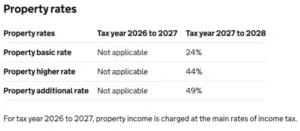
The 2027/28 property rates are the latest Budget proposals, not rates already applying to 2026/27 income.
The Personal Allowance will generally be applied against employment, trading and pension income before property income from April 2027. This may increase the amount of rent subject to the separate property rates.
Tax specialists Richard Woolich and Natalie Groves, writing in DLA Piper’s analysis of the 28 October 2026 Budget, highlighted the additional pressure these measures place on returns for private landlords.
Their analysis also identified the government’s proposed expansion of property-income data reporting as a sign of increased compliance scrutiny.
Landlords should review projected after-tax rental yields rather than relying exclusively on gross rental returns.
Which Allowable Expenses Can Reduce Rental Income Tax?
Allowable expenses must generally be incurred wholly and exclusively for running the rental business.
| Expense | Typical tax treatment |
|---|---|
| Letting agents’ management fees | Deductible |
| Landlord building and contents insurance | Deductible |
| Genuine repairs and maintenance | Deductible |
| Council Tax and utilities paid by landlord | Normally deductible |
| Property-related accountancy fees | Normally deductible |
| Advertising and tenancy administration | Normally deductible |
| Capital improvements | Not an ordinary revenue deduction |
| Residential mortgage interest | Restricted relief for individual landlords |
For example, a landlord receiving £18,000 in rent and paying £4,000 in eligible operating expenses has £14,000 of property profit before residential finance-cost relief.
A 40% taxpayer would generally save £1,600 in Income Tax from those £4,000 of eligible deductions in 2026/27, assuming the entire reduction falls within the higher-rate band.
Repairs Versus Capital Improvements
Replacing broken windows, repairing a roof or redecorating an existing rental property will normally qualify as repair expenditure.
Installing an extension, creating an additional bedroom or substantially upgrading the building may instead be capital expenditure.
Replacing single glazing with modern double glazing can still constitute a repair where it is a modern equivalent without a significant improvement to the asset. The facts of the work matter.
Ask contractors to itemise genuine repairs separately from improvements. This helps establish the correct tax treatment without artificially dividing costs.
Replacement of Domestic Items Relief
Landlords can generally deduct the qualifying cost of replacing furniture and domestic appliances supplied for tenants.
Suppose an old washing machine is replaced with a similar model costing £650. Delivery and installation cost £80, and disposal costs £40.
The potential qualifying deduction is £770, less any proceeds from disposing of the old machine.
Initial furnishing does not normally qualify, and any improvement element beyond an equivalent replacement may be restricted.
Less Obvious Deductible Costs
Other potentially eligible expenses include:
- Reasonable property-management travel, with qualifying 2026/27 car mileage rates of 55p for the first 10,000 business miles and 25p thereafter.
- Genuine additional home-office costs. Simplified home-working rules should not be assumed to apply automatically to every property business.
- Appropriate updating or compliance training relating to existing activities, subject to HMRC’s expense rules.
- Eligible pre-letting revenue expenditure incurred within seven years before the rental business begins.
Bad-debt treatment depends on the accounting basis. Under accruals accounting, genuinely irrecoverable rent may qualify after reasonable recovery efforts.
Under the cash basis, unpaid rent is generally not recorded as received, so no separate bad-debt deduction is needed.
How Does Section 24 Mortgage Interest Relief Work?
Section 24 restricts residential finance-cost relief for individual landlords.
Instead of deducting mortgage interest from taxable rental profit, eligible landlords generally receive a basic-rate tax reduction.
For 2026/27, the reduction is 20% of the lowest of:
- Eligible current-year finance costs plus qualifying unused costs brought forward.
- Property business profits after relevant losses.
- Adjusted total income exceeding the Personal Allowance, excluding savings and dividend income for this calculation.
Finance costs can include mortgage interest, qualifying loan arrangement fees, broker fees and interest on borrowing used for the property business, including qualifying repairs or furnishings.
Mortgage capital repayments do not qualify.
Higher-Rate Landlord Example
Assume a landlord already falls entirely within the higher-rate tax band and has:
| Calculation | 2026/27 | 2027/28 proposed |
|---|---|---|
| Rental profit before finance costs | £20,000 | £20,000 |
| Eligible mortgage interest | £10,000 | £10,000 |
| Tax on rental profit | £8,000 | £8,800 |
| Finance-cost tax reduction | −£2,000 | −£2,400 |
| Net rental Income Tax | £6,000 | £6,400 |
The higher property tax rate outweighs the increase in finance-cost relief in this example.
Unused qualifying finance costs can potentially be carried forward when the three-way calculation restricts the current-year relief. The tax reduction cannot create a refund beyond the relevant liability.
What Is Making Tax Digital for Landlords in 2026?
Making Tax Digital (MTD) for Income Tax is already operating.
It requires qualifying landlords to maintain digital records, send quarterly updates through compatible software and complete their annual tax return.
Which MTD Threshold Applies?
| Start date | Qualifying income | Tax year used to assess eligibility |
|---|---|---|
| 6 April 2026 | Over £50,000 | 2024/25 |
| 6 April 2027 | Over £30,000 | 2025/26 |
| 6 April 2028 | Over £20,000 | 2026/27 |
Qualifying income means combined gross property and self-employment income before allowable expenses. Employment earnings are not normally included in this threshold calculation.
For example, £28,000 in gross rent and £8,000 of self-employment turnover produces £36,000 of qualifying income.
Making Tax Digital Reporting Deadlines
| Reporting requirement | Deadline |
|---|---|
| First quarterly update | 7 August 2026 — passed |
| Second quarterly update | 7 November 2026 |
| Third quarterly update | 7 February 2027 |
| Fourth quarterly update | 7 May 2027 |
| 2026/27 final tax return | 31 January 2028 |
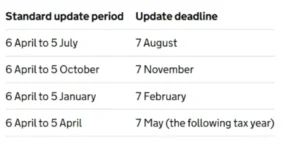
The second quarterly update is due on 7 November 2026, just nine days after this article’s update date.
Craig Ogilvie, HMRC’s Director of Making Tax Digital, said in HMRC’s October 2026 announcement that signing up early gives taxpayers the opportunity to prepare and become familiar with the process before it becomes mandatory.
HMRC is not applying penalty points for late quarterly updates during the 2026/27 tax year, but the submissions remain compulsory. Late final returns and payments can still attract penalties.
Landlords choosing software should examine digital-record functions, property-income support and year-end submissions.
Comparing accounting software options for small businesses can help identify suitable record-keeping features, but MTD for Income Tax compatibility must be independently confirmed.
Are Furnished Holiday Lets Still Eligible for Special Tax Relief?
No. The special furnished holiday lettings (FHL) regime ended on:
- 6 April 2025 for Income Tax and Capital Gains Tax.
- 1 April 2025 for Corporation Tax and Corporation Tax on chargeable gains.
Former FHL businesses are generally treated like ordinary property businesses.
Special access to Business Asset Disposal Relief, rollover relief and other trading-business CGT reliefs has ended for new qualifying disposals, subject to any applicable transitional provisions.
Former FHL income also no longer counts as relevant earnings for pension relief solely because it comes from holiday letting.
Historic capital allowance pools established before abolition may still receive transitional treatment. Existing owners should have their previous claims reviewed before disposing of an FHL property.
Which Tax Allowances Can Help Landlords Pay Less?
Several allowances can reduce tax legally, provided the landlord meets the eligibility requirements.
| Allowance | 2026/27 position |
|---|---|
| Property allowance | £1,000 |
| Rent-a-Room Scheme | Up to £7,500 |
| Shared Rent-a-Room income | £3,750 limit per recipient |
| Marriage Allowance | £1,260 transferable, potentially worth £252 |
| Personal Allowance | £12,570 |
| CGT annual exempt amount | £3,000 |
Rent-a-Room relief applies to qualifying furnished accommodation within the landlord’s home, not an ordinary separately rented buy-to-let.
The property allowance is an alternative to deducting actual expenses, not an additional deduction.
The trading allowance applies separately to qualifying trading or miscellaneous income.
It is £1,000 in 2026/27, with an increase to £3,000 announced from April 2027. It cannot be combined with actual expenses against the same trading receipts.
For higher earners, the Personal Allowance reduces by £1 for every £2 of adjusted net income above £100,000 and disappears at £125,140.
Eligible pension contributions may reduce adjusted net income or extend the basic-rate band, subject to relief limits.
EIS, SEIS and VCT investments can offer tax advantages but involve significant investment risk and should not be pursued merely to offset rental tax.
The interaction between rental profits and the allowance taper is particularly important when considering when you lose your Personal Allowance.
Can Married Couples Reduce Rental Income Tax Through Joint Ownership?
Married couples and civil partners living together are normally taxed on jointly owned property income in equal 50/50 shares.
An unequal income split is possible where genuine beneficial ownership and income entitlements are unequal.
For example, a couple might own a property as tenants in common in 90/10 shares.
Where the legal requirements are met, they can submit Form 17 with supporting evidence to have income taxed according to those beneficial shares.
Form 17 must normally reach HMRC within 60 days of signing.
Simply directing rent into a lower-earning spouse’s bank account does not establish a different ownership entitlement.
Genuine transfers between spouses may qualify for no-gain/no-loss CGT treatment, but SDLT can arise where mortgage debt or other chargeable consideration is involved.
A genuine property partnership may have different profit-allocation arrangements.
However, joint ownership alone does not automatically establish a tax partnership, and artificial profit-sharing arrangements can be challenged.
Marriage Allowance is a separate option where one eligible spouse transfers £1,260 of unused Personal Allowance to the other, potentially reducing tax by £252.
Is a Limited Company Better for Reducing Rental Income Tax?
A property investment company can deduct qualifying mortgage interest before Corporation Tax, whereas an individual residential landlord is subject to Section 24.
Corporation Tax is generally 19% for qualifying small profits and 25% at the main rate, with marginal relief potentially applying between the relevant thresholds.
However, company profits can face another tax charge when distributed to shareholders.
Personal Ownership Versus Limited Company
| Feature | Individual landlord | Limited company |
|---|---|---|
| Rental profit tax | Income Tax | Corporation Tax |
| Mortgage interest | Restricted tax reduction | Generally deductible |
| Profit retained | Personally available after tax | Can remain within company |
| Dividend tax | Not applicable to personal rental profit | Potential additional charge |
| Administration | Self Assessment or MTD | Company accounts, Corporation Tax and filings |
Worked Example: Keeping or Extracting £10,000
Assume £20,000 rental profit before £10,000 mortgage interest. The individual is already a higher-rate taxpayer.
| Tax calculation | Individual 2026/27 | Individual 2027/28 proposed | Company, either year |
|---|---|---|---|
| Income/Corporation Tax | £6,000 | £6,400 | £1,900 |
| Additional dividend tax if all profits extracted | — | — | £2,895.75 |
| Combined tax | £6,000 | £6,400 | £4,795.75 |
The company example assumes 19% Corporation Tax, £8,100 distributed as dividends, the shareholder’s dividend allowance already used and all dividends taxed at the 35.75% upper rate.
Associated-company rules and other circumstances may change the Corporation Tax result.
Dividend ordinary and upper rates increased to 10.75% and 35.75% from April 2026; the additional rate remains 39.35%.
The comparison excludes company administration, mortgage pricing and acquisition or transfer costs. Retaining profits within the company produces a different result from withdrawing them personally.
What Does Transferring a Property into a Company Cost?
Transferring an existing buy-to-let is usually treated as a disposal at market value for CGT purposes.
For an illustrative £300,000 additional residential property in England, SDLT could be £20,000 on a company acquisition under the standard higher-rate bands.
If the owner also makes a taxable gain of £100,000 and qualifies for the £3,000 CGT exemption, CGT at 24% would be £23,280, assuming no other reliefs, losses or deductible costs.
Combined illustrative taxes: £43,280, before legal and refinancing expenses.
Incorporation Relief can defer qualifying gains when a genuine business and its assets transfer to a company in exchange for shares.
Whether a property activity meets the conditions requires specialist advice; relief is not automatic merely because several properties are owned.
How Can Landlords Reduce Capital Gains Tax When Selling Property?
Selling a buy-to-let property can trigger CGT even when its rental income has been correctly declared.
For 2026/27, individual CGT rates are 18% and 24%, depending on the available basic-rate band and other taxable income.
The annual exempt amount is £3,000.
The taxable gain is generally calculated using the disposal proceeds less allowable acquisition, improvement and disposal costs, followed by eligible losses and reliefs.
Potentially deductible costs include SDLT paid on acquisition, conveyancing, estate-agent fees and qualifying capital improvements.
Ordinary maintenance already claimed against rental income cannot be deducted again.
Private Residence Relief Example
Suppose a property generates a £120,000 gain after allowable purchase and selling costs.
Its owner held it for ten years, lived in it as their qualifying main home for four years, then rented it out for six years.
The final nine months normally also qualify for Private Residence Relief.
| Calculation | Amount |
|---|---|
| Total gain | £120,000 |
| Qualifying occupation: 4.75 of 10 years | 47.5% |
| Private Residence Relief | £57,000 |
| Remaining gain | £63,000 |
| Annual exemption | −£3,000 |
| Taxable gain | £60,000 |
| CGT at 24% | £14,400 |
This assumes no other gains, losses or reliefs and that the whole taxable gain falls at 24%.
Letting Relief is now generally limited to situations involving qualifying shared occupation with a tenant.
Most reportable UK residential property gains must be declared and any CGT paid within 60 days of completion.
Can Landlords Carry Forward Rental Property Losses?
Yes. An allowable UK property-business loss can generally be carried forward against future profits of that property business.
For example, a £3,000 rental loss followed by £8,000 of eligible property profit in the next year may reduce that later taxable profit to £5,000.
Losses from one qualifying property can normally offset profits from other properties within the same UK property business.
They cannot ordinarily be offset against employment income or unrelated business profits.
Do Landlords Pay National Insurance on Rental Income?
Ordinary passive rental income does not generally attract National Insurance contributions, and the October 2026 Budget did not introduce a general NI charge on residential rent.
Some landlords who are considered gainfully employed in their property activity may be eligible to pay voluntary Class 2 contributions.
Other landlords may be eligible to make voluntary Class 3 contributions to protect their National Insurance record and State Pension entitlement.
HMRC considers the nature and scale of the activity, not merely the number of properties owned.
What Other Tax Rules Should Landlords Consider?
Landlords living overseas remain potentially liable for UK tax on UK rental income.
Under the Non-resident Landlords Scheme, agents or qualifying tenants may have to deduct tax unless HMRC authorises gross rental payments.
Overseas properties can also create UK reporting obligations for UK-resident individuals, subject to residence rules, reliefs and double-taxation arrangements.
Most individual property businesses use the cash basis by default, recognising receipts and eligible expenses when received or paid.
Accruals accounting may be appropriate or required in particular circumstances; the accounting basis affects unpaid rent, prepaid costs and timing.
Tax on acquiring property also varies across the UK.
England and Northern Ireland generally use SDLT, Scotland uses Land and Buildings Transaction Tax with an Additional Dwelling Supplement, and Wales uses Land Transaction Tax with higher residential rates.
Scotland has its own Income Tax structure, and the new property-income rate framework contains devolved provisions. Landlords should not automatically apply English calculations to every Scottish situation.
Inheritance Tax matters too. Investment properties generally form part of an owner’s estate, potentially increasing exposure above available thresholds and reliefs.
Accurate property valuations and documented transfers are important, particularly given HMRC’s scrutiny of property valuations.
How Much Tax Can a Landlord Actually Save? A Worked Example
Consider Sarah, a hypothetical part-time teacher earning £10,000 annually from employment and £15,000 from rent.
Her allowable operating expenses are £4,500, qualifying replacement items cost £1,000 and eligible mortgage interest totals £3,000.
| Calculation | Without claiming eligible deductions or finance relief | With eligible claims |
|---|---|---|
| Rental income | £15,000 | £15,000 |
| Operating and replacement deductions | £0 | £5,500 |
| Property profit | £15,000 | £9,500 |
| Employment income | £10,000 | £10,000 |
| Personal Allowance | −£12,570 | −£12,570 |
| Taxable income | £12,430 | £6,930 |
| Income Tax at 20% | £2,486 | £1,386 |
| Finance-cost reduction | £0 | −£600 |
| Final Income Tax | £2,486 | £786 |
Illustrative reduction: £1,700.
This corrects the earlier unsupported claim of nearly £2,000 in savings. It assumes the costs were genuinely eligible and not already claimed, and that the finance-cost relief is fully available.
For a similar 2027/28 case, applying the proposed 24% property basic rate and finance-cost relief would produce approximately £943.20 of rental Income Tax, assuming all other circumstances remain unchanged.
The figures demonstrate how legal deductions and changing tax rates can affect liability. They are not evidence of an actual taxpayer’s experience.
What Should Landlords Do Before the Next Tax Year?
Effective tax planning starts with accurate records and realistic forecasts.
Landlords should review their rental profitability after expenses, interest and tax; assess whether MTD applies; check ownership structures; and calculate the impact of the proposed April 2027 rates.
Bringing income forward or deferring legitimate expenditure may sometimes affect the tax-year outcome, but only where accounting rules and genuine commercial timing support it.
Artificial transactions or backdated records are not acceptable.
Keep invoices, tenancy agreements, mortgage statements, ownership documents and evidence supporting relief claims.
The ordinary Self Assessment tax filing deadlines remain relevant to landlords outside MTD and to prior-year returns.
There is no single legal method that eliminates rental tax for every landlord.
The strongest strategy combines correct deductions, appropriate allowances, ownership planning and compliance with HMRC’s reporting requirements.
Frequently Asked Questions
Can I legally avoid paying tax on rental income?
You may owe no tax where eligible allowances and deductions cover your taxable rental profit. However, deliberately hiding rental receipts or falsely claiming expenses is tax evasion.
Does Making Tax Digital apply to landlords with only one property?
Yes, if their qualifying gross property and self-employment income exceeds the applicable threshold. The number of properties owned does not determine MTD eligibility.
Are furnished holiday lets still eligible for special tax relief?
No. The dedicated FHL tax regime ended in April 2025. Certain historic claims and transitional arrangements may remain relevant.
Does Section 24 apply to limited companies?
No. The residential finance-cost restriction generally applies to individual landlords, not companies. Companies can normally deduct qualifying property-finance costs when calculating taxable profits.

Leave a Reply