
Last Updated on 12.08.2026
The UK Personal Allowance determines how much income an individual can usually receive before Income Tax becomes payable. Higher earners, however, may receive only part of the standard allowance or no Personal Allowance at all.
For the 2026/27 tax year, running from 6 April 2026 to 5 April 2027, the standard Personal Allowance remains £12,570. The latest GOV.UK rates confirm that once a person’s adjusted net income exceeds £100,000, the allowance is reduced by £1 for every £2 above that threshold. It reaches £0 when adjusted net income reaches £125,140.
A significant development since the start of 2026 is that the Government has extended the freeze in the Personal Allowance. Finance Act 2026 maintains the £12,570 Personal Allowance through the 2030/31 tax year, meaning the threshold is currently legislated to remain unchanged until 5 April 2031.
The position can therefore be summarised as follows:
- £100,000 or less adjusted net income: the full standard £12,570 Personal Allowance is normally available.
- Above £100,000: the Personal Allowance starts to reduce.
- £125,140 or more: the standard Personal Allowance is reduced to £0.
- The test uses adjusted net income, rather than salary alone.
- The standard £12,570 allowance is currently legislated to remain frozen through 2030/31.
The Personal Allowance applies across the UK, but Scottish Income Tax rates and bands for wages, pensions and most other non-savings, non-dividend income are different.
Important: These figures explain general UK tax rules and should not be treated as personalised tax or financial advice. Pension contributions, Gift Aid, investment income, property income and other individual circumstances can affect adjusted net income and the amount of tax ultimately payable.
For authoritative information, taxpayers should use GOV.UK guidance on adjusted net income and current Income Tax rates and allowances, or obtain advice from a suitably qualified tax professional where their circumstances are complex.
What Is the Personal Allowance in 2026/27?

The standard UK Personal Allowance for 2026/27 is £12,570.
This is the amount of income an individual can normally receive before Income Tax becomes payable, although the actual position depends on the person’s income, allowances, reliefs and other circumstances.
For someone whose adjusted net income does not exceed £100,000, the standard Personal Allowance will normally remain available in full.
Once adjusted net income exceeds £100,000, the allowance starts to be withdrawn at £1 for every £2 of excess income. It is completely withdrawn once adjusted net income reaches £125,140.
There is also an important longer-term development. The Government has extended the freeze in the Personal Allowance beyond 2027/28. Under Finance Act 2026, the £12,570 Personal Allowance is maintained for 2028/29, 2029/30 and 2030/31 as well, extending the existing freeze until 5 April 2031.
This means that, under current legislation, the standard Personal Allowance is scheduled to remain at £12,570 for:
| Tax year | Standard Personal Allowance |
|---|---|
| 2026/27 | £12,570 |
| 2027/28 | £12,570 |
| 2028/29 | £12,570 |
| 2029/30 | £12,570 |
| 2030/31 | £12,570 |
The position could still be changed by future legislation, so taxpayers should check the applicable rates for the tax year concerned.
When Does the Personal Allowance Start to Reduce?
The Personal Allowance starts to reduce when an individual’s adjusted net income exceeds £100,000 during the tax year.
HMRC reduces the allowance by:
£1 for every £2 of adjusted net income above £100,000.
That means the allowance does not suddenly disappear as soon as income reaches £100,001. Instead, it is gradually withdrawn between £100,000 and £125,140.
For example, someone with adjusted net income of £110,000 is £10,000 over the threshold.
The reduction is therefore:
£10,000 ÷ 2 = £5,000
Their remaining standard Personal Allowance would be:
£12,570 − £5,000 = £7,570
At What Income Do You Lose the Personal Allowance Completely?
The standard Personal Allowance is fully withdrawn when adjusted net income reaches £125,140.
The calculation is:
£125,140 − £100,000 = £25,140
The allowance is reduced by £1 for every £2:
£25,140 ÷ 2 = £12,570
As £12,570 is the full standard Personal Allowance, nothing remains.
HMRC therefore states that a person has no standard Personal Allowance where income reaches £125,140 or more under the current rules.
Personal Allowance taper examples
| Adjusted net income | Amount above £100,000 | Allowance reduction | Remaining Personal Allowance |
|---|---|---|---|
| £100,000 | £0 | £0 | £12,570 |
| £105,000 | £5,000 | £2,500 | £10,070 |
| £110,000 | £10,000 | £5,000 | £7,570 |
| £115,000 | £15,000 | £7,500 | £5,070 |
| £120,000 | £20,000 | £10,000 | £2,570 |
| £125,140 | £25,140 | £12,570 | £0 |
| £130,000 | Above full taper | £12,570 | £0 |
These examples assume that the income figure shown is the person’s adjusted net income rather than simply gross salary.
Personal Allowance Calculator
Enter your adjusted net income to estimate how much of the standard £12,570 Personal Allowance may remain.
Personal Allowance
What Is Adjusted Net Income?
Adjusted net income is particularly important because the £100,000 Personal Allowance threshold is not based solely on salary.
HMRC defines adjusted net income broadly as a person’s total taxable income before Personal Allowances, after taking account of certain permitted deductions and tax reliefs.
Income included when calculating adjusted net income can include:
- employment income, including taxable employment benefits;
- self-employed profits;
- most pension income, including the State Pension and private pensions;
- savings interest;
- dividends;
- some rental income;
- some taxable state benefits;
- trust income; and
- foreign income where applicable.
This means someone earning a salary below £100,000 could potentially have adjusted net income above £100,000 if substantial taxable income is received from other sources.
Conversely, someone with gross income above £100,000 may have adjusted net income below that level after eligible deductions are taken into account.
HMRC provides a detailed adjusted net income guide explaining the calculation.
Is the £100,000 Threshold Based on Salary or Total Income?
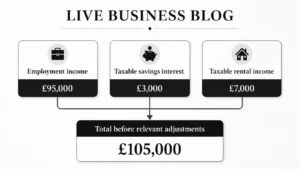
It is based on adjusted net income rather than salary alone.
Consider an employee receiving:
| Income source | Amount |
|---|---|
| Employment income | £95,000 |
| Taxable savings interest | £3,000 |
| Taxable rental income | £7,000 |
| Total before relevant adjustments | £105,000 |
Looking only at the £95,000 salary could incorrectly suggest that the £100,000 threshold has not been reached.
The wider taxable income position matters.
Eligible pension contributions, Gift Aid and certain other reliefs may then affect the final adjusted net income calculation.
Which Pension Contributions Can Affect Adjusted Net Income?
Certain pension contributions can reduce adjusted net income.
HMRC’s guidance explains that the calculation can take account of pension contributions paid gross and contributions where a pension provider has already provided basic-rate tax relief.
In the latter case, HMRC uses the grossed-up contribution when calculating adjusted net income.
For example, where an individual personally pays £8,000 into a relief-at-source pension and the pension provider claims £2,000 of basic-rate tax relief, the gross pension contribution is £10,000.
Subject to the applicable pension and tax rules, that £10,000 gross amount may be relevant when calculating adjusted net income.
However, pension tax relief has its own rules and limits. Making pension contributions solely to obtain a tax result should therefore not be treated as automatically suitable for every person.
Can Gift Aid Reduce Adjusted Net Income?

Qualifying Gift Aid donations can also reduce adjusted net income.
HMRC says that the grossed-up amount is deducted for this purpose. Under the current basic-rate mechanism, every £1 donated under Gift Aid represents £1.25 when calculating the adjustment.
For example, a qualifying £800 Gift Aid donation would have a grossed-up value of:
£800 × 1.25 = £1,000
That £1,000 can therefore be relevant to the adjusted net income calculation.
Again, Gift Aid should reflect a genuine charitable donation rather than being treated simply as a tax-planning mechanism.
Example: Someone Earning £105,000
Suppose an individual has adjusted net income of £105,000 with no further relevant adjustments.
The excess over £100,000 is:
£5,000
The Personal Allowance reduction is:
£5,000 ÷ 2 = £2,500
The remaining allowance is therefore:
£12,570 − £2,500 = £10,070
The individual has not lost the entire allowance. Only £2,500 has been withdrawn.
Example: Someone Earning £115,000
With adjusted net income of £115,000, the person is £15,000 above the threshold.
The Personal Allowance reduction is:
£15,000 ÷ 2 = £7,500
Remaining allowance:
£12,570 − £7,500 = £5,070
Only £5,070 of the standard Personal Allowance remains.
Example: Someone Earning £125,140
At adjusted net income of £125,140, the person is £25,140 above the £100,000 threshold.
Dividing the excess by two gives:
£25,140 ÷ 2 = £12,570
That equals the entire standard Personal Allowance.
The remaining standard allowance is therefore:
£0
Any further increase in adjusted net income does not reduce the standard Personal Allowance below zero.
Why Can the £100,000 to £125,140 Income Range Produce a High Effective Tax Rate?
The Personal Allowance taper can create a particularly high marginal Income Tax rate because an individual can simultaneously pay tax on additional income and lose part of their tax-free Personal Allowance.
For every £2 of adjusted net income above £100,000, £1 of Personal Allowance is withdrawn.
For a taxpayer in England, Wales or Northern Ireland whose additional non-savings income falls within the 40% higher-rate band, an additional £2 of income can therefore result in:
- 40% Income Tax being charged on the additional income; and
- another £1 of previously tax-free income becoming taxable because £1 of Personal Allowance has been withdrawn.
The combined effect can produce an effective marginal Income Tax rate of 60% on relevant income within the taper range. This is not an official 60% tax band; it is the mathematical result of the 40% higher rate interacting with the Personal Allowance withdrawal. HMRC’s own statistical documentation describes this effect as a notional 60% marginal rate.
The position is different for Scottish taxpayers. In 2026/27, Scottish non-savings, non-dividend income between the relevant higher-income thresholds can be subject to the 45% Advanced rate. Where the 45% rate interacts with the £1-for-every-£2 Personal Allowance taper, the equivalent marginal effect can reach 67.5% on the relevant slice of income.
The calculation is:
45% + (50% × 45%) = 67.5%
Again, this does not mean Scotland has a statutory 67.5% Income Tax band. It describes the combined marginal effect of the Advanced rate and withdrawal of the Personal Allowance. Scottish rates for 2026/27 range up to a 48% Top rate.
The precise marginal effect may also differ where the income involved consists of dividends or savings because separate tax rates apply to those sources.
Does Losing the Personal Allowance Mean All Income Is Taxed at 45%?
No.
Losing the Personal Allowance means that the individual no longer has the standard £12,570 general tax-free Personal Allowance.
It does not mean every pound of income automatically becomes subject to the highest Income Tax rate.
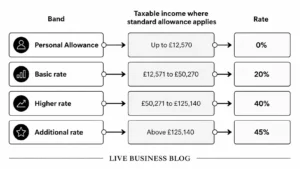
Different parts of taxable income are charged according to the relevant tax bands. For people outside Scotland in 2026/27, the standard main rates shown by GOV.UK are:
| Band | Taxable income where standard allowance applies | Rate |
|---|---|---|
| Personal Allowance | Up to £12,570 | 0% |
| Basic rate | £12,571 to £50,270 | 20% |
| Higher rate | £50,271 to £125,140 | 40% |
| Additional rate | Above £125,140 | 45% |
These figures describe the standard main Income Tax bands. Scottish Income Tax rates are different for wages, pensions and most other taxable income.
Savings and dividend income also have separate rules and allowances.
What Are the Scottish Income Tax Rates in 2026/27?
The Personal Allowance taper itself is a UK-wide rule, but Scotland has different Income Tax rates and bands for wages, pensions and most other non-savings, non-dividend income.
For 2026/27, a Scottish taxpayer receiving the standard £12,570 Personal Allowance is subject to the following published bands:
| Income range | Scottish rate |
| Up to £12,570 | 0% Personal Allowance |
| £12,571 to £16,537 | 19% Starter rate |
| £16,538 to £29,526 | 20% Basic rate |
| £29,527 to £43,662 | 21% Intermediate rate |
| £43,663 to £75,000 | 42% Higher rate |
| £75,001 to £125,140 | 45% Advanced rate |
| Over £125,140 | 48% Top rate |
Scottish Income Tax applies to wages, pensions and most other taxable income. Savings interest and dividends continue to use UK-wide rates rather than the Scottish earned-income bands.
This distinction matters particularly for people affected by the Personal Allowance taper because the marginal tax effect can differ from that experienced by taxpayers elsewhere in the UK.
Does the Personal Allowance Taper Apply to Pensioners?
Yes. The reduction is based on adjusted net income and applies regardless of age. HMRC’s published rates explicitly state that the reduction for income above £100,000 applies irrespective of date of birth.
Most pensions, including the State Pension, company pensions and personal pensions, form part of taxable income when adjusted net income is calculated.
A pensioner’s Personal Allowance could therefore be reduced where their combined taxable income is sufficiently high.
Does the Rule Apply to Self-Employed People?
Yes.
For a self-employed person, taxable profits can form part of adjusted net income.
Other taxable income, such as employment earnings, property income, dividends, savings interest or pensions, may also need to be included.
The relevant figure is therefore not necessarily the business’s turnover.
A sole trader could have £150,000 of sales but substantially lower taxable profits after allowable business expenses.
The Personal Allowance calculation would depend on the individual’s taxable income and subsequent adjusted net income calculation, not simply gross sales.
Can a Bonus Cause Someone to Lose Part of the Personal Allowance?

It can.
A taxable employment bonus normally contributes to taxable employment income. If the bonus pushes adjusted net income above £100,000, some or all of the Personal Allowance may consequently be withdrawn.
The same issue can arise with:
- commission;
- taxable benefits in kind;
- investment income;
- rental income;
- pension income;
- dividends; or
- other taxable income.
This is why the £100,000 test should not be viewed simply as a basic salary threshold.
What Happens to a Tax Code When the Personal Allowance Is Reduced?
Employees and pension recipients paying tax through PAYE may see their tax code reflect HMRC’s estimate of the Personal Allowance available to them.
GOV.UK allows taxpayers to check their current Personal Allowance, tax code, tax already paid and the amount they are expected to pay for the rest of the tax year.
Unexpected tax code changes can have several causes, so a reduced code should not automatically be assumed to result from the £100,000 taper.
HMRC’s records should be checked where an income estimate appears incorrect, particularly where income changes substantially during the year.
Does Everyone Have a £12,570 Personal Allowance?
No.
Although £12,570 is the standard Personal Allowance for 2026/27, an individual’s actual allowance can differ because of factors such as:
- adjusted net income above £100,000;
- certain tax-code adjustments;
- Marriage Allowance transfers where applicable;
- Blind Person’s Allowance, which is a separate additional allowance; and
- individual tax circumstances.
The £12,570 figure should therefore be treated as the standard starting point rather than an amount guaranteed to every taxpayer.
Personal Allowance vs Personal Savings Allowance
The Personal Allowance and Personal Savings Allowance are separate parts of the Income Tax system.
The standard Personal Allowance is £12,570 in 2026/27 and can be reduced once adjusted net income exceeds £100,000.
The Personal Savings Allowance applies specifically to savings interest. Under the current rules:
| Income Tax position | Personal Savings Allowance |
| Basic-rate taxpayer | £1,000 |
| Higher-rate taxpayer | £500 |
| Additional-rate taxpayer | £0 |
A separate starting rate for savings of up to £5,000 may also be available to some people with relatively low amounts of other income. The amount available falls as other income increases.
Dividend income has a separate £500 Dividend Allowance in 2026/27. Importantly, dividend tax rates changed from 6 April 2026. The 2026/27 rates above the Dividend Allowance are:
- 10.75% at the dividend ordinary rate;
- 35.75% at the dividend upper rate; and
- 39.35% at the dividend additional rate.
The ordinary and upper dividend rates increased from 8.75% and 33.75% respectively from the start of the 2026/27 tax year.
Losing the standard Personal Allowance therefore does not automatically mean every other allowance disappears. The Personal Savings Allowance, Dividend Allowance and other tax reliefs have their own eligibility and calculation rules.
How to Work Out Whether the Personal Allowance Is Being Lost
A simplified approach is:
- Calculate taxable income from relevant sources.
- Apply relevant deductions used when establishing net income.
- Adjust for qualifying Gift Aid and pension contributions in accordance with HMRC’s rules.
- Establish the resulting adjusted net income.
- If it is £100,000 or less, there is normally no income-related reduction to the standard Personal Allowance.
- If it exceeds £100,000, calculate the excess.
- Divide that excess by two.
- Deduct the result from £12,570.
- Once adjusted net income reaches £125,140, the standard Personal Allowance has been fully withdrawn.
HMRC’s official Income Tax rates and allowances page should be checked before relying on the thresholds, particularly when reviewing a different tax year.
Key Personal Allowance Figures for 2026/27
| Rule | Current position |
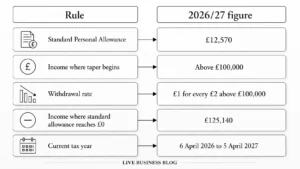
| Standard Personal Allowance | £12,570 |
| Tax year | 6 April 2026 to 5 April 2027 |
| Adjusted net income where taper begins | Above £100,000 |
| Withdrawal rate | £1 for every £2 above £100,000 |
| Adjusted net income where standard allowance reaches £0 | £125,140 |
| Personal Allowance legislated for 2027/28 | £12,570 |
| Personal Allowance legislated for 2028/29 | £12,570 |
| Personal Allowance legislated for 2029/30 | £12,570 |
| Personal Allowance legislated for 2030/31 | £12,570 |
| Current end of Personal Allowance freeze | 5 April 2031 |
The £12,570 Personal Allowance, £100,000 income limit and £1-for-every-£2 taper remain the key figures for 2026/27. Finance Act 2026 has also extended the £12,570 freeze through the 2030/31 tax year.
Future Budgets or legislation could amend these figures, so the rules applying to the relevant tax year should always be checked.
Final Summary
For the 2026/27 UK tax year, the standard Personal Allowance remains £12,570.
The key threshold is £100,000 of adjusted net income. Once adjusted net income exceeds this amount, the Personal Allowance is withdrawn at £1 for every £2 above £100,000.
At adjusted net income of £125,140, the standard Personal Allowance has been completely withdrawn. These core rules remain confirmed by current GOV.UK guidance.
The major longer-term update is that Finance Act 2026 has extended the £12,570 Personal Allowance freeze through 2030/31, meaning it is currently set to remain at this level until 5 April 2031.
Taxpayers should also distinguish between salary and adjusted net income. Taxable pension income, savings, dividends, property income and other income can contribute to adjusted net income, while qualifying pension contributions and Gift Aid can reduce the figure used for the Personal Allowance test.
Scottish taxpayers should additionally take account of Scotland’s separate Income Tax bands for non-savings, non-dividend income, while savings and dividend taxation continues to operate under UK-wide rates.
Frequently Asked Questions
When do you start losing your Personal Allowance?
The standard Personal Allowance starts reducing once adjusted net income exceeds £100,000. It falls by £1 for every £2 above that threshold.
At what salary is the Personal Allowance completely lost?
There is no single salary figure because the calculation uses adjusted net income rather than salary alone. The standard allowance reaches £0 at adjusted net income of £125,140 in 2026/27.
How much Personal Allowance is left at £110,000?
Assuming £110,000 is the person’s adjusted net income, the allowance falls by £5,000, leaving a standard Personal Allowance of £7,570.
How much Personal Allowance is left at £120,000?
At £120,000 of adjusted net income, the £20,000 excess over the threshold reduces the allowance by £10,000. The remaining standard Personal Allowance is therefore £2,570.
Can pension contributions stop someone losing the Personal Allowance?
Certain qualifying pension contributions can reduce adjusted net income and can therefore affect the amount of Personal Allowance available.
Pension decisions should take account of the wider pension and tax rules rather than the Personal Allowance taper alone.
Does rental income count towards the £100,000 threshold?
Taxable rental income can form part of adjusted net income. The precise amount included depends on the applicable property-income and tax rules.
Do dividends count towards the Personal Allowance taper?
Dividend income can be included when adjusted net income is calculated. This means dividends may contribute to a person’s income exceeding the £100,000 threshold.
Do pensioners lose their Personal Allowance over £100,000?
They can. The taper applies regardless of age, and most pension income forms part of taxable income for adjusted net income purposes.

Leave a Reply