
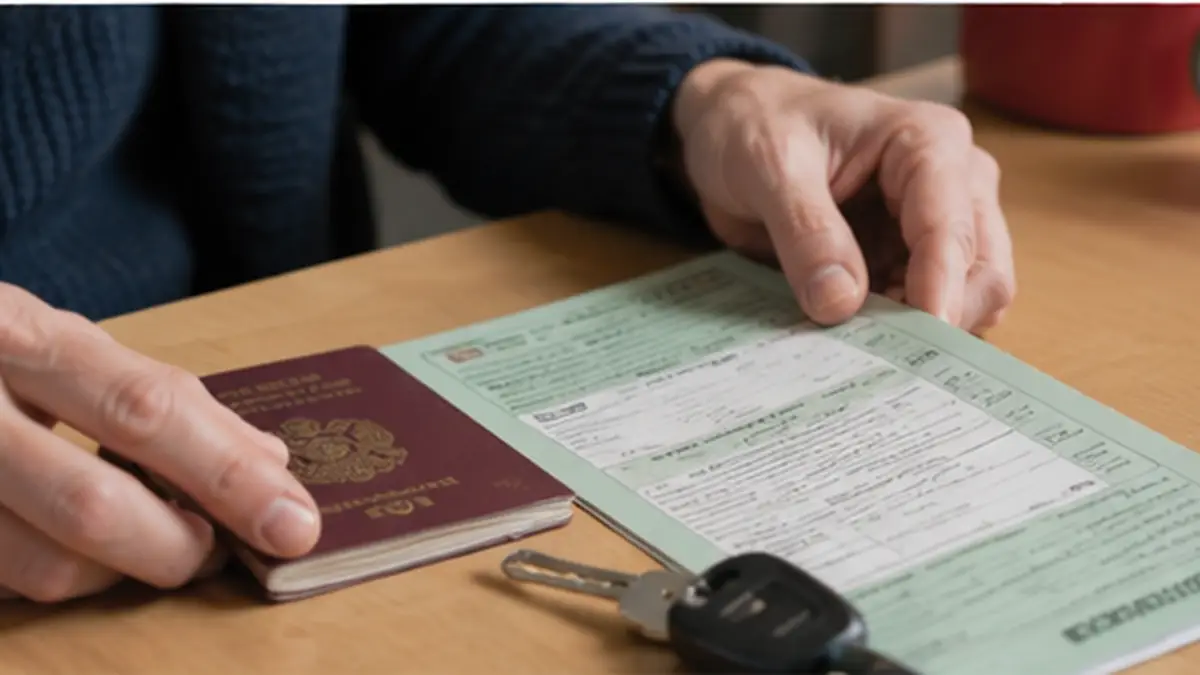
To tax your car at the Post Office, you normally need an accepted vehicle document, a valid MOT where required and either payment or your bank details for a Direct Debit.
The document could be your V11 tax reminder, V5C logbook, green V5C/2 new-keeper slip or a completed V62 application, depending on your circumstances.
If the vehicle is registered in Northern Ireland, you must also take the required paper insurance and MOT evidence. You should visit a participating branch because not every Post Office provides vehicle-tax services.
Which DVLA Document Should You Take for Your Situation?
The correct document depends on whether you are the current keeper or have just bought the vehicle.
Use your V11 vehicle-tax reminder when renewing tax for a vehicle already registered to you. A recent last-chance warning letter may also contain the reference needed to complete the application.
Your V5C registration certificate, commonly called the logbook, can be used when you are the current keeper. It must be in your name. The online reference from a V5C normally contains 11 digits.
Use the V5C/2 green new-keeper slip if you have recently bought the car and the full logbook has not yet arrived. Its new-keeper reference normally contains 12 digits.
A V62 application is generally used when the current keeper needs a replacement V5C. You may be able to apply for the replacement and tax the vehicle during the same transaction.
The V5C identifies the registered keeper, but it is not proof of legal ownership. Check that its registration number, keeper name and address are correct before attending the branch.
Can You Tax Your Car Without a V11 Reminder or V5C?
You can often tax a vehicle without the V11, but the available route depends on whether you are already recorded as its keeper. A current keeper and a new keeper without documents are treated differently.
If You Have Lost the V11 Reminder
You can normally use the V5C in your name instead of the reminder. The document must relate to the correct vehicle and contain the current keeper’s details.
A missing V11 does not automatically require a replacement V5C. You only need the replacement-logbook process if the V5C is also missing, damaged or unavailable.
Can the Current Keeper Use Form V62?
A current keeper without a V5C can usually complete a V62 application and tax the vehicle at a participating branch. A replacement V5C costs £25.
The official missing-document guidance confirms that a current keeper may apply for a replacement and tax the vehicle at the same time.
An online replacement service may also allow an existing keeper to tax immediately rather than waiting for the new document to arrive.
What If You Are a New Keeper Without the V5C/2?
A new keeper cannot tax the vehicle without the green new-keeper slip. You must apply for a new V5C by post if the seller did not give you that document.
Contact the seller first, because the V5C/2 should normally be supplied when the vehicle changes hands. Do not drive the vehicle on a public road until it has been taxed, insured and made legally roadworthy.
Do You Need a Valid MOT to Tax Your Car at the Post Office?
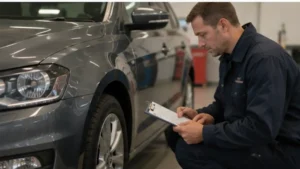
A vehicle that is subject to MOT testing must normally have an MOT that is valid when the new tax starts. It does not need to remain valid for the whole six-month or 12-month tax period.
You may be asked to show an MOT certificate or a screenshot of the vehicle’s online MOT history. This is particularly useful when the electronic record cannot be confirmed immediately at the counter.
MOT information can take up to two days to update after a test. If your car has just passed, you may be unable to tax it until the result appears in the official record.
Northern Ireland follows additional documentary rules. You normally need an original MOT certificate or evidence of a Temporary Exemption Certificate.
A screenshot of the MOT history can be used as TEC evidence; where that is unavailable, an expired MOT certificate may be accepted for that purpose.
Vehicles that are legally MOT-exempt may require the appropriate exemption declaration or supporting form.
Do You Need Proof of Insurance to Tax Your Car at the Post Office?
You do not routinely have to present a paper insurance certificate when taxing a vehicle at a Post Office in England, Scotland or Wales. Insurance must still be in place before you drive the vehicle.
The rules are different for vehicles registered in Northern Ireland. You must take a paper copy of a current insurance certificate or cover note, together with the required MOT evidence.
The insurance should be valid from the date the vehicle tax starts or the date the tax is issued, whichever is later. An electronic policy displayed on a phone may not satisfy a requirement that specifically asks for a paper copy.
Do not confuse the documents needed for the counter transaction with your wider legal responsibilities. Taxing a vehicle does not confirm that it is insured, roadworthy or otherwise legal to drive.
How Can You Pay for Car Tax at the Post Office?
You can pay using several methods, although the amount depends on the vehicle’s registration date, emissions, fuel type, list price and tax class.
Accepted Payment Methods
Participating branches generally accept cash, cheque, postal order, debit or credit card and Direct Debit. Vehicle tax can normally be purchased for six or 12 months, while monthly payments are available through Direct Debit.
For cars registered on or after 1 April 2017, the first-year rate is based mainly on CO2 emissions. The following figures reproduce the current bands found in the current vehicle tax rates.
First-year rates for qualifying cars
| CO2 Emissions | Petrol, RDE2 Diesel, Alternative Fuel And Zero Emission | Other Diesel |
|---|---|---|
| 0g/km | £10 | £10 |
| 1–50g/km | £115 | £135 |
| 51–75g/km | £135 | £280 |
| 76–90g/km | £280 | £365 |
| 91–100g/km | £365 | £405 |
| 101–110g/km | £405 | £455 |
| 111–130g/km | £455 | £560 |
| 131–150g/km | £560 | £1,410 |
| 151–170g/km | £1,410 | £2,270 |
| 171–190g/km | £2,270 | £3,420 |
| 191–225g/km | £3,420 | £4,850 |
| 226–255g/km | £4,850 | £5,690 |
| Over 255g/km | £5,690 | £5,690 |
From the second tax payment, the standard annual rate is £200. Twelve monthly Direct Debit payments total £210; a six-month single payment is £110, while six months by Direct Debit costs £105.
Cars above the applicable list-price threshold pay an additional £440 a year for five years from the second taxation. The thresholds are more than £40,000 for petrol or diesel vehicles and more than £50,000 for electric vehicles.
Combined payments can therefore reach £640 annually, £672 through monthly Direct Debit, £352 for six months or £336 for six months by Direct Debit.
What Details Are Needed for Direct Debit?
Take your address, date of birth and bank or building society account details. The account must support Direct Debit payments, and you must be authorised to use it.
You cannot set up a vehicle-tax Direct Debit through the 24-hour telephone service. That service is available on 0300 123 4321 but accepts other supported payment arrangements.
How Do the Requirements Change for a Newly Bought, SORN or Exempt Vehicle?
Different vehicle circumstances affect both the documents you need and whether a payment is due.
Special situations
- A newly bought car normally requires the V5C/2 green slip.
- A SORN vehicle needs an accepted tax document and a valid MOT before returning to normal road use.
- A £0-rated vehicle must still be formally taxed.
- A disabled tax-class application may require eligibility evidence.
- A historic vehicle may need an MOT-exemption declaration.
- A goods vehicle may require a GVT, V85 or annual test certificate.
Vehicle tax does not transfer when you buy a used car. You must arrange new tax in your own name before driving it, even if the previous keeper’s tax period had not ended.
If a vehicle remains SORN, it must be kept off public roads. It may generally be driven only for a pre-booked MOT test where the relevant legal conditions are met.
Official guidance states:
“You must tax your vehicle even if you do not have to pay anything because it’s exempt from vehicle tax.”
Changing a car’s tax class to or from “disabled” may only be completed at a participating Post Office in certain circumstances. Supporting evidence and a current MOT or exemption declaration may also be required.
Why Might the Post Office Be Unable to Tax Your Car?
Most failed applications result from an unsuitable document, an expired MOT or a mismatch in the keeper’s records.
Common reasons for a delay
- The branch does not provide vehicle-tax services.
- The V5C is not in your name.
- You are a new keeper without the V5C/2 slip.
- The document reference has already been replaced or is invalid.
- The MOT has expired or has not updated.
- Northern Ireland paper evidence is missing.
- The vehicle or keeper details do not match the records.
- Required exemption or tax-class evidence is unavailable.
- A V62 is being used by someone who is not eligible for that route.
A recently issued V5C can make an older reference number unusable, so use the latest document. If a branch cannot complete the transaction, identify the exact missing item before making another attempt.
What Should You Do Before and After Visiting the Post Office?
A short preparation check can prevent a wasted journey and reduce the risk of leaving the vehicle untaxed.
Before You Travel
First, confirm whether you are the current keeper, a new keeper or applying for a special tax class. Select the appropriate V11, V5C, V5C/2 or V62 and check that all names, references and registration details are correct.
Verify that the MOT remains valid on the date the new tax starts. Gather payment details, exemption evidence and any Northern Ireland documents, then find a branch that specifically lists vehicle tax among its services.
What Happens at the Counter?
The staff member will use your document reference to identify the vehicle and process the tax period and payment method.
Check the registration number, tax duration and payment arrangement before the transaction is finalised.
Keep the receipt because no paper tax disc is issued. Tax discs were phased out in October 2014.
Checking the Tax Status Afterwards
Use the official vehicle status checker to confirm that the tax has been recorded. The online result may not change instantly, so retain the receipt while the system updates.
Tax is only one requirement for driving. The vehicle must also be insured, have an MOT where required and remain roadworthy.
Conclusion
What you need to tax your car at the Post Office depends mainly on your keeper status. Most applicants need a V11, V5C, V5C/2 or eligible V62, together with a valid MOT and an accepted payment method.
Northern Ireland applicants must also take the required paper insurance and MOT evidence.
Before travelling, confirm that the branch provides vehicle-tax services, check that your documents match the vehicle records and keep the transaction receipt until the online tax status updates.
Frequently Asked Questions
Do I Need Photo ID to Tax My Car?
Photo identification is not normally included in the standard document checklist. You will, however, need personal information such as your address and date of birth when arranging a Direct Debit.
Can Someone Else Tax My Car for Me?
Another person may be able to present the correct documents and payment at the branch. They should have everything required for the transaction and must not provide inaccurate keeper or bank details.
Can I Tax My Car Before the Existing Tax Expires?
You can normally renew from the fifth day of the month in which the current tax expires. A different advance application process may apply if you will be abroad when the tax becomes due.
Does Car Tax Transfer When I Buy a Used Car?
No, vehicle tax does not transfer to the buyer. You must tax the car using the green new-keeper slip before driving it.
Will I Receive a Paper Tax Disc?
No, paper tax discs have not been issued since October 2014. Keep your receipt and check the vehicle’s digital tax status instead.
How Long Does Post Office Car Tax Take to Show Online?
The status may not update immediately after the counter transaction. Retain your receipt and check again after the relevant systems have processed the payment.
Can I Drive Immediately After Taxing the Car?
You may drive once the tax is active and every other legal requirement has been met. You still need valid insurance, a valid MOT where required and a roadworthy vehicle.
Note: Vehicle-tax rates, document fees and branch services can change. Check the current requirements for your vehicle and jurisdiction before visiting a participating branch.

Leave a Reply