
Last Updated on AUG 18, 2026
UK smart meter rules have been strengthened in 2026, with energy suppliers required to take all reasonable steps to restore smart meters that have stopped operating in smart mode as soon as possible and within 90 days of becoming aware of the problem.
Consumer protections have also expanded. Since 23 February 2026, new Ofgem Guaranteed Standards of Performance have provided £40 automatic compensation for certain smart meter installation and service failures.
The government has also confirmed requirements for suppliers to replace smart metering equipment affected by the 2G and 3G network shutdown and to work towards completing the domestic smart meter rollout by the end of 2030.
Key Takeaways:
- Suppliers must take all reasonable steps to restore meters that lose smart functionality as soon as possible and within 90 days
- The 90-day period can start when the supplier becomes aware of the problem, not only when a customer reports it
- Three new £40 smart meter compensation standards have applied since 23 February 2026
- Smart metering equipment affected by the 2G and 3G shutdown must be replaced before those services end by 2033
- Suppliers must take all reasonable steps to complete the domestic smart meter rollout by the end of 2030
What Are the New UK Smart Meter Rules Introduced by the Government?
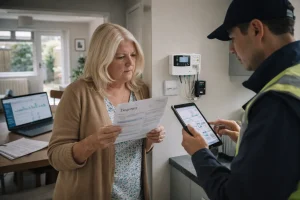
The UK government has introduced stronger regulations to ensure that smart meters installed in homes and small businesses work reliably and continue to provide accurate energy readings.
The government published its final post-2025 smart metering policy framework on 10 March 2026, confirming stronger obligations covering faulty smart meters, the remaining smart meter rollout and the replacement of equipment affected by older communications networks.
These updated UK smart meter rules are designed to improve the overall performance of the national smart metering system and ensure that consumers receive the benefits promised when the technology was introduced.
Smart meters are an essential part of the UK’s modern energy infrastructure. They allow automatic transmission of meter readings to energy suppliers, helping eliminate estimated bills and giving households better control over their energy consumption.
However, when smart meters stop working properly or lose their smart functionality, consumers may experience inaccurate billing, delayed repairs, and reduced visibility of their energy usage.
To address these issues, the government introduced new standards requiring energy suppliers to take clear and timely action when faults are reported.
These standards aim to ensure suppliers provide faster repairs, maintain higher service levels, and remain accountable for the performance of installed smart meters.
Why the Government Introduced Tougher Smart Meter Regulations?
The decision to introduce stricter rules was largely driven by consumer complaints and operational challenges experienced during the national smart meter rollout.
While the majority of smart meters function correctly, a noticeable percentage of devices have experienced communication failures or technical faults.
In many cases, smart meters stopped operating in smart mode, which meant they were still recording energy consumption but were no longer transmitting readings automatically to energy suppliers. This often led to estimated billing and confusion for households.
The government recognised that without a clear repair timeframe, some consumers were waiting several months before their smart meters were fixed.
The introduction of the updated UK smart meter rules is intended to ensure that these problems are addressed within a defined and reasonable period.
The policy also reflects broader goals within the UK energy market. Regulators aim to create a system where technology improves transparency, supports energy efficiency, and strengthens trust between consumers and energy providers.
The Role of Ofgem in Smart Meter Compliance
Ofgem plays a central role in monitoring compliance with the UK smart meter rules. As the UK’s independent energy regulator, Ofgem is responsible for ensuring that energy suppliers meet their obligations and provide reliable services to consumers.
Under the updated framework, Ofgem can intervene if suppliers fail to meet the standards required for smart meter maintenance and repair. Enforcement measures are intended to maintain industry accountability and ensure that suppliers prioritise consumer service.
Key responsibilities overseen by Ofgem include:
- Monitoring whether energy suppliers comply with their smart metering obligations
- Setting and enforcing Guaranteed Standards of Performance for supplier services
- Taking compliance or enforcement action where suppliers breach regulatory requirements
- Monitoring supplier performance and the delivery of the wider smart meter framework
Ofgem does not normally investigate individual household smart meter complaints. Consumers should first raise the problem with their energy supplier and can seek further support through Citizens Advice or escalate an unresolved complaint to the Energy Ombudsman where appropriate.
| Regulatory Authority | Key Responsibility | Impact on Consumers |
|---|---|---|
| Ofgem | Enforcing smart meter compliance | Ensures suppliers meet repair deadlines |
| Department for Energy Security and Net Zero | Policy development | Establishes national smart metering strategy |
| Energy Suppliers | Meter installation and maintenance | Provide repair services and customer support |
These regulatory structures work together to ensure that the UK smart metering programme operates effectively and continues to deliver benefits to households.
Why Are Faulty Smart Meters a Concern for UK Households?
Faulty smart meters can create several practical challenges for households. When these devices stop working correctly, the benefits of automatic readings and real time energy monitoring are lost. This can lead to confusion about energy consumption and unexpected billing issues.
Smart meters are designed to send energy usage data directly to suppliers through a secure communication network.
When the meter operates normally, households receive accurate bills based on real consumption. However, when the smart functionality fails, the system often reverts to estimated billing.
This situation can cause frustration for households that rely on smart meters to manage their energy use and monitor costs.
Some of the most common smart meter issues experienced by UK consumers include:
- Smart meters are losing connection with the communication network
- Devices are stopping automatic meter readings
- Display units not showing accurate usage data
- Communication failures between the meter and supplier systems
These problems can disrupt the entire purpose of smart metering technology. Consumers expect the technology to simplify energy management, but technical failures can reduce confidence in the system.
| Common Smart Meter Problem | Description | Impact on Households |
|---|---|---|
| Loss of smart mode | Meter records usage but does not send readings | Leads to estimated bills |
| Communication failure | Meter cannot connect to supplier systems | Data transmission stops |
| Display malfunction | In home display shows incorrect information | Consumers cannot track usage accurately |
| Delayed repairs | Suppliers take too long to fix the issue | Extended billing uncertainty |
One energy sector professional explained the concern surrounding faulty meters in practical terms.
“When a smart meter stops communicating with the supplier, the customer immediately loses one of the biggest benefits of the system. From my experience working with metering services, the longer these faults remain unresolved, the more frustration builds among customers who expected accurate and automated billing.”
The updated UK smart meter rules are therefore intended to reduce these disruptions by ensuring faults are resolved quickly.
What Is the 90 Day Rule for Fixing Faulty Smart Meters in the UK?
One of the most important changes to the smart metering framework is the new 90-day recovery requirement.
Energy suppliers must take all reasonable steps to return smart meters that are operating in traditional mode to smart mode as soon as possible and no later than 90 days after the supplier first becomes aware of the issue.
Importantly, the 90-day period does not depend solely on a customer reporting the problem.
A supplier may become aware through failed remote readings, information available through the Data Communications Company, a change of supplier, problems identified during installation or its own monitoring of smart meter performance.
The requirement is therefore better described as a 90-day smart-mode recovery obligation rather than a simple guarantee that every type of physical smart meter fault will be repaired within exactly 90 days.
The 90-day rule applies to several types of smart meter issues, including meters that:
- Stop operating in smart mode
- Fail to send automatic readings
- Experience communication network problems
- Display inaccurate or incomplete usage data
Once the supplier becomes aware that a smart meter is not operating in smart mode, it must take all reasonable steps to investigate the cause and restore smart functionality as soon as possible and within the 90-day timeframe.
How does the New Repair Deadline Work?
The repair process typically follows a structured service procedure that ensures faults are properly diagnosed and resolved.
| Step | Action Taken | Responsible Party |
|---|---|---|
| 1 | Consumer reports the issue to the supplier | Household |
| 2 | Supplier investigates the reported fault | Energy supplier |
| 3 | Technical team diagnoses the problem | Smart meter technicians |
| 4 | Repair or replacement is scheduled | Supplier service team |
| 5 | Issue resolved within the regulatory timeframe | Supplier |
This structured approach ensures that each stage of the repair process is clearly defined.
A professional involved in smart meter servicing described the importance of having a fixed repair timeline.
“In practical terms, the 90 day repair window helps everyone involved. It gives technicians a clear service target while also reassuring customers that the problem will not remain unresolved for months.”
What Happens If Energy Suppliers Fail to Fix Smart Meters?

If suppliers fail to meet the repair deadline, they may face enforcement action from the regulator. Ofgem has the authority to investigate cases where suppliers repeatedly fail to meet their obligations.
Possible enforcement actions include regulatory warnings, formal compliance notices, or financial penalties.
These consequences encourage suppliers to improve internal repair systems and ensure that smart meter faults are addressed promptly.
How Will the New UK Smart Meter Rules Affect Smart Meter Repair Services?
The introduction of stricter UK smart meter rules is expected to significantly influence the way repair services operate across the energy sector. Energy suppliers must now ensure that their technical infrastructure and support teams are capable of responding quickly to reported faults.
This requirement may lead to operational changes within the industry:
Energy suppliers may need to
- Increase the number of qualified smart meter technicians
- Improve diagnostic systems for identifying faults
- Streamline repair appointment scheduling
- Invest in improved customer support processes
These improvements will help ensure that suppliers remain compliant with regulatory requirements while providing better service to customers.
The changes may also create increased demand for specialised repair providers who support energy companies with technical services.
| Industry Impact | Description | Expected Outcome |
|---|---|---|
| Increased technician demand | More engineers required for repairs | Faster service response |
| Improved maintenance systems | Better monitoring of meter performance | Early fault detection |
| Higher service standards | Stronger regulatory oversight | Improved customer satisfaction |
| Technology upgrades | Replacement of outdated meters | Reliable communication networks |
From the author’s perspective, these regulatory changes represent an important shift in the way smart metering services are managed.
“When I look at how the industry has evolved, it becomes clear that clear regulations often push service providers to improve their operational standards. In my opinion, the repair deadline encourages suppliers to treat smart meter faults as urgent technical issues rather than minor service requests.”
The impact of these rules will likely become more visible as suppliers continue to upgrade their repair processes and support systems.
What Compensation Can Consumers Get for Smart Meter Issues?
In addition to repair requirements, the updated regulatory framework also introduces compensation measures designed to protect consumers during the smart meter installation process.
These standards are intended to ensure that suppliers maintain professional service levels when installing new smart meters.
| 2026 Smart Meter Standard | When £40 Compensation Can Apply |
|---|---|
| Installation appointment availability | Supplier fails to offer a first-time/new smart meter installation appointment taking place within six weeks of the request |
| Failed smart meter installation | Installation fails because of a fault within the energy supplier’s control |
| Investigation of an operational problem | Supplier fails within five working days to carry out an initial assessment, take appropriate action and offer the customer an update |
These three smart meter Guaranteed Standards of Performance took effect on 23 February 2026, with a £40 automatic compensation payment applying when a supplier fails to meet the relevant standard.
£40 Compensation for Installation Problems
When installation issues occur, consumers may be entitled to a £40 payment under the guaranteed standards of performance framework.
This payment is designed to compensate households for the inconvenience caused by missed or delayed appointments.
When Consumers Are Eligible for Compensation?
Eligibility generally depends on whether the supplier failed to meet the required service standards. If the supplier cancels or misses an appointment without proper notice, the compensation rule may apply.
These measures strengthen consumer protection and ensure that households are treated fairly during the smart meter installation process.
What Responsibilities Do Energy Suppliers Have Under Smart Meter Regulations?
Energy suppliers carry significant responsibilities under the UK smart meter rules. These obligations are intended to ensure that smart metering technology operates effectively and continues to provide accurate data to both consumers and suppliers.
Suppliers must manage the entire lifecycle of smart meters, from installation to maintenance and eventual replacement when technology becomes outdated.
Their responsibilities typically include:
- Installing smart meters safely in homes and small businesses
- Ensuring meters remain functional and connected to communication networks
- Repairing or replacing faulty devices within the regulatory timeframe
- Providing clear information to consumers about smart meter services
- Maintaining secure data communication systems
Larger energy suppliers are also required to provide Ofgem with annual smart metering deployment plans explaining how they intend to meet their installation, operational and replacement obligations.
The deadline for the first deployment plans was originally set for 30 June 2026 but was subsequently moved by Ofgem to 15 July 2026.
From January 2027, annual milestones covering new smart meter installations and pre-emptive replacements will become binding and will operate without tolerances, strengthening supplier accountability for meeting their rollout commitments.
A further 2026 change is the new long-term rollout obligation. Suppliers must take all reasonable steps to complete the domestic smart meter rollout across remaining premises by 31 December 2030.
Ofgem has also introduced deployment-plan requirements for suppliers, with the first plans required during 2026 and binding annual installation and pre-emptive replacement milestones applying from 2027.
Why Must Smart Meters Move from 2G and 3G to 4G Networks?
Many smart meters installed during the early stages of the UK smart meter rollout rely on 2G and 3G mobile communication networks to send energy usage data to suppliers. However, these networks are gradually being phased out as telecommunications infrastructure moves toward newer technologies.
The government’s 2026 smart metering framework requires suppliers to take all reasonable steps to pre-emptively replace smart metering equipment that would otherwise lose communication when older Wide Area Network services end.
This includes equipment affected by the planned switch-off of 2G and 3G mobile services by the end of 2033.
The transition is not simply a change from one mobile network on the household’s existing meter to another.
The smart metering communications infrastructure is being upgraded to support 4G communications, with affected communications hubs and other relevant smart metering assets needing replacement where required.
| Network Type | Current Status | Impact on Smart Meters |
|---|---|---|
| 2G | Gradual phase out planned | Older meters must be upgraded |
| 3G | Being retired across many networks | Replacement required |
| 4G | Modern communication standard | Supports current smart meter systems |
| Future networks | Ongoing development | May support advanced metering technology |
Suppliers must ensure that affected smart meters are upgraded or replaced before 2033 so that households continue receiving accurate readings.
If outdated communication systems are not replaced, meters may lose connectivity and stop sending data to suppliers. This would result in the same issues that occur when smart meters stop operating in smart mode.
Upgrading communication technology, therefore, ensures that the national smart metering system remains reliable and capable of supporting future energy infrastructure developments.
Conclusion: How the New UK Smart Meter Rules Are Transforming Repair Services?
The updated UK smart meter rules represent a significant step toward improving service standards within the energy sector.
By introducing a 90-day repair deadline, stronger enforcement measures, and compensation protections, the government aims to ensure households benefit fully from smart meter technology.
These changes also place greater responsibility on energy suppliers to maintain and repair smart meters promptly. As a result, smart meter repair services across the UK are likely to become more efficient and better structured.
With millions of homes already using smart meters and more installations expected in the future, these regulations play an important role in ensuring the technology continues to deliver accurate billing, better energy management, and long-term savings for UK households.
Frequently Asked Questions
How long does it take to repair a smart meter in the UK?
Under the new regulations, energy suppliers must take all reasonable steps to repair a faulty smart meter within 90 days of being notified about the issue.
Are energy suppliers responsible for fixing faulty smart meters?
Yes. Energy suppliers are responsible for maintaining and repairing smart meters installed in customers’ homes, including resolving faults that prevent the device from operating in smart mode.
Can households refuse a smart meter in the UK?
Yes, smart meters are not mandatory in the UK. Consumers have the right to refuse installation if they prefer to continue using a traditional meter.
What happens if a smart meter stops sending readings?
If a smart meter stops sending automatic readings, it may no longer be operating in smart mode. In this case, the consumer should contact their energy supplier to arrange a repair or investigation.
How do smart meters help reduce energy bills?
Smart meters provide real-time energy usage data, allowing households to monitor their consumption and make adjustments that can reduce energy waste and lower bills.
What compensation is available for smart meter installation issues?
Consumers may receive £40 compensation if they experience certain problems during the installation process, such as delayed appointments or failed installations.
Will older smart meters stop working after network upgrades?
Some older smart meters that rely on 2G or 3G networks may require upgrades or replacement before those networks are phased out, which is expected by 2033.

Leave a Reply