
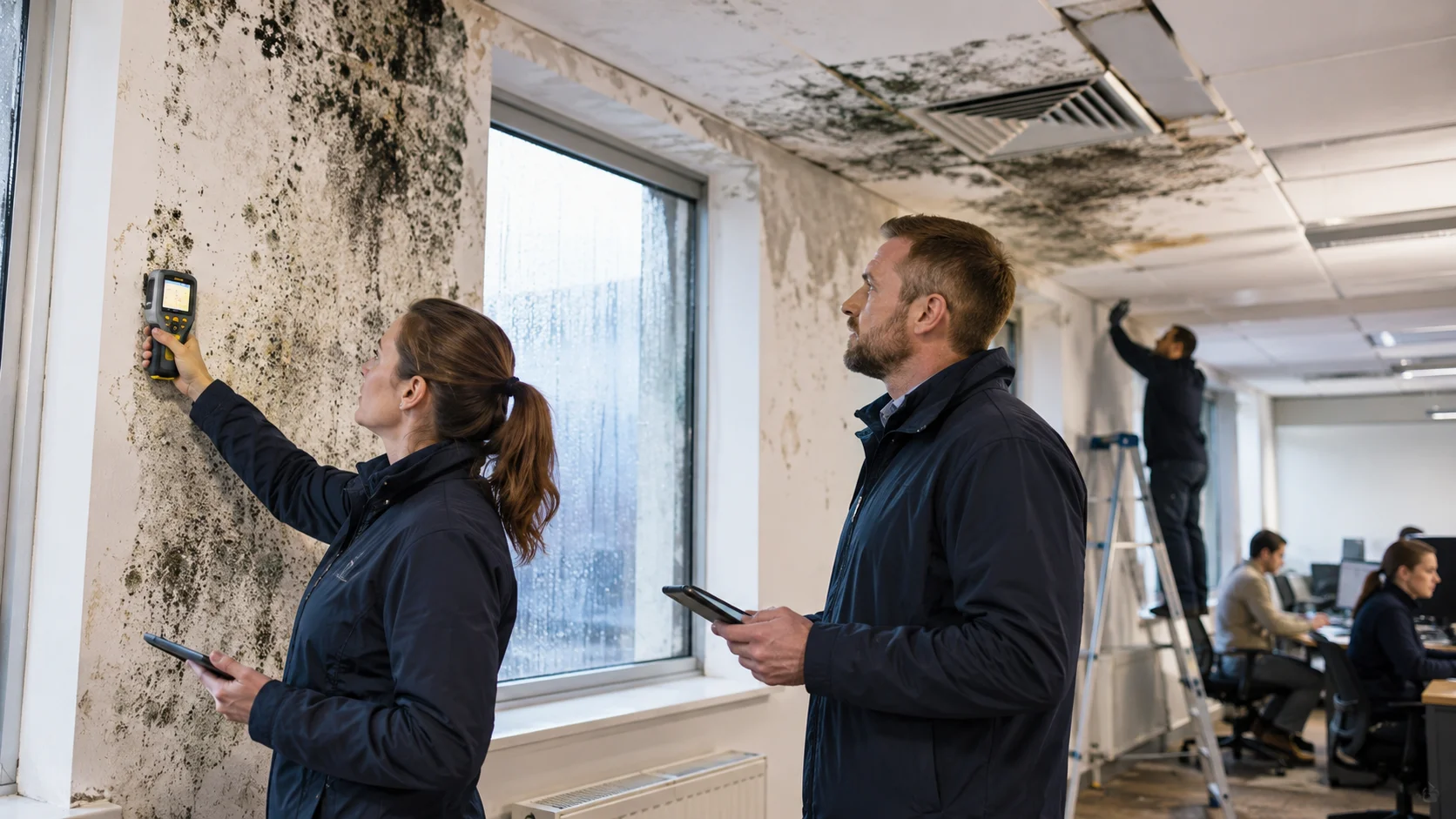
Mould doesn’t just look bad. In a commercial setting, it can trigger enforcement action, lease disputes, staff health complaints, and costly remediation bills.
With damp and mould getting more regulatory attention in recent years, employers and landlords alike are finding that ignoring the problem is no longer an option.
Whether you manage an office, warehouse, retail unit, or any other commercial space, the question of who’s responsible isn’t always straightforward.
Carry on reading to get a clear picture of where the liability sits and what you’ll be dealing with if mould takes hold.
What Does Mould Remediation Cost in Commercial Properties?
What the Law Says About Mould in Workplaces?
Employers have a duty of care under the Workplace (Health, Safety and Welfare) Regulations 1992 to maintain premises in a condition that doesn’t put workers at risk.
Mould produces spores that can cause or worsen respiratory conditions, allergies, and other health problems.
If you’re aware of a mould issue in your workplace and fail to act on it, you could face enforcement action from the Health and Safety Executive or your local authority’s environmental health team, depending on the type of premises.
This doesn’t mean every patch of surface mould becomes a legal crisis overnight, but persistent damp or significant mould growth in areas where employees work regularly is something a regulator will take seriously.
The duty isn’t just to fix it when it’s reported. It’s to carry out regular checks and deal with conditions that create the problem in the first place.
Landlord and Tenant Obligations in Commercial Leases

Unlike residential tenancies, commercial leases don’t come with a standard implied term that the property must be fit for purpose. What matters is what the lease actually says.
Most full repairing and insuring (FRI) leases place the repair and maintenance burden squarely on the tenant.
Depending on the lease wording, this can extend to all repairs across the property, not just those caused by the tenant’s own use or neglect.
That said, structural issues are usually the landlord’s responsibility. If mould is caused by a defective roof, failed damp-proof course, or faulty drainage, the landlord will typically be liable to repair the root cause.
Disputes often arise when both parties claim the other is at fault. In those cases, a surveyor’s report and the specific wording of the lease will usually determine who pays.
What Happens When an Inspector Flags It?
If an HSE inspector or environmental health officer visits and identifies mould as a health risk, they have the power to issue an improvement notice requiring the issue to be resolved within a set timeframe.
Failure to comply with an improvement notice can lead to prosecution. Where an inspector identifies a risk of serious personal injury, they can also issue a prohibition notice, which may require the affected area to be closed immediately until the risk is resolved.
The reputational impact can be just as damaging as the financial one. Staff who feel their health is being put at risk have grounds to raise formal grievances, and in some cases to refuse to work in the affected space.
Getting ahead of the problem is always less costly than responding to enforcement.
Professional Remediation: What’s Involved and What It Costs?

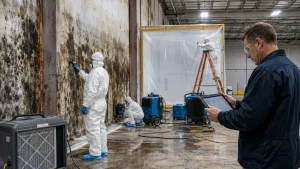
Surface cleaning products won’t cut it for serious mould infestations. A professional team will identify the source of moisture, treat the affected area with appropriate biocidal products, and often use HEPA filtration equipment to prevent spores from spreading to clean areas during the work.
Companies like ICE Cleaning carry out this kind of commercial mould remediation across the UK, including in properties where the spread has gone beyond what basic maintenance can address.
Costs vary significantly depending on the scale of the problem. A localised treatment in a single room might come in at a few hundred pounds.
Extensive mould covering large wall areas, ceilings, or hidden cavities behind plasterboard can run into thousands once moisture investigation, treatment, and reinstatement work are factored in.
It’s worth getting a survey done before committing to a quote, as the visible area is often not the full extent of the problem.
How to Reduce Your Exposure to Liability?
Documentation matters. If you’re a landlord, keep records of inspections, any issues raised by tenants, and the steps you took in response.
If you’re a tenant or employer, report damp and mould in writing as soon as it’s identified and keep a copy of the correspondence.
Beyond the paperwork, the practical steps that reduce liability are the same ones that prevent mould from developing:
- Maintain adequate ventilation in areas prone to moisture build-up
- Act on leaks and water ingress quickly, not when it’s convenient
- Commission regular building condition surveys, particularly in older stock
- Don’t ignore condensation problems on windows and walls, as these often indicate a wider issue
The Bottom Line
Mould in a commercial property is a legal, financial, and operational problem. The longer it’s left, the more expensive and complicated it becomes.
Knowing where responsibility sits under your lease and under health and safety law puts you in a much better position to deal with it decisively rather than spending time and money arguing about who should have acted first.
If you’re dealing with mould right now, get a professional assessment before deciding on a course of action. The full picture is rarely what it looks like on the surface.

Leave a Reply