

If you’ve been watching your energy bills creep up over the past few years, you’re not imagining it. The average UK household is now paying around 35% more for gas and electricity than it did before the energy crisis hit in late 2021.
And while the April 2026 price cap has brought a welcome dip to £1,641 a year, forecasters are already warning that bills will climb again by summer. So what does the rest of the decade actually look like for UK households?
Let’s take a closer look at the numbers, the policies, and the practical steps that could make a real difference to your monthly outgoings.
-
Why UK Energy Bills Are Rising Again and What It Means for Households?

Where Bills Stand Right Now?
The Ofgem energy price cap for the current period reflects the ongoing volatility in global oil and gas markets. While there was hope for a significant drop following the energy crisis, the cap remains substantially higher than 2021 levels.
Current policy keeps the Renewables Obligation and the Energy Company Obligation (ECO) as part of the green levies on domestic bills. These levies fund essential home insulation and renewable projects, but they mean that household bills stay sensitive to policy costs as well as wholesale prices.
But here’s the catch. This drop is mostly down to a one-off reduction in policy costs, not a fall in the actual cost of energy.
Wholesale gas prices remain high, and electricity unit rates have risen by around 13% since mid-2024.
Standing charges have also been creeping up, adding to the fixed costs you’ll pay regardless of how much energy you use.
Why Bills Are Expected to Rise Again in Summer 2026?

Several forecasters, including Cornwall Insight and EDF Energy, are predicting a sharp rise in the July 2026 price cap. Current estimates put the Q3 cap somewhere between £1,858 and £1,972, which would mean an increase of over £300 in a single quarter.
The main driver is the ongoing conflict in the Middle East, which has pushed up global oil and gas prices significantly since early 2026. European natural gas prices have roughly doubled since the start of the year.
Because the UK still generates a large chunk of its electricity from gas-fired power stations, those global price swings hit British households hard.
There’s also a structural issue at play. The UK’s electricity pricing system is based on marginal cost, meaning the price is set by the most expensive generator on the network. Even when wind and solar are producing cheap power, gas still sets the price when it’s called upon to fill gaps.
What Will Drive Energy Costs Towards 2030?
Looking further ahead, the picture gets more complicated. The government’s Clean Power 2030 Action Plan aims to generate 95% of Britain’s electricity from low-carbon sources by the end of the decade.
That’s a massive jump from around 74% in 2024, and it’ll require record levels of new wind and solar capacity.
In theory, more renewable generation should bring electricity costs down over time. Wind and solar have no fuel costs, and the price of building new capacity has fallen dramatically over the past decade. But the transition itself comes with high costs that will land on household bills.
Network upgrades are a big one. The UK’s electricity grid needs a major overhaul to handle the shift from centralised gas plants to distributed renewables.
Ofgem has approved billions in new spending on transmission infrastructure, and those costs will be passed through to consumers.
Octopus Energy’s Rachel Fletcher told MPs in late 2025 that household bills could rise by 20% over the following four years as a result.
The Capacity Market is another cost that’s rising fast. This is the system that pays backup generators to be on standby for when the wind isn’t blowing and the sun isn’t shining. The rate paid to these providers more than doubled for 2025/26, and then doubled again for 2026/27. Those costs feed directly into your bill.
On top of that, the UK is building Sizewell C, a new nuclear power station in Suffolk. Construction costs for this project will be funded through a surcharge on everyone’s electricity bills via the Regulated Asset Base model.
How Solar Panels Can Help You Get Ahead of Rising Costs?
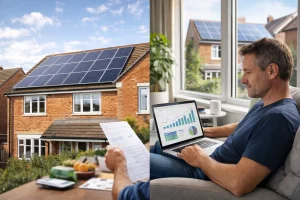
With bills expected to stay high through the rest of the decade, more homeowners are looking at ways to reduce their reliance on the grid. Solar panels are one of the most effective options available right now.
Ofgem defines typical household electricity consumption as 2,700 kWh per year, though the actual mean across all UK households is around 3,450 kWh, as larger and all-electric homes push the average up.
The real savings come from using that electricity yourself instead of buying it from the grid at around 24.7p per unit under the current price cap.
If you want to understand the solar panels cost and what a typical installation involves, it’s worth comparing quotes from MCS-certified installers who can assess your roof and usage properly.
Battery storage is also worth considering. A home battery lets you store surplus solar energy generated during the day and use it in the evening, when grid prices tend to be highest.
Combined solar and battery systems typically cost between £10,000 and £16,000, but they can significantly increase the amount of your own electricity you use rather than export.
The Big Picture
The UK’s energy bills are unlikely to return to pre-crisis levels any time soon. Wholesale prices remain volatile, network costs are rising to fund infrastructure upgrades, and new policy costs like the Sizewell C surcharge will add to bills through the rest of the decade.
Cornwall Insight has forecast that energy prices will remain elevated until the late 2030s.The flip side is that the transition to clean power should eventually bring more price stability.
Once the infrastructure is built, renewable electricity is cheap to produce and isn’t subject to the same geopolitical shocks as gas. But that benefit is still several years away.
For now, the households best positioned to ride out the next few years of price volatility are those generating at least some of their own electricity.
Whether that’s through solar panels, battery storage, or a combination of both, reducing your dependence on the grid is one of the few things within your direct control.

Leave a Reply