

UK businesses are operating in an economy where growth opportunities exist, but cost pressures, changing customer behaviour, technology adoption and tighter commercial discipline are all influencing competition.
So, how can UK businesses stay competitive in 2026? The strongest approach is not simply to cut prices or increase marketing expenditure.
Businesses need to protect margins, manage cash carefully, improve productivity, understand customers, invest selectively in technology and build enough operational flexibility to respond when market conditions change.
For many companies, competitiveness in 2026 is increasingly about doing more with existing resources while remaining valuable to customers.
How Can UK Businesses Stay Competitive in 2026?
UK businesses can stay competitive by concentrating on eight areas:
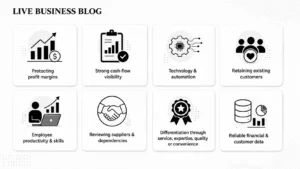
- Protecting profit margins rather than chasing revenue alone
- Maintaining strong cash-flow visibility
- Using technology and automation where there is a measurable benefit
- Retaining valuable existing customers
- Improving employee productivity and skills
- Reviewing suppliers and operational dependencies
- Differentiating through service, expertise, quality or convenience
- Making decisions using reliable financial and customer data
The exact priorities will depend on the company’s industry, size, financial position and customer base.
A local retailer will face different competitive pressures from a software company, construction contractor or professional services firm.
What Is the UK Economic Environment Like in 2026?
The economic picture in 2026 is not simply one of expansion or contraction.
At the time of writing on 12 August 2026, the latest published ONS UK GDP figures showed that real GDP grew by 0.7% in the three months to May 2026 compared with the previous three-month period.
Monthly GDP was estimated to have grown by 0.1% in May, with services making a positive contribution.
At the same time, businesses are still operating with changing prices. The ONS inflation figures for June 2026 showed annual CPI inflation of 2.6%, down from 2.8% in May. Services inflation remained higher at 3.6%.
This means businesses should avoid planning on the assumption that either demand or operating costs will remain unchanged.
Economic growth can create opportunities, while inflation, sector-specific weakness, financing costs and changes in consumer spending can still affect individual businesses very differently.
1. Protect Profit Margins Before Chasing More Turnover

Revenue growth can look positive while disguising deteriorating profitability.
A business selling £1 million of products at increasingly thin margins may be in a weaker position than a smaller competitor producing less revenue but retaining considerably more profit and cash.
Management should therefore understand what actually generates margin.
Useful areas to review include:
| Area | Question to Ask |
|---|---|
| Products | Which products generate the strongest gross margin? |
| Services | Which services require disproportionate staff time? |
| Customers | Which customer groups are genuinely profitable? |
| Discounts | Are discounts creating profitable sales or simply reducing margin? |
| Delivery | Are transport and fulfilment costs fully reflected in pricing? |
| Suppliers | Can purchasing terms or order volumes be improved? |
| Overheads | Which recurring costs no longer generate sufficient value? |
This does not automatically mean cutting expenditure.
Some costs support future growth and should be protected.
Marketing that consistently produces profitable customers, specialist staff who generate valuable work or technology that reduces repetitive administration may justify continued investment.
The objective should be to remove inefficient spending while protecting productive spending.
2. Make Pricing More Responsive
Businesses sometimes leave prices unchanged for too long because they fear losing customers.
However, costs can change more quickly than pricing structures.
A better approach is to review pricing periodically alongside:
- Supplier costs
- Wage costs
- Energy and transport expenses
- Competitor positioning
- Customer demand
- Gross margins
- Service levels
- Product quality
- Delivery speed
Price should not be considered independently from value.
A business may be able to charge more if it offers faster delivery, stronger customer support, specialist knowledge, better reliability or a more convenient buying experience.
Companies competing entirely on being the cheapest can become particularly exposed when their input costs increase.
3. Treat Cash Flow as a Competitive Capability
Profitable companies can still experience financial pressure when cash enters the business more slowly than money leaves it.
Cash-flow management therefore affects far more than the finance department.
A business with healthy liquidity may be better placed to:
- Purchase stock when opportunities arise
- Negotiate with suppliers
- Invest in equipment
- Recruit important employees
- withstand a temporary reduction in sales
- Fund marketing campaigns
- Respond quickly to new opportunities
Management should regularly monitor upcoming payments and expected receipts rather than relying only on the bank balance.
Useful indicators include accounts receivable, accounts payable, stock levels, monthly operating costs and expected cash requirements.
Forecasts should also contain realistic assumptions rather than automatically assuming that future sales will rise.
4. Use Technology to Remove Friction
Digital transformation does not have to involve replacing an entire technology stack.
For many businesses, the greatest improvements can come from identifying repetitive processes that absorb staff time without creating significant customer value.
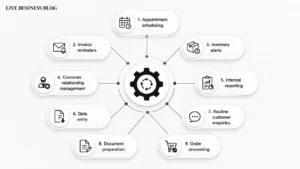
Possible areas for automation include:
- Appointment scheduling
- Invoice reminders
- Inventory alerts
- Customer relationship management
- Internal reporting
- Data entry
- Routine customer enquiries
- Document preparation
- Order processing
The important question is not whether a business uses the newest software.
It is whether the technology reduces cost, saves time, improves accuracy, increases capacity or creates a better customer experience.
Businesses should avoid purchasing software simply because competitors appear to be using it. Every tool creates its own costs, training requirements, integrations and data-management responsibilities.
5. Use AI Selectively Rather Than Everywhere
Artificial intelligence has become another potential productivity tool, but businesses should approach adoption with clear commercial objectives.
Suitable applications may include helping staff organise information, produce first drafts, classify enquiries, analyse internal datasets or automate repetitive administrative workflows.
However, human oversight remains particularly important where work involves:
- Legal obligations
- Financial decisions
- Personal information
- Sensitive customer data
- Employment decisions
- Safety-critical processes
- Material business commitments
Businesses should know what information employees are putting into AI systems and establish appropriate internal rules.
Instead of asking, “How can the company use AI?”, management can ask a more useful question:
“Which recurring business problem could technology help solve more efficiently?”
That keeps technology investment connected to operational outcomes.
6. Focus More Heavily on Customer Retention
Winning a new customer is only the beginning of the commercial relationship.
Companies should understand why customers return, why they leave and what makes their strongest customers valuable.
Useful retention indicators can include:
- Repeat purchase rate
- Renewal rate
- Customer complaints
- Refunds
- Average order value
- Customer churn
- Response times
- Product returns
- Contract renewals
Businesses can also speak directly with customers rather than relying entirely on analytics.
Simple conversations may reveal problems that dashboards fail to explain, such as slow communication, confusing ordering processes, inconsistent quality or unexpected charges.
Strong customer retention can also make revenue planning more predictable.
7. Improve Workforce Productivity Without Simply Increasing Workloads
Productivity should not mean expecting employees to complete continuously increasing amounts of work with fewer resources.
A more sustainable approach is to examine how effectively working time is being used.
Common productivity obstacles include:
- Unnecessary meetings
- Repeated manual administration
- Poorly defined responsibilities
- Slow internal approvals
- Duplicate data entry
- Outdated software
- Insufficient training
- Unclear priorities
Managers should identify bottlenecks before assuming that additional recruitment is always required.
Training can also be a competitive investment. Existing employees who develop stronger technical, commercial or management capabilities may help a business expand its capacity without constantly depending on external recruitment.
8. Reduce Dependence on Individual Suppliers
Low-cost procurement is useful, but excessive reliance on one supplier can create operational risk.
Businesses should understand which suppliers are genuinely critical.
For important goods and services, management can consider:
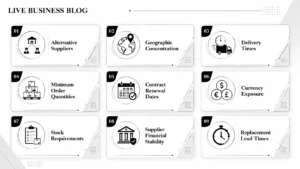
- Alternative suppliers
- Geographic concentration
- Delivery times
- Minimum order quantities
- Contract renewal dates
- Currency exposure
- Stock requirements
- Supplier financial stability
- Replacement lead times
It may not be commercially sensible to maintain multiple suppliers for every purchase.
Instead, businesses should identify the areas where failure would prevent them from serving customers.
Those dependencies deserve the greatest attention.
9. Compete on More Than Price
Price matters, particularly when customers are cautious about spending.
But businesses usually need something else that makes customers choose them over alternatives.
Possible differentiators include:
Faster Service
Speed can be extremely valuable where customers want immediate answers, quotations or delivery.
Specialist Expertise
A business serving a narrow sector may understand customer problems better than a generalist competitor.
Reliability
Consistently delivering what was promised can itself become a competitive advantage.
Customer Experience
Clear communication and easy purchasing processes can influence repeat business.
Quality
Customers may accept higher prices where superior quality provides sufficient additional value.
Convenience
Online ordering, flexible appointments, easy returns or simplified administration can remove friction from buying.
Businesses should be able to explain their competitive advantage clearly.
If the only explanation is “the company provides good service”, the positioning may still be too broad.
10. Make Marketing Accountable
A larger marketing budget does not necessarily make a business more competitive.
Marketing should be assessed according to the commercial outcome it creates.
Businesses can evaluate:
| Metric | What It Helps Show |
|---|---|
| Cost per lead | Cost of generating potential customers |
| Conversion rate | Percentage of prospects becoming customers |
| Customer acquisition cost | Approximate cost of gaining a customer |
| Average order value | Typical customer transaction size |
| Repeat purchase rate | Ability to generate additional purchases |
| Lead source | Which channels produce opportunities |
| Gross margin by channel | Whether sales remain profitable |
Not every metric is relevant to every company.
For example, an e-commerce retailer may focus heavily on conversion and repeat purchases, while a consultancy may place more importance on qualified enquiries, proposals and contract value.
Alongside official economic information, businesses looking for broader SME commentary and practical business topics can also follow resources such as UK Small Business Blog.
Market commentary should complement rather than replace a company’s own financial information, customer research and official guidance.
What Should Small UK Businesses Prioritise?
Smaller companies often have fewer resources, which makes prioritisation particularly important.
Rather than trying to transform every part of the company simultaneously, a small business can concentrate first on the areas with the greatest commercial impact.
A sensible sequence could be:
- Understand cash flow.
- Identify the most profitable products and customers.
- Review pricing.
- Remove unnecessary costs.
- Improve the main customer journey.
- Automate one or two repetitive processes.
- Strengthen customer retention.
- Reduce critical supplier dependencies.
- Measure a small number of useful KPIs.
- Reinvest selectively where evidence supports expansion.
This approach makes competitiveness an ongoing management process rather than a one-off project.
A 90-Day Competitiveness Review for UK Businesses
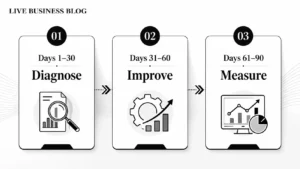
Businesses can convert the strategy into a practical quarterly cycle.
Days 1–30: Diagnose
Management can review:
- Revenue trends
- Product margins
- Cash flow
- Customer retention
- Supplier costs
- Staff capacity
- Marketing performance
- Competitor positioning
The purpose is to identify the two or three issues having the greatest commercial impact.
Days 31–60: Improve
The business can then test targeted improvements.
These might involve:
- Revising prices
- Renegotiating supplier arrangements
- Automating administration
- Improving sales follow-ups
- Updating customer communications
- Removing unnecessary expenditure
- Training employees
- Testing another marketing channel
Changes should be measurable wherever possible.
Days 61–90: Measure
Management can compare results with the starting position.
The business can then decide whether to:
- Continue the change
- Expand it
- Modify it
- Stop it
This creates a continuous improvement cycle based on evidence rather than assumptions.
Final Thoughts
Staying competitive in 2026 does not require UK businesses to predict every economic development correctly.
It requires them to become more adaptable.
A company that understands its cash position, margins, customers, employees and operational dependencies can make better decisions when conditions change.
Businesses should therefore focus less on reacting to every headline and more on strengthening the fundamentals they can control: productivity, customer value, financial discipline, technology, workforce capability and operational resilience.
The most competitive businesses are likely to be those that can identify change early, decide what matters and adjust without losing sight of what customers actually value.
Frequently Asked Questions
How can UK businesses stay competitive in a changing economy?
UK businesses can remain competitive by protecting margins, controlling cash flow, improving productivity, using technology selectively, retaining customers, developing employee skills and maintaining flexible supply chains.
Businesses should regularly review performance rather than relying on strategies that worked under previous economic conditions.
What is the biggest competitive advantage for a small business?
There is no single advantage for every small business.
Smaller firms can sometimes compete effectively through specialist expertise, responsiveness, personal customer service, local knowledge or faster decision-making rather than trying to match larger competitors on scale.
Should businesses cut prices during difficult economic conditions?
Not automatically. Lower prices may stimulate demand but can also reduce margins.
Businesses should first understand customer price sensitivity, competitor positioning and their own costs before changing prices.
How can technology help a UK business become more competitive?
Technology can be useful when it reduces administrative work, improves customer service, increases operational capacity or provides better information for decision-making.
Businesses should evaluate the measurable benefit rather than adopting software solely because it is fashionable.
How often should a business review its competitive strategy?
A full strategy does not necessarily need constant rewriting, but key indicators can be reviewed regularly.
A structured quarterly review can help businesses detect changes in margins, customer behaviour, costs and operational performance before problems become more serious.

Leave a Reply