

Last Updated On – 06-08-2026
Housing Benefit can help eligible tenants meet some or all of their rent, but savings can affect both whether a person qualifies and how much they receive.
The central rule is straightforward: a claimant will usually not get Housing Benefit if their savings are over £16,000, unless they receive the Guarantee Credit part of Pension Credit.
Below that upper limit, the calculation depends on age. For most working-age Housing Benefit claims, savings of up to £6,000 are ignored.
For pension-age Housing Benefit, the usual ignored amount is £10,000. Savings above the relevant threshold are converted into an assumed weekly income known as tariff income.
This is not the interest actually earned on the money; it is a figure used in the benefit calculation.
Housing Benefit has largely been replaced by Universal Credit for new working-age claims.
New Housing Benefit claims are now generally limited to people who have reached State Pension age and people living in qualifying supported, sheltered or temporary accommodation.
Important: This article provides general information about UK benefit rules.
It is not personalised financial, legal or welfare-rights advice. A claimant should ask their local council or an accredited benefits adviser to assess their circumstances.
Who Can Make a New Housing Benefit Claim?

Housing Benefit is being replaced by Universal Credit. A new claim can usually be made only where the claimant has reached State Pension age or lives in qualifying supported, sheltered or temporary housing.
A single person who has reached State Pension age may claim. For a couple, both partners will normally need to have reached that age.
Exceptions protect certain mixed-age couples whose Pension Credit or pension-age Housing Benefit position dates from before 15 May 2019.
Qualifying accommodation can include:
- council-arranged temporary accommodation;
- a refuge for survivors of domestic abuse; or
- supported or sheltered housing providing care, support or supervision.
Most other working-age renters must claim Universal Credit for housing costs instead.
A person in supported or sheltered accommodation that does not provide care, support or supervision may also need to claim Universal Credit rather than Housing Benefit.
Can I Make a New Housing Benefit Claim?
Answer a few questions to identify whether Housing Benefit or Universal Credit may be the more appropriate route.
How Does the £6,000 Working-Age Threshold Work?
For a working-age Housing Benefit claimant, capital up to £6,000 is normally disregarded. This means it does not create tariff income.
Once combined capital exceeds £6,000, the council adds £1 a week to the claimant’s assessed income for every £250, or part of £250, above the threshold.
The calculation applies to the claimant’s and partner’s combined assessable capital.
The council does not assume that the savings genuinely produce that amount of interest.
It applies the tariff formula and includes the resulting figure alongside earnings, pensions and other relevant income when calculating Housing Benefit.
Working-Age Tariff Income Examples
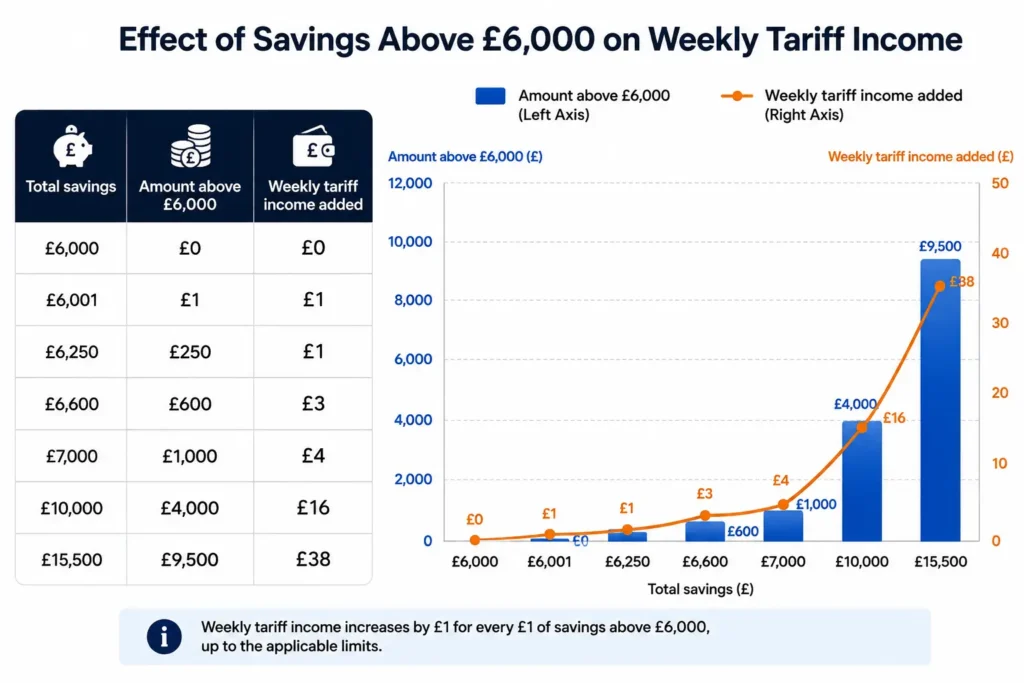
| Total savings | Amount above £6,000 | Weekly tariff income added |
|---|---|---|
| £6,000 | £0 | £0 |
| £6,001 | £1 | £1 |
| £6,250 | £250 | £1 |
| £6,600 | £600 | £3 |
| £7,000 | £1,000 | £4 |
| £10,000 | £4,000 | £16 |
| £15,500 | £9,500 | £38 |
The “or part of” rule matters. Savings of £6,251 are treated as two £250 bands above the threshold, creating £2 a week of tariff income. This is why even a relatively small balance change can alter the calculation.
These figures show only the assumed income from capital. They do not show how much Housing Benefit would actually be paid.
Real-Life Example: How Savings Can Affect Housing Benefit?
Consider a 58-year-old private tenant named Sarah who has £8,400 across a current account and a savings account. As she is below State Pension age, the working-age Housing Benefit capital rules would normally apply.
The first £6,000 of her savings would be ignored. This leaves £2,400 to be included in the tariff-income calculation.
Under the working-age rules, the council assumes £1 of weekly income for every £250, or part of £250, above £6,000.
| Calculation step | Amount |
|---|---|
| Sarah’s total savings | £8,400 |
| Savings ignored | £6,000 |
| Capital used for tariff-income calculation | £2,400 |
| Number of £250 bands, rounded up | 10 |
| Assumed weekly tariff income | £10 |
The council would therefore treat Sarah as having an additional £10 a week of income, even if her savings did not actually earn £10 in interest.
That assumed income would be added to her wages, benefits and any other assessable income when calculating her Housing Benefit.
This does not necessarily mean that her Housing Benefit would fall by exactly £10 a week.
The final award would also depend on her eligible rent, household income, Local Housing Allowance rate, personal circumstances and anyone else living in the property.
If Sarah’s savings later increased to more than £16,000, she would usually no longer qualify for Housing Benefit. She would need to report the change to her local council promptly to avoid being overpaid.
This is an illustrative example rather than an individual benefit calculation. Actual entitlement must be determined by the claimant’s local council.
What Is the Savings Limit for Pension-Age Housing Benefit?
For pension-age Housing Benefit, the usual lower capital threshold is £10,000. Capital at or below that amount is normally ignored.
Above £10,000, the tariff is £1 a week for every £500, or part of £500. This rule applies where the Housing Benefit claimant or relevant partner falls under the pension-age rules.
This is more favourable than the working-age formula because the ignored amount is higher and each assumed £1 of weekly income covers a larger band of savings.
However, tariff income can still reduce the award when it is added to pensions and other assessable income.
Pension-Age Tariff Income Examples
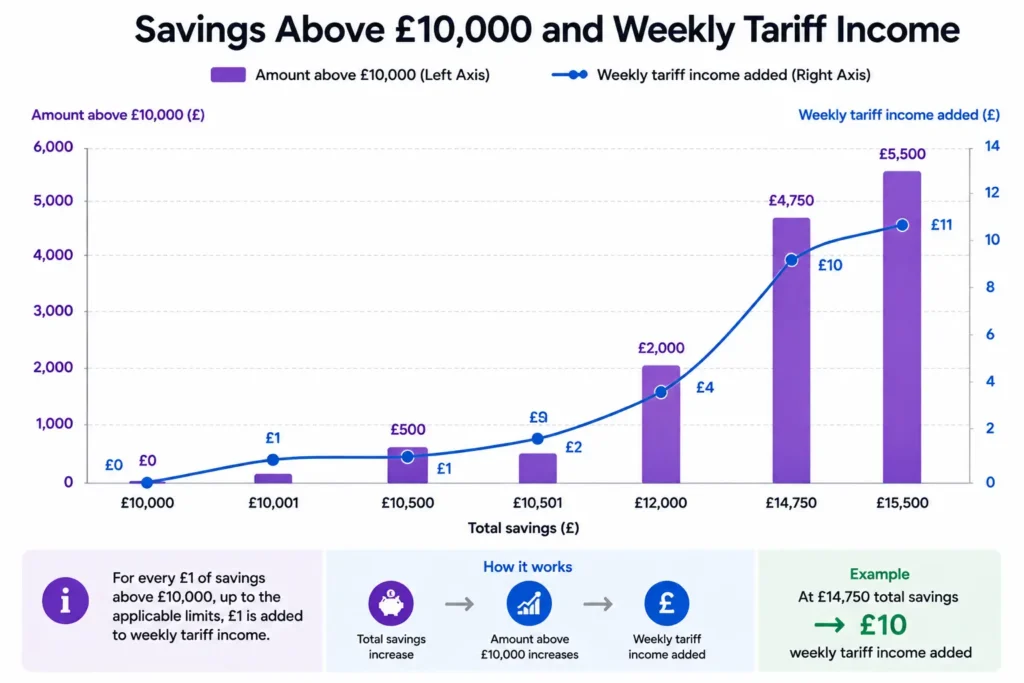
| Total savings | Amount above £10,000 | Weekly tariff income added |
|---|---|---|
| £10,000 | £0 | £0 |
| £10,001 | £1 | £1 |
| £10,500 | £500 | £1 |
| £10,501 | £501 | £2 |
| £12,000 | £2,000 | £4 |
| £14,750 | £4,750 | £10 |
| £15,500 | £5,500 | £11 |
A pension-age claimant receiving Pension Credit Guarantee Credit is treated differently. GOV.UK states that the usual £16,000 Housing Benefit savings restriction does not apply to someone receiving Guarantee Credit.
Savings may still affect whether Guarantee Credit itself is payable. Pension Credit normally ignores the first £10,000 and applies deemed income to capital above that amount, but it does not have a fixed upper capital limit.
What Counts as Savings or Capital?
Housing Benefit looks beyond a single savings account. A council will generally consider capital belonging to the claimant and their partner, including jointly owned money and assets.
Common examples include:
- cash;
- current-account balances;
- bank, building society and Post Office accounts;
- Individual Savings Accounts;
- Premium Bonds and National Savings products;
- stocks, shares and unit trusts;
- redundancy payments and tax refunds; and
- land or property other than the home occupied by the claimant.
Treatment depends on ownership, accessibility, valuation and the money’s source. A balance is not ignored merely because it sits in a current account rather than an account labelled “savings”.
| Usually declared for assessment | May be disregarded under specific rules |
|---|---|
| Cash and money in current or savings accounts | The home the claimant owns and occupies |
| ISAs, Premium Bonds, National Savings, shares and investments | Certain business assets of a self-employed person |
| Redundancy payments, tax refunds and some lump sums | Certain compensation payments |
| Land or another property owned in the UK or abroad | Some arrears of state benefits for a specified period |
| Capital held jointly with a partner or another person | An uncashed life-insurance policy in qualifying circumstances |
The list is not exhaustive. The claimant should declare the asset and let the council decide whether a disregard applies.
Certain qualifying Post Office compensation, Grenfell Tower and Vaccine Damage payments are disregarded under specific Housing Benefit rules.
Do Gifts, Inheritances and Lump Sums Affect Housing Benefit?

They can. A cash gift, inheritance, redundancy payment, pension lump sum or property interest may increase capital and change entitlement.
The council may consider:
- the amount received;
- the date it became available;
- who legally and beneficially owns it;
- whether it can be accessed; and
- whether a statutory disregard applies.
A claimant receiving money should keep evidence showing its source, date and any legal restrictions.
Guide on whether a gift of money affects benefits explains why gifts should not automatically be treated as harmless for means-tested support.
Some payments are ignored permanently or temporarily, but the council must make that decision under the relevant rules. Money should not be assumed to be exempt simply because it is intended for a future expense.
Can Someone Give Away Savings to Stay Below the Limit?
Deliberately disposing of capital to obtain Housing Benefit or increase an award can be treated as deprivation of capital.
Under Housing Benefit rules, a person may be treated as still possessing capital they gave away or transferred when securing benefit entitlement was a significant purpose. This amount is known as notional capital.
Normal spending is not automatically deprivation. The council considers why the money was spent and whether the expenditure was reasonable. Paying ordinary living costs or genuine liabilities is different from transferring money solely to qualify.
Large transfers can be fact-sensitive, so independent welfare-rights advice may be useful. Concealing capital or giving false information can lead to recovery action, penalties or further investigation.
Do a Partner’s Savings Count?
Housing Benefit normally considers the combined capital of a claimant and their partner. It does not usually matter that the money is held only in one partner’s name.
Joint accounts and jointly owned assets may also require the council to determine each person’s beneficial ownership.
Money belonging to someone else but held in the claimant’s account may require evidence showing its source and ownership.
Savings rules also affect other means-tested benefits. Readers comparing entitlements may find the guide on claiming Jobseeker’s Allowance with savings useful, although each benefit has its own eligibility structure.
What Happens When Savings Rise or Fall?

A claimant must report changes to savings, investments or property to the council administering Housing Benefit.
GOV.UK warns that a claim may be stopped or reduced if a change is not reported straight away. A person may also have to repay Housing Benefit received because of missing or incorrect information.
Report inheritances, compensation, property sales, redundancy payments, major withdrawals, new accounts and material investment changes. Keep statements and documents explaining the transaction.
| Change | Practical action |
|---|---|
| Savings rise above £6,000 or £10,000 | Tell the council so tariff income can be reassessed |
| Capital approaches or exceeds £16,000 | Report it immediately and ask how entitlement is affected |
| An inheritance or lump sum is received | Provide the amount, date, source and supporting documents |
| Capital falls after reasonable spending | Keep receipts and evidence showing what the money was used for |
| A potentially disregarded payment is received | Declare it and ask the council to apply the correct disregard |
| A partner moves in or out | Report the household change and updated combined capital |
Housing Benefit is administered by local councils, so the change should normally be reported to the council rather than only to the Department for Work and Pensions.
Those concerned about benefit-related financial checks can read the separate explainer on whether the DWP can access bank accounts, but claimants remain responsible for providing complete and current information.
Is £16,000 an Absolute Cut-Off?
GOV.UK says a person will usually not get Housing Benefit where savings are over £16,000. The main stated exception is receipt of Pension Credit Guarantee Credit.
The official 2026/27 benefit-rate tables show no Housing Benefit capital upper limit for people receiving that element of Pension Credit.
Disregarded capital is removed before the relevant total is compared with the limit. The gross bank balance and the capital counted for Housing Benefit are therefore not always identical.
For example, a claimant could hold money from a specifically disregarded compensation scheme. The money should still be declared, but the council may exclude it when calculating assessable capital.
How Is Housing Benefit Affected Apart From Savings?
Savings are only one part of the assessment. There is no single fixed Housing Benefit payment.
The council may consider:
- eligible rent;
- household income;
- earnings and pensions;
- other benefits;
- household composition;
- disability-related circumstances;
- non-dependants living in the home;
- Local Housing Allowance; and
- spare-bedroom rules.
For private tenants, the calculation generally uses the lower of actual rent and the applicable Local Housing Allowance rate.
For social tenants, eligible-rent and bedroom rules can affect the maximum. Heating, energy and food are not normally covered.
A free GOV.UK benefits calculator can provide an estimate. It normally requires accurate details about savings, income, pensions, rent, other household members and existing benefits.
The council makes the formal Housing Benefit decision.
Housing Benefit or Universal Credit: Which Should Be Claimed?

Most working-age renters making a new claim must use Universal Credit rather than Housing Benefit.
Housing Benefit remains relevant mainly for pension-age claimants and people in specified supported, sheltered or temporary accommodation.
Universal Credit also uses £6,000 and £16,000 capital thresholds, but applies a monthly reduction rather than Housing Benefit’s weekly tariff-income calculation.
The schemes are not interchangeable, so the correct route depends on age, household and accommodation.
People living in qualifying supported or temporary accommodation may receive Housing Benefit for eligible housing costs while claiming Universal Credit for other living costs.
Final Answer
The Housing Benefit savings limit is normally £16,000. Working-age claimants can usually hold up to £6,000 before savings affect the calculation, while pension-age claimants can usually hold up to £10,000.
Above those lower thresholds, tariff income is added:
- £1 a week for each £250, or part of £250, above £6,000 under working-age rules; or
- £1 a week for each £500, or part of £500, above £10,000 under pension-age rules.
People receiving Pension Credit Guarantee Credit are exempt from the normal Housing Benefit upper capital limit.
The safest approach is to declare all savings and assets, report changes promptly and ask the council to confirm any capital disregard in writing.
That prevents assumptions about bank balances, gifts, inheritances or lump sums from turning into avoidable overpayments.
Frequently Asked Questions
Can someone claim Housing Benefit with £10,000 in savings?
A working-age claimant would normally have £16 of weekly tariff income added because £4,000 is above the £6,000 disregard.
A pension-age claimant would normally have no tariff income at exactly £10,000. Other income and eligibility conditions still apply.
Does money in a current account count?
Usually, yes. Current-account balances can count as capital. Councils may ask for statements covering every account, not only accounts specifically described as savings accounts.
Does the claimant’s home count as capital?
The value of the home the claimant owns and occupies is normally disregarded. Another property, land or beneficial property interest may count unless a specific disregard applies.
Can Housing Benefit stop after an inheritance?
It can be reduced or ended if the inheritance takes counted capital above the relevant thresholds.
The claimant should report it promptly and provide probate, bank or property evidence so the council can determine the correct date and value.
Do debts reduce the savings figure?
Having debts does not automatically mean they can be deducted from money held in an account. However, using capital to repay a genuine debt is not necessarily deprivation of capital. The precise treatment depends on the circumstances and should be confirmed with the council.
Does an ISA count towards the savings limit?
Yes. Cash ISAs and investment ISAs are normally included as capital unless a specific exception applies. The fact that withdrawing money could cause a penalty or loss of benefits within the ISA does not automatically make it exempt.
Where should a claimant get a definitive answer?
The claimant should contact the local council’s Housing Benefit team. An independent benefits adviser may help where ownership, trusts, compensation, property valuation or deprivation of capital is disputed.

Leave a Reply