

Last Updated on AUG 20, 2026
EO Charging, the trading name of Juuce Limited, entered administration on 8 April 2026 after renewed liquidity pressures and an unsuccessful sale process.
The administration resulted in 69 redundancies from a workforce of 93, while the company was reported to have around £56 million in debt. However, the story did not end with the initial wind-down.
Pod, part of EDF Group, subsequently acquired EO Charging, with PwC confirming the sale of the business and certain assets following the administration.
Pod said the acquisition would strengthen its commercial fleet and depot charging capabilities.
Juuce Limited itself remains recorded as in administration, meaning the acquisition of the EO business and assets should not be confused with the administration process having formally ended.
Key Takeaways:
- EO Charging entered administration with reported debts of around £56 million.
- The company cited challenging trading conditions and losses linked to overseas expansion.
- Operations had expanded into the US, Australia, New Zealand and Italy.
- 69 employees were made redundant, with 24 retained temporarily.
- Employees and former employees are owed £852,811.64.
- EO Charging manufactured over 85,000 chargers and deployed 13,000 commercial charging stations globally.
- Administrators are helping customers transition to alternative suppliers.
- The collapse highlights financial and operational challenges within the EV charging sector.
What Led EO Car Chargers Into Administration?

The EO Car Chargers administration became a major development in the UK electric vehicle sector after accounts revealed that the company collapsed with debts of around £56m.
EO Charging, also referred to as EO Car Chargers, had built its reputation around electric vehicle charging infrastructure, software, commercial charging stations, repair support and incident response services.
EO Charging, legally Juuce Limited, entered administration on 8 April 2026, when Edward Williams, Ross Connock and Victoria Hatton of PwC were appointed joint administrators.
PwC said the business had experienced challenging trading conditions and had become loss-making following expansion into the US, Australia, New Zealand and Italy.
During the second half of 2025, EO scaled its operations back to the UK and refocused on its cloud-based charge point management platform.
The company also received additional shareholder funding and completed a fundraising round in the fourth quarter of 2025.
However, PwC said uncertainty and delays surrounding that process affected customer confidence, reducing the company’s order book and pipeline. Liquidity pressures subsequently returned.
An accelerated sale process began in January 2026, but no acceptable transaction was secured before administration. PwC said this left the company without a viable alternative to entering administration.
The situation also highlights a common challenge for fast-growing infrastructure businesses.
Demand for EV charging may be rising, but installation costs, equipment manufacturing, maintenance obligations, software development, customer service and overseas operating costs can all affect profitability.
International Expansion and Financial Pressures
EO Charging had developed a global presence before its collapse. The company manufactured more than 85,000 chargers and deployed around 13,000 commercial charging stations across approximately 35 countries.
Those figures show that EO Charging was not a minor player in the EV charging market.
It had experience, customer relationships and international activity. However, rapid expansion can become difficult to sustain if revenue growth does not keep pace with spending.
A business restructuring adviser described the issue clearly:
“I often see companies grow quickly into overseas markets before their cash flow is strong enough to support that scale. In a case like this, I would look closely at whether expansion costs, contract delays and operational spending created pressure faster than the business could absorb.”
Area Detail Company EO Charging / EO Car Chargers Sector Electric vehicle charging infrastructure Administration date April Reported debt Around £56m Overseas markets mentioned US, Australia, New Zealand and Italy Main issue stated Challenging trading conditions and loss-making expansion
Challenging Trading Conditions in the EV Sector
The EV charging sector can appear highly attractive because electric vehicle adoption is increasing. However, charging companies must often spend heavily before they see reliable returns.
EO Charging’s services included hardware, software and support. That means the business was not only selling chargers but also maintaining operational systems and offering ongoing repair and incident support.
These services can be valuable to customers, but they also create continuing costs.
Some of the pressures facing EV charging companies include:
- High manufacturing and installation costs
- Competition from larger infrastructure providers
- Long sales cycles for commercial charging projects
- Expensive software development and technical support
- Maintenance obligations after installation
- Uncertain returns from new international markets
For a company expanding across several countries, these challenges can multiply quickly. Each market has different regulations, customer expectations, suppliers, staffing requirements and commercial risks.
How Much Debt Did EO Charging Accumulate Before Its Collapse?
EO Charging was reported to have entered administration with approximately £56 million of liabilities, while £852,811.64 was reported as being owed to employees and former employees.
The insolvency process has since progressed through formal filings at Companies House. Juuce Limited filed its statement of affairs on 9 June 2026, followed by the administrators’ proposals on 10 June 2026 and a notice of deemed approval of those proposals on 29 June 2026.
The £56 million figure therefore remains useful as a description of the financial position surrounding the administration, but it should not be presented as the amount creditors will ultimately lose. Recoveries depend on the administration process, asset realisations and creditor priority.
This is an important detail because company failures are often discussed in terms of creditors, assets and administration processes, while the direct impact on workers can be overlooked.
The debt position suggests that EO Charging had reached a stage where its liabilities could no longer be managed through normal trading. Administration is typically used when a company is insolvent or cannot pay its debts as they fall due.
It gives appointed administrators control over the business while they assess the best way to deal with assets, creditors, employees and customers.
Debt and Workforce Detail Reported Figure
Total reported debt £56m
Amount owed to employees and former employees £852,811.64
Total workforce before redundancies 93
Employees made redundant 69
Employees retained temporarily 24
The size of the debt also raises questions about how quickly costs increased compared with income. For EV infrastructure firms, the gap between investment and return can be wide.
A company may win contracts, manufacture equipment and build its brand, but still face cash flow problems if payments are delayed or margins are too thin.
In EO Charging’s case, the overseas expansion appears to have played a central role. International growth can bring access to new customers, but it can also increase costs in areas such as staffing, compliance, logistics, technology adaptation and local partnerships.
What Happened To EO Charging Employees Following The Administration?

The administration had an immediate impact on EO Charging’s workforce. Administrators confirmed that 69 people lost their jobs when the business collapsed.
Out of 93 employees, only 24 were retained to assist with the wind-down process and help customers transition to alternative suppliers.
This type of job loss can be particularly difficult because it often happens quickly.
Once administrators are appointed, they must assess which roles are needed to preserve value and support the remaining operations. Employees whose roles are no longer required may be made redundant soon after the appointment.
Edward Williams, joint administrator and partner at PwC, said:
“It’s regrettable that the company has been left with no option but to enter administration and that 69 employees have sadly been made redundant.”
The remaining 24 employees were initially retained for a short period to support customers and assist with the orderly wind-down. PwC also confirmed that the joint administrators would support employees affected by redundancy in making claims through the Redundancy Payments Service.
The position later changed after Pod acquired EO Charging. Pod said it was welcoming EO Charging’s team into its business, although neither Pod nor PwC publicly specified in the material reviewed how many of the 24 retained employees transferred as part of the transaction. The article should therefore avoid implying that all 24 remained solely for the wind-down.
Workforce Outcome Number
Employees before administration 93
Redundancies confirmed 69
Remaining workforce 24
Purpose of retained staff Customer transition and orderly wind-dow
For employees and former employees owed money, the administration process can involve claims through the company’s estate and, in some cases, statutory redundancy support routes.
However, the amount recovered often depends on the company’s assets and creditor ranking.
How Has EO Charging Impacted The UK EV Charging Industry?
EO Charging’s collapse is notable because the company had made a visible contribution to the EV charging industry. It built chargers, supported commercial charging projects and operated internationally.
The company’s work covered several important parts of the EV ecosystem. It was involved in manufacturing, software, infrastructure deployment and maintenance support. This made it more than a simple hardware provider.
EO Charging’s Global Operations and Achievements
Before administration, EO Charging had manufactured more than 85,000 chargers. It had also deployed around 13,000 commercial charging stations across about 35 countries.
These figures indicate that the company had built a meaningful footprint in the global charging market.
Its commercial charging stations would have supported businesses, fleets and organisations looking to move towards electric transport. Commercial charging is particularly important in the wider EV transition because company fleets, delivery vehicles and workplace charging all depend on reliable infrastructure.
EO Charging Activity Reported Detail
Chargers manufactured More than 85,000
Commercial charging stations deployed Around 13,000
Countries reached Around 35
Services offered Infrastructure, software, repair and incident support
Customer types Households, businesses and commercial users
The company’s scale makes the administration more significant for the sector. When a business with thousands of installations and international operations fails, customers and partners may need to reassess supplier risk.
Partnerships and Commercial Charging Projects
EO Charging also partnered with the Oxford-based EV Charging Company to provide charging stations to households and businesses across Oxfordshire.
Local partnerships like this are important because EV adoption depends on accessible charging, not only on national networks.
Households need reliable home charging options. Businesses need workplace and fleet charging. Local charging providers can play a key role in supporting both groups.
The administration may now create uncertainty for customers connected to these partnerships. They may need to confirm who will provide maintenance, whether software access continues and how future service issues will be handled.
What Happened To EO Charging After Administration?

EO Charging’s position changed after the initial administration announcement. PwC had originally said administrators would help customers transition to alternative suppliers while seeking to optimise the value of the company’s assets.
A subsequent deal provided a different outcome for significant parts of the EO business. Pod, part of EDF Group, announced its acquisition of EO Charging in May 2026, while PwC subsequently confirmed that it had advised Juuce Limited on the sale of the business and certain assets to Pod following the administration.
The acquisition gives Pod access to EO Charging’s fleet and depot charging capabilities, including technology designed to manage charging performance, optimise energy consumption and support large-scale fleet operations.
Pod said existing EO Charging customers would continue to receive stable and uninterrupted service, marking an important change from the initial expectation that customers would simply have to move to alternative suppliers.
Pod chief executive Melanie Lane said the company was pleased to:
“welcome EO Charging into the Pod family”
and said its depot charging capabilities complemented Pod’s existing smart charging operations.
Importantly, the transaction does not mean the administration of Juuce Limited has disappeared. Companies House continues to record Juuce Limited as being in administration, with Edward Williams, Victoria Hatton and Ross Connock listed as practitioners.
| Current Position | Updated Detail |
|---|---|
| Administration | Juuce Limited entered administration on 8 April 2026 |
| Buyer | Pod, part of EDF Group |
| Transaction | Business and certain assets sold to Pod |
| EO operations | Fleet and depot charging capabilities incorporated into Pod |
| Existing customers | Pod says service will remain stable and uninterrupted |
| Juuce Limited | Remains in administration |
What Does EO Charging’s Collapse Mean For Customers And Partners?
The position for EO Charging customers is clearer following Pod’s acquisition. Pod has said existing EO Charging customers will continue to receive stable and uninterrupted service, rather than simply being left to find alternative suppliers themselves.
Pod acquired EO Charging to expand its capabilities in commercial fleet and depot charging. EO’s technology supports fleet operators with charging performance, energy optimisation and large-scale electric vehicle operations, while Pod brings an existing presence across home, workplace and public charging.
For commercial customers, the acquisition therefore creates greater continuity than appeared likely immediately after the administration announcement.
Businesses should nevertheless check their own contractual arrangements, particularly where warranties, maintenance agreements, software subscriptions or services were originally contracted directly with Juuce Limited.
Pod says combining EO’s depot platform with its smart charging capabilities and EDF’s wider energy operations will allow the combined business to provide depot software, energy management and charging services for fleet operators.
Could EO Charging’s Administration Reflect Wider Challenges In The EV Charging Market?
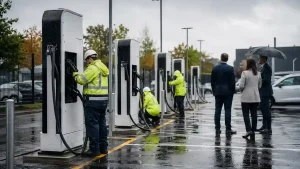
The collapse of EO Charging does not mean the EV charging market is weak overall. The UK still needs more charging points, and the shift towards electric vehicles remains a major long-term trend.
However, the case does show that market growth does not guarantee business survival.
EV charging providers operate in a competitive environment. They need to deliver reliable technology, manage installations, support customers and maintain systems over time.
At the same time, they may face pressure to scale quickly so they can compete for larger contracts.
This creates a difficult balance. Growing too slowly can mean losing market share. Growing too quickly can create financial strain.
Market Challenge Impact On EV Charging Providers
High capital requirements Companies need funding before revenue stabilises
Fast competition Providers must invest to stay relevant
Technology demands Software and support require ongoing spending
Customer expectations Reliability and service quality are essential
International expansion New markets can increase risk and cost
The EO case also raises a wider question about how EV businesses manage investor expectations. Companies in fast-growth sectors are often encouraged to expand rapidly.
However, infrastructure businesses are different from purely digital companies. They deal with physical products, installation costs, logistics, technical faults and maintenance obligations.
For the UK market, the administration may lead other charging firms to review their own exposure to debt, overseas operations and support costs.
Investors and customers may also pay closer attention to financial stability when choosing EV infrastructure partners.
Conclusion
EO Charging’s administration remains a significant event in the UK EV charging industry. Juuce Limited, trading as EO Charging, entered administration on 8 April 2026 after renewed liquidity pressures and an unsuccessful sale process, resulting in 69 redundancies from its 93-person workforce.
However, describing EO Charging simply as a company being wound down is no longer accurate. Pod, part of EDF Group, subsequently acquired EO Charging, with PwC confirming the sale of the business and certain assets. Pod says existing customers will continue to receive stable and uninterrupted service.
The approximately £56 million debt figure remains relevant to the administration, while Juuce Limited continues to be recorded as in administration.
The wider outcome shows both sides of EO Charging’s story: substantial financial difficulties led to insolvency and major job losses, but parts of its technology, customer operations and fleet-charging expertise have found a new home within Pod.
FAQs
Why did EO Charging enter administration?
EO Charging entered administration after facing challenging trading conditions and becoming loss-making following overseas expansion into markets such as the US, Australia, New Zealand and Italy.
How much debt did EO Charging have?
Accounts revealed that the company collapsed with around £56m of debt.
How many employees lost their jobs at EO Charging?
Administrators confirmed that 69 employees were made redundant when the company entered administration.
What services did EO Charging provide?
EO Charging provided EV charging infrastructure, charging software, commercial charging stations, repair support and incident response services.
How many chargers had EO Charging manufactured?
The company had manufactured more than 85,000 chargers before entering administration.
What happens to EO Charging customers now?
Customers are expected to transition to alternative suppliers, with administrators seeking to support that process through the remaining workforce.
Did EO Charging operate outside the UK?
Yes, EO Charging had expanded into international markets including the US, Australia, New Zealand and Italy.
Who is handling EO Charging’s administration?
PwC administrators are handling the process, with Edward Williams named as joint administrator.

Leave a Reply