
Last updated: 2 October 2026
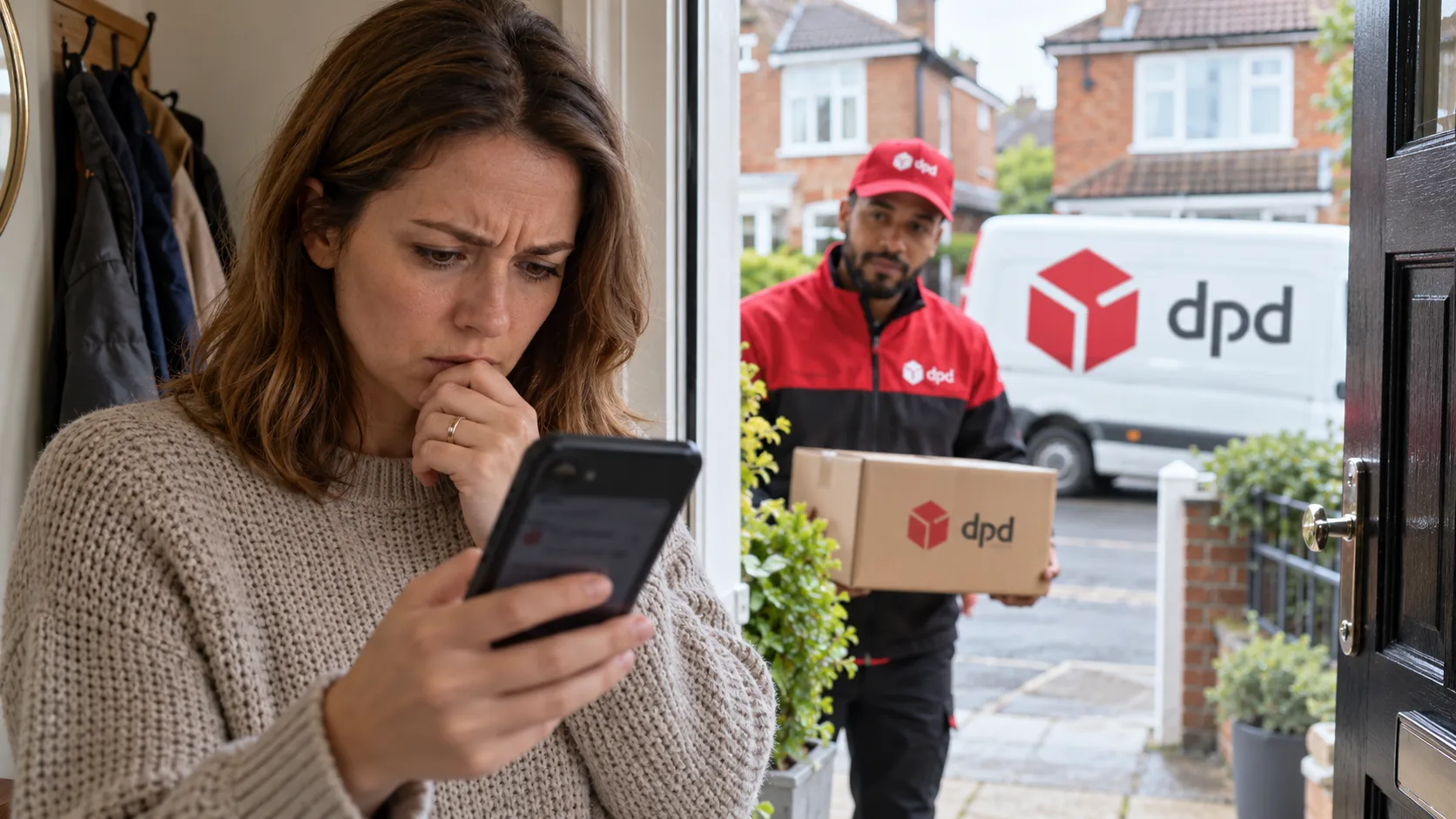
No. DPD does not charge UK recipients a standard redelivery fee simply because a delivery was missed.
DPD’s current fraud guidance is stronger than saying redelivery is “normally free”: the company says it will never ask customers to pay a redelivery fee through a link in an email, text message or iMessage.
That distinction matters because fake DPD redelivery messages commonly request a small payment such as £1.50, £1.99 or £2.99.
The amount is deliberately low enough to appear believable. The real objective can be to collect card details, personal information or banking information for a larger fraud later.
There are separate situations where legitimate money may be due, particularly customs duties or import taxes on international shipments.
Those charges should not be confused with a standard missed-delivery redelivery fee.
What Does DPD Redelivery Mean?
DPD redelivery simply means another arrangement is made after a parcel could not be successfully delivered as originally planned.
Depending on the parcel and restrictions imposed by the sender, the recipient may be able to:
- Receive the parcel on another day
- Redirect it to an eligible DPD Pickup location
- Nominate a neighbour
- Choose an approved safe place
- Manage the delivery through the DPD app
- Collect it after it has been redirected to an eligible collection point.
Anyone wanting more background on the courier can also see what DPD means in parcel delivery and how its UK parcel network operates.
Not every option is available for every parcel. The sender can restrict delivery changes, particularly for high-value, age-restricted, perishable or security-sensitive goods.
Is DPD Redelivery Free in the UK?
For an ordinary missed UK delivery, the recipient should not be asked to pay a DPD redelivery fee.
DPD’s fraud guidance says it will never ask a customer to pay a redelivery fee through a link sent in an email, SMS or iMessage.
This is more definitive than saying redelivery is merely “normally” free.
If a message says:
“Your parcel could not be delivered. Pay £1.99 to arrange redelivery.”
the safest response is not to use the link.
Instead, independently open DPD’s website or app and enter the parcel reference there.
There can still be legitimate charges associated with a parcel. For example, an international shipment might attract import VAT, customs duty or another genuine customs-related charge. That is different from paying because the driver missed the recipient.
What Does a Genuine DPD Delivery Update Look Like?
Understanding genuine delivery communication makes fake messages easier to identify.
DPD’s delivery services use parcel references and tracking information that should correspond with a real shipment. Recipients may receive delivery updates by SMS, email or through the DPD app.
DPD is particularly known for its Predict service, which provides customers with a delivery window once the parcel is scheduled for delivery.
Tracking and delivery-management services can also provide more detailed information as the parcel approaches the address.
Depending on the parcel, the recipient may be offered choices including:
- Delivering on a different day
- Leaving the parcel in an approved safe place
- Delivering to a nominated neighbour
- Redirecting to a DPD Pickup location
- Managing available delivery preferences through the app.
The crucial test is whether the parcel can be independently verified.
A message displaying DPD branding is not proof that DPD sent it.
Why Are DPD £1.99 Redelivery Texts So Dangerous?
Fake redelivery charges work because the requested payment looks insignificant.
Common scam amounts include £1.50, £1.99 and £2.99, although criminals can use almost any amount.
A fake message may claim:
- “Delivery attempt unsuccessful”
- “Final delivery notice”
- “Your parcel is being held”
- “Pay the outstanding delivery fee”
- “Confirm your address”
- “Your parcel will be returned to sender”
- “Schedule redelivery within 24 hours.
The small payment is sometimes only the first stage.
A victim may enter their name, address, mobile number and card information into a convincing fake courier website. Criminals can then possess enough information to make the next contact significantly more believable.
UK Finance has previously documented the wider pattern: after submitting information to a fake parcel site, a victim may later receive a call from someone impersonating their bank’s fraud department.
The caller already knows personal details supplied through the fake delivery page. They can therefore sound convincing when claiming there has been suspicious activity.
The victim may then be told to transfer savings to a supposedly “safe account”.
There is no legitimate bank “safe account” to which customers need to move their money because of a suspicious call.
Can a Fake DPD Text Appear in a Genuine Message Thread?
Potentially, which is why the sender name alone should never be treated as proof.
SMS sender information can be manipulated or spoofed, and modern scam campaigns may be designed to make a fraudulent message appear more convincing than an obvious message from an unfamiliar mobile number.
Ofcom’s 2026 measures are intended to make abuse of mobile messaging services more difficult, but consumers should still independently verify unexpected payment requests.
A recipient should therefore check the request itself, not simply whether the message says “DPD”.
How Can You Spot a Fake DPD Redelivery Link?
Fraudsters frequently register web addresses designed to look similar to genuine courier domains.
A fake address might contain:
- Extra words before or after the courier name
- Unnecessary hyphens
- Misspellings
- Unusual domain endings
- Long strings of numbers or letters
- Words such as “parcel”, “delivery”, “support”, “rebook” or “tracking” added to make the URL appear convincing.
Seeing the letters “DPD” somewhere in a web address does not establish that the website belongs to DPD.
The safest method is simple: do not use an unexpected message link to check whether a parcel exists. Open the official app or type the known DPD address into the browser yourself.
Our separate article on DPD scam emails and fake delivery messages covers sender addresses, suspicious links and phishing warning signs in more detail.
How Should You Rearrange a Missed DPD Delivery?
If a genuine parcel has been missed, the process should start with the parcel reference rather than a payment request.
- Open the official DPD website or app independently.
- Enter the parcel or calling-card reference.
- Confirm that the parcel details match the order expected.
- Review the delivery choices actually offered for that shipment.
- Choose a different day, Pickup location, neighbour or safe place where available.
- Save or check the updated tracking information.
If an option does not appear, it may have been restricted by the sender or may not be suitable for that particular parcel.
There is no need to trust an unexpected £1.99 payment text simply because a genuine parcel happens to be on its way.
What Happens After DPD Misses a Delivery?
What happens next depends on the parcel, sender instructions and service being used.
DPD may make another delivery attempt or provide alternative delivery-management options. Some DPD services can make multiple attempts before an undeliverable parcel is eventually returned to its sender.
The important distinction is between recipient redelivery and sender-side charges.
A courier contract may allow DPD to charge a sender for an undeliverable parcel, return-to-sender handling or another shipping service.
That does not mean a recipient should receive a random text demanding a small redelivery payment.
If the parcel ultimately returns to the retailer, the customer may need to contact that retailer to decide whether the order will be resent, refunded or handled under the retailer’s terms.
Can DPD Redeliver on Saturday or at the Weekend?
Weekend delivery is available through some DPD UK services, but availability depends on the service purchased by the sender, the destination and the individual parcel.
A missed weekday parcel therefore cannot automatically be assumed to qualify for Saturday redelivery.
The recipient should check the options displayed in tracking.
Our detailed explanation of DPD Saturday deliveries in the UK covers weekend services and how Saturday availability works.
Importantly, “weekend delivery” and “redelivery charge” are different issues. A sender may pay for a particular Saturday delivery service, but that does not turn an unsolicited recipient-facing £1.99 redelivery text into a legitimate request.
What Happens When a Parcel Goes to a DPD Pickup Shop?
DPD operates a large Pickup network, including shops, lockers and participating locations. Its published sustainability information shows that its UK out-of-home network has grown beyond 11,000 Pickup points.
If a parcel is redirected, the recipient should wait for confirmation that it is ready before travelling to collect it.
Depending on the location and parcel, the customer may need:
- The DPD collection or pick-up pass
- The parcel reference or collection notification
- Photo identification
- Evidence matching the recipient details where required.
Some third-party courier guides describe collection situations requiring both photo ID and proof of address, but customers should follow the specific instructions sent for their parcel, because requirements can differ between Pickup locations and services.
If the parcel is being collected from a Post Office location at the weekend, check whether the relevant Post Office is open on Saturday before travelling.
Where a parcel is held at a participating Post Office branch, the collection window may be limited. If it is not collected within the stated period, it can be returned to DPD and ultimately to the sender.
Do Other UK Couriers Charge for Redelivery?
The wider “redelivery fee” issue is not exclusive to DPD. Criminals regularly impersonate several UK courier brands.
| Courier | What Happens After a Missed Delivery? | Redelivery Position |
|---|---|---|
| DPD | Another attempt or alternative delivery options may be available | DPD says it will not request a redelivery fee through a link in an email, SMS or iMessage |
| Evri | Evri says it attempts deliveries up to three times | Evri says its texts will never ask customers to reschedule a delivery or pay to do so |
| Royal Mail | Automatic or arranged redelivery is available | Royal Mail states redelivery to eligible local options is free |
| Yodel by InPost | Delivery/collection arrangements depend on the service | Check current tracking rather than paying an unsolicited message |
| InPost | A missed home delivery may be redirected to a nearby Locker or attempted again | Check the official app/tracking for the parcel’s next step |
| Amazon Logistics | Delivery information and available actions appear under Your Orders | Manage delivery through the Amazon account rather than an unsolicited payment link |
Royal Mail explicitly describes redelivery to the recipient’s address, another local address, an eligible Post Office branch, Royal Mail Shop or eligible Parcel Locker as free.
Evri is similarly explicit that its text messages will never ask customers to reschedule a delivery or pay to do so.
InPost’s current UK guidance says that after some failed home deliveries it may send the parcel to a nearby Locker.
Where that is not possible, another delivery attempt may be made. InPost also says its home-delivery service can make up to three further attempts in some circumstances.
Older articles sometimes refer to particular Yodel calling-card colours.
Because courier branding and processes have changed, especially following the closer integration of Yodel and InPost, the current tracking information attached to the parcel is more useful than relying on historic calling-card descriptions.
What Should You Do With a Suspicious DPD Redelivery Text?
Do not pay it simply to see whether it is genuine.
Instead:
- Do not click the link.
- Do not reply.
- Open DPD tracking separately.
- Check whether the parcel reference corresponds to a genuine order.
- Forward the suspicious text to 7726.
- Delete the message after reporting it.
The National Cyber Security Centre’s official scam-text reporting guidance explains how to forward suspicious messages to 7726.
How to Forward a Scam Text to 7726 on iPhone?
The NCSC advises iPhone and iPad users to:
- Note the sender’s number.
- Press and hold the suspicious message.
- Select More.
- Select the message.
- Tap the forwarding arrow.
- Enter 7726 and send it.
How to Forward a Scam Text to 7726 on Android?
On Android:
- Note the sender’s number.
- Open the conversation.
- Press and hold the suspicious message.
- Open the three-dot menu.
- Select Forward.
- Send it to 7726.
The service is free on participating UK mobile networks.
What Should You Do If You Clicked a Fake DPD Link?
The response depends on what happened after the page opened.
If You Only Opened the Page
Close it without entering information or installing anything.
Do not revisit it to investigate.
Instead, check the genuine parcel through DPD independently.
If You Installed an App or Profile
Remove any application, configuration profile or software the suspicious website persuaded you to install.
Run the device’s security or antivirus checks and install legitimate operating-system security updates.
The NCSC has warned that fake missed-parcel messages can be used to distribute malicious applications capable of accessing sensitive information.
If You Entered a Password
Change it immediately.
If the same password was used on another account, change it there as well. Reusing a compromised password can allow criminals to move from one account to another.
Enable two-step verification or multi-factor authentication wherever it is available.
If You Entered Card or Bank Details
Contact the bank or card provider immediately using a number you independently know to be genuine.
Do not wait for an unauthorised transaction to appear.
The bank may advise cancelling the card, freezing the account or taking additional security steps.
Why Might a Fake DPD Fee Lead to a Fake Bank Call?
This is one of the most important parts of the scam to understand.
The fake £1.99 payment can be data collection rather than the final fraud.
Suppose a victim gives a fake parcel website their:
- Name
- Home address
- Mobile number
- Email address
- Card details
- Bank name.
A criminal can later call and already know several genuine facts about that person.
The caller may claim:
“We’re calling from your bank’s fraud department because your card was compromised when you paid a DPD delivery charge.”
Because the victim really did make that payment, the story can sound convincing.
The criminal may then claim the account is under attack and tell the victim to move money elsewhere.
Banks do not require customers to transfer their savings to a “safe account”.
If a suspicious caller claims to be from the bank, end the call rather than continuing the conversation.
You can then call 159 to connect safely to participating UK banks, or use the number printed on the back of your bank card.
Do not simply call back a number supplied by the suspicious caller.
Can DPD Scam Victims Get Their Money Back?
Possibly, but the rules depend on how the money was taken.
If criminals make an unauthorised card transaction after stealing card details, different protections can apply from a situation where the victim was manipulated into personally authorising a bank transfer.
For qualifying authorised push payment (APP) scams, mandatory reimbursement protections have applied to eligible Faster Payments transactions since October 2024.
The current maximum mandatory reimbursement level is £85,000 per eligible claim.
Payment providers can apply an excess of up to £100, although they do not have to do so. That excess cannot be applied to qualifying vulnerable consumers.
The Payment Systems Regulator says firms should normally reimburse eligible claims within five business days, although additional investigation can extend the process.
An outcome must generally be reached within 35 business days where the payment firm needs additional information.
The rules also contain eligibility requirements and exceptions, so reimbursement should not be treated as automatic in every fraud case.
Anyone who has transferred money after a DPD impersonation scam should contact their bank immediately and then check the Payment Systems Regulator’s APP fraud reimbursement protections.
How Should a DPD Scam Be Reported?
Reporting depends on what happened.
| Situation | What to Do |
|---|---|
| Suspicious SMS only | Forward to 7726 |
| Suspicious email | Forward to report@phishing.gov.uk |
| Fake website | Report it through the NCSC |
| Bank/card details supplied | Contact the bank immediately |
| Suspicious bank impersonation call | Hang up and call 159 or a known bank number |
| Money lost in England, Wales or Northern Ireland | Contact Report Fraud |
| Fraud in Scotland | Contact Police Scotland on 101 |
| Immediate danger | Call 999 |
The UK’s fraud reporting system changed in 2026, with Report Fraud replacing the former Action Fraud service as the national reporting route.
Report Fraud can be contacted online or by telephone on 0300 123 2040.
In Scotland, fraud should instead be reported to Police Scotland on 101.
What Changed for Scam Messages in 2026?
There are two important developments worth adding to any current article about DPD redelivery scams.
Ofcom Introduced New Mobile Messaging Scam Rules
Ofcom consulted on stronger protections against scam SMS and mobile messages in late 2025 and early 2026.
That process is no longer merely a proposal.
Ofcom published its final statement in July 2026, introducing new rules and guidance for mobile network operators and business messaging aggregators.
The measures are intended to strengthen checks on organisations using messaging services and improve how providers identify and stop suspicious messaging activity.
This is particularly relevant to parcel scams because criminals rely heavily on the trust people place in delivery notifications.
Consumers should not assume the problem has disappeared, however. The new rules are designed to reduce the opportunity for abuse rather than make every incoming message automatically trustworthy.
The UK Fraud Strategy 2026–2029 Is Now Active
The Government published its Fraud Strategy 2026 to 2029 in March 2026.
It focuses on three broad areas: disrupting fraud, safeguarding the public and improving the response to victims.
The strategy includes more than £250 million of investment between 2026 and 2029 and includes measures aimed at tackling the technology and communications channels criminals use.
It also introduced the new Report Fraud service and places greater emphasis on preventing technology-enabled fraud before victims lose money.
For consumers, however, the practical rule remains straightforward: an unexpected delivery message should be verified independently before any information or money is provided.
What If DPD Says the Parcel Was Delivered but It Is Missing?
A missing parcel is different from a redelivery-fee scam.
Start by checking:
- The delivery photograph
- The nominated safe place
- Whether a neighbour accepted it
- Whether tracking shows a Pickup location
- The delivery address on the order
- Any delivery instructions entered during checkout.
If the retailer arranged the courier, the customer should also contact the retailer.
Under UK consumer rules, responsibility for getting an online purchase to the consumer generally remains with the retailer where the retailer selected the delivery service.
The customer should not automatically be sent back and forth between the retailer and courier.
The position can be different where the customer specifically nominated a safe place, neighbour or independent delivery arrangement.
What Charges Can Be Genuine If DPD Redelivery Is Free?
The fact that standard redelivery is free does not mean every payment request associated with a DPD parcel is fraudulent.
Customs Duty and Import VAT
International parcels can attract genuine import VAT, customs duty or other customs-related charges.
A legitimate customs request should correspond to an identifiable shipment and should be independently verifiable.
Do not assume that an unexpected payment page is genuine simply because an international order is expected.
Retailer-Specific Charges
A retailer can have its own terms covering failed nominated deliveries, perishable products, specialist goods or repeat dispatch.
That is a retailer arrangement rather than a standard DPD redelivery charge.
Return-to-Sender Charges
Courier contracts can contain charges payable by the sender when a parcel cannot be delivered and has to be returned.
Again, this is not the same as DPD sending the recipient a £1.99 text demanding payment.
FAQs About DPD Redelivery
Does DPD charge £1.99 for redelivery?
No standard £1.99 DPD redelivery charge applies simply because a UK delivery was missed. An unexpected £1.99 payment link should be treated as suspicious and checked independently.
Is DPD redelivery free?
Standard recipient redelivery after a missed UK delivery does not carry a DPD redelivery fee. Available options depend on the parcel and sender restrictions.
Does DPD ask for redelivery payment by text?
DPD says it will never ask customers to pay a redelivery fee through a link in an email, text or iMessage.
Is DPD redelivery free on weekends?
Weekend availability and redelivery charges are separate issues. Saturday services are available for eligible parcels, but recipients should check the options shown in their individual DPD tracking.
What is a DPD missed delivery card used for?
A genuine calling card can contain information needed to identify or manage a missed parcel. The reference should be checked through DPD’s official tracking service rather than an unrelated payment website.
What ID do I need for a DPD Pickup shop?
Requirements can vary by Pickup location and parcel. Take the collection notification or pass and any identification specified in the DPD collection instructions.
How many times will DPD attempt delivery?
The exact process depends on the service and parcel. Some DPD services provide multiple delivery attempts before an undeliverable parcel is returned to its sender.
What should I do with a fake DPD redelivery text?
Do not click its link or provide payment information. Forward the text to 7726 and verify any real parcel separately through official DPD tracking.
What should I do if I paid a fake DPD fee?
Contact your bank or card provider immediately. Change any compromised passwords, enable two-step verification and report fraud through the appropriate UK reporting service.
Can a DPD customs payment be genuine?
Yes. International parcels can incur legitimate customs duties, import VAT or related charges. Verify the shipment independently because a genuine customs charge is different from a standard redelivery fee.

Leave a Reply