

FMCG and CPG companies are under more pressure than they were a few years ago. Price growth has cooled, but costs are still high, and shoppers are more selective about what they buy.
Bain noted that global consumer products sales grew more slowly in 2024 as price-led growth lost momentum, while the U.S. Bureau of Labor Statistics said food prices rose 3.1% in 2025.
At the same time, trade spending remains huge. The Promotion Optimization Institute says CPG companies typically spend between 11% and 27%+ of revenue on trade promotions. Trade promotions management software is no longer a “nice to have.”
It is a control system for planning, budgeting, forecasting, execution, and deductions. TPM software helps brands stop relying on gut feel to run promotions and start managing them as a profit engine.
This article compares seven well-known vendors, from ecosystem-led platforms to legacy enterprise tools and mid-market options, so brands can see where each one fits.
Why Are FMCG and CPG Brands Investing in Trade Promotion Management Software?
1. SoftServe Business Systems: The AI-Driven Ecosystem for High-Performance Brands
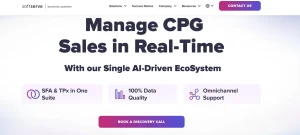
SoftServe Business Systems stands out because it does not treat TPM as an isolated tool. For companies looking for the best trade promotion management software, the wider operating model is a major reason it sits near the top of this list. Its approach is broader.
The company positions its offering as an AI-Driven Ecosystem that integrates trade promotion planning, sales force automation, and image recognition into a single operating environment. That matters in real life.
A promotion may look strong on a planning calendar, but if execution fails in-store, the numbers will disappoint.
SoftServe tries to close that gap by connecting plan, field action, and shelf reality. Its platform highlights AI-based forecasting, baseline automation, pre- and post-event analysis, and trade spend control. It also links promotional activity to field teams, so promo briefs can move faster into execution.
For CPG teams that want planning and store checks to inform each other rather than live in separate systems, that is a serious advantage. For product details, see https://softservebs.com/en/ai-driven-ecosystem/trade-promotion-management-software/.
Pros And Cons Of SoftServe Business Systems Trade Promotions Management Software
The strongest point here is integration. SoftServe Business Systems ties TPM to SFA and image recognition, giving commercial teams a broader view of what is happening before, during, and after a promotion.
That can improve baseline accuracy and make ROI tracking more useful, since execution data won’t arrive weeks later from a different workflow. Another plus is planning usability.
The platform emphasizes interactive calendars, real-time profit-and-loss visibility, and AI-led forecasting, which can help sales and finance work from the same commercial picture. But there is a trade-off. A smaller brand with a narrow SKU range may not need a full ecosystem.
And while the platform can work as a strong TPM layer on its own, the biggest gains come when a company is ready to adopt several connected modules. So the fit is best for brands that want an operating model, not just a budgeting screen.
2. SAP Trade Management: The Enterprise Heavyweight
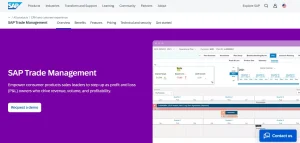
SAP Trade Management remains a common choice for large manufacturers that already run core business processes on SAP. Its value is not mystery or novelty. It is control, structure, and deep process discipline.
SAP presents the solution as a holistic platform for trade management and customer business planning, with support for sales planning, budgeting, promotion planning, and analytics.
In that sense, it behaves like a deeply structured trade-promotion management system for companies that already operate within SAP. For global organizations with layered approvals, country-level complexity, and strict audit expectations, that matters.
SAP is built for scale, and that is still a major reason some companies stay with it. If a business already depends on SAP ERP and wants trade funding, claims, and planning tightly connected to that backbone, SAP is a practical fit.
The downside is that it clearly sits on the more traditional end of the market. Compared with newer cloud-native platforms, the experience can feel heavier and less flexible, especially when teams want faster change cycles.
Pros And Cons Of SAP Trade Management
SAP’s biggest strength is the depth of its enterprise integration. When finance, customer planning, and trade management are all close to the SAP core, the result can be cleaner governance, stronger audit trails, and greater consistency across regions.
It is also built to support large data volumes and complex organizational structures, which is why many global companies still trust it. But that same depth creates friction.
Implementation and change management usually require serious IT involvement. The overall cost of ownership can be high, especially once configuration, support, and internal process alignment are included.
And while SAP is powerful, it does not usually win in terms of speed of use or interface simplicity compared with newer SaaS products. For a giant enterprise, that may be acceptable. For a fast-moving mid-market brand, it can feel like more of a system than the team wants to carry.
3. CPGvision: The Agentic AI Specialist
CPGvision leans hard into AI, and that is its core identity. The company describes itself as an AI-powered trade management team and centers Agentic AI in its messaging.
In practice, that means using AI and machine learning to help commercial teams build plans faster, automate repetitive work, and improve the quality of scenario planning.
CPGvision also places a lot of emphasis on base and lift modeling, which is critical if a brand wants to understand what a promotion actually changed, rather than just reading a topline sales spike.
Buyers comparing modern trade promotion management solutions will notice that CPGvision leans heavily into predictive planning.
Its platform covers trade promotion management, optimization, and revenue growth management, and it is built on Salesforce infrastructure. That gives it a cloud-native position and, for many users, a familiar enterprise foundation.
For mid-to-large CPG companies that want predictive planning without buying into a massive legacy stack, CPGvision is one of the more focused options in this space.
Pros And Cons Of CPGvision
CPGvision’s main appeal is its AI-first design. The company talks about constraint-based what-if analysis, predictive insights, and agents that support planning and workflow execution.
That can reduce manual admin work and help sales, finance, and revenue growth teams model scenarios with more confidence.
Another plus is the platform base. CPGvision says its core applications do not require separate Salesforce licenses, while still benefiting from Salesforce architecture and security.
That lowers one barrier for some buyers. But the platform is still closely tied to the Salesforce ecosystem in its design logic and value story, so brands that do not want that orientation may see less benefit.
It also does not appear to have the same field execution depth as an ecosystem that directly connects TPM to image-based shelf checks. So it is strong for intelligent planning, but not necessarily the most complete closed loop from shelf to plan.
4. TELUS Consumer Goods (Exceedra): The Integrated Global Player

TELUS Consumer Goods, which includes the Exceedra heritage, is one of the stronger end-to-end SaaS players in this category. Its position is clear: help CPG companies move from fragmented planning to one integrated platform that supports trade spend across retail and foodservice channels.
TELUS says its software is trusted by more than 300 consumer goods companies worldwide, including 15 of the top 20 global CPG leaders.
It also markets the platform around end-to-end visibility, from forecast accuracy and annual planning through promotions, approvals, fund management, deduction tracking, and post-event analysis.
That broad channel coverage is a real strength. Many brands struggle because retail and foodservice planning live in separate operating habits, even when the financial pressure is the same.
TELUS tries to address that by giving teams a single platform and a single data model for a broader view of trade effectiveness.
Pros And Cons Of TELUS Consumer Goods
TELUS has a strong case for companies that need breadth. The platform supports both retail and foodservice, includes AI-powered scenario planning, and covers planning, financial control, claims, and deduction visibility within a single environment.
For brands trying to move away from spreadsheet culture, that can be a big step forward. The company also frames the solution around productivity gains and governance, which matters when trade processes span markets and teams.
But broad capability often comes with a learning curve. New users may need time to understand the full planning and financial workflow, especially in organizations where data sits in silos.
Deployment can also be slower when a company is trying to standardize messy inputs from different regions or business units. So the tool is broad and capable, but it works best when the organization is ready for process discipline, not only software replacement.
5. Infor Trade Promotion Management: The Data-Centric Optimizer
Infor positions its TPM product as part of a wider industry cloud offering for consumer goods and food and beverage companies. That context matters because many brands do not want a point solution that sits outside planning, supply, and financial operations.
Infor Trade Promotion Management focuses on visibility, accuracy, and control across planning, execution, analysis, and optimization.
The company also emphasizes review and approval workflows, which makes sense for teams trying to tighten governance around spend. Another practical point is accessibility.
Infor says the product supports mobile use, enabling managers to review plans, budgets, and approvals without being tied to a desktop process.
On the performance side, Infor reports outcomes such as 2% to 5% revenue growth, a 50% to 70% reduction in manual tasks, and a 20% increase in forecast accuracy for FMCG customers. That gives the platform a clear value story.
Pros And Cons Of Infor TPM
Infor’s strengths are discipline and measurable workflow improvement. If a brand wants more accurate planning guidelines, stronger review processes, and better budget control, the product has a credible case.
The published benefits of reduced manual work and improved forecast accuracy also suggest it can clean up core TPM operations, not just add reporting on top.
And because it sits inside a broader industry suite, it may appeal to companies already considering wider process modernization. The limits are more about ecosystem depth and innovation style. Infor has strong analytics, but its TPM message feels more data-centric than execution-centric.
It is built to improve planning and governance, but it does not project the same shelf-to-planning closed loop as a platform with native image recognition and field execution tightly connected. Some organizations may also need other Infor products to unlock the full value of the environment.
6. Vividly: The Growth-Focused Choice for Emerging Brands
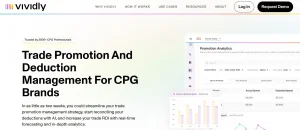
Vividly targets a different buyer profile from SAP or even TELUS. Its product story is closer to modern trade promotion software built for speed than to a heavy enterprise transformation stack.
Its pitch is built around speed, usability, and the daily pain points that high-growth CPG brands feel most sharply.
That includes forecasting, trade spend visibility, and especially deduction management. Anyone who has worked with retailer chargebacks knows how quickly deductions can drain time and cash.
Vividly puts that issue front and center. The company says brands using its deduction management services see a 90% reduction in deduction-processing labor, and it also claims 98% accuracy, with the potential to recover up to $700K in trade spend.
Those are strong operational messages for lean teams. Vividly also says implementation can happen in as little as six months, including more complex ERP and EDI integrations. That makes it attractive for brands that are outgrowing spreadsheets but are not ready for a heavy enterprise program.
Pros And Cons Of Vividly
Vividly’s advantages are clear. It is built for speed, a cleaner user experience, and practical commercial control for mid-market teams. The deduction angle is especially useful because smaller brands often suffer more from retailer disputes and weak documentation processes than from advanced modeling gaps.
Fast deployment is another real plus. A company that needs better forecasting and cleaner deductions this year, not two years from now, may find that appealing. But Vividly is not trying to be everything for everyone.
It does not claim the same enterprise-scale depth as SAP, and it does not appear to offer the same full ecosystem loop as a platform that connects TPM, sales force automation, and shelf image recognition.
So it is a smart fit for growth brands, but probably not the first choice for a global company that needs a highly layered, multi-market operating model.
7. AFS Technologies (MEI): The Specialized Industry Veteran
AFS Technologies, including the MEI TPM heritage, is a long-standing name in North American consumer goods software. Its positioning is less about flashy innovation and more about industry know-how, settlement discipline, and trade control.
AFS has long emphasized closed-loop sales and trade planning, deduction management, validation, settlement, and analytics. That makes it relevant to manufacturers that are less interested in new AI language and more interested in reducing financial leakage.
For businesses that want a seasoned vendor with a strong operational understanding of trade and deductions, AFS still deserves a place on the shortlist.
It may not be the loudest name in the market, but veteran platforms often survive because they solve expensive problems well.
Pros And Cons Of AFS Technologies
AFS brings deep category experience, especially in trade settlement and deduction-heavy environments.
Its long history in consumer goods and foodservice can be useful for teams that need a vendor that understands the mess behind claims, contracts, and reconciliation, not just the front-end planning layer.
The platform’s closed-loop positioning is also important because it suggests a practical link between planning, validation, and settlement.
But there are trade-offs. Compared with newer vendors, AFS does not feel as aggressive in its public messaging about AI, and its user-experience language is less modern.
Some buyers may read that as a signal that the platform is more mature than innovative. That does not make it weak. It just means the appeal is different.
AFS is likely a better fit for companies that value industry depth and financial control over a more modern-looking interface or broader generative AI positioning.
Conclusion
There is no single answer for every brand. The right platform depends on company size, channel mix, internal data maturity, and the extent to which the team wants AI to shape daily planning.
SAP still makes sense for large enterprises that need strict control inside an SAP-centered environment.
TELUS and Infor offer broad process coverage with strong planning and financial discipline. CPGvision is compelling for buyers who want AI-led scenario planning and modern cloud architecture.
Vividly is a strong option for rising brands that need speed and tighter control over deductions.
AFS remains relevant when settlement rigor and industry experience matter most. But if a company wants a more connected commercial system, not just a planning tool, SoftServe Business Systems has a strong edge because it links planning, sales activity, and store-level execution into a single ecosystem.
In 2026, the best trade promotion management software should do more than track budgets. It should help brands connect decisions to real market execution.

Leave a Reply