
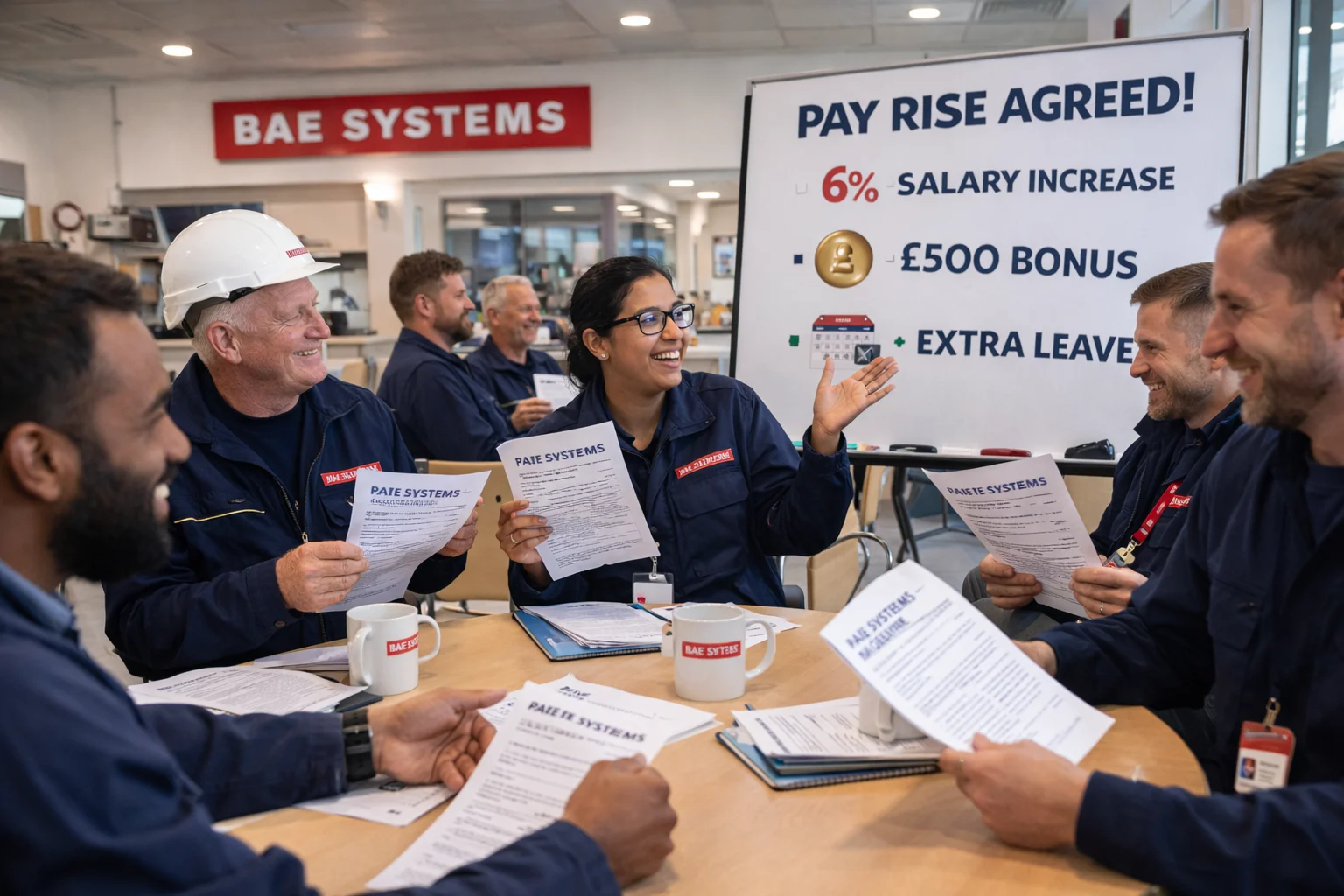
The BAE pay rise agreed for workers at the company’s Lancashire sites has officially brought an end to months of industrial action.
More than 1,000 BAE Systems employees at the Warton and Samlesbury facilities have voted to accept a package that includes a 6% pay increase, a £500 one-off bonus, extra annual leave and a reduction in daily working hours.
The agreement follows negotiations between BAE Systems and Unite the Union after staff rejected an earlier pay offer.
The final settlement includes a 4.8% pay rise backdated to 1 January, an additional 0.75% increase from 1 October, one extra day of annual leave, a further one-off day for union members, and a permanent 30-minute reduction in the working day.
Key points of the agreement include:
- A combined 6% pay increase for staff
- £500 one-off bonus payment
- Additional annual leave for employees
- Permanent reduction of the working day by 30 minutes
- End of the industrial action that began in late 2024
The settlement represents a significant outcome for employees involved in the dispute and highlights the importance of pay negotiations within the UK’s defence and aerospace sector.
What Is the Latest Update on the BAE Pay Rise for Lancashire Workers?

The latest update on the BAE pay rise confirms that more than 1,000 employees working at BAE Systems facilities in Lancashire have approved a revised pay agreement following several months of industrial action and negotiations.
Workers based at the Warton and Samlesbury sites voted to accept a package that includes a pay increase, bonus payment, additional leave, and a permanent change to working hours.
These two Lancashire locations are among the most important aerospace and defence facilities in the United Kingdom. The Warton site is widely known for its involvement in combat aircraft development and testing, while Samlesbury focuses heavily on advanced manufacturing and engineering support for major defence programmes.
The workforce at these locations includes highly skilled professionals working in technical and safety critical roles. Their responsibilities involve supporting complex defence systems, aircraft development, and engineering programmes that require advanced expertise.
The newly agreed BAE pay rise package was negotiated between the company and Unite the Union, which represents a large group of the professional services workforce at these facilities.
After rejecting an earlier offer, employees voted to accept a revised deal that addressed concerns related to pay parity, benefits, and working conditions.
The pay rise structure includes two separate increases applied during the year. The first adjustment introduces a 4.8 percent pay rise backdated to the beginning of January. The second adjustment provides an additional 0.75 percent increase from October.
The overall settlement includes several benefits for employees such as:
- A combined salary increase of close to six per cent
- A one-off £500 bonus payment
- Additional annual leave days
- A permanent reduction in the working day
The table below outlines the main elements of the settlement.
| Component | Details of Agreement |
|---|---|
| Pay Increase Phase 1 | 4.8 percent salary increase backdated to 1 January |
| Pay Increase Phase 2 | 0.75 percent additional rise from 1 October |
| One Off Bonus | £500 payment per employee |
| Annual Leave | One additional day of annual leave for all staff |
| Unite Member Benefit | One additional one off leave day |
| Working Hours | Permanent reduction of working day by 30 minutes |
This agreement officially ends the strike activity that had affected operations intermittently since late 2024. For both the company and the workforce, the deal provides a resolution that restores stability while addressing employee concerns.
A professional labour relations analyst commented on the outcome of the settlement saying,
“When disputes in highly skilled sectors reach this stage, the final agreement usually reflects a balance between financial improvements and quality of life changes for employees.”
This observation reflects how the final BAE pay rise agreement combines salary adjustments with workplace benefits rather than relying solely on pay increases.
Why Did BAE Systems Workers Demand a Pay Rise?
The demand for a BAE pay rise developed from concerns among employees that the original salary offer did not accurately reflect their professional responsibilities, technical expertise, or the company’s financial performance.
The dispute first emerged when workers rejected an initial pay proposal that many believed undervalued their contributions to major aerospace and defence programmes.
Staff working in professional services divisions argued that their roles require specialised knowledge, years of training, and responsibility for safety-critical systems.
Several factors contributed to the demand for a revised pay agreement:
- Concerns about the initial salary increase proposal
- Comparisons with pay rises offered to other workforce groups
- The company’s strong financial performance in recent years
Concerns Over the Initial 3.6% Pay Offer
The original pay offer presented to employees included a 3.6 percent salary increase. While this represented a standard adjustment in some industries, many workers believed it was insufficient considering the highly specialised nature of their work.
Employees working at the Lancashire sites often hold roles that involve advanced engineering expertise and responsibility for critical aerospace systems.
These roles commonly include:
- Aerospace engineering specialists
- Systems integration engineers
- Safety-critical programme professionals
- Technical project coordinators
Many employees argued that the proposed increase did not align with the value they bring to national defence projects.
The table below compares the progression of the pay negotiations.
| Pay Offer Stage | Proposed Increase | Employee Response |
|---|---|---|
| Initial Proposal | 3.6 percent | Rejected by workforce |
| Revised Negotiation | 4.8 percent backdated | Accepted as part of final deal |
| Additional Increase | 0.75 percent from October | Included in final agreement |
| Overall Package Value | Close to 6 percent with benefits | Approved by workers |
A workplace compensation consultant explained the issue clearly stating,
“When skilled engineers compare their pay progression with the broader industry, even a small difference in percentage increases can create dissatisfaction.”
Comparison With Shop Floor Workers’ 4.5% Increase
Another major factor in the dispute was the comparison between pay rises offered to different workforce groups within BAE Systems.
Shop floor workers had previously received a 4.5 percent pay increase. This was higher than the initial 3.6 percent proposal offered to professional services staff.
Many employees believed this difference created an imbalance within the organisation.
While job responsibilities between departments vary, employees felt their roles in engineering, safety, and technical programme management justified a competitive pay structure.
From an author’s perspective covering workplace developments, I have seen similar situations arise across multiple industries.
“In large organisations, internal pay comparisons can quickly influence employee morale because workers naturally expect fairness within the same company.”
Role of BAE Systems’ £3 Billion Profit Announcement
The financial performance of BAE Systems also became part of the negotiation discussions.
The company reported profits of around £3 billion in 2024. Employees and union representatives referenced this figure during negotiations when arguing that the workforce deserved a higher pay settlement.
When companies report strong financial results, workers often expect improved compensation packages that reflect the success of the organisation.
Profit performance frequently becomes an important factor in wage negotiations, especially in sectors where employees contribute to long-term high-value projects.
What Does the New BAE Pay Rise Agreement Include?
The final BAE pay rise agreement includes several improvements that extend beyond salary increases.
The settlement combines pay adjustments with additional benefits designed to improve employee wellbeing and work life balance.
6% Salary Increase Structure
The salary component of the agreement is structured in two stages to deliver immediate financial improvement and future pay growth.
The first adjustment introduces a 4.8 per cent increase that is backdated to January. This ensures employees receive compensation covering the earlier months of the year while negotiations were ongoing.
The second stage introduces a 0.75 per cent increase starting in October.
A compensation specialist reviewing the agreement explained the approach saying,
“Structured pay increases allow organisations to deliver meaningful financial improvements while managing long term payroll commitments.”
The structure also ensures employees benefit from both immediate and future adjustments.
£500 One-Off Bonus Payment
The agreement also includes a £500 one off bonus payment for each employee.
This payment provides immediate financial recognition for staff following the dispute and negotiations.
The financial components of the BAE pay rise settlement are summarised in the following table.
| Financial Benefit | Description |
|---|---|
| Salary Increase | Two stage pay rise totalling close to 6 percent |
| Bonus Payment | £500 one off payment for employees |
| Backdated Pay | Pay increase applied from January |
One off bonuses are commonly included in labour agreements because they allow companies to reward employees without permanently increasing salary commitments.
Additional Annual Leave for Employees
Work-life balance improvements also form part of the agreement.
Employees covered by the settlement will receive an additional day of annual leave.
Unite members will receive an additional one-off holiday day as part of the negotiated benefits.
The table below summarises these workplace benefits.
| Workplace Benefit | Details |
|---|---|
| Additional Annual Leave | One extra day added to employee entitlement |
| Union Member Leave | One additional one off day for Unite members |
| Work Life Balance Impact | Increased rest time and flexibility |
Additional leave benefits are frequently included in negotiations because they improve employee satisfaction while maintaining manageable operational costs for employers.
Permanent Reduction in Working Hours
One of the most notable outcomes of the agreement is the permanent reduction of the working day by thirty minutes.
Reducing daily working hours without reducing pay effectively increases the hourly value of an employee’s salary.
This change can offer several advantages:
- Improved work-life balance for employees
- Reduced fatigue in highly technical roles
- Increased productivity and concentration
A workplace productivity consultant highlighted the importance of this type of change stating,
“Shorter working days can improve focus and overall performance, especially in complex engineering environments.”
How Did the Industrial Action at BAE Systems Unfold?
The industrial dispute that led to the BAE pay rise agreement developed over several months.
The conflict began when employees voted in favour of strike action after rejecting the original pay offer. The vote took place in October and led to organised industrial action across the Lancashire facilities.
Employees participated in scheduled walkouts while negotiations continued between the union and the company.
The timeline below outlines the key stages of the dispute.
| Date | Event |
|---|---|
| October | Workers vote for strike action |
| November 5 | Industrial action begins |
| November to January | Intermittent strikes continue |
| January 28 | Initial strike period ends |
| February 2 | Additional walkouts begin |
| February | Negotiations lead to settlement |
During the dispute, BAE Systems reportedly attempted to challenge the strike action through legal channels. Reports indicated that the company sought High Court intervention in an attempt to prevent further walkouts.
Despite this effort, industrial action continued until negotiations produced a revised settlement.
Industrial disputes in large defence organisations can attract significant attention due to the strategic importance of the projects involved.
Which Employees Are Affected by the BAE Pay Rise in Lancashire?

The BAE pay rise primarily affects employees working in professional services divisions at the Warton and Samlesbury sites.
These workers support engineering, safety, and programme management operations that contribute to the development of advanced aerospace technologies.
Roles affected by the agreement include:
- Aerospace engineers involved in aircraft design
- Safety-critical system specialists
- Technical programme and operations staff
- Systems engineers responsible for integration and testing
- Project support professionals managing programme coordination
The workforce involved in the settlement supports several key defence and aerospace initiatives within the United Kingdom.
The table below highlights the types of roles covered by the agreement.
| Job Category | Typical Responsibilities |
|---|---|
| Aerospace Engineers | Aircraft development and testing |
| Safety Specialists | Ensuring compliance with safety regulations |
| Systems Engineers | Integration of aircraft and defence systems |
| Technical Programme Staff | Supporting operational delivery |
| Project Support Professionals | Managing documentation and coordination |
These roles require extensive technical training and experience. Maintaining competitive compensation is therefore considered important for attracting and retaining skilled professionals.
What Have Unite Union and BAE Systems Said About the Pay Deal?
Following the agreement on the BAE pay rise, both BAE Systems and Unite the Union released statements regarding the outcome of the negotiations.
BAE Systems stated that it was pleased to reach an agreement with the union group and emphasised the importance of its workforce in supporting the United Kingdom’s defence capabilities.
The company also highlighted the role of employees in maintaining combat air capability and supporting defence programmes for the UK and allied nations.
Unite general secretary Sharon Graham praised the determination shown by workers throughout the dispute.
She explained that employees demonstrated unity while advocating for a pay settlement that recognised their contribution to the company’s success.
From my perspective covering labour relations and business developments, this outcome demonstrates the impact of collective bargaining.
“When skilled workers organise effectively and maintain solidarity during negotiations, employers often respond with improved offers that better reflect workforce expectations.”
How Could the BAE Pay Rise Affect the UK Aerospace and Defence Sector?
The BAE pay rise agreement could influence compensation discussions across the wider aerospace and defence industry.
Large companies like BAE Systems often establish benchmarks for employment standards within the sector. When a major pay settlement occurs, other organisations sometimes review their own pay structures to remain competitive.
Several potential effects may emerge from this agreement:
- Increased focus on competitive engineering salaries
- Greater emphasis on employee well-being and work-life balance
- Stronger union influence during pay negotiations
Engineering talent remains one of the most valuable resources in the aerospace sector. Companies must ensure their compensation packages remain competitive to attract and retain highly skilled professionals.
What Does This Pay Rise Mean for Future BAE Systems Pay Negotiations?

The resolution of the BAE pay rise dispute may influence how future negotiations are conducted between the company and its workforce.
Successful settlements often establish reference points for future discussions.
Employees may view the agreement as an example of how collective negotiation can influence workplace conditions.
A labour market strategist explained this dynamic clearly saying,
“Every major pay settlement becomes a benchmark for future negotiations because both employers and unions analyse what strategies were effective.”
Future negotiations at BAE Systems may therefore focus on improving communication between management and workforce representatives to prevent disputes from escalating to industrial action again.
Conclusion
The BAE pay rise accepted by workers at Warton and Samlesbury represents a significant development following months of industrial action.
More than 1,000 employees will benefit from a package that includes a 6% pay increase, £500 bonus, additional leave and reduced working hours. The agreement highlights the impact of union negotiations and employee solidarity in securing improved workplace conditions.
For the wider aerospace and defence industry, the settlement may influence future pay discussions and reinforce the importance of competitive compensation for highly skilled technical professionals.
Frequently Asked Questions About the BAE Pay Rise
When will the BAE Systems pay rise come into effect?
The pay rise will be introduced in stages. A 4.8% increase is backdated to 1 January, while an additional 0.75% increase will be applied from 1 October as part of the agreed settlement.
How much is the total pay increase for BAE workers in Lancashire?
The combined pay increase is approximately 6%, delivered through two separate salary adjustments during the year.
Why did BAE employees take industrial action?
Employees voted for strike action after rejecting an initial 3.6% pay offer, arguing it did not match the pay rise given to shop-floor workers or reflect the company’s financial performance.
Will all BAE Systems employees receive the £500 bonus?
The £500 payment forms part of the settlement agreed with the Unite union group and applies to the employees covered by that agreement.
What additional benefits are included in the BAE pay deal?
The agreement includes an extra day of annual leave for all staff, a further one-off day for Unite members and a permanent reduction of the working day by 30 minutes.
Which BAE Systems sites are affected by the pay rise?
The pay settlement applies to employees working at the Warton and Samlesbury sites in Lancashire, two major aerospace facilities operated by BAE Systems.
Could similar pay negotiations happen again at BAE Systems?
Pay negotiations are a normal part of employment relations in large organisations, so future discussions between unions and the company may occur during upcoming pay review cycles.
Related Articles

Leave a Reply