
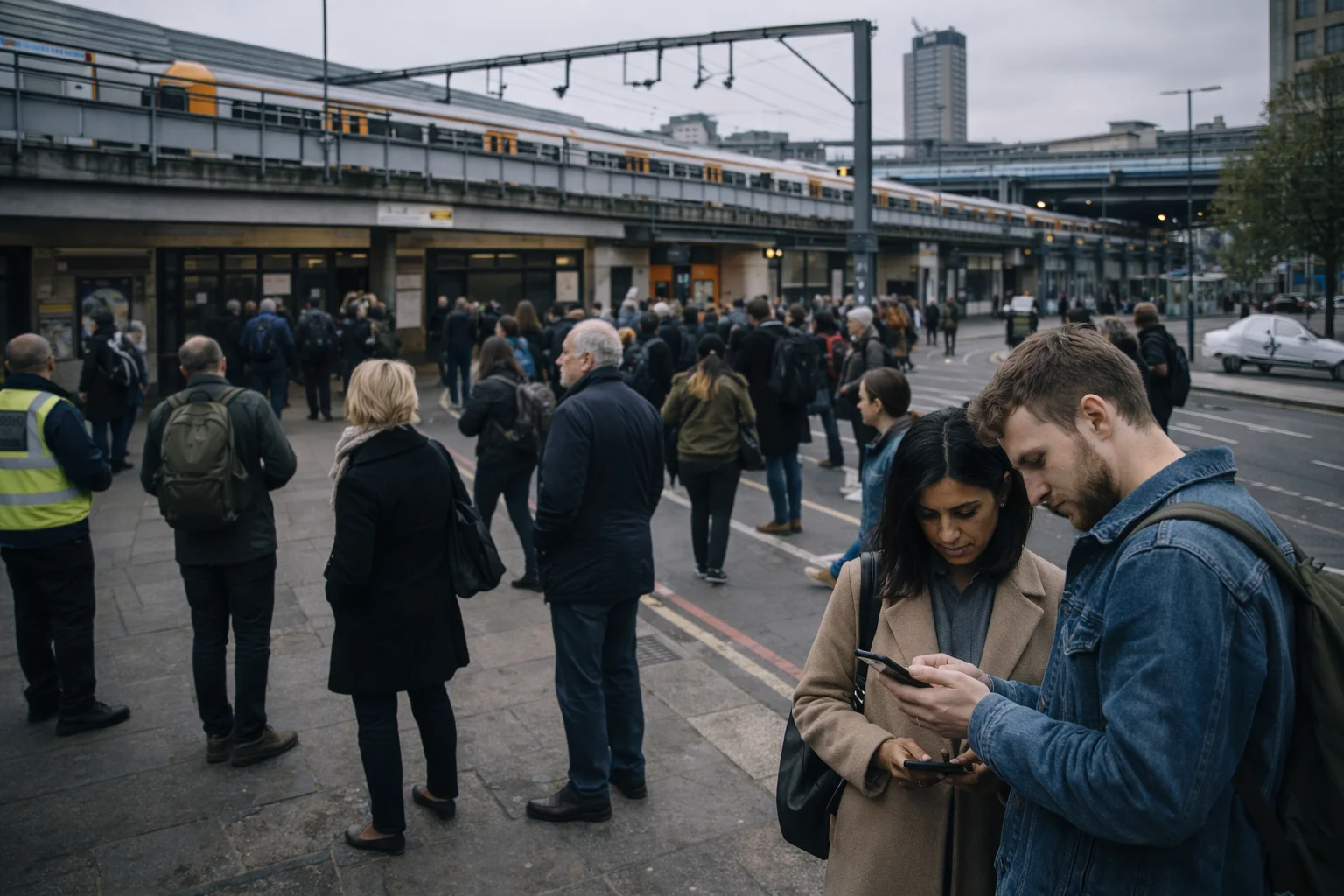
The London Overground strike 2026 will take place on three confirmed Thursdays: 26 February, 26 March, and 23 April.
The industrial action, led by RMT union members working under subcontractor Cleshar CS Ltd, will mainly affect the Windrush Line, which runs from Highbury & Islington to Clapham Junction, Crystal Palace, and West Croydon. The strike will cause full-day service disruptions and potential delays into the following mornings.
What Are The Confirmed Dates For The London Overground Strike In 2026?

The Rail, Maritime and Transport Union (RMT) has confirmed that industrial action affecting the London Overground network will take place on three separate days during early 2026.
These strikes are expected to significantly disrupt Overground services across the capital.
Each strike is planned to run for a 24-hour period, starting from midnight. The following days may also experience residual delays due to train and crew displacement from the previous day’s action.
London Overground Strike Dates
| Date | Day | Duration | Potential Follow-Up Disruption |
|---|---|---|---|
| 26 February 2026 | Thursday | 24 Hours | Morning of 27 February |
| 26 March 2026 | Thursday | 24 Hours | Morning of 27 March |
| 23 April 2026 | Thursday | 24 Hours | Morning of 24 April |
Each of these days falls on a Thursday, which is a critical weekday for work commutes, school travel, and operational delivery. The timing is not coincidental; it’s designed to cause widespread disruption, maximising leverage for striking staff during negotiations.
The RMT has formally notified Transport for London (TfL), and the strike action is being coordinated in conjunction with other potential industrial activities, such as the national rail walkouts expected later this spring.
Which London Overground Lines Will Be Affected By The Strike Action?
The primary line affected by the 2026 London Overground strike is the Windrush Line. This line plays a significant role in connecting north and south London without requiring passengers to travel through Zone 1.
Windrush Line Overview
| Station Start Point | Major Stops | End Point |
|---|---|---|
| Highbury & Islington | Dalston Junction, Peckham Rye | Clapham Junction |
| Highbury & Islington | Canada Water, New Cross | West Croydon |
| Highbury & Islington | Brockley, Sydenham, Norwood Junction | Crystal Palace |
Only this line is officially affected by the confirmed strike action. However, because the Windrush Line interchanges with multiple other services, including the Jubilee Line at Canada Water and the Northern Line at Clapham Junction, the effects may spill over to parts of the broader network.
For example, passengers rerouting through Canada Water are likely to increase congestion on Jubilee Line services, especially during morning and evening peaks.
While TfL has not confirmed if there will be additional service planning, historically, during similar strike actions, temporary bus services and marshals have been deployed to assist affected passengers.
Why Are London Overground Staff Going On Strike?

The strikes are being led by staff responsible for signalling and telecom systems who are employed by Cleshar CS Ltd, a subcontractor for Transport for London. This action stems from multiple unresolved issues around compensation, working conditions, and job protections.
The core grievances raised by the RMT union include:
- Pay increases that fall below the current inflation rate, impacting take-home pay in real terms
- Discrepancies in overtime payment policies, with staff reporting unpaid hours
- Issues relating to annual leave policies, including scheduling limitations
- Degraded terms and conditions compared to their previous contracts before Cleshar CS Ltd took over operations
RMT has stated publicly that they attempted to resolve the matter through negotiation, but the company has failed to meet demands that ensure parity with other TfL-employed staff.
I’ve followed the evolution of this dispute, and to me, the situation reflects the increasingly fragile structure of subcontracting in London’s public transport.
One signaler I briefly spoke to during last year’s Underground strike told me:
“It’s not even about getting more money, it’s about getting what’s fair and promised when we were hired. The company changed, but we didn’t.”
These strikes are less about disruption and more about structural fairness. In my view, the frustration seems deeply rooted in ongoing neglect of subcontracted employees, who are essential to the network’s smooth operation but often excluded from core pay and benefit schemes.
What Is The RMT Union’s Role In The Overground Strike?
The Rail, Maritime and Transport Union (RMT) is orchestrating the industrial action and represents the workers currently employed under Cleshar CS Ltd. RMT is widely recognised for defending the interests of transport workers across London and the UK, and has been at the centre of numerous strike actions in recent years.
While many passengers associate the union primarily with Tube strikes, their involvement in the Overground highlights how broader parts of the public transport workforce are increasingly engaging in industrial action to protect their rights.
The union has released several public statements indicating its willingness to resume talks with Cleshar CS Ltd, as long as meaningful proposals are presented.
A senior transport policy analyst I spoke with had this to say:
“The union’s position is not unique. We’re seeing more and more disputes across UK transport due to outsourcing, pay gaps, and weakened worker protections. In the RMT’s case, they’re drawing a line because if they don’t now, the working standards will just continue to erode across all contract levels.”
That insight stuck with me. It revealed the underlying concern: if left unresolved, disputes like these might become more frequent, not just for the Overground, but across bus and tram services as well.
How Will The Strike Affect Commuters And Daily Travel?

For many Londoners, the Overground is an essential route between home and work, especially for those travelling between east and south London without navigating Zone 1. The Windrush Line is a popular alternative to the Underground, providing fast, frequent connections without additional central zone fares.
Expected Commuter Impact
| Commuter Group | Travel Changes Required |
|---|---|
| Daily Workers | Shift to bus or alternate Underground routes |
| Students | Potential delays for school and university |
| NHS & Shift Staff | Early departures, rerouting via bus/tram |
| Tourists | Loss of direct routes to attractions/hotels |
On strike days, service on the Windrush Line is expected to be fully suspended, and disruptions may spill into early morning travel the following day.
If you are one of the thousands who rely on this route, consider the following adjustments:
- Leave earlier than usual to account for congestion and rerouted services
- Download real-time travel apps like Citymapper or TfL Go
- Work remotely if your employer allows it on the strike days
- Use bike-sharing schemes or walking routes for short distances between stations
From personal experience, I find that early planning is the best response. During a previous strike, I combined walking and Overground, where services were available, and surprisingly, the trip didn’t take much longer.
What Alternative Travel Routes Can Londoners Use During The Strike?
With the Windrush Line unavailable, commuters will need to look at viable alternatives across buses, the Underground, National Rail, and cycling routes.
Suggested Travel Alternatives
| Origin | Destination | Suggested Alternative Route |
|---|---|---|
| Highbury & Islington | Clapham Junction | Victoria Line to Vauxhall, then SWR to Clapham |
| Canada Water | Crystal Palace | Jubilee Line to London Bridge, then Southern Rail |
| Dalston Junction | Peckham Rye | Bus 78 or Overground + walk |
| West Croydon | Highbury & Islington | Southern Rail to London Bridge + Northern Line |
In addition to traditional rail and bus options, walking and cycling can be surprisingly efficient for Zone 2 and Zone 3 trips. TfL Cycle Hire stations are widely distributed near Overground stations, and walking routes through parks and canals often offer pleasant alternatives for short-to-mid journeys.
How Can Travellers Stay Updated With The London Overground Strike?
Staying informed is crucial during strike periods, especially because last-minute negotiation outcomes can lead to changes or cancellations of planned industrial action.
Here’s how you can stay informed:
- TfL Website – Real-time Overground updates and alerts
- TfL Twitter (@TfL) – Quick responses and news
- RMT Official Website – Latest strike confirmation and union statements
- News Media (BBC London, Evening Standard) – Coverage of strike impact and commuter feedback
- Journey Planner Apps (Citymapper, National Rail) – Alternative route suggestions and live delays
I recommend setting up TfL service alerts through the app or email. They can give you a clear sense of morning disruption and alternative options before leaving the house.
Is There A Possibility That The Strikes Will Be Called Off?
Although the current stance of the RMT suggests the strike will proceed as scheduled, there remains the possibility of cancellation if meaningful negotiation progress is made before each planned walkout.
Historically, the union has withdrawn industrial action when employers return to the negotiation table with revised terms that address key concerns. In this case, if Cleshar CS Ltd puts forward a reasonable compromise on pay, overtime, and leave policies, there’s a chance the strike may be suspended.
As per a statement from Transport for London:
“We urge the RMT and Cleshar CS Ltd to work together to resolve this dispute over pay and conditions. We are assessing the impact of potential strike action and are putting plans in place to help minimise any disruption for our customers.”
It’s a familiar cycle for many London commuters. Announcements. Negotiations. Cancellations. Or, sometimes, walkouts. I’ve learned to stay informed but not alarmed, plan for disruption, hope for resolution.
What’s The Complete Strike Calendar For London In 2026?
In addition to the confirmed Overground strikes, other unions representing Tube, rail, and bus workers are also planning or considering industrial action in 2026. This makes it important for commuters and businesses alike to understand the broader strike context.
2026 London Transport Strike Calendar (So Far)
| Sector | Union | Dates Confirmed/Expected | Affected Services |
|---|---|---|---|
| London Overground | RMT | 26 Feb, 26 Mar, 23 Apr | Windrush Line |
| London Underground | ASLEF | Expected Spring 2026 | Bakerloo, Piccadilly Lines |
| National Rail | RMT/ASLEF | Under Discussion (April–May) | Cross-country and Southeastern |
| London Buses | Unite | Pending Ballot Results | Selected South and East routes |
These dates are still subject to change depending on negotiations, but they offer a snapshot of the transport climate in the capital for the coming months.
Keeping track of this evolving strike calendar will help commuters and organisations better prepare for disruptions and find alternative ways to move around the city.
How Are Businesses Preparing For The Overground Strike Disruptions?
For many London-based businesses, especially those reliant on in-person staff, the Overground strike poses a clear operational challenge. From hospitality and retail to logistics and healthcare, several sectors are now actively preparing to mitigate the impact of the Windrush Line shutdown.
Key Business Impacts And Responses
| Business Sector | Main Challenge | Common Preparation Strategy |
|---|---|---|
| Hospitality & Retail | Staff lateness, reduced foot traffic | Adjusted shifts, remote inventory control |
| Office-Based Companies | Commuter delays, reduced productivity | Temporary remote work allowances |
| Logistics & Delivery | Route delays and driver shortages | Route planning using A-roads & vans |
| Healthcare | Staff shortages during peak hours | Pre-arranged shift swaps or carpooling |
Many employers, especially those in central and south-east London, are adjusting working hours or encouraging employees to start earlier or work remotely on strike days. Some offices are staggering start times to reduce peak-hour congestion.
While speaking with a friend who manages a team in a Canary Wharf tech firm, she mentioned:
“We’ve shifted all our in-office meetings away from strike days. The team has the flexibility to work from home, but we’ve had to plan for that in advance.”
It’s a useful reminder for businesses to anticipate disruption, not just react to it. Those who have well-documented continuity plans will be better equipped to adapt when transport reliability falters.
What Could Be The Long-Term Effects Of Recurring Overground Strikes?
The 2026 Overground strike isn’t just a momentary inconvenience; it’s part of a longer story of worker-employer disputes and systemic pressure on London’s transport model. As more public services are subcontracted to third parties, tensions over wages, job security, and workplace rights continue to rise.
For the travelling public, repeated strike action may lead to changes in behaviour over time:
- A shift toward remote or hybrid work, even in roles that once required office presence
- Increased reliance on cycling, walking, or carpooling for local journeys
- Growing public support for improved worker protections across outsourced roles
Long-Term Impacts On London’s Transport And Workforce
| Area Affected | Projected Outcome |
|---|---|
| Commuter Habits | Flexible commuting patterns are adopted long-term |
| Worker Retention | Reduced appeal for subcontracted roles |
| TfL Operations | Pressure to re-integrate subcontracted staff |
| Policy Discourse | Renewed focus on pay equity and contracts |
As someone who’s relied on public transport for most of my adult life in London, I can say the trust commuters place in the Overground system is strong, but it’s not unbreakable. Every strike chips away slightly at public confidence, especially when the root causes go unresolved.
One signal technician I spoke to last year during a similar event said:
“We’re not trying to stop London from moving. We’re just trying to be heard before we’re pushed out.”
That comment stayed with me. It reminded me that transport strikes are about more than trains; they’re about people trying to preserve a livelihood that’s becoming increasingly insecure.
Conclusion: How should Londoners prepare for the Overground strikes?
The 2026 London Overground strike is a firm reminder of how fragile parts of our transport system can be, especially when subcontracting complicates the employment structure.
While there’s hope that negotiations may avert the walkouts, it’s best to plan for disruption, follow official updates, and consider your commute alternatives now rather than later.
I’ll be keeping an eye on developments and, like many Londoners, hoping for a swift and fair resolution not just for our commutes, but for the workers behind the service too.
FAQs about the London Overground Strike 2026
Will the Overground strike affect weekend services too?
The strike dates are limited to Thursdays, but delayed service recovery may affect early morning travel on the Friday following each strike.
Can I claim compensation for delays due to the strike?
TfL generally does not offer compensation for delays caused by strike action. However, unused tickets may be eligible for refunds under certain conditions.
Are Overground staff employed directly by TfL?
Not all. Many are subcontracted, like those under Cleshar CS Ltd, which is at the centre of this dispute.
Will Overground Night Services be suspended during the strike?
Yes, night services on affected lines will also be suspended during the 24-hour strike period.
How early should I leave home on strike days?
Expect longer waits and busier services. Plan to leave at least 30 minutes earlier than usual.
Are any other unions planning strikes during the same time?
There are discussions underway, especially from Tube-related unions, but no confirmed overlapping dates yet.
How will the strike impact travel for tourists visiting London?
Tourists should plan using alternate Underground lines or buses and check TfL’s live updates regularly during their stay.

Leave a Reply