
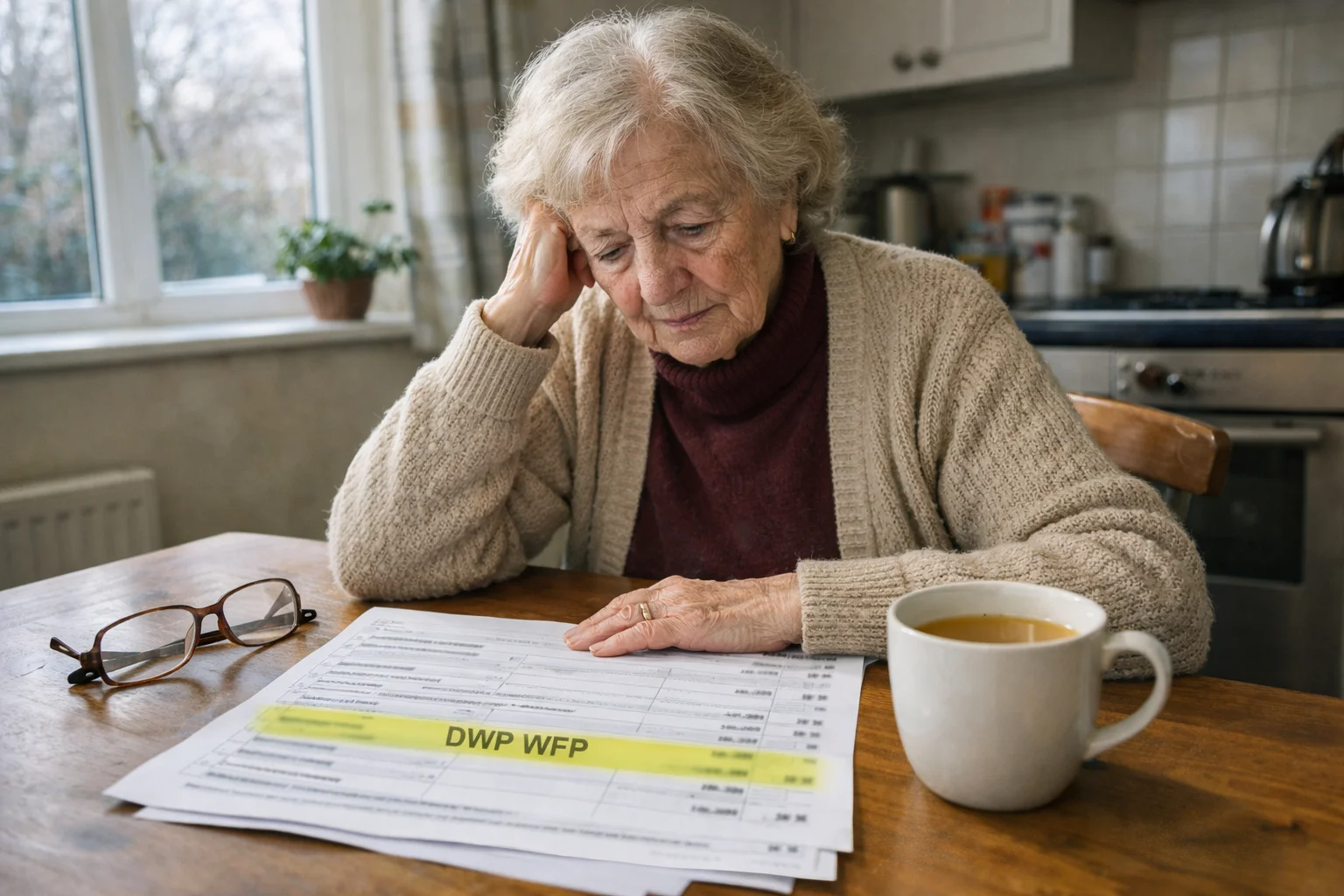
If you’ve noticed “DWP WFP” on your bank statement, it stands for the Department for Work and Pensions Winter Fuel Payment – a tax-free annual payment to help people of State Pension age cover heating costs during winter.
It usually arrives in November or December, with the reference showing your National Insurance number followed by DWP WFP.
Here’s what you’ll learn in this guide:
- DWP WFP meaning
- Eligibility criteria and exceptions
- Payment amounts based on age and living situation
- How to confirm the payment is yours
- What to do if you haven’t received it
- Application process if you’re not paid automatically
- HMRC reclaim rules for high earners
- How to avoid scams
- Additional heating-related support schemes are available in the UK
What Does ‘DWP WFP’ Mean On Your Bank Statement?
When you check your bank statement in late autumn or early winter, you may spot a transaction that reads something like: QQ123456C DWP WFP. This code is often unfamiliar, particularly for those who are new to receiving government benefits related to age or heating support.
To break it down simply, this is a Winter Fuel Payment issued by the Department for Work and Pensions (DWP), and it appears with your National Insurance number followed by the DWP WFP label.
What The Payment Reference Code Looks Like?
The reference often follows a consistent pattern.
Here’s how it’s structured:
- Your National Insurance number (e.g., QQ123456C)
- Followed by the letters DWP WFP
This is a helpful way to verify that the payment is legitimate. For example, if you see a reference like AB987654B DWP WFP and AB987654B matches your NI number, that confirms it’s your Winter Fuel Payment.
From personal experience, and having assisted many pensioners and older clients with checking their financial transactions, this specific code often causes confusion. I remember receiving calls asking if this was a new form of benefit or a scam, especially because of the obscure-looking transaction references.
Once you understand that DWP WFP simply means Winter Fuel Payment, it becomes easier to track and confirm.
Who Qualifies For The Winter Fuel Payment?
To be eligible for a Winter Fuel Payment during the 2025 to 2026 winter period, you must meet several conditions. The most important criteria are related to age and residency.
You can get a Winter Fuel Payment if:
- You were born before 22 September 1959
- You live in the UK during the qualifying week, which is between 15 and 21 September 2025
A government professional from the DWP was quoted recently addressing this exact concern, noting:
“There’s no need for most people to apply for the Winter Fuel Payment. If you’re receiving the State Pension or other qualifying benefits, you will receive the payment automatically.”
This clarification helps those who may be uncertain if any action is needed to receive the support.
Other Eligibility Considerations
There are additional specific scenarios where your eligibility might differ slightly:
- If you live in a care home, you may still qualify, unless you receive certain income-based benefits and have been in the home for the entire qualifying period.
- If you live in Northern Ireland, you may still qualify under similar eligibility rules set by the Northern Ireland Executive.
- If you live in Scotland, Winter Fuel Payments are no longer provided. Instead, eligible residents may receive the Pension Age Winter Heating Payment from Social Security Scotland.
When You Are Not Eligible
You will not be eligible for the Winter Fuel Payment if:
- You live outside England or Wales
- You were in the hospital receiving free treatment for the entire week of 15 to 21 September 2025
- You were in prison for the entire qualifying week
- You require permission to enter the UK and your immigration status prevents access to public funds
How Much Is The DWP WFP Payment And When Is It Paid?

The actual amount of the Winter Fuel Payment varies depending on your age, household situation, and benefits status. In general, most payments fall between £100 and £300.
You’ll receive a letter in October or November 2025 outlining the payment amount and confirming which bank account it will be sent to.
If you qualify, the payment is typically made in November or December, arriving just in time to help with heating costs during the coldest part of the year.
Here’s how the payment is calculated:
Table: Winter Fuel Payment Amounts Based on Living Situation
| Your Situation | Born Between 22 Sep 1945 and 21 Sep 1959 | Born Before 22 Sep 1945 |
|---|---|---|
| Live Alone | £200 | £300 |
| Live With Someone Also Eligible | £100 | £150 |
| In A Care Home And Not On Income-Based Benefits | £100 | £150 |
| In A Care Home And Receiving Income-Based Benefits | Not Eligible | Not Eligible |
These amounts may also be increased if the government issues Cost of Living Payments on top of the standard Winter Fuel Payment, as has happened in recent years to help combat rising energy bills.
When Payment Is Made
Most payments are processed automatically, and you don’t need to apply if you’re already receiving:
- State Pension
- Pension Credit
- Universal Credit
- Attendance Allowance
- Disability Living Allowance (DLA)
- Personal Independence Payment (PIP)
These payments generally arrive between mid-November and late December, and if not received by 28 January 2026, it is advisable to contact the DWP.
How Do You Know The WFP Payment Is Yours?
To confirm the payment is yours, look closely at your bank statement. The key is the National Insurance number at the beginning of the reference. If this matches your own, then the payment is legitimate and assigned to you.
For many pensioners, the payment will arrive in the same account where other benefits, like the State Pension, are paid.
If you’re unsure, cross-check the account details in the confirmation letter sent by the DWP during October or November.
From personal experience, I recall reviewing a relative’s bank transaction and seeing the code without any clear context. At first glance, it looked like a potential error or a mislabelled transaction.
But once we linked the National Insurance number and matched the timeline with the expected Winter Fuel Payment, everything became clear.
What Should You Do If You Haven’t Received Your WFP Payment?
If you were expecting a Winter Fuel Payment but haven’t seen it appear in your account, the first step is to confirm whether you received the confirmation letter.
This letter usually arrives in October or early November, informing you of:
- The amount you’ll be paid
- The account where it will be deposited
- The expected payment period
If you didn’t receive this letter or the payment is still missing after 28 January 2026, you should contact the Winter Fuel Payment Centre.
Contacting The DWP
Here are the details to get in touch:
- Phone: 0800 731 0160
- Relay UK: 18001 then 0800 731 0160
- Monday to Friday, 8am to 6pm
Before calling, prepare the following:
- Your National Insurance number
- Your bank or building society details
- Your marital status or civil partnership information
- Any information about time spent in hospital, care homes, or prison during the qualifying week
If your case is more complex, you may need to request a mandatory reconsideration, which is a formal process for disputing DWP decisions.
How Can You Apply For The Winter Fuel Payment If You’re Not Paid Automatically?

Not everyone receives the Winter Fuel Payment automatically. If you do not get the State Pension or a qualifying benefit, you may need to submit a claim.
This often applies to:
- People who have deferred their State Pension
- Individuals who have recently returned to the UK after living abroad
- Those who have never received a Winter Fuel Payment before
You can apply:
- By post, using a claim form available from the GOV.UK website
- By phone, using the contact number provided earlier
Deadline To Apply
For the 2025 to 2026 winter period, the deadline to apply is 31 March 2026. Claims submitted after this date will not be processed.
When applying, you’ll need to provide your NI number, bank details, and relevant personal information, including your marital status and living situation during the qualifying week.
Can HMRC Reclaim Your Winter Fuel Payment?
In some cases, HMRC may reclaim your Winter Fuel Payment, particularly if your total taxable income exceeds £35,000. While the Winter Fuel Payment itself is not means-tested, the government reserves the right to recover the amount through taxation if you are above this income threshold.
There are two main ways this can happen:
- Tax Code Adjustment: HMRC may increase the amount of tax you pay during the 2026 to 2027 tax year by adjusting your tax code.
- Self-Assessment Return: If you complete a Self-Assessment tax return, the payment amount will be added to your taxable income.
Table: HMRC Reclaim Process for Higher Earners
| Your Income Level | Method Of Reclaim |
|---|---|
| Below £35,000 | No reclaim |
| Above £35,000 (PAYE) | Adjustment in tax code |
| Above £35,000 (Self-Employed) | Declared in Self-Assessment |
If you are unsure whether this affects you, it’s worth speaking with HMRC or consulting a tax advisor.
What Scams Should You Be Aware Of With WFP Payments?
Unfortunately, scams around government payments like the Winter Fuel Payment are on the rise. Fraudsters often send emails, texts, or even phone calls claiming to be from the DWP and requesting personal details to process or release your payment.
Here are some signs a message may be a scam:
- Requests for your bank details
- Messages urging you to click a link to “claim” your WFP
- Phone calls that sound threatening or demand immediate action
The DWP has made it clear that they will never ask for your bank details over email or text. If you get a suspicious message, it’s best to report it to the National Cyber Security Centre or forward phishing emails to report@phishing.gov.uk.
In my own research and writing on social support schemes, I’ve seen how pensioners, in particular, are often targeted by these scams. Raising awareness is critical, especially during the winter period when such payments are being processed.
What Other Heating-Related Government Support Is Available In The UK?
While the Winter Fuel Payment is a well-known form of government support for heating costs, especially for older residents, it’s far from the only one.
With the ongoing challenges of rising energy prices, the UK government has introduced and maintained several additional schemes to assist those struggling with household energy bills, particularly during the colder months.
These schemes are not all age-based. Many are linked to income levels, benefits eligibility, or disability status, and can provide meaningful financial relief to individuals and families during winter.
As someone who has followed social support developments closely, I’ve found that understanding how these schemes work can often make the difference between staying warm and falling into debt during the heating season.
Let’s take a detailed look at the primary alternatives or complements to the Winter Fuel Payment.
Cold Weather Payment
The Cold Weather Payment is a benefit that activates automatically in areas experiencing severe winter conditions. This scheme is specifically designed to provide additional support to people on low incomes or those receiving certain benefits.
You may be eligible for Cold Weather Payments if you receive:
- Pension Credit
- Income Support
- Income-based Jobseeker’s Allowance (JSA)
- Income-related Employment and Support Allowance (ESA)
- Universal Credit (with health conditions or child element)
This payment is triggered when the temperature in your area drops to 0°C or below for seven consecutive days between 1 November and 31 March.
Each qualifying period of seven days results in a £25 payment, which is paid automatically into the same account as your benefits. No application is necessary if you meet the criteria.
For example, in certain parts of Scotland and Northern England where cold snaps are more frequent, eligible households may receive multiple Cold Weather Payments over the course of a single winter.
These payments can add up and significantly ease the burden of unexpected heating costs.
As a writer tracking benefit usage patterns, I’ve spoken to individuals who said these payments were the only reason they could afford to run their heating continuously during extreme cold spells. For many, especially those in poorly insulated homes, this support is essential.
Warm Home Discount Scheme
The Warm Home Discount Scheme offers direct savings by reducing your electricity bill by £150. This is not a cash payment; instead, the discount is applied directly to your bill by your energy supplier.
There are two main eligibility groups:
- Core Group: Those receiving the Guarantee Credit element of Pension Credit
- Broader Group: Individuals on a low income who meet their energy supplier’s criteria
The discount is typically applied between October and March, and most of the process is handled automatically.
If you’re part of the core group, you should receive a letter from the DWP confirming your eligibility. Those in the broader group may need to apply directly with their energy supplier.
In recent years, the scheme has been adjusted to ensure data sharing between the DWP and energy providers, making the process smoother and ensuring more people receive the discount without needing to take extra steps.
One important note is that not all energy suppliers participate in the scheme. It’s worth checking with your provider to confirm whether the Warm Home Discount is available and how to apply if needed.
Household Support Fund
Introduced in response to the rising cost of living, the Household Support Fund is a flexible emergency support programme administered by local councils across England.
The fund can be used for:
- Utility bills (gas, electric, water)
- Food and essential supplies
- Clothing or essential household items
- Emergency heating support
The eligibility criteria vary by council, but many focus on low-income households, families with children, disabled individuals, and pensioners not receiving adequate support through traditional benefits.
Applications are generally made through your local authority’s website, and evidence such as recent bills, benefit letters, or proof of hardship may be required.
In some areas, the fund also includes vouchers or prepaid cards that can be used for fuel or groceries.
The fund is reviewed and extended periodically, based on government budget allocations. As of early 2026, many councils are continuing to receive funding for the scheme, although support levels may differ depending on local priorities.
Having spoken with local council officers and support organisations, I’ve learned that this fund can act as a lifeline for households in temporary crisis.
It’s especially valuable when other national schemes, such as Winter Fuel Payment or Cold Weather Payment, don’t cover specific needs or arrive too late in the season.
Other Local and Regional Support
In addition to national schemes, there are local grants and programmes available across the UK.
These may include:
- Boiler replacement grants
- Home insulation schemes
- Energy efficiency assessments
- Local hardship grants for energy debts
These vary by region and are often tied to larger government initiatives, such as the Energy Company Obligation (ECO) scheme or local fuel poverty reduction plans.
Residents are encouraged to contact their local council, Citizens Advice, or Age UK to learn about region-specific support.
Final Thoughts: Understanding DWP WFP Payments is Key This Winter
Recognising “DWP WFP” on your bank statement can save a lot of confusion, especially during the winter months when expenses are high.
It’s a valuable support mechanism for pensioners and those on lower incomes, and knowing the details of the payment can help avoid missed benefits or falling for scams.
As someone who’s worked closely with older adults and financial education, I’ve often been asked what this line on a bank statement really means.
It’s reassuring to know that this payment is straightforward, reliable, and designed to help during the coldest times of year.
But vigilance is still important. If you’re unsure whether you’ve received your payment, double-check your bank statement and look for your NI number followed by “DWP WFP”.
And if something doesn’t feel right, always reach out to the DWP directly, not through any links in messages or emails.
Frequently Asked Questions about DWP WFP
How do I know if I’m eligible for WFP?
If you were born before 22 September 1959 and live in England or Wales, you’re likely eligible.
Why is DWP WFP showing on my bank account in December?
This is the usual time when Winter Fuel Payments are disbursed. Check for your NI number in the reference.
What should I do if the payment is missing?
Call the Winter Fuel Payment Centre and provide your personal details. If eligible, they can reissue the payment.
Is the Winter Fuel Payment taxable?
Generally, no. But if your income is over £35,000, it may be reclaimed via your tax code or Self Assessment.
Will my benefits be affected by WFP?
No. The Winter Fuel Payment is non-means-tested and won’t impact your other benefits.
What’s the difference between WFP and Cold Weather Payment?
WFP is an annual grant based on age; Cold Weather Payment is triggered by specific temperature conditions.
Can people living abroad claim the Winter Fuel Payment?
Only if they’ve lived in the UK previously and meet eligibility rules. Scotland is excluded, but some residents may get alternative support.

Leave a Reply