
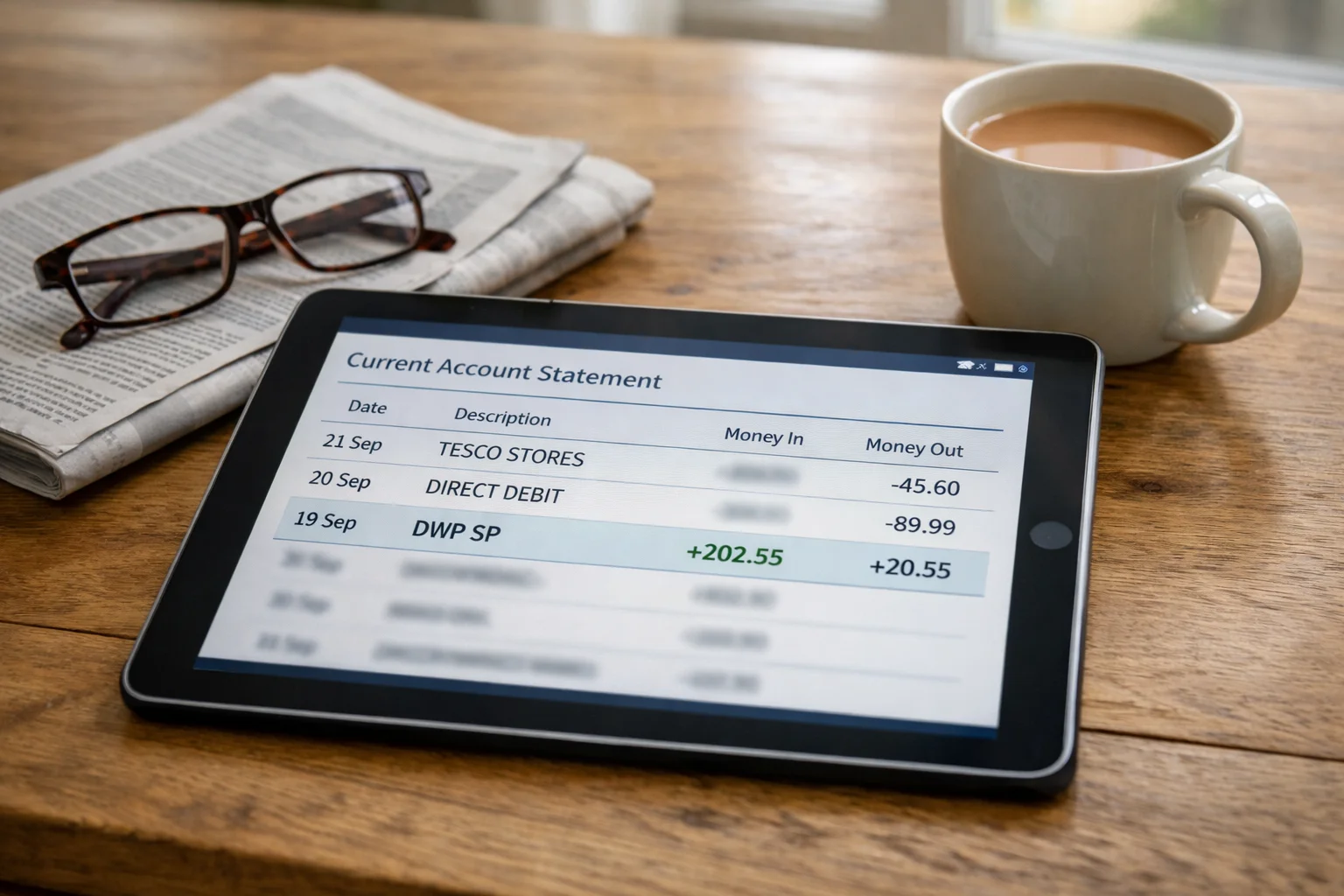
If you’ve seen “DWP SP” on your bank statement, it typically means a State Pension payment from the Department for Work and Pensions (DWP).
In some cases, it may also represent a Special Payment, such as a lump sum from backdated benefits. Understanding this code helps you manage your retirement income and avoid confusion.
Here’s what this guide covers:
- Meaning of “DWP SP” and when it refers to Special Payments
- Explanation of other common DWP bank codes
- Eligibility criteria and National Insurance requirements
- How State Pension amounts are calculated
- Payment schedules and how to identify your payday
- Steps to take if you’re unsure about a payment
- Working while claiming State Pension and deferral benefits
- How to claim your pension from the UK or abroad
What Does ‘DWP SP’ Mean On A Bank Statement?

Seeing DWP SP on your bank statement can cause some initial confusion if you’re not familiar with government payment codes. In most cases, DWP SP stands for a State Pension payment made by the Department for Work and Pensions (DWP).
This is the standard label used when the government deposits your State Pension into your bank account.
The abbreviation “SP” typically refers to “State Pension”. However, it can occasionally indicate a Special Payment.
These are less common and are usually one-time deposits relating to backdated claims or lump sums owed from previous benefit periods.
For example, if you were underpaid Pension Credit or there was a delay in processing a claim, the resulting compensation may be labelled under the same DWP SP reference.
In my experience reporting on personal finance and government support schemes, I’ve often had readers write in confused when they received a higher amount under “DWP SP” than usual. These cases usually turn out to be delayed payments or benefits finally processed.
When this happens, the key is to look at the amount and frequency. A one-off, irregular figure should raise questions, whereas your regular four-weekly State Pension amount is more straightforward.
Could ‘DWP SP’ Also Mean A Special Payment?
Yes, and this is where many people get caught off guard. While the State Pension is the most common reason you’ll see DWP SP, Special Payments also use the same code on your bank statement. These could be for a variety of reasons, such as:
- Backdated State Pension payments due to late processing
- Corrected underpayments from previous months or years
- Lump-sum payments following a successful appeal or benefit reassessment
From what I’ve seen, it’s quite rare for DWP to send a lump sum without a follow-up letter, but sometimes that letter arrives after the payment.
If you’re ever unsure, it’s best to wait a few days for correspondence or log in to your State Pension forecast on GOV.UK for clarification.
In one case, a reader contacted me after receiving over £900 unexpectedly under a DWP SP reference. It turned out to be a backdated Pension Credit adjustment covering several months due to an error in how their income was originally assessed.
These payments often come with a second code like PC or are accompanied by a separate smaller transaction that clarifies their nature.
How Do I Identify Other DWP Payment Codes On My Statement?
The DWP uses a range of codes on bank statements depending on the type of benefit being paid. Knowing what these abbreviations mean can help you better track your finances and understand what money is coming in and why.
Here’s a helpful table that outlines the most common DWP payment codes and their meanings:
| DWP Code | Meaning |
|---|---|
| DWP SP | State Pension or Special Payment |
| DWP PC | Pension Credit |
| DWP UC | Universal Credit |
| DWP PIP | Personal Independence Payment |
| DWP DLA | Disability Living Allowance |
| DWP XB | Christmas Bonus (usually in December) |
Understanding these codes can help you distinguish between regular pensions, one-off bonuses, and other benefit-related payments.
In particular, the Christmas Bonus (DWP XB) often surprises people in December, especially if they’ve newly become eligible. These small amounts can be easily mistaken for errors if you’re not expecting them.
Who Is Eligible For The DWP SP (State Pension) Payment?

Eligibility for the new State Pension depends on your age, gender, and National Insurance (NI) contributions. The government sets specific rules around this, and they differ depending on when you were born.
To qualify, you must be:
- A man born on or after 6 April 1951
- A woman born on or after 6 April 1953
If you were born before these dates, you fall under the basic State Pension rules, which may include Additional State Pension elements.
You must also have made at least 10 qualifying years of National Insurance contributions. These qualifying years can be built up in several ways:
- Working and making National Insurance contributions
- Receiving NI credits (e.g. while unemployed, ill, a parent or carer)
- Paying voluntary NI contributions
What If I’ve Lived Or Worked Abroad?
Many people I’ve spoken with who lived or worked outside the UK worry about whether they still qualify. In most cases, your foreign work history doesn’t exclude you from eligibility. If you’ve worked in an EEA country, Switzerland, or one of the countries with reciprocal agreements, your contribution years can often be transferred or credited.
Additionally, some individuals have paid a reduced rate of National Insurance, particularly married women in past decades. While this may reduce the amount you receive, it doesn’t automatically disqualify you.
How Is The DWP SP Amount Calculated?
Your State Pension amount is calculated based on the number of qualifying years you have on your National Insurance record. The full rate for the new State Pension (as of 2024–2025) is £230.25 per week.
If you’ve paid the correct contributions for 35 qualifying years, you will usually get the full amount. However, your pension may differ based on several factors.
Here’s a breakdown of how certain circumstances affect your payment:
| Factor | Impact On Pension Amount |
|---|---|
| Less than 35 qualifying years | Reduced weekly amount |
| Contracted out before April 2016 | You may receive less than the full amount |
| Paid into Additional State Pension (pre-2016) | You may get a “protected payment” on top |
What If I Was Contracted Out?
Before 2016, some workers were contracted out of the additional State Pension. This meant paying lower NI contributions while building a separate workplace or personal pension. If this applies to you, your State Pension could be lower unless you have extra qualifying years.
Contracted-out individuals may need more than 35 years to reach the full amount.
Can I Increase My State Pension Amount?
Yes. If you have gaps in your National Insurance record, you can pay voluntary contributions to boost your qualifying years. Additionally, deferring your State Pension increases your payment. For each year you delay claiming it, your pension increases by roughly 5.8%, which can be significant over time.
In my reporting, I’ve come across retirees who didn’t realise how beneficial deferring could be. Especially for those still working or with other income sources, this strategy can lead to a better long-term outcome.
What Do Government Professionals Say About DWP SP References?
While researching for a similar case on benefits confusion, I found a helpful quote from a DWP spokesperson in a regional news outlet that directly clarified the DWP SP issue:
“DWP SP is the correct and current abbreviation used for State Pension payments, and it will continue to appear this way unless new payment codes are introduced,” the spokesperson said.
This kind of official clarification helps cut through the confusion many feel when they spot a new or unfamiliar code on their statements.
It’s always worth checking GOV.UK for official guidance, but I’ve found these spokesperson quotes particularly useful in breaking down complex government messaging.
When And How Is The DWP SP Payment Made?
Once you’ve successfully claimed your State Pension, payments are made every four weeks into your nominated bank or building society account.
Payment schedules are determined by the last two digits of your National Insurance number. Here’s a reference table for clarity:
| Last 2 Digits of NI Number | Payment Day |
|---|---|
| 00 to 19 | Monday |
| 20 to 39 | Tuesday |
| 40 to 59 | Wednesday |
| 60 to 79 | Thursday |
| 80 to 99 | Friday |
If your scheduled payment day falls on a bank holiday, you’ll usually receive the payment on the working day before.
Sometimes, when starting your pension, the first payment may be partial depending on the date you choose to start it. After that, full payments are made every four weeks.
What Should I Do If I’m Unsure About A DWP SP Payment?
If you receive a payment labelled DWP SP that seems incorrect or unexpected, you should take the following steps:
- Check for other payment codes such as PC (Pension Credit) or XB (Christmas Bonus)
- Compare the amount to previous payments
- Log in to your State Pension forecast on GOV.UK to view payment history
- Wait for a letter from DWP explaining any lump sums or adjustments
If no letter arrives and the payment remains unexplained, you should contact the Pension Service for clarification.
How To Claim Or Query From Abroad?
If you’re living outside the UK, the process is slightly different. The International Pension Centre handles overseas claims. You can receive your pension in most countries, and payment schedules may vary depending on the local banking system.
If you’ve worked or lived abroad, your UK and overseas pension records may be assessed together to determine eligibility.
Can I Claim State Pension And Still Work?
Yes, absolutely. You can claim your State Pension and continue working with no penalty. Your earnings from employment will not reduce your State Pension, though both may be taxed depending on your total income.
If you’re still earning and don’t need your pension right away, deferring it could increase your payment. Many of the older workers I’ve spoken with didn’t realise that every 9 weeks of deferral results in a 1% increase, which adds up over time.
Deferral is automatic if you do not claim your pension at State Pension age. You can later choose when to start receiving it.
How Do I Apply For My DWP SP (State Pension)?
You will not receive your State Pension automatically. You must actively apply, and you can do this in three ways:
- Online through GOV.UK
- By phone if you are within 4 months of reaching State Pension age
- By post, using a paper form requested from the Pension Service
To apply, you’ll need:
- Your marital or partnership history
- Details of any time spent abroad
- Your bank account details
- Any foreign social security numbers, if applicable
What Info Do I Need To Apply?
If you’re applying online, you’ll need an invitation code. This is usually sent in a letter 3 months before you reach State Pension age.
If you haven’t received one, but you’re within the 3-month window, you can request an invitation code via GOV.UK.
Once your claim is submitted and accepted, you’ll get a confirmation letter that includes your payment schedule, amount, and first payment date.
What Else Should I Know About DWP SP Payments?

A few other key details to keep in mind:
- Annual Increases: The State Pension increases each April by the Triple Lock system, which ensures payments rise by the highest of inflation (CPI), average earnings growth, or 2.5%.
- Tax Implications: State Pension is taxable, though DWP does not deduct tax at source. HMRC will assess it alongside your other income.
- Protected Payments: If you were eligible for more under the old pension rules, you’ll receive a protected payment, which is added on top of the full State Pension.
- Isle of Man Pension: If you qualify for both UK and Isle of Man pensions, you’ll receive separate payments.
Conclusion
Understanding what “DWP SP” means on your bank statement can give you clarity and confidence in managing your retirement income.
Whether it’s a regular State Pension or a Special Payment, knowing the difference helps you stay informed and prepared.
Always review accompanying codes or payment details, and check your pension forecast if anything seems unclear.
Staying proactive with your records and communicating with the DWP when needed ensures you get the support you’re entitled to—without unnecessary confusion.
FAQs about DWP SP on bank statements
What is a DWP SP payment?
It typically stands for State Pension from the Department for Work and Pensions. Sometimes it can also mean a Special Payment like a backdated benefit.
Can DWP SP mean more than one thing?
Yes. It may represent your regular State Pension or a one-off Special Payment.
Why did I receive a larger DWP SP amount this month?
You may have received a backdated payment or a correction. Check for a second code or contact DWP for clarification.
How can I check my State Pension forecast?
Visit the official GOV.UK website and use your Government Gateway account to view your forecast and National Insurance record.
Can I get State Pension if I live abroad?
Yes. You can claim your State Pension while living in the EEA, Switzerland, or countries with reciprocal agreements.
What if I never worked in the UK?
You may still be eligible through National Insurance credits, or if your spouse or civil partner contributed.
Is the DWP SP payment taxed?
Yes, your State Pension is taxable, although tax isn’t deducted at source. HMRC calculates it based on your overall income.

Leave a Reply