
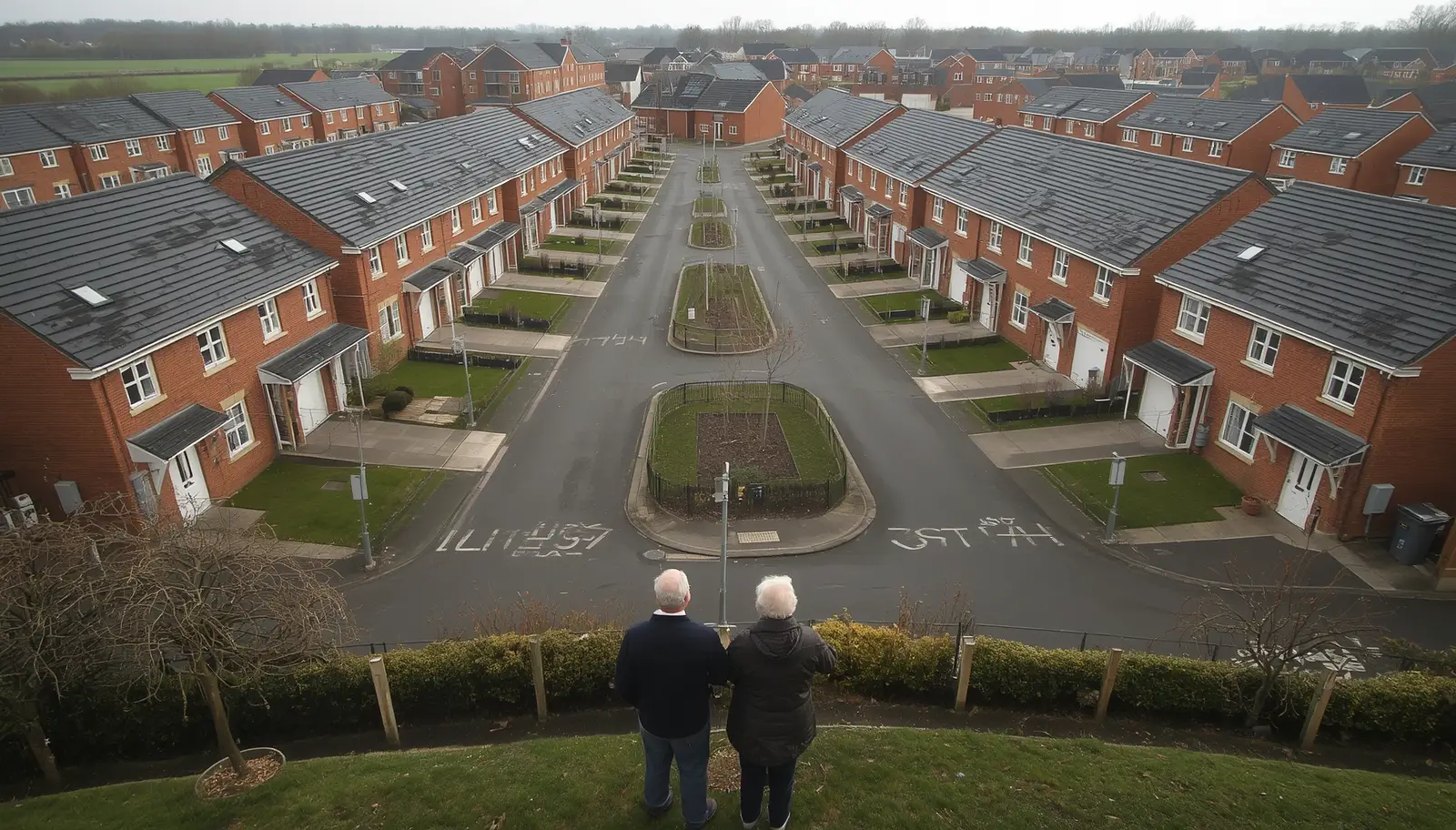
The UK completed around 122,000 new homes in 2025. That’s already well short of the government’s target. But the bigger problem isn’t just how many homes are being built. It’s what kind.
The overwhelming majority are three and four-bedroom family houses on suburban estates. That makes sense from a developer margin perspective, but it doesn’t match what the population actually needs. Single-person households now make up nearly 30% of all UK households.
The over-65s are the largest group of homeowners. And bungalows, one of the few housing types that works for older and less mobile buyers, have all but disappeared from the new-build pipeline. In Q3 2025, just 309 bungalows were registered with the NHBC across the entire country.
The NHBC’s own strategy director described it as the “death of the bungalow.” Find out how this mismatch is holding back the entire property chain and what it’ll take to fix it.
The Numbers Don’t Lie
ONS data from 2025 shows that 8.6 million people in the UK live alone. That’s 29.5% of all households, and nearly half of those living alone are aged 65 or over. Meanwhile, around 3.6 million properties owned by the over-65s have at least two spare bedrooms.
These are people occupying homes far larger than they need, not because they want to, but because there’s nothing suitable to move into.
At the same time, the over-65 population is growing faster than any other age group. It currently stands at roughly one in five people nationally and is projected to keep climbing for decades.
The UK will need between 30,000 and 50,000 later living homes per year to keep pace with demand. The industry is delivering around 7,000.
That gap isn’t closing. If anything, it’s getting wider with every new estate of identikit four-beds that gets planning approval.
Why the Market Keeps Producing the Wrong Product?

There’s no great mystery here. Volume housebuilders build what makes money, and three or four-bedroom detached houses on greenfield sites generate the highest revenue per plot.
A bungalow takes up the same footprint as a two-storey house but produces half the saleable floor area. From a land economics standpoint, it’s a terrible use of an expensive resource.
Planning policy reinforces the problem. Local housing need assessments tend to focus on overall numbers rather than specifying what type of homes should be built.
A council under pressure to hit a target of 500 new homes a year isn’t going to push back against a developer proposing 500 family houses, even if the local demographic data screams for something different.
Then there’s the Help to Buy legacy. The scheme ran from 2013 to 2023 and supported hundreds of thousands of purchases, almost all of them new-build family homes.
It was enormously effective at boosting output, but it locked an entire generation of development into a single buyer profile: younger, first-time buyers purchasing two to four-bedroom houses.
Developers built their land banks, their supply chains and their business models around that demand signal. Now the scheme is gone, but the habits it created haven’t changed.
The Knock-On Effect Across the Chain
When older homeowners can’t downsize, the properties they’re sitting in don’t come onto the market.
That means second-steppers can’t upgrade, and first-time buyers face even less supply at the bottom. It’s a chain problem, and it starts at the top.
Each retirement home built frees up an average of 2.6 existing homes further down the chain, according to NHBC Foundation research. That’s a multiplier effect that no three-bedroom starter home can match.
Building appropriate housing for the over-50s doesn’t just serve that age group. It unblocks the entire market.
Yet the numbers tell a different story. The UK currently has just 0.6% of its over-65 population living in dedicated retirement or later-living housing. In Australia, New Zealand and the US, that figure is 5% to 6%. We’re not slightly behind. We’re decades behind.
What the Right Housing Mix Should Actually Include?
The conversation about housing supply needs to move beyond raw numbers and start addressing the type of homes being built. The population data points clearly towards several categories that are badly underserved.
Single-storey, accessible homes for older adults who don’t want a retirement village but do want somewhere manageable. Smaller one and two-bedroom properties for the growing number of single-person households.
Adaptable homes designed to meet Part M building regulations that can work for occupants at any stage of life.
Some of this is happening in pockets. McCarthy Stone and Churchill Retirement Living build later-living apartments, though their service charge model doesn’t suit everyone.
A few housing associations are experimenting with bungalow provision. But the scale is nowhere near what’s needed, and the private market shows little sign of correcting itself.
What Seniors Who Downsize Are Getting Right?
There’s a quieter part of the market that’s worth paying attention to. Residential park bungalow communities are single-storey, factory-built homes on managed sites, typically designed for the over-45s.
They’re more affordable than traditional bungalows, more energy efficient than most of the existing housing stock, built to BS 3632 standards and usually fall below the stamp duty threshold.
Some developers, like Regency Living, build exactly this type of home, with communities across Cornwall, Devon, Dorset, Hampshire, Kent and Norfolk.
They offer part-exchange and assisted move schemes that directly address the friction keeping older homeowners stuck in oversized houses. It’s a model that doesn’t require government subsidy or planning reform to work. It’s already working.
What’s instructive about this approach is the lesson it offers the broader market.
The people choosing these homes aren’t doing it reluctantly. They’re actively opting for lower running costs, less maintenance and a better-insulated property than the one they left behind.
It’s a smarter, more efficient way to live, and the demand for it is growing precisely because the mainstream market isn’t offering anything comparable.
The Market Won’t Self-Correct

There’s a tempting argument that says the market will eventually respond to demand. If older buyers want bungalows, developers will build them. But that logic doesn’t hold when the economics of land and planning actively discourage the product.
Until bungalows and accessible homes are treated as a distinct planning category with their own allocation targets, they’ll keep losing out to higher-density, higher-margin alternatives.
Stamp duty reform for downsizers has been floated repeatedly but never implemented. Even a modest exemption for buyers over 60 purchasing a smaller home would free up family stock and generate activity across the chain.
Without these kinds of structural changes, the mismatch between what’s being built and what’s needed will only widen as the population ages. The data is clear. The question is whether policy and the industry will catch up before the gap becomes impossible to close.
A Quick Recap
The UK doesn’t just have a housing supply problem. It has a housing type problem. We’re building for a demographic that’s shrinking and ignoring the one that’s growing.
The fix isn’t complicated in theory: build more single-storey homes, incentivise downsizing, and give accessible housing proper weight in planning decisions.
The developers and communities already doing this are proving the demand exists. The rest of the industry, and the planning system behind it, needs to catch up.

Leave a Reply