

Millions of households could receive a £100 energy payment from January 2027, following a major cost-of-living announcement in the UK Autumn Budget on 28 October 2026.
Chancellor John Healey confirmed that up to 20 million households in England, living in Council Tax bands A to D, will qualify for the one-off Household Energy Payment.
The government has allocated approximately £2.6 billion to the scheme, with a further £100 million available to councils to support households facing financial hardship.
Eligible households paying Council Tax by Direct Debit will receive the £100 automatically into their bank accounts.
Those using other payment methods will be contacted by their local councils with instructions on claiming the money.
However, the eligibility criteria are not based solely on income or whether someone receives benefits. Property classification, Council Tax responsibility and residency will determine who receives the payment.
What Is the £100 Energy Payment Announced in the Autumn Budget 2026?
The £100 energy payment is a one-off financial support measure introduced to help households manage rising gas and electricity costs during winter 2026/27.
Officially named the Household Energy Payment, the initiative was announced by Chancellor John Healey on 28 October 2026.
Unlike discounts applied directly to electricity accounts, the government will distribute the payment through the Council Tax system.
This means eligible households will receive financial assistance without having to switch energy suppliers or change their electricity tariffs.
The payment is intended to provide temporary relief as rising wholesale energy prices place additional pressure on household budgets.
| Payment detail | Information |
|---|---|
| Official scheme name | Household Energy Payment |
| Amount | £100 per eligible household |
| Announcement date | 28 October 2026 |
| Payment begins | January 2027 |
| Eligible Council Tax bands | A to D |
| Eligible area | England |
| Households supported | Up to 20 million |
| Total funding | Approximately £2.6 billion |
| Administration | Local councils |
| Direct Debit payments | Automatic |
| Other payment methods | Council application process |
According to the government’s Autumn Budget 2026 energy announcement, the scheme will reach an estimated 83% of fuel-stressed households in England.
It is also expected to cover 88% of households in the bottom three income deciles.
These figures indicate that the payment will reach a substantial proportion of lower-income households, although the eligibility structure means some financially vulnerable residents will remain excluded.
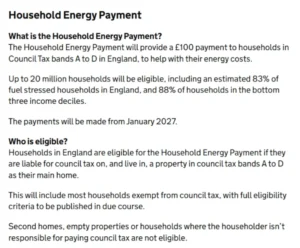
The government’s Autumn Budget 2026 announcement confirms the £100 Household Energy Payment for eligible households in Council Tax bands A to D.
Who Is Eligible for the £100 Energy Payment in 2027?
Eligibility is primarily determined by a household’s Council Tax band, main residence and legal responsibility for Council Tax.
The government’s current guidance confirms that households in England generally qualify when they occupy a property in bands A to D as their main residence and are liable for Council Tax.
Most Council Tax-exempt households are also expected to be included, although further details will be published.
Which Council Tax Bands Qualify?
The Household Energy Payment covers the first four Council Tax bands in England.
| Council Tax band | Eligible for £100 payment? |
|---|---|
| Band A | Yes |
| Band B | Yes |
| Band C | Yes |
| Band D | Yes |
| Band E | No, under the standard scheme |
| Band F | No, under the standard scheme |
| Band G | No, under the standard scheme |
| Band H | No, under the standard scheme |
This property-based approach means a household’s eligibility does not necessarily reflect its income.
For example, a working family in a Band C property may qualify even if its earnings exceed those of a pensioner living in a Band E property.
The pensioner would not qualify under the standard scheme despite potentially facing greater financial pressure.
It is important to understand that Council Tax bands in England are generally based on property valuations from 1 April 1991 rather than current market prices.
Consequently, living in an expensive-looking property does not automatically mean the household is in a higher band.
Are Renters Eligible for the £100 Payment?
Yes. Renters can receive the £100 energy payment if they meet the Council Tax eligibility requirements.
This includes eligible private tenants and social housing residents.
For example, someone renting a Band B flat and paying Council Tax directly to the local authority would normally satisfy the principal requirements.
However, the position is different for tenants whose landlord is legally responsible for Council Tax.
Some houses in multiple occupation and other shared properties have arrangements where the landlord is liable for Council Tax rather than the individual tenants.
Under the government’s current guidance, households where the householder is not responsible for Council Tax are excluded.
Renters should therefore check their Council Tax liability before assuming that living in a Band A–D property guarantees the payment.
Can Households Exempt From Council Tax Qualify?
The government has confirmed that most households exempt from Council Tax will be included.
However, it has not yet published the complete exemption rules.
This distinction matters for student households, people with severe mental impairments and residents receiving certain forms of Council Tax relief.
A Council Tax exemption is not necessarily the same as having no legal responsibility for the tax.
Eligibility will depend on the final scheme regulations and how councils identify qualifying households.
When Will the £100 Energy Payment Be Paid?
The government has confirmed that payments will begin in January 2027.
However, no exact nationwide payment date has been announced as of 29 October 2026.
Local authorities will administer the scheme, so processing dates could differ depending on the council.
The current timeline is:
| Date or period | Payment update |
|---|---|
| 28 October 2026 | Payment announced in Autumn Budget |
| Late 2026 | Further implementation guidance expected |
| January 2027 | Payments begin |
| After rollout begins | Councils process payments and applications |
The government has not confirmed that every eligible household will receive the money on 1 January.
Residents should also avoid assuming their payment will arrive on the same date as their Universal Credit, pension or other benefits.
The Household Energy Payment is separate from the Department for Work and Pensions regular benefit payment arrangements.
Simon Francis, coordinator of the End Fuel Poverty Coalition, warned that the one-off support would “barely dent the predicted rise households face in January.”
His assessment, published following the Budget announcement, highlights the difference between short-term financial assistance and a lasting reduction in household energy expenditure.
With energy prices expected to increase further, the payment may help cover part of a winter bill without compensating for the full rise in household costs.
How Can You Claim the £100 Energy Payment?
The claiming process depends on how an eligible household pays Council Tax.
The government has confirmed two principal routes.
Automatic Payment for Council Tax Direct Debit Customers
Households paying Council Tax by Direct Debit should receive the £100 automatically.
The local authority already holds their bank information for collecting Council Tax, enabling it to arrange the payment directly.
Eligible residents should not need to submit an application or contact their energy supplier.
However, households should make sure their Council Tax records and banking arrangements are accurate.
Application Process for Non-Direct Debit Customers
Residents who do not pay Council Tax by Direct Debit will be contacted by their local council.
The council will explain how eligible households can claim the rebate.
This could include people who pay their Council Tax using:
- Online debit card payments
- Standing orders
- Cash payments
- Payment cards
- Other council-approved methods
The exact application process has not yet been confirmed nationally.
Residents should use their council’s official website and communications rather than following links from unknown third parties.
The government has specifically warned that nobody other than the relevant council should contact households asking them to claim the rebate.
| Payment arrangement | Action required |
|---|---|
| Council Tax Direct Debit | No application normally required |
| Online card payment | Follow council claiming instructions |
| Standing order | Wait for council guidance |
| Cash payment | Apply through the council when invited |
| Council Tax-exempt household | Check final eligibility guidance |
| Landlord responsible for Council Tax | Generally excluded under current rules |
Residents struggling with essential expenses while waiting for the payment can also investigate local cost-of-living assistance and council crisis payments.
Such schemes operate separately from the £100 Household Energy Payment and may have different eligibility criteria.
How Can You Check Your Council Tax Band for the £100 Energy Payment?
Checking your property’s Council Tax band is the most straightforward way to establish whether you meet the main eligibility condition.
The official government service allows residents in England and Wales to search their property information.
You can use the GOV.UK Council Tax band checker without paying a fee.
Follow these steps:
- Visit the official Council Tax band checking service.
- Select the option to start your search.
- Enter your property’s postcode or address.
- Find your property in the search results.
- Confirm whether it falls within bands A, B, C or D.
Most Council Tax bills also display the property’s valuation band.
Residents who have recently moved should check their current main residence rather than an old address.
What Are the Council Tax Band Values in England?
Council Tax classifications are generally based on the estimated value of a property on 1 April 1991.
| Council Tax band | Property value on 1 April 1991 |
|---|---|
| A | Up to £40,000 |
| B | £40,001–£52,000 |
| C | £52,001–£68,000 |
| D | £68,001–£88,000 |
| E | £88,001–£120,000 |
| F | £120,001–£160,000 |
| G | £160,001–£320,000 |
| H | Above £320,000 |
These are historic valuation thresholds, not today’s property prices.
Someone living in a home now worth substantially more than £88,000 may still be in one of the eligible bands.
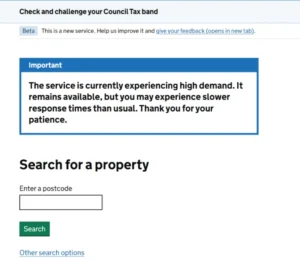
The official Council Tax band checker allows residents to search their property and confirm whether they fall within bands A to D.
Can Pensioners and Universal Credit Claimants Receive the £100 Payment?
Yes. Pensioners and Universal Credit recipients can qualify if their household meets the relevant Council Tax conditions.
The government has not introduced a general earnings or benefits threshold for the standard payment.
Therefore, qualification is not restricted to households receiving Universal Credit, Pension Credit or other means-tested benefits.
| Household circumstances | Eligibility position |
|---|---|
| Pensioner living in Band A–D | Can qualify |
| Universal Credit claimant in Band A–D | Can qualify |
| Working household in Band A–D | Can qualify |
| Unemployed household in Band A–D | Can qualify |
| Household receiving Council Tax Reduction | Depends on Council Tax liability and final rules |
| Student household exempt from Council Tax | Subject to final exemption guidance |
| Household in Band E–H | Excluded from standard scheme |
Will Pensioners Receive the Payment Alongside Winter Fuel Payments?
Eligible pensioners may receive the £100 Household Energy Payment as well as a separate Winter Fuel Payment.
These are different support schemes with different eligibility rules.
The Winter Fuel Payment for winter 2026/27 is worth between £100 and £300 for qualifying pensioners.
Unlike the new Household Energy Payment, Winter Fuel Payment recovery rules can apply when an individual’s annual income exceeds £35,000.
Pensioners concerned about this distinction can read more about why HMRC recovers Winter Fuel Payments from some recipients.
Receiving the Household Energy Payment does not, by itself, mean someone automatically qualifies for Winter Fuel Payment.
Both schemes must be assessed independently.
Will Households in Scotland, Wales and Northern Ireland Receive £100?
Although the main Household Energy Payment scheme applies directly to England, the UK Government has allocated funding to devolved administrations to provide similar assistance.
Scotland and Wales confirmed plans to introduce corresponding £100 support following the Budget announcement.
Wales
The Welsh Government confirmed on 28 October 2026 that it will provide a £100 cost-of-living payment to households in Council Tax bands A to D.
The announcement was made by Finance Minister Elin Jones.
The precise payment timetable and administrative arrangements will be determined by the Welsh Government.
Scotland
The Scottish Government has confirmed that households in Scotland will benefit from a one-off £100 energy support payment.
Deputy First Minister Jenny Gilruth announced the commitment following the UK Budget.
However, the detailed qualifying conditions and payment arrangements have yet to be finalised.
Northern Ireland
Northern Ireland has received additional funding through the Budget, allowing its Executive to consider comparable household energy assistance.
As of 29 October 2026, a confirmed Northern Ireland-wide £100 household payment scheme had not been announced.
Residents should therefore await official guidance rather than assume that England’s Council Tax eligibility rules apply to them.
| Nation | £100 payment position |
|---|---|
| England | Confirmed; payments from January 2027 |
| Wales | £100 payment confirmed for Council Tax bands A–D |
| Scotland | £100 household support commitment confirmed |
| Northern Ireland | Funding allocated; payment arrangements not confirmed |
What Happens If You Are Not Eligible for the £100 Energy Payment?
Not every household facing high energy costs will qualify for the standard payment.
People living in Council Tax bands E to H will generally be excluded, even if they are experiencing financial difficulties.
To address this issue, the government has announced an additional £100 million for local authorities.
This discretionary funding will help councils support households particularly affected by rising energy costs but excluded from the main rebate.
Who Could Qualify for Additional Council Support?
Local authorities will establish their own eligibility criteria.
Potential beneficiaries could include households facing severe financial hardship, high unavoidable heating costs or other circumstances that make energy bills unaffordable.
For example, a disabled resident in a Band E property may have substantial energy costs associated with heating or medical equipment.
Although the household would not qualify for the standard £100 payment, it may be considered for discretionary assistance if the council’s criteria permit.
The government has not established a national payment amount for individual recipients of this separate fund.
Councils will publish their arrangements and application instructions when they are available.
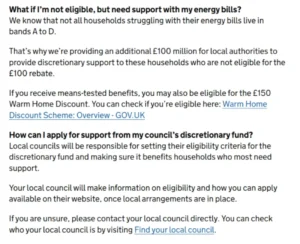
The government has allocated an additional £100 million to local authorities to assist households excluded from the standard £100 energy payment.
Can You Receive the £100 Energy Payment and £150 Warm Home Discount Together?
The Household Energy Payment and Warm Home Discount are separate forms of financial assistance.
The £100 Household Energy Payment is delivered through the Council Tax system.
The Warm Home Discount provides qualifying households with a £150 reduction on their electricity bills through their energy supplier.
The government has not announced a general restriction preventing eligible households from receiving both forms of assistance.
Consequently, someone satisfying the conditions for both schemes could potentially receive support worth £250.
| Support scheme | Amount | Payment type |
|---|---|---|
| Household Energy Payment | £100 | Direct household payment |
| Warm Home Discount | £150 | Electricity bill discount |
| Combined potential support | £250 | If eligible for both |
However, the Warm Home Discount has its own qualifying rules, including requirements relating to benefits, household circumstances and electricity accounts.
The £150 is not normally paid as cash directly into a bank account.
People who want to understand the separate eligibility requirements can check the British Gas Warm Home Discount for winter 2026/27.
The distinction is important because the announcement of a new £100 energy payment does not replace or increase the existing £150 Warm Home Discount.
What Other Energy Payments Are Available in Winter 2026/27?
The £100 payment forms part of a wider system of financial assistance designed to help households meet essential living costs.
Some existing schemes remain available to eligible residents.
| Scheme | Support available | Main eligibility factor |
|---|---|---|
| Household Energy Payment | £100 | Council Tax bands A–D |
| Warm Home Discount | £150 | Qualifying benefits and electricity account |
| Cold Weather Payment | £25 per qualifying cold period | Benefits and local temperatures |
| Winter Fuel Payment | £100–£300 | Age and other qualifying conditions |
| Council discretionary energy support | Varies | Local financial hardship criteria |
Cold Weather Payments
Cold Weather Payments provide £25 for each qualifying seven-day period of particularly cold weather.
The scheme operates from 1 November 2026 to 31 March 2027 in England, Wales and Northern Ireland.
Eligibility depends on receiving certain benefits and, in some cases, satisfying additional household conditions.
The payments are not triggered simply because someone experiences unusually high energy bills.
Instead, the temperature criteria must be met in the relevant area.
Households can compare these benefits with the Cold Weather Payment rules for winter 2026/27.
Scotland operates a separate Winter Heating Payment scheme.
Council Crisis Payments
Some councils provide additional crisis assistance for people unable to afford essentials.
In England, the Crisis and Resilience Fund has replaced the previous Household Support Fund from April 2026.
The amount of financial assistance depends on the local authority’s arrangements.
Residents should not assume that receiving the £100 energy payment makes them automatically eligible for another council grant.
Will the £100 Energy Payment Actually Reduce Household Electricity Bills?
The £100 payment will help eligible households meet their costs, but it does not directly change the electricity price charged by energy suppliers.
For example, a household facing a £250 electricity and gas bill could use the £100 payment towards that expense.
However, the underlying tariff and energy consumption would remain unchanged.
The Autumn Budget also introduced and extended measures that could affect bills more directly.
Electricity VAT Relief Extended Until July 2027
The government removed the 5% VAT rate from qualifying domestic electricity supplies on 1 October 2026.
Originally scheduled to expire in March 2027, the measure has now been extended until 1 July 2027.
The Treasury estimates that the extension will reduce the annualised Ofgem energy price cap by approximately £50 in April 2027.
However, an annualised £50 reduction in the price cap should not be confused with a further £50 cash payment to every household.
The actual amount saved will depend on electricity consumption, tariff arrangements and the period during which the temporary VAT reduction applies.
Gas Standing Charges Could Be Removed in 2027
Another major announcement concerns the planned removal of domestic gas standing charges.
Standing charges are fixed daily amounts that consumers pay regardless of how much gas they use.
The government has asked Ofgem to remove these charges as early as 2027.
However, the costs currently recovered through standing charges will not disappear entirely.
Instead, they are expected to move into gas unit prices.
This redistribution means that households using relatively little gas could benefit, while those with higher consumption may face increased costs.
Dame Clare Moriarty, chief executive of Citizens Advice, welcomed the government’s energy support but cautioned that “significant gaps remain.”
In her published response to the Budget, she emphasised the need for stronger assistance for households with substantial unavoidable energy requirements, particularly families with children and disabled people.
Her concerns highlight the limitations of reforms that provide broad financial relief without fully reflecting individual household energy needs.
Is the £100 Energy Payment Enough to Cover Rising Costs?
Whether £100 provides meaningful financial relief depends on the size of a household’s existing energy bills.
For some families, it may cover a substantial portion of one month’s energy expenditure.
For others, particularly those with high heating requirements, the amount may be relatively small compared with the additional costs expected during winter.
The policy also raises questions about how effectively Council Tax bands identify households experiencing financial hardship.
A household living in a Band D property could qualify regardless of income, while a financially vulnerable household in Band E would ordinarily be excluded from the main scheme.
Research published by PolicyEngine on 28 October 2026 provides additional context.
David Trimmer, who authored its Autumn Budget energy analysis, estimated that approximately 19.7 million English households, representing 80.6% of the total, would receive the payment.
The modelling also estimated that the combined effect of the £100 Household Energy Payment and electricity VAT relief would increase average UK household net income by £96 during the 2026/27 financial year.
That figure represents a modelled average across households, not the actual cash payment to each eligible family.
It also reflects the effect of both policy measures rather than the £100 payment alone.
The broader financial concern is that a one-off payment may provide immediate relief without permanently reducing the difference between household income and essential living costs.
For families already managing energy arrears, supplier repayment arrangements and targeted debt assistance may therefore be important alongside the new rebate.
How Can You Avoid £100 Energy Payment Scams?
New government financial support schemes frequently attract fraudulent messages.
Scammers may impersonate local councils, government departments or energy suppliers to persuade residents to disclose personal information.
A fraudulent message might claim that the £100 payment has been approved but requires immediate online registration.
Others may include links to websites designed to collect bank account details.
Residents should watch for:
- Unexpected texts claiming the £100 payment must be activated.
- Requests for banking passwords or verification codes.
- Payment links using unofficial website addresses.
- Demands for a processing or registration fee.
- Messages warning that eligibility will expire within hours.
The government has confirmed that eligible Direct Debit households will receive the rebate automatically.
Households using other payment methods will be contacted by their councils.
If a message appears suspicious, residents should independently visit their council’s official website rather than using the link provided.
The existence of a government-funded scheme does not make every message referring to it genuine.
FAQs About the £100 Energy Payment
Is the £100 energy payment confirmed for January 2027?
Yes. The government has confirmed that payments will begin in January 2027, although individual council payment dates have not yet been announced.
Will everyone get the £100 energy payment?
No. England’s standard payment is restricted to eligible households in Council Tax bands A to D, subject to the household and residency conditions.
Do pensioners qualify for the £100 energy payment?
Yes. Pensioners can qualify if their household meets the Council Tax eligibility requirements. The payment is separate from Winter Fuel Payment.
Can Universal Credit claimants receive the £100 payment?
Yes. Universal Credit recipients can qualify, but receiving Universal Credit alone does not guarantee the payment.
Do renters get the £100 energy payment?
Renters can qualify when they meet the relevant Council Tax requirements. Those whose landlord is legally responsible for Council Tax may be excluded.
Do I need to apply for the £100 energy payment?
Eligible Direct Debit payers do not need to apply. Other eligible households will be contacted by their councils about the application process.
Will households in Council Tax Band E receive £100?
Band E properties are excluded from the standard payment. However, financially vulnerable households may qualify for additional discretionary council assistance.
Can I receive £100 and the Warm Home Discount together?
Potentially, yes. The schemes have separate eligibility requirements, and no general restriction against receiving both has been announced.
Is the £100 energy payment taxable?
The government has not yet published complete tax and benefit-treatment guidance for the new scheme. Households should await further official clarification.
Will there be another £100 energy payment in 2028?
No repeat payment has been confirmed. The current Household Energy Payment is a one-off measure announced for winter 2026/27.

Leave a Reply