

The UK National Living Wage plays a critical role in shaping income standards, business operations, and employment policy.
With the government’s commitment to ensuring it reaches two-thirds of median earnings by 2026, both employers and workers are closely monitoring developments.
This article explores the latest estimates, calculation methods, and potential impacts of the projected changes.
Backed by government data and expert analysis, it provides a comprehensive view of what to expect from the National Living Wage in 2026.
What Is The UK National Living Wage?

The UK National Living Wage (NLW) is the statutory minimum hourly rate employers must pay to workers aged 21 and over.
Introduced in April 2016, it was designed to ensure a fairer wage floor for adults, improving income levels and reducing dependency on in-work benefits.
Unlike voluntary wage frameworks, the NLW is legally enforceable and set annually based on the recommendations of the Low Pay Commission.
It aims to reflect the general standard of living by aligning with two-thirds of national median earnings, as directed by government policy.
The NLW is updated each April and applies regardless of sector or job type, covering most employees, including casual, part-time, and agency workers.
How Does It Differ From The Minimum Wage?
The National Minimum Wage (NMW) refers to the legal hourly pay rates for workers under the age of 21, as well as apprentices. While both the NLW and NMW are statutory wage levels, they cater to different age brackets and skill levels.
Key differences include:
- Age Eligibility: NLW applies to workers aged 21 and over; NMW applies to younger workers and apprentices.
- Rate Levels: The NLW is higher, reflecting the expectation that older workers have greater financial responsibilities.
- Policy Objective: The NLW is tied to a government-set benchmark (two-thirds of median earnings), while the NMW is determined by broader affordability and labour market considerations.
Here’s a breakdown of the current rates for comparison:
| Age Group | Hourly Wage (April 2025) | Applies To |
|---|---|---|
| 21 and over | £12.21 | National Living Wage |
| 18 to 20 | £10.00 | National Minimum Wage |
| 16 to 17 | £7.55 | National Minimum Wage |
| Apprentices | £7.55 | National Minimum Wage (Apprentices) |
The system is designed to provide a fair starting point for young people entering the workforce while ensuring working adults receive wages more aligned with living costs and economic conditions.
How Is The UK National Living Wage 2026 Estimate Calculated?
The 2026 estimate for the National Living Wage is not a fixed figure determined through a simple formula. Instead, it is guided by a target set by the government, which tasks the Low Pay Commission (LPC) with ensuring the NLW reaches two-thirds of median earnings for eligible workers.
The methodology includes:
- Analysing historical and current wage growth trends
- Estimating the future median wage using labour market data
- Assessing inflation forecasts and cost of living between April 2026 and April 2027
- Evaluating potential impacts on employment, competitiveness, and business costs
- Considering sector-specific dynamics such as wage structures in retail, hospitality, and care
Although the two-thirds of median earnings benchmark provides a guiding principle, the LPC is also mandated to account for broader macroeconomic trends. These include GDP growth, labour productivity, consumer demand, and business feedback.
The process balances wage fairness for workers with sustainability for employers. Recommendations are evidence-based and draw from a variety of economic models and stakeholder consultations.
What Are The Latest Government Projections For The National Living Wage In 2026?
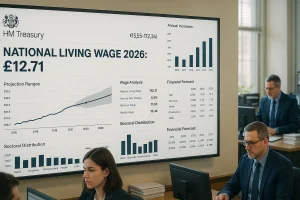
The latest update from the UK government indicates a central estimate of £12.71 per hour for the National Living Wage in April 2026. This estimate reflects a 4.1 percent increase over the current rate of £12.21 per hour introduced in April 2025.
However, the actual rate in 2026 could fall within a broader projected range based on ongoing economic performance:
| Estimate Type | Projected Rate |
|---|---|
| Lower Estimate | £12.55 |
| Central Estimate | £12.71 |
| Upper Estimate | £12.86 |
These estimates are based on the assumption that year-on-year wage growth was 5.1 percent in May 2025, with expected wage growth of 3.9 percent in Q4 2025 and 3 percent in Q4 2026.
The improvement in the 2026 forecast reflects stronger-than-anticipated wage growth earlier in 2025, which has pushed median earnings upward.
The figures are published to provide employers, employees, and policymakers with a working projection, although the final rate will only be confirmed after the Low Pay Commission submits its recommendations in October 2025.
Why Has The 2026 Estimate For The National Living Wage Increased?
The 2026 estimate for the UK National Living Wage has increased due to a combination of economic, policy, and market-driven factors.
The revised central estimate of £12.71 per hour, up from earlier forecasts of £12.65, reflects stronger-than-anticipated wage growth across multiple sectors and the government’s continued focus on maintaining real-terms wage stability for low-income workers.
Several key influences have contributed to this upward revision:
Stronger Wage Growth In 2025
Throughout 2025, average earnings in the UK have outperformed previous projections. Wage data from the Office for National Statistics (ONS) indicated consistent monthly increases, driven by tight labour market conditions, record employment levels, and competitive hiring practices among employers.
Industries such as healthcare, hospitality, logistics, construction, and retail have led this surge, as employers raised wages to attract and retain staff.
This robust wage performance directly affects the two-thirds of median earnings benchmark, pushing the National Living Wage estimate upward.
Upward Revisions To Median Earnings Forecasts
The National Living Wage is linked to median earnings, and any rise in median pay directly increases the benchmark for future NLW calculations. Median earnings have climbed faster than expected due to:
- Rising demand for skilled and semi-skilled labour
- Pay settlements influenced by inflationary pressures
- Increased employer contributions to counter workforce shortages
These changes have resulted in a higher baseline from which the 2026 National Living Wage is calculated.
Inflation And Cost Of Living Pressures
Although inflation has eased compared to previous years, the lingering effects of high living costs continue to influence wage policies.
The Low Pay Commission (LPC) takes into account inflation forecasts between April 2026 and April 2027, ensuring that pay rates do not lag behind real-world expenses such as housing, transport, and utilities.
Employers have also been under social and market pressure to maintain fair pay standards, particularly as the cost of living remains a significant concern for households across the UK.
Labour Market Tightness And Recruitment Challenges
Labour shortages in certain industries have intensified competition for workers, prompting employers to raise wages to remain competitive.
Sectors heavily reliant on lower-paid labour, such as retail, food services, and social care, have experienced persistent recruitment difficulties.
This trend has contributed to overall wage inflation, which has been reflected in the National Living Wage projections for 2026. Businesses offering above-minimum pay rates to secure staff effectively lift the average wage level across the broader economy.
Government Commitment To Wage Growth
The government’s Growth Mission prioritises raising living standards for working people by ensuring that the National Living Wage continues to track two-thirds of median earnings.
This long-term commitment means that, even if short-term economic conditions fluctuate, policy direction remains focused on steady upward adjustments.
The remit given to the Low Pay Commission explicitly instructs that the National Living Wage “should not fall below two-thirds of median earnings” for eligible workers.
This ensures the NLW reflects ongoing progress in wage equality and supports the government’s ambition to build a more productive and fair economy.
Revised Economic And Productivity Forecasts
Recent data indicates a modest improvement in national productivity and overall business output. This provides more economic room for wage increases without jeopardising employment stability.
The Low Pay Commission considers such factors when adjusting its projections to balance fairness for workers with feasibility for employers.
The updated projections assume:
| Economic Indicator | 2025 Projection | 2026 Projection |
|---|---|---|
| Year-on-Year Wage Growth | 5.1% (May 2025) | 3.0% (Q4 2026) |
| Inflation Rate | 3.2% | 2.8% |
| GDP Growth | 1.2% | 1.6% |
These metrics collectively justify a moderate but sustainable rise in the National Living Wage estimate, aligning pay levels with both economic capacity and living costs.
Adjustments From Previous Consultations
In the May 2025 consultation, the Low Pay Commission projected the NLW at a central estimate of £12.65, with a range of £12.50 to £12.80. The latest update increases this to a central estimate of £12.71, with a higher range of £12.55 to £12.86.
The difference, although incremental, underscores an ongoing upward trajectory in UK wage expectations, driven by stronger wage growth data and improved confidence in the broader economic outlook.
What Are The Current National Minimum Wage And National Living Wage Rates As Of April 2025?
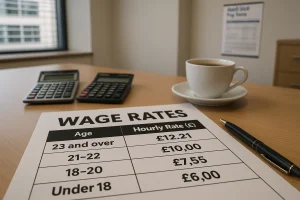
As of 1 April 2025, the UK government implemented new wage rates for different age categories and employment conditions. These rates reflect annual adjustments based on inflation, wage growth, and living costs.
The table below outlines the current statutory wage structure:
| Category | Hourly Rate | Annual Increase (£) | Annual Increase (%) |
|---|---|---|---|
| National Living Wage (21+) | £12.21 | £0.77 | 6.7% |
| 18–20 Year Old Rate | £10.00 | £1.40 | 16.3% |
| 16–17 Year Old Rate | £7.55 | £1.15 | 18.0% |
| Apprentice Rate | £7.55 | £1.15 | 18.0% |
| Accommodation Offset (Daily) | £10.66 | £0.67 | 6.7% |
These rates ensure that younger workers and apprentices also benefit from annual pay increases, although they remain lower than the NLW for adults aged 21 and over.
The higher percentage increases for younger groups indicate a commitment to reducing the pay gap across age bands.
How Could The 2026 National Living Wage Impact Businesses And Workers In The UK?
The projected rise in the National Living Wage for 2026 will have significant implications for both workers and businesses.
For employees, benefits include:
- Improved financial stability and purchasing power
- Better alignment of wages with rising living costs
- Increased motivation and job satisfaction
For employers, particularly in sectors that employ a high proportion of minimum wage workers, the implications may be more complex. Key considerations include:
- Increased labour costs that could impact profit margins
- Potential price adjustments for goods and services
- Re-evaluation of staffing levels and shift patterns
- Greater focus on productivity and operational efficiency
Small and medium-sized enterprises may need to implement strategic planning measures to manage higher wage bills effectively. In contrast, larger organisations might absorb the increase more easily or leverage it as part of employer branding and employee retention strategies.
Industries such as social care, hospitality, cleaning, and retail are likely to feel the most direct impact due to their reliance on hourly-paid workers.
However, the overall effect will depend on how businesses adapt and whether wage increases lead to improved productivity or reduced turnover.
When Will The Final UK National Living Wage 2026 Rate Be Confirmed?
The final rate for the 2026 National Living Wage will be announced after the Low Pay Commission submits its advice to the UK government. This is scheduled to occur by the end of October 2025. The confirmed rate will then take effect from 1 April 2026.
The commission’s recommendation is not solely determined by formulas. It involves consultations with:
- Employers and business groups
- Trade unions and employee representatives
- Economic analysts and government departments
Factors influencing the final recommendation include:
- Real-time inflation rates
- Employment trends and business viability
- Regional economic differences
- Sector-specific challenges and recovery trajectories
Once the LPC submits its recommendations, the government typically announces the final NLW and NMW rates within a few weeks. This gives employers a short window to prepare for implementation, making forward planning essential.
Conclusion
The UK National Living Wage 2026 estimate represents a continued commitment to wage growth and a fairer economy. The projected central estimate of £12.71 per hour is a step forward for millions of workers.
However, final figures will depend on real-time economic conditions and government decisions in late 2025.
Both employers and employees should remain informed and agile in responding to wage policy changes. As the cost of living and wage forecasts evolve, staying updated is key to ensuring stability and compliance.
FAQs About the UK National Living Wage 2026 Estimate
What is the difference between the National Living Wage and the Real Living Wage?
The National Living Wage is a statutory rate set by the government, while the Real Living Wage is a voluntary rate promoted by the Living Wage Foundation, calculated based on actual living costs.
Will the National Minimum Wage also increase in 2026?
Yes, the Low Pay Commission also provides recommendations for the NMW, and it is expected to rise alongside the NLW in April 2026.
Who qualifies for the National Living Wage?
As of April 2024, workers aged 21 and over qualify for the NLW. Younger workers fall under the NMW based on their age group.
How often is the National Living Wage reviewed?
The NLW is reviewed annually, with new rates typically coming into effect each April based on recommendations made the previous October.
What happens if an employer fails to pay the correct wage?
Employers who underpay staff can face penalties, fines, and public naming by HMRC. Employees may also take legal action to recover owed wages.
How does the government determine the median earnings?
Median earnings are based on national pay data collected through labour market surveys and adjusted seasonally by the Office for National Statistics.
Can the National Living Wage estimates change before 2026?
Yes. The figures released by the government are estimates and could shift based on changes in wage growth, inflation, and other macroeconomic factors.

Leave a Reply