
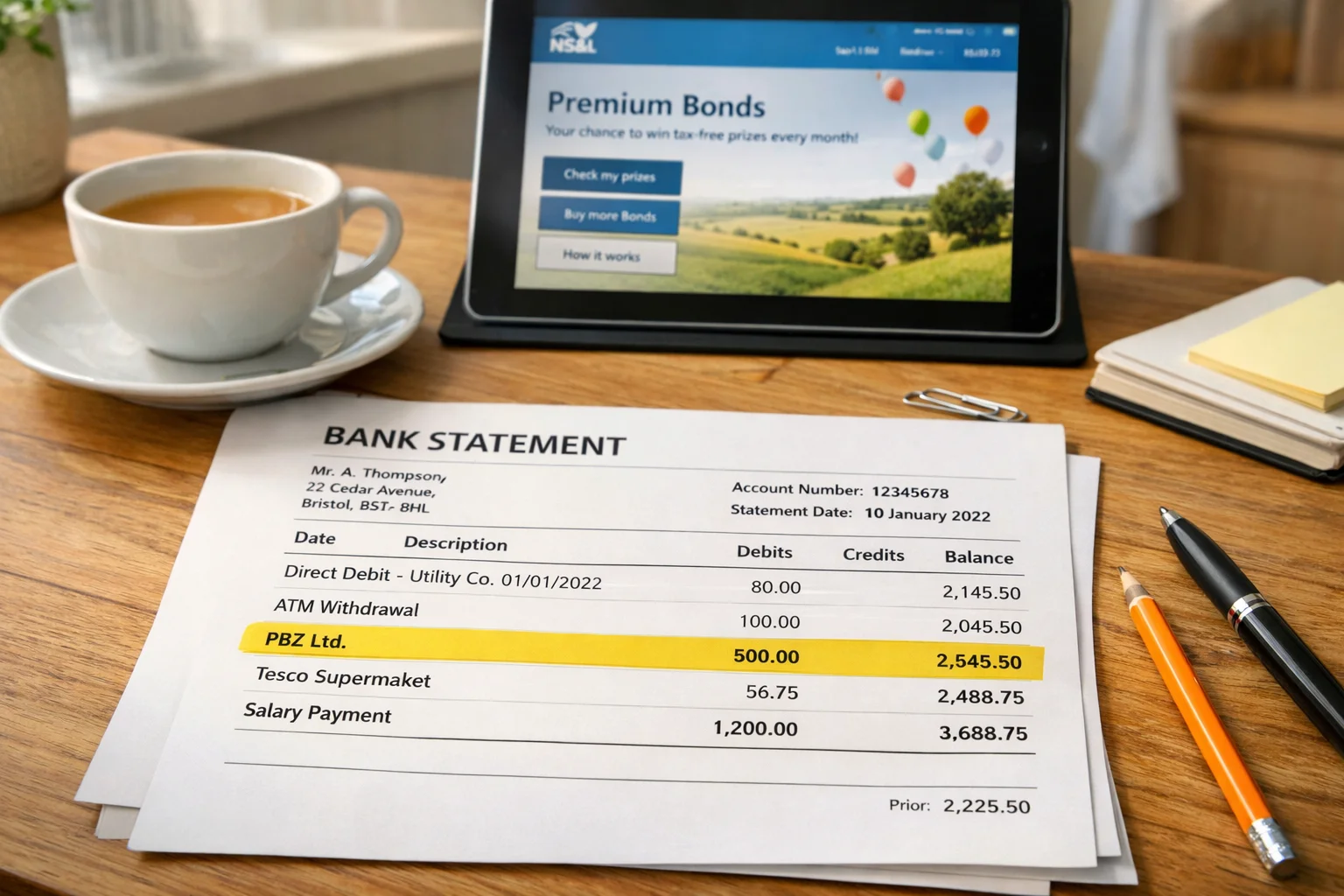
PBZ on a bank statement typically refers to a Premium Bonds prize payment from NS&I (National Savings and Investments), meaning money has been credited directly into the account as a result of a prize win.
It is a legitimate and commonly used banking reference in the UK, not a charge or suspicious transaction.
Understanding this code helps avoid confusion and ensures better financial awareness when reviewing statements.
Key Takeaways:
- PBZ indicates a Premium Bonds prize payment from NS&I
- It is a credit transaction, not a debit
- No action is required if the payment is expected
- It commonly appears after monthly prize draws
- Rarely, it may relate to international banking references
- Always verify through NS&I if unsure
What Is the Meaning of “PBZ” on a UK Bank Statement?

The term pbz on bank statement is widely recognised in the UK banking system as a reference linked to National Savings and Investments, commonly known as NS&I.
When this code appears on a bank statement, it almost always indicates that a payment has been made into the account as a result of a Premium Bonds prize.
Premium Bonds are a savings product offered by NS&I where instead of earning interest, bondholders are entered into a monthly prize draw.
If an individual wins, the prize money can either be reinvested, sent via cheque, or transferred directly into their bank account. When the direct transfer option is selected, the transaction may appear with the reference PBZ.
The abbreviation itself is generally understood to stand for Premium Bonds prize or Premium Bonds zone.
While banks do not always publicly define every code, the consistency of PBZ appearing alongside NS&I payments has made its meaning widely accepted across financial platforms and consumer guidance sources.
To clarify the meaning further, the table below outlines the essential interpretation of PBZ in a UK context.
| Element | Explanation |
|---|---|
| PBZ | Premium Bonds prize payment reference |
| Issuer | National Savings and Investments |
| Transaction Type | Credit |
| Frequency | Monthly draw based |
| Action Required | None if expected |
Unlike many other banking abbreviations that may relate to fees or outgoing payments, PBZ is associated with incoming funds.
This distinction is important because it immediately signals that the transaction is beneficial rather than a deduction.
From a technical standpoint, banks use short codes like PBZ to streamline transaction processing and display.
Instead of showing a long narrative description, the system assigns a concise identifier that links back to the payment origin.
In professional banking environments, clarity of transaction labelling is essential. As one financial specialist explains,
“When we see a PBZ reference, it is almost always categorised as a non-risk inbound payment linked to NS&I. It is one of the cleaner transaction types in terms of traceability.”
This clarity is one of the reasons PBZ has become easier for consumers to recognise over time.
Even though it may initially appear cryptic, its association with Premium Bonds makes it relatively straightforward once understood.
Why Would You Receive a PBZ Payment in Your Account?
Receiving a PBZ entry on a bank statement is directly tied to participation in the Premium Bonds scheme.
NS&I conducts a monthly draw where millions of bond numbers are entered, and winners are selected randomly. If a bondholder wins, the prize is then distributed according to their chosen payment method.
There are several scenarios in which a PBZ payment may appear:
- The individual has won a prize in the latest monthly draw
- The account is set up for direct bank transfer payments
- NS&I has processed the winnings automatically
In the past, many prize payments were issued via paper warrants, which are essentially cheques sent by post.
However, digital banking has shifted preferences towards faster and more secure payment methods. As a result, direct deposits have become the standard option.
The process of receiving a PBZ payment typically follows a structured flow.
| Step | Description |
|---|---|
| 1 | Monthly Premium Bonds draw takes place |
| 2 | Winners are selected randomly |
| 3 | NS&I processes prize payments |
| 4 | Funds are transferred to linked bank accounts |
| 5 | Transaction appears as PBZ |
This system ensures efficiency and reduces delays associated with postal delivery. It also minimises the risk of lost or unclaimed cheques.
From a professional perspective, the move towards direct payments has significantly improved transaction reliability. A banking operations expert notes,
“Direct crediting through references like PBZ reduces administrative friction and ensures customers receive funds without manual intervention.”
In practical terms, this means that if someone holds Premium Bonds and has opted for bank transfers, the appearance of PBZ is not only expected but also a sign that the system is functioning correctly.
It is also worth noting that prize amounts can vary significantly. While many prizes are relatively small, larger winnings can also be paid through the same method. Regardless of the amount, the reference code remains consistent.
Is a PBZ Transaction Safe or Could It Be Fraud?

When reviewing financial activity, it is natural to question unfamiliar transaction codes. However, in the case of pbz on bank statement, the transaction is generally considered safe and legitimate.
PBZ is not associated with outgoing payments, hidden fees, or unauthorised deductions. Instead, it represents a credit from a government-backed savings institution. This significantly reduces the likelihood of fraud.
That said, there are still situations where caution is advisable. These include cases where the account holder does not recognise the transaction or does not recall holding Premium Bonds.
The following table highlights how to distinguish between a legitimate PBZ transaction and a potentially suspicious one.
| Indicator | Legitimate PBZ | Suspicious Activity |
|---|---|---|
| Source | NS&I | Unknown or unclear |
| Transaction Type | Credit | May vary |
| Account Holder | Holds Premium Bonds | No known connection |
| Amount | Matches prize structure | Irregular or unexpected |
| Frequency | Monthly | Random or inconsistent |
A financial professional might explain it this way:
“A true PBZ transaction aligns with NS&I records. If there is no corresponding bond ownership or prize confirmation, it should be investigated further.”
In reality, most concerns around PBZ stem from a lack of familiarity rather than actual risk. Once the connection to Premium Bonds is established, the transaction becomes easy to validate.
If uncertainty remains, the safest approach is to verify the payment through official channels rather than making assumptions. This ensures both accuracy and financial security.
What Should You Do After Seeing PBZ on Your Bank Statement?
The appropriate response to seeing PBZ depends largely on whether the transaction is expected. For individuals who actively hold Premium Bonds, the appearance of PBZ typically requires no action.
However, verification is always a sensible step, especially for those who monitor their finances closely.
A simple approach includes:
- Reviewing recent NS&I activity
- Checking for prize notifications
- Confirming the transaction amount
How Can You Check Your NS&I Premium Bonds Prize?
NS&I provides several tools to help users confirm their winnings. These tools are designed to be accessible and easy to use.
| Method | Description |
|---|---|
| Online Account | Log in to view prize history |
| Prize Checker Tool | Enter bond details to check results |
| Mobile App | Access results on the go |
| Email Notifications | Receive alerts for winnings |
Using these methods, account holders can quickly match a PBZ transaction with a confirmed prize.
When Is It Necessary to Contact Your Bank?
While most PBZ transactions are straightforward, there are situations where further action may be required.
You may need to contact your bank if:
- You do not hold Premium Bonds
- The payment cannot be verified through NS&I
- There are discrepancies in the transaction details
Banks are equipped to trace transaction origins and provide additional information if needed. In rare cases, they may escalate the issue for further investigation.
Could PBZ Have Other Meanings on a Bank Statement?
Although PBZ is strongly associated with NS&I in the UK, it is not an exclusive abbreviation globally. In international banking contexts, PBZ may refer to other financial institutions.
Two possible alternatives include:
- Privredna banka Zagreb, a Croatian bank
- Peoples Bank of Zanzibar, based in Tanzania
These interpretations are uncommon for UK account holders but may appear in specific scenarios involving international transfers.
The table below provides a comparison of possible meanings.
| Context | Meaning of PBZ | Likelihood in UK |
|---|---|---|
| UK Domestic | Premium Bonds prize | Very high |
| Croatia | Privredna banka Zagreb | Low |
| Zanzibar | Peoples Bank of Zanzibar | Very low |
Context plays a crucial role in interpreting transaction codes. Factors such as currency, transaction origin, and account activity can help determine the correct meaning.
A financial analyst might state,
“Transaction references must always be interpreted within context. In the UK, PBZ overwhelmingly points to NS&I, but cross-border payments require additional scrutiny.”
Understanding this distinction helps prevent confusion and ensures accurate interpretation of financial data.
How Do Bank Statement Codes Like PBZ Actually Work?

Bank statement codes are part of a broader system designed to standardise transaction reporting. These codes allow banks to process and display financial activity efficiently while maintaining clarity for users.
Each code serves as a shorthand reference that links to a specific type of transaction. This system reduces the need for lengthy descriptions and ensures consistency across banking platforms.
The following table highlights common UK banking codes alongside their meanings.
| Code | Meaning | Usage |
|---|---|---|
| PBZ | Premium Bonds prize | NS&I payments |
| ATM | Cash withdrawal | ATM transactions |
| DD | Direct Debit | Automatic billing |
| SO | Standing Order | Scheduled payments |
| BACS | Bank transfer | Standard transfers |
These codes are integrated into banking systems and are recognised across financial institutions. While they may vary slightly between banks, many abbreviations remain consistent due to industry standards.
What Are Common UK Bank Statement Abbreviations?
Beyond PBZ, there are numerous abbreviations that appear regularly on UK bank statements. Understanding these can improve financial awareness and reduce confusion.
Examples include transaction types related to payments, withdrawals, and transfers. Each serves a specific function within the banking ecosystem.
How Can You Recognise Unknown Transactions?
Recognising unknown transactions involves a combination of observation and verification.
Key steps include:
- Reviewing transaction details carefully
- Matching codes with known activities
- Checking account history
This process helps identify legitimate transactions and flag potential issues early.
How Can You Quickly Identify Unfamiliar Transactions in Your Account?

Financial awareness is essential for managing personal accounts effectively. When an unfamiliar entry appears, taking a structured approach can help determine its origin.
Start by examining the transaction reference, amount, and date. These details often provide initial clues about the nature of the payment.
Next, compare the transaction with known activities such as subscriptions, transfers, or savings products. Many seemingly unfamiliar entries can be traced back to regular financial behaviour.
A practical method for identification is outlined below.
| Step | Action |
|---|---|
| 1 | Review the transaction reference |
| 2 | Check recent financial activity |
| 3 | Match with known services |
| 4 | Verify through official sources |
| 5 | Contact bank if unresolved |
Using banking apps and online tools can also speed up this process. Many platforms now provide enhanced transaction details, making it easier to identify sources without contacting support.
Maintaining this level of awareness not only reduces confusion but also strengthens financial security.
Conclusion
In summary, pbz on bank statement is most commonly a clear indication of a Premium Bonds prize payment from NS&I, making it a positive and legitimate transaction for UK account holders. It reflects a secure and automated deposit rather than any form of charge or deduction.
By understanding how this code works and verifying it through official channels if needed, individuals can confidently interpret their bank statements and avoid unnecessary concern about unfamiliar transaction references.
Frequently Asked Questions
WhZ usually refers to a Premium Bonds prize payment from NS&I, credited directly into your account.
Is PBZ a debit or credit transaction?
It is a credit transaction, meaning money is being added to your account rather than taken out.
Can PBZ appear if I don’t have Premium Bonds?
It is unlikely. If you see PBZ without holding Premium Bonds, you should investigate further with your bank.
How often do PBZ payments occur?
They occur whenever you win a Premium Bonds prize, typically during NS&I’s monthly draw.
Is PBZ linked to fraud or scams?
In most cases, no. PBZ is a legitimate reference. However, always verify unfamiliar transactions.
Can I track my PBZ payment online?
Yes, you can check your winnings through the NS&I website or official prize checker tools.
Why didn’t I receive a cheque instead of PBZ?
NS&I now commonly uses direct bank transfers instead of cheques for faster and safer payments.

Leave a Reply