
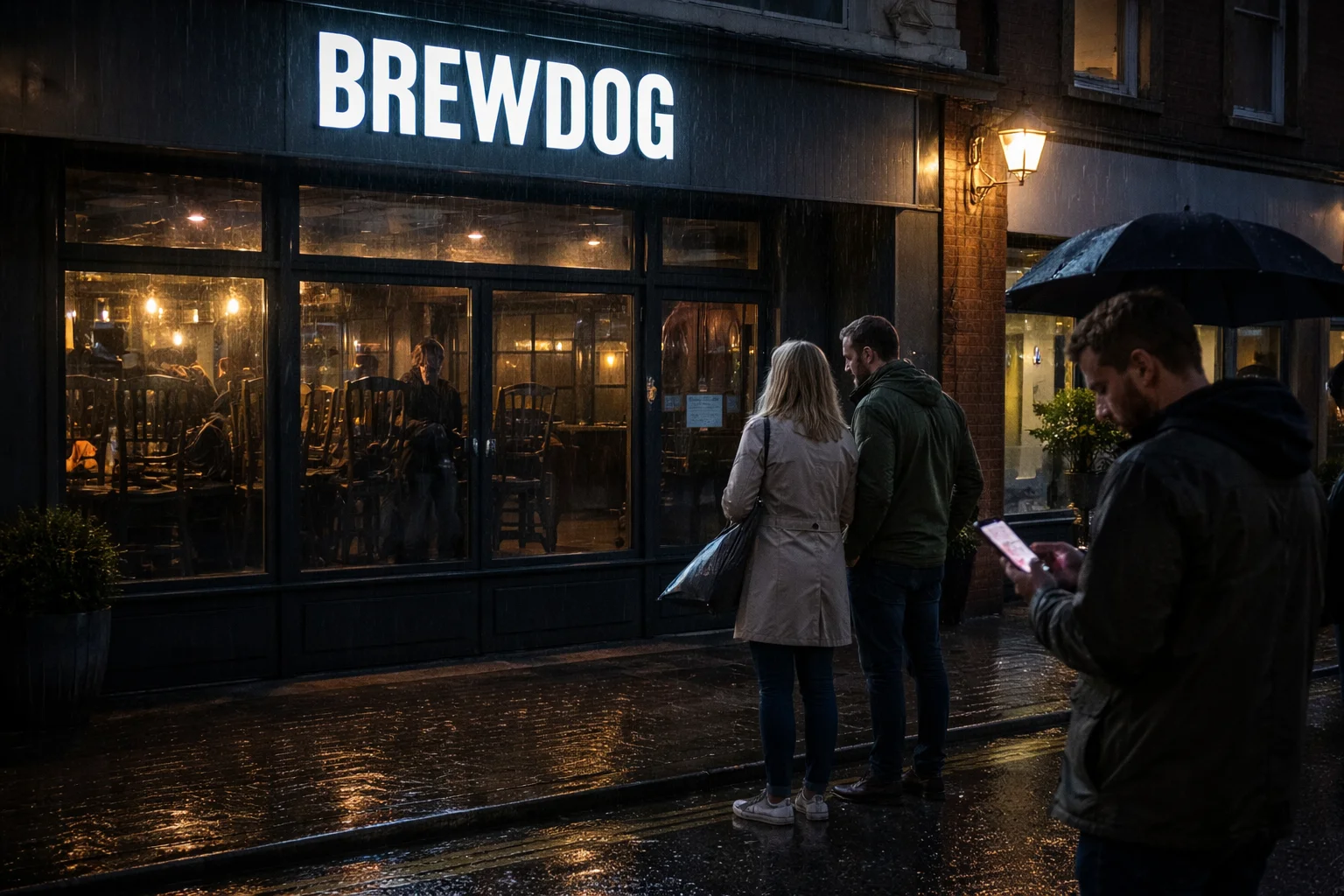
BrewDog has officially gone bust in its original form, entering administration in March 2026 after years of financial losses and failed recovery attempts.
Its core UK brewing operations and brand were sold to Tilray for £33 million, marking a dramatic fall from its peak valuation of nearly £2 billion. While parts of the business will continue under new ownership, the collapse has resulted in widespread job losses, bar closures, and investor wipeouts.
Key takeaways from this collapse:
- BrewDog entered administration after failing to make a profit post-2019
- The business was sold for £33 million to Tilray
- 38 bars closed and 484 jobs were lost
- 200,000+ investors lost their money
- Rapid expansion and high debt drove financial strain
- Rising UK hospitality costs worsened the situation
- The brand may survive, but in a reduced form
What Happened to BrewDog in 2026?
BrewDog entered administration in early March 2026 after a prolonged period of financial instability and failure to return to profitability.
The company, once seen as a flagship success of the UK craft beer movement, was forced into a distressed sale. Its core UK brewing operations, brand assets, and a limited number of pubs were acquired by US-based Tilray for £33 million.
This outcome marked a dramatic reversal from its peak valuation, which had approached £2 billion just a few years earlier. The administration process immediately triggered widespread operational and human consequences across the business.
The scale of the collapse can be better understood through the following data:
| Category | Details |
|---|---|
| Administration Date | March 2026 |
| Buyer | Tilray (USA) |
| Sale Value | £33 million |
| Peak Valuation | Approx. £2 billion |
| Bars Closed | 38 |
| Jobs Lost | 484 |
| Investors Affected | 200,000+ |
The deal itself was selective. While Tilray acquired the most valuable components of the business, a significant portion of BrewDog’s infrastructure was excluded. This included dozens of bars and parts of its international operations, leaving those segments to be shut down or liquidated.
The administration process also revealed the depth of the company’s financial distress. BrewDog had been unable to secure a buyer willing to take on the full business, largely due to its debt obligations and lack of consistent profitability.
A restructuring advisor explained the situation in practical terms:
“Once a business reaches a point where liabilities outweigh realistic future earnings, buyers only step in for specific assets rather than the whole company.”
How Did BrewDog Rise From a Garage Start-Up to a Billion-Pound Brand?
BrewDog’s origins are rooted in a small-scale brewing operation in Fraserburgh, Scotland. Founded by James Watt and Martin Dickie, the company began with a clear mission to disrupt the traditional beer market.
Their early efforts were characterised by limited resources but strong ambition.
The success of Punk IPA became a turning point. After gaining recognition through awards and retail partnerships, the brand quickly scaled beyond its local beginnings. BrewDog differentiated itself through bold marketing and a strong anti-establishment identity.
One of the most significant innovations was the introduction of the Equity for Punks scheme. This allowed ordinary consumers to invest in the company, effectively turning customers into shareholders and brand advocates.
The growth trajectory over the years highlights how quickly the company expanded:
| Year | Milestone |
|---|---|
| 2007 | BrewDog founded |
| 2009 | Equity for Punks launched |
| 2017 | Valuation reaches £1 billion |
| 2019 | Last profitable year |
| 2020 | Claimed valuation of £1.8 billion |
| 2026 | Administration and £33 million sale |
By the late 2010s, BrewDog had built a global presence. It operated bars in major cities, launched hotels, and diversified into spirits. This rapid expansion was supported by both investor funding and reinvested revenue.
A long-time industry observer summarised this phase clearly:
“They didn’t just grow fast. They grew in every direction at once, which made the brand exciting but the business increasingly complex.”
Where Did Things Start Going Wrong for BrewDog?
BrewDog’s decline did not happen suddenly. The warning signs had been building for years, largely driven by strategic decisions that prioritised rapid growth over long-term stability. As the company scaled across markets and sectors, cracks began to appear in its operational and financial foundations.
Aggressive Expansion and Growth Strategy
One of the earliest and most significant pressure points was BrewDog’s aggressive expansion strategy, which gradually became difficult to control.
The company pursued rapid international growth, opening bars in premium, high-cost locations such as central London, major US cities, and global tourist hubs.
These were often large flagship venues designed to make a statement rather than optimise profitability. While they enhanced brand visibility, they also required substantial upfront investment and consistently high footfall to break even.
Alongside this, BrewDog expanded into multiple non-core areas, including hotels, distilleries, and branded experiences.
This level of diversification added layers of operational complexity. Each new venture demanded its own management structure, supply chain, and financial oversight.
A hospitality consultant described this shift clearly:
“Expansion works when it is controlled and measured. In BrewDog’s case, growth became scattered across too many areas at once, which diluted focus and stretched resources.”
As more locations opened, the operational burden increased significantly. Managing a global estate meant higher staffing requirements, rising maintenance costs, and logistical challenges across different regions. The business was no longer a lean craft brewery but a large, complex hospitality group.
To understand the pressure created by this model:
| Expansion Area | Challenge Created |
|---|---|
| Global bar openings | High fixed costs and variable demand |
| Flagship venues | Long payback periods |
| Hotels and experiences | Capital-intensive investments |
| Product diversification | Increased operational complexity |
Many of these ventures failed to generate consistent returns, meaning revenue growth did not keep pace with spending. Over time, this imbalance became a major financial strain.
The TSG Investment and Financial Pressure
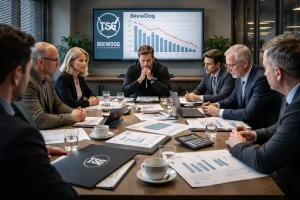
As BrewDog scaled, external investment became a key driver of its growth, particularly through its deal with TSG Consumer Partners.
While this investment injected significant capital into the business, it also introduced financial structures that increased pressure on performance.
The deal was not just about funding expansion. It came with expectations of strong and sustained returns, effectively setting a high benchmark for annual growth.
This created a situation where BrewDog had to continuously expand to justify its valuation and meet investor expectations.
Slowing down or consolidating operations was not easily possible under these conditions, even when certain parts of the business began to underperform.
The impact of this investment structure can be clearly seen below:
| Investment Factor | Impact |
|---|---|
| High return expectations | Pressure to sustain rapid expansion |
| Board influence | Reduced flexibility in decision-making |
| Priority payouts | Equity investors placed at higher risk |
This pressure influenced strategic decisions across the company. Instead of focusing on profitability, the emphasis remained on growth metrics, new openings, and brand expansion. Over time, this created a disconnect between the company’s perceived success and its actual financial health.
Post-2019 Profit Decline
While BrewDog continued to grow in size and visibility, its financial performance began to deteriorate after 2019. This marked a critical turning point where expansion no longer translated into profitability.
Despite increasing revenues, the company struggled to convert income into sustainable earnings. The cost base had grown significantly, and many newer locations were not delivering expected returns.
Several underlying issues contributed to this decline:
- New bars failing to meet projected performance
- Rising operational expenses across multiple regions
- Increased debt servicing obligations
- Lower efficiency due to over-diversification
The relationship between growth and profit became increasingly unbalanced.
| Year | Financial Trend |
|---|---|
| 2019 | Last profitable year |
| 2020 onwards | Rising revenue but declining profitability |
| 2023 to 2025 | Continued losses and mounting pressure |
This period marked the beginning of sustained financial instability, setting the stage for the eventual collapse.
Why Did BrewDog Collapse Financially in 2026?
By the time BrewDog entered 2026, its financial position had become increasingly fragile. The collapse was not the result of a single failure but rather the accumulation of long-term structural weaknesses combined with external economic pressures.
Internally, the company struggled to maintain control over its cost base. Expansion had been prioritised for years, often without sufficient focus on efficiency or profitability. This led to a situation where operating expenses consistently outpaced sustainable income.
Debt levels also became a growing concern. Borrowing and investment had supported expansion, but repayments and interest obligations added further strain to an already stretched financial model.
Externally, the business faced a challenging economic environment. The UK hospitality sector was under pressure from multiple directions, including rising energy costs, increased taxation, and changing consumer behaviour.
The combined effect of these pressures can be summarised below:
| Financial Issue | Description |
|---|---|
| High debt | Built up through years of expansion and investment |
| Rising costs | Energy, wages, and supply chain expenses increasing rapidly |
| Declining profits | No sustained profitability after 2019 |
| Reduced demand | Lower discretionary spending in hospitality |
James Watt later acknowledged these issues directly, stating:
“We expanded too fast and diversified too broadly. I did not control spend well enough.”
This statement reflects a broader reality. BrewDog’s strategy had been built on momentum and ambition, but without sufficient financial discipline, that model became unsustainable over time.
How Did BrewDog’s Valuation Fall From £2 Billion to £33 Million?
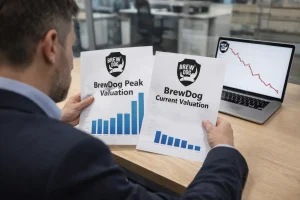
BrewDog’s valuation decline highlights the gap between perceived growth and actual financial performance. At its peak, the company’s valuation was largely based on future potential, brand strength, and expansion plans rather than consistent profitability.
Investors and stakeholders placed significant value on the company’s rapid growth and global presence. However, as financial results weakened, confidence in those projections began to decline.
When profitability stalled and losses continued, the valuation model began to unravel. The company’s worth could no longer be justified by future expectations alone.
The shift in valuation can be seen clearly:
| Stage | Valuation |
|---|---|
| Peak | £1.8 to £2 billion |
| Pre-collapse | Gradual decline as financial issues emerged |
| Administration sale | £33 million |
Once BrewDog entered administration, the valuation process changed entirely. Buyers were no longer assessing the brand based on its growth story. Instead, they focused on tangible assets, liabilities, and immediate revenue potential.
In practical terms, this meant that BrewDog’s breweries, selected pubs, and brand assets were valued independently of its previous reputation. The result was a heavily discounted sale that reflected financial reality rather than past ambition.
This sharp decline serves as a clear example of how quickly high-growth companies can lose value when underlying fundamentals fail to support their expansion.
What Was the Human Impact of BrewDog’s Collapse?
Beyond the financial headlines, BrewDog’s collapse had a significant human impact that extended across employees, communities, and the wider hospitality ecosystem. The consequences were immediate and, for many, deeply personal.
Job Losses and Staff Redundancies
One of the most direct effects of the administration was the loss of 484 jobs. These redundancies were not gradual but happened abruptly, leaving many employees without time to prepare or respond.
Reports suggest that staff were informed during a short internal call, which added to the shock and uncertainty surrounding the situation.
For a workforce that had been part of a fast-growing and high-profile brand, the suddenness of the announcement made the situation even more difficult.
A former employee described the experience:
“We went from planning future projects to being told everything was over in minutes.”
This reflects a broader issue often seen in large corporate failures, where operational decisions move faster than the human systems supporting them. Employees who had contributed to the company’s growth were left dealing with immediate financial and personal consequences.
The scale of redundancies can be broken down as follows:
| Category | Impact |
|---|---|
| Total job losses | 484 employees |
| Notification process | Short internal meeting |
| Immediate effect | Sudden unemployment |
| Wider impact | Financial and emotional strain |
In addition to direct employees, many contract workers and support staff were also affected indirectly, further extending the reach of the collapse.
Closure of Bars Across the UK
Alongside job losses, the closure of 38 BrewDog bars removed a visible and established part of the brand from towns and cities across the UK. These venues were not just commercial spaces but had become part of local social and cultural environments.
Many BrewDog bars operated in high-footfall areas and contributed to the surrounding economy. Their closure affected landlords, local suppliers, and neighbouring businesses that relied on consistent customer traffic.
The closures also created gaps in local hospitality scenes, particularly in areas where BrewDog had positioned itself as a key destination venue.
| Impact Area | Outcome |
|---|---|
| Local economies | Reduced footfall and spending |
| Suppliers | Loss of regular business contracts |
| Landlords | Vacant commercial spaces |
| Communities | Loss of social venues |
Industry-Wide Ripple Effects
The collapse of BrewDog has also sent wider signals across the UK craft beer and hospitality industries. As one of the most recognisable brands in the sector, its failure has raised concerns about the sustainability of similar business models.
Smaller breweries and hospitality operators are now facing increased scrutiny from investors and lenders. The situation has highlighted how even well-established brands are vulnerable to financial mismanagement and external pressures.
Industry observers have pointed out that BrewDog’s trajectory may act as a cautionary example for other high-growth businesses operating in challenging economic conditions.
What Happened to Equity for Punks Investors?
The collapse of BrewDog has had a particularly strong impact on its community of retail investors, many of whom had supported the company for years through the Equity for Punks scheme.
This initiative was originally seen as a groundbreaking way to democratise investment, allowing everyday consumers to become shareholders. Over time, more than 200,000 individuals invested over £100 million into the business.
However, the structure of the company meant that these investors were placed at the bottom of the repayment hierarchy during administration. As a result, they received no return on their investment.
The outcome for different investor groups is outlined below:
| Investor Category | Outcome |
|---|---|
| Institutional investors | Partial recovery possible |
| Debt holders | Prioritised in repayment |
| Equity for Punks investors | No return |
This has led to widespread disappointment among retail investors, many of whom were motivated by loyalty to the brand rather than purely financial returns.
The situation has also triggered broader discussions about the risks associated with crowd-based investment models, particularly when investors may not fully understand where they sit in the financial hierarchy.
Did Leadership Decisions Contribute to BrewDog’s Downfall?
While external pressures played a role, leadership decisions were central to shaping BrewDog’s overall direction and risk profile. The same bold and unconventional approach that drove early success also contributed to later challenges.
James Watt stepped down as CEO in 2024 following increasing criticism related to workplace culture and management practices.
By that point, the company had already begun experiencing financial difficulties, and leadership changes added further uncertainty.
Strategic decisions taken during this period had long-term consequences. These included continued expansion despite declining profitability, diversification into non-core business areas, and high levels of spending across multiple projects.
The impact of these decisions can be summarised below:
| Leadership Decision | Outcome |
|---|---|
| Continued expansion | Increased financial strain |
| Diversification | Reduced operational focus |
| High spending | Weak cost control |
| Leadership changes | Strategic instability |
This highlights a key tension within BrewDog’s story. The qualities that made the company successful in its early years became increasingly difficult to manage as the business scaled.
How Did Market Conditions Affect BrewDog’s Survival?
While internal decisions were significant, BrewDog was also operating in a challenging external environment. The UK hospitality sector has faced sustained pressure in recent years, affecting profitability across the board.
Rising costs have been one of the most significant challenges. Energy prices, raw materials, wages, and taxation all increased, placing pressure on margins. At the same time, consumer behaviour began to shift.
Customers became more cautious with discretionary spending, particularly in response to economic uncertainty. This reduced demand for premium-priced products and experiences, which had been a key part of BrewDog’s offering.
The main external pressures can be outlined as follows:
| Market Factor | Effect on BrewDog |
|---|---|
| Inflation | Increased operating costs |
| Energy prices | Higher brewing and venue expenses |
| Consumer behaviour | Reduced spending in hospitality |
| Market saturation | Increased competition in craft beer |
A sector analyst explained the combined effect:
“Even strong brands struggle when costs rise and demand falls at the same time. For BrewDog, those pressures came on top of existing financial issues.”
This environment made it increasingly difficult for the company to stabilise its operations or return to profitability.
Could BrewDog Have Been Saved Before Administration?
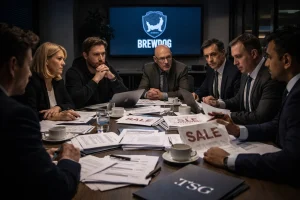
In the period leading up to administration, efforts were made to secure additional funding or find a buyer for the entire business. However, these attempts were unsuccessful.
The complexity of BrewDog’s financial structure made it difficult for potential investors to assess the full risk. High debt levels, ongoing losses, and operational complexity reduced the attractiveness of the company as an acquisition target.
Timing also played a critical role. By the time serious intervention was required, the company’s options had become limited.
Potential outcomes that were explored included:
- Full acquisition by a strategic buyer
- Partial asset sales
- Additional investment rounds
Ultimately, none of these options materialised in a way that could preserve the entire business, leading to administration as the final step.
What Happens to BrewDog Under Tilray Now?
Following the administration process, Tilray acquired key parts of BrewDog’s business, focusing on assets that offered the most immediate value and operational stability.
These include the core brewing operations, the BrewDog brand, and a limited number of pub locations. This selective acquisition approach allows Tilray to concentrate on the most viable elements of the business.
The structure of the deal can be summarised below:
| Asset Type | Status |
|---|---|
| UK brewing operations | Acquired |
| Brand rights | Acquired |
| Selected pubs | Acquired |
| Remaining bars | Closed or excluded |
| International assets | Uncertain |
Under Tilray, there is potential for a more streamlined business model. This could involve reducing operational complexity, focusing on profitable locations, and improving cost control.
However, uncertainty remains around how the brand will evolve. Decisions regarding international markets, product strategy, and long-term positioning will shape BrewDog’s future under new ownership.
What Lessons Can Businesses Learn From BrewDog’s Collapse?
BrewDog’s journey offers a number of important lessons for businesses, particularly those pursuing rapid growth in competitive industries.
One of the most significant takeaways is the importance of balancing ambition with financial discipline. Growth can drive visibility and market share, but without sustainable profitability, it creates long-term risk.
The key lessons can be outlined as follows:
| Lesson | Explanation |
|---|---|
| Controlled expansion | Growth should match operational capacity |
| Financial discipline | Costs must be managed alongside revenue |
| Realistic valuation | Expectations should reflect actual performance |
| Focus on core business | Diversification should be carefully managed |
These insights are not limited to BrewDog but apply broadly across industries where scaling too quickly can lead to instability.
Is BrewDog Truly Finished or Can It Recover?
Although BrewDog has entered administration, its story does not end there. The brand continues under new ownership, creating the possibility of recovery in a different form.
The transition to Tilray represents a shift from high-growth ambition to potential stabilisation. A more focused and financially disciplined approach could allow parts of the business to rebuild over time.
However, recovery will depend on several factors:
- Rebuilding trust with customers and stakeholders
- Streamlining operations to improve profitability
- Adapting to changing market conditions
The situation remains uncertain, but it is clear that BrewDog’s future will look very different from its past.
Final Verdict: Is BrewDog Going Bust or Evolving?
BrewDog has effectively gone bust in its original form, entering administration and undergoing a major asset sale.
However, the brand is not completely disappearing. Instead, it is transitioning into a new phase under different ownership.
Whether this marks the end or a reset will depend on how the business is managed moving forward.
FAQs
Is BrewDog bankrupt or in administration?
BrewDog entered administration in March 2026, which is a legal process to protect a company while its assets are sold or restructured.
Who owns BrewDog now?
Key parts of BrewDog have been acquired by US-based company Tilray.
Will BrewDog bars reopen?
Some locations may continue under new ownership, but 38 bars have already been permanently closed.
What happened to BrewDog investors?
Equity for Punks investors lost their investments, as no returns were paid out during the administration process.
Why did BrewDog fail financially?
The main reasons include overexpansion, high debt, rising costs, and declining profitability.
Is the UK craft beer industry declining?
The sector is facing challenges due to rising costs and changing consumer behaviour, though it is not entirely in decline.
Can BrewDog recover in the future?
There is potential for recovery under new ownership, but it will likely be a smaller and more controlled business.

Leave a Reply