
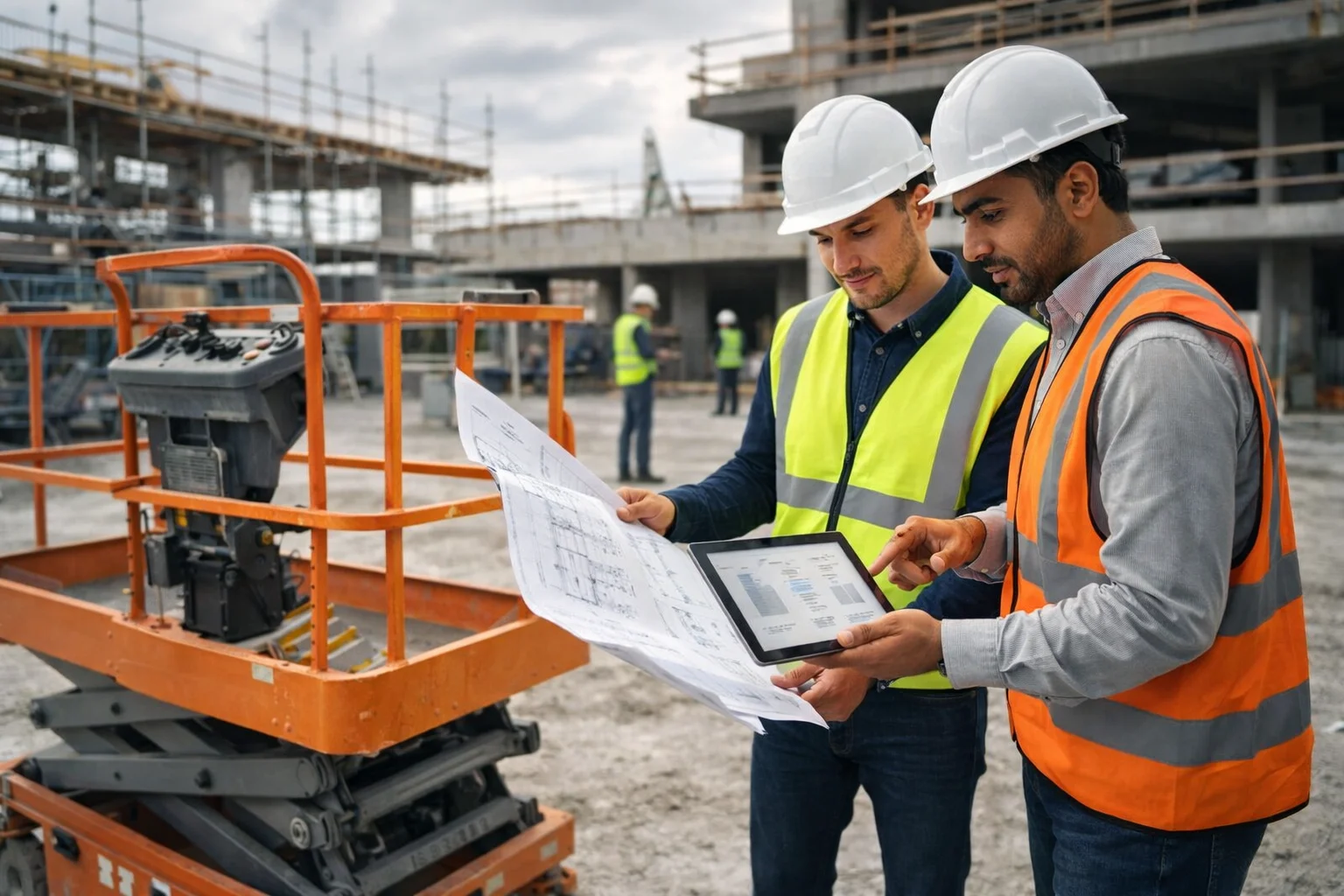
In the world of construction, warehousing, and facilities management, efficiency is the currency of success. When it comes to working at height, few tools are as indispensable as the scissor lift.
Unlike boom lifts or cherry pickers, which offer complex reach and articulation, the scissor lift provides a stable, high-capacity platform that moves vertically, making it the workhorse of indoor and outdoor maintenance.
However, investing in a new scissor lift is a significant capital expenditure. Whether you are expanding a rental fleet or purchasing a dedicated machine for a distribution centre, the “cheapest” option is rarely the most cost-effective in the long run.
To ensure your investment yields the best return on investment (ROI) and keeps your operators safe, you must look beyond the price tag.
From power sources and terrain capabilities to the nuances of platform dimensions, here are the five key factors you must consider before purchasing a new scissor lift via Access Platform Sales.
What Are the 5 Key Factors to Consider When Investing in a New Scissor Lift?
1. Environment: Indoor vs. Outdoor Application
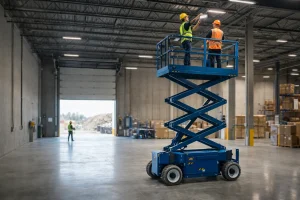
The first and most critical question is: Where will the machine be used? The environment dictates almost every other specification of the lift.
Indoor Use
For indoor applications, such as electrical installations in retail units or stock picking in a warehouse, electric scissor lifts are the industry standard.
- Emissions: Indoor environments require zero-emission machinery to comply with health and safety regulations.
- Tyres: Indoor lifts are typically fitted with non-marking rubber tyres to protect delicate floor finishes like polished concrete or tiles.
- Dimensions: Indoor lifts are often “slimline” models, designed to pass through standard single or double doorways and navigate tight aisles.
Outdoor Use
Outdoor projects, such as cladding or external facilities maintenance, require “Rough Terrain” (RT) models.
- Power: These are usually powered by diesel engines to provide the torque necessary for uneven ground.
- Stability: Outdoor lifts feature four-wheel drive and oscillating axles to maintain traction on mud or gravel.
- Levelling: Many outdoor models include hydraulic outriggers (levelling jacks) to ensure the platform remains level even when the chassis is on a slope.
2. Power Source and Battery Technology
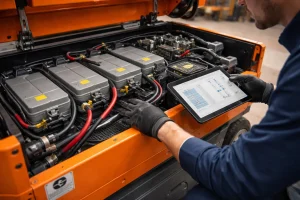
The transition toward “green” construction has revolutionized the power sources available for new scissor lifts. Your choice here impacts not only your carbon footprint but also your daily operational uptime.
Traditional Lead-Acid Batteries
Most electric scissor lifts have historically relied on deep-cycle lead-acid batteries. They are cost-effective upfront but require regular maintenance (watering) and long charging cycles (typically 8–10 hours).
Lithium-Ion Innovation
The modern trend is moving toward Lithium-Ion power. While the initial investment is higher, the benefits are substantial:
- Opportunity Charging: Unlike lead-acid, Lithium batteries can be “topped up” during a lunch break without damaging the battery life.
- Zero Maintenance: No watering or cleaning of terminals is required.
- Longevity: They typically last 2–3 times longer than traditional batteries, significantly reducing the total cost of ownership.
Bi-Energy and Hybrid Models
For companies that need a “do-it-all” machine, bi-energy models offer the best of both worlds. They use a diesel engine for travelling across a site and an electric motor for quiet, emission-free work once inside a building.
3. Capacity: Weight, Personnel, and Platform Size
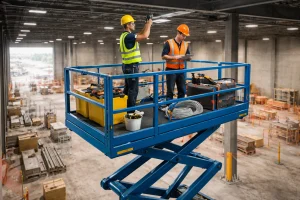
It is a common mistake to choose a scissor lift based solely on its maximum working height. However, the Lift Capacity (Safe Working Load) is equally vital.
Calculating Your Load
You must account for the combined weight of:
- The operator(s).
- All tools (drills, saws, levels).
- Materials (drywall, pipes, cable reels).
If a machine is rated for 227kg and you have two operators and a heavy tool chest, you may already be approaching the safety limit. Overloading a lift triggers safety sensors that will prevent the machine from rising, leading to project delays.
Extension Decks
Check the “roll-out” or “slide-out” extension deck specifications. Most new scissor lifts allow the platform to extend horizontally by 0.9m to 1.5m.
This is crucial for reaching over fixed obstacles (like machinery or counters) while the base of the lift remains stationary. Note that the lift capacity often decreases on the extended portion of the deck.
4. Total Cost of Ownership (TCO) and Maintenance
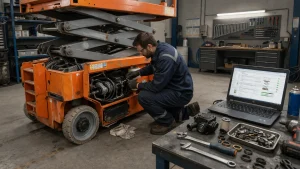
When investing in a new scissor lift, the purchase price is just the beginning. A smart investor looks at the Total Cost of Ownership.
Parts Availability
Before committing to a brand, research the availability of spare parts in the UK. A machine that is out of action for three weeks because a controller needs to be shipped from overseas is a liability.
Opt for manufacturers with established UK parts hubs and service networks.
LOLER Compliance
In the UK, all lifting equipment must undergo a LOLER (Lifting Operations and Lifting Equipment Regulations) inspection every six months.
When buying new, consider:
- Ease of Access: Are the hydraulic pumps and valves easy for an engineer to reach?
- Onboard Diagnostics: Does the machine have a digital display that provides fault codes? This can turn a four-hour repair into a ten-minute fix.
Warranty and Support
A standard manufacturer’s warranty is essential, but look for “extended” options.
A 2-year or 5-year warranty on major components can provide peace of mind and make the machine more attractive if you decide to sell it in the second-hand market later.
5. Transportability and Site Access
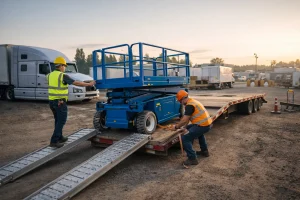
How will you get the scissor lift to the job site? The physical footprint and weight of the machine affect your logistics costs.
Transport Dimensions
If you plan to move the lift between sites using a 3.5-tonne plant trailer, you must ensure the machine’s “Gross Vehicle Weight” (GVW) doesn’t exceed your towing capacity.
Some high-reach electric scissors are surprisingly heavy due to the large battery packs required to power them.
Stowed Height and Folding Guardrails
Will the lift fit through a standard doorway? Many models feature folding guardrails.
This allows the machine to reduce its height to under 2 metres, enabling it to pass through a standard office door before being redeployed to its full height in the working area.
Gradeability
If your site has steep ramps or loading bays, check the machine’s gradeability rating (usually expressed as a percentage, e.g., 25% or 30%). This tells you the maximum slope the lift can climb in its stowed position.
Summary Comparison: Electric vs. Rough Terrain
| Feature | Electric Scissor Lift | Rough Terrain Scissor Lift |
|---|---|---|
| Primary Power | Battery (Lead-Acid/Lithium) | Diesel / Hybrid |
| Best Surface | Flat, Level (Concrete/Screed) | Uneven (Mud/Gravel/Grass) |
| Tyres | Solid, Non-Marking | Foam-Filled, Lug Tread |
| Outriggers | Rarely (Usually Self-Levelling) | Often (For Slope Compensation) |
| Common Use | Warehousing, Retail, Fit-out | Construction, Cladding, Glazing |
Final Thoughts: Safety and Training
Regardless of which machine you invest in, the most important component is the person operating it. In the UK, it is a legal requirement under the Health and Safety at Work Act that operators are “competent”.
The industry-recognized standard is the IPAF (International Powered Access Federation) PAL Card. Ensure that your team is trained specifically in Category 3a (Mobile Vertical), which covers scissor lifts.
Investing in a high-tech new machine is only effective if your operators know how to use its safety features, such as the emergency lowering system and pothole protection.
Conclusion
Investing in a new scissor lift is a move that can drastically improve your team’s productivity and safety.
By focusing on the working environment, selecting the right power technology, and being realistic about capacity and TCO, you ensure that your equipment remains an asset rather than a maintenance burden.
High-quality access equipment is an investment in your business’s future. When you choose a machine that perfectly matches your operational needs, you aren’t just buying a lift, you’re buying the ability to reach higher, work faster, and stay safer.

Leave a Reply