
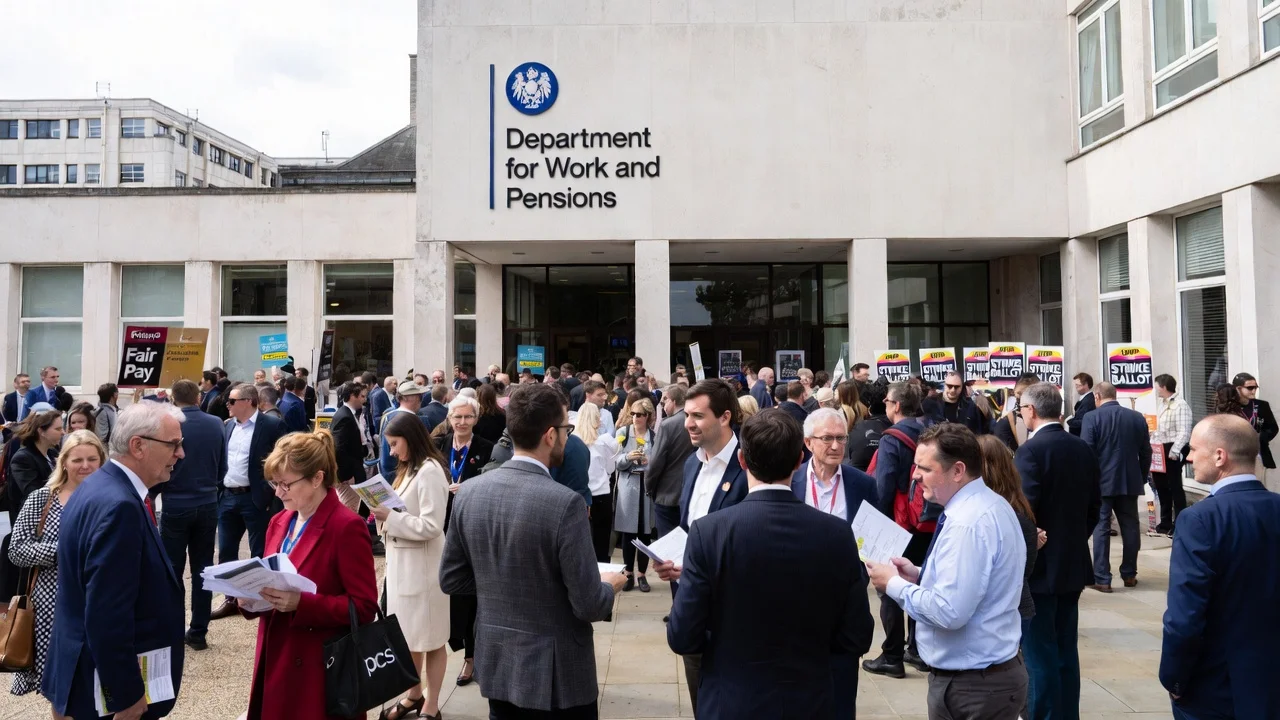
The Department for Work and Pensions (DWP) strike ballot is now officially open, with nearly 50,000 PCS union members voting on potential industrial action.
The ballot, running from 19 January to 23 February 2026, is a direct response to chronic low pay, wage compression, and the DWP’s refusal to address these issues in its 2025/26 pay offer.
Key points:
- Staff face being paid at National Living Wage levels from April 2026
- PCS rejected DWP’s below-par pay proposal
- No business case submitted by DWP to Treasury for additional pay funding
- Recruitment and retention issues are worsening service delivery
- PCS demands fair pay and structural reform
- Strike action could affect Universal Credit, pensions, and other vital services
- Ballot participation is by postal vote only
Why Are Nearly 50,000 DWP Staff Voting for Strike Action?

The current DWP strike ballot has not appeared suddenly or without warning. It is the result of years of frustration among staff who feel that their pay has failed to reflect both their responsibilities and the increasing cost of living.
Around 50,000 members of the Public and Commercial Services Union working at the Department for Work and Pensions are being asked whether they are willing to take industrial action after attempts to resolve pay concerns through negotiation have stalled.
At the centre of the dispute is low pay and wage compression. Wage compression occurs when pay differences between grades narrow to the point where progression loses its meaning.
In the DWP, this has become particularly acute for administrative assistants, administrative officers and some executive officers. Many of these staff are now facing the reality that their pay will sit at the National Living Wage from April 2026, despite the skills, experience and responsibility their roles demand.
From speaking to staff and reviewing PCS briefings, it is clear that anger is not driven by a single pay deal alone. Instead, it reflects a pattern where annual increases have failed to keep pace with inflation and where structural problems in pay bands have been repeatedly postponed rather than resolved.
A senior government workforce professional I spoke with explained the issue clearly:
“I see this dispute as a structural problem rather than a one year disagreement. When lower grades cluster around the minimum wage, you remove incentives, weaken morale and make recruitment extremely difficult. That creates operational risks for departments like DWP.”
That assessment aligns closely with what PCS members have been reporting for several years. Pay dissatisfaction is being compounded by workload pressure and by the sense that frontline staff are carrying the consequences of policy decisions without being properly valued for their role in delivering them.
What Is the Timeline and Process of the DWP Strike Ballot?
The strike ballot follows a legally defined process that trade unions must observe before any industrial action can take place. In this case, the ballot opened on 19 January and will remain open until 23 February.
Voting is conducted by post, as required under current trade union legislation, and members must return their completed ballot papers by the closing date for their vote to count.
The process is more than a formality. A successful ballot requires not only a majority voting in favour of action but also sufficient turnout across the eligible membership. This means that PCS has placed significant emphasis on engagement and participation.
Key elements of the ballot process include:
- Ballot papers issued to eligible PCS members working at DWP
- Postal return of completed ballots within the statutory period
- Provision for replacement ballots if papers are not received
- Ongoing communication to encourage participation and awareness
PCS has also organised online rallies and briefings to coincide with the ballot period. These events are designed to explain the issues, outline the union’s demands and ensure that members understand both the legal and practical implications of a strike vote.
From my own experience of covering industrial disputes, turnout often becomes the decisive factor. Even where frustration runs high, complex balloting rules can undermine collective action if engagement drops.
This is why unions tend to focus as much on mobilisation as they do on negotiation during ballot periods.
How Is the Current Pay Offer From DWP Falling Short?

The DWP’s pay offer for the 2025 to 2026 period followed Treasury pay remit guidance, which limited average increases across departments.
While the headline figures may appear reasonable on paper, PCS argues that the way the offer was structured failed to address the most urgent problem facing staff at the bottom of the pay scale.
Instead of prioritising the lowest-paid grades, parts of the additional uplift were used to address anomalies higher up the pay structure. This decision was viewed by many members as a missed opportunity to confront wage compression directly.
To understand why this matters, it helps to look at how DWP compares with other departments.
Comparative Civil Service Pay Context
| Department | Indicative Pay Increase | Impact on Lower Grades |
|---|---|---|
| Department for Work and Pensions | Around 3.75 percent | Limited improvement |
| Department for Education | Up to 7.88 percent | Stronger uplift |
| Ministry of Justice | Around 5.6 to 5.7 percent | Moderate support |
| HMRC | Around 4 percent | Some grade protection |
PCS rejected the DWP offer because it did not prevent thousands of staff from being paid at or near the legal minimum within the next year. For many employees, this raised questions about long-term career viability within the department.
A PCS representative summarised the mood succinctly.
“Our members are not asking for special treatment. They are asking for pay structures that recognise skill, responsibility and progression rather than trapping people at the bottom.“
What Are the Broader Issues Affecting DWP Staff?
Pay is only one part of a much wider picture. The DWP is undergoing significant operational change, with transformation programmes affecting how services are delivered and how staff are deployed.
These changes place additional pressure on an already stretched workforce.
Several interconnected challenges are shaping the current dispute:
- Recruitment difficulties linked to uncompetitive pay
- High staff turnover in frontline roles
- Increased workloads due to policy change and service demand
- Rising levels of stress and burnout
PCS surveys have highlighted worrying trends, including staff struggling with household bills and, in some cases, relying on food banks or in-work benefits. While these findings are uncomfortable, they reflect the reality facing some of the lowest-paid workers in the civil service.
A government professional with experience in departmental workforce planning offered a candid assessment.
“When departments cannot recruit or retain staff, the impact is felt quickly in service delivery. You can redesign systems endlessly, but without a stable workforce, performance suffers.“
This perspective reinforces the idea that the dispute is not just about fairness for employees but about the long term resilience of essential public services.
What Are the PCS Union’s Demands in This Dispute?

PCS has set out clear and specific demands aimed at addressing both immediate and structural pay concerns. These demands are not limited to headline pay percentages but focus on how pay is distributed and how future risk is managed.
The union is calling for:
- Reopening of the 2025 to 2026 pay negotiations
- Submission of a business case to the Treasury for increased pay funding
- Targeted action to lift the lowest-paid grades above the National Living Wage
- Meaningful engagement with PCS on long-term pay reform
One particularly contentious issue is the decision not to submit a business case to the Treasury, despite indications that additional funding could be available.
PCS argues that this decision represents a failure to advocate for staff at a time when recruitment and retention risks are well-documented.
From my own analysis, this point is central to the dispute. Pay negotiations are not just about what departments are offered, but about how robustly they argue their case within government spending processes.
How Are PCS Members and Activists Mobilising for the Ballot?
Mobilisation has become a defining feature of the current ballot. Across the DWP, PCS branches and activists are engaging directly with members to explain the stakes and encourage participation.
Activities include:
- Workplace discussions and leafleting
- Regional training sessions to support campaign skills
- Use of digital tools to coordinate outreach
- Encouragement of new members to join before eligibility deadlines
These efforts reflect a recognition that high turnout is essential. Without it, even strong support for action can fail to translate into a legally valid mandate.
I have observed similar campaigns in other sectors, and the pattern is consistent. Where members feel informed and involved, participation increases. Where communication falters, ballots become vulnerable to apathy rather than opposition.
What Does This Mean for the Public and the Welfare System?
Any potential strike action at the DWP raises concerns about the impact on the public, particularly on those who rely on benefits and employment support.
Services such as Universal Credit processing, pension administration and disability assessments could experience delays if industrial action proceeds.
It is important to note that unions generally aim to apply pressure without causing unnecessary harm. However, the reality is that disruption is often the mechanism through which negotiations are forced to move.
A government policy professional I consulted offered this reflection.
“The challenge is balancing the immediate impact on claimants with the long term consequences of underinvesting in staff. Short-term disruption is visible. Long-term decline is often hidden until it becomes a crisis.“
That observation highlights the difficult trade-offs involved. While no one welcomes service disruption, unresolved workforce issues can undermine the welfare system more profoundly over time.
Conclusion
The DWP strike ballot reflects deep-seated concerns about pay, recognition, and long-term workforce sustainability.
With nearly 50,000 staff voting, the outcome could shape not only negotiations but the future of public service delivery.
As government departments face rising demand and recruitment challenges, addressing wage compression and frontline staff welfare becomes increasingly urgent.
Whether or not industrial action proceeds, the message from PCS members is clear: lasting change is needed to secure fair conditions and a resilient civil service.
Frequently Asked Questions
What is the purpose of the DWP strike ballot?
The ballot asks PCS members at the DWP to vote on whether they are willing to authorise strike action over pay and working conditions.
How long does the ballot stay open?
Voting opened on 19 January and runs until 23 February 2026.
Why did PCS reject the DWP pay offer?
PCS argued the offer did not sufficiently address low pay and wage compression for the lowest grades.
What happens if the strike vote passes?
If a majority votes in favour, PCS may plan industrial action within six months, following legal requirements.
Do other departments face similar challenges?
Yes, wage and staffing issues are not unique to DWP and feature in broader civil service and public sector discussions.
Can non‑PCS members vote?
Only PCS members employed at DWP who are eligible and receive ballot papers can vote.
How can staff get involved if they haven’t received a ballot paper?
PCS provides replacement ballots on request if the original papers are not delivered

Leave a Reply