

The UK government is introducing significant changes to disability benefits, with a series of DWP PIP reforms set to begin in 2026.
These changes will impact disabled people, carers, and claimants of Universal Credit.
With the proposed abolition of the Work Capability Assessment and a new single assessment system on the horizon, it is essential to understand what lies ahead.
This article outlines the key updates, timelines, and what claimants and carers should expect from the evolving welfare system.
What Are The Key Personal Independence Payment (PIP) Changes In 2026?
The Personal Independence Payment (PIP) system will undergo important changes starting in 2026, with the government aiming to simplify benefit delivery and improve fairness in assessments.
Although the proposed 4-point daily living rule has been removed from legislation, broader structural changes are still planned.
The Removal Of The 4-Point Daily Living Rule
Initially, the government had proposed that only individuals scoring at least four points in a single daily living activity would qualify for the daily living component of PIP.
This would have restricted eligibility for thousands of claimants with a range of moderate but combined impairments.
However, following strong feedback during the consultation process, this clause was removed from the final version of the Universal Credit Bill.
This decision was welcomed by disability rights groups and ensures that claimants will continue to be assessed based on cumulative scores across multiple activities, rather than performance in just one.
New Focus On Fairness And Individual Circumstances
Although the 4-point rule was scrapped, the government has not abandoned plans to reform how PIP is assessed.
Instead, emphasis is now being placed on understanding:
- How long-term health conditions affect day-to-day life
- The role of an individual’s living environment and personal support needs
- Whether current assessment descriptors and activities remain fit for purpose
This represents a shift towards a more holistic model of assessment, one that factors in real-world limitations rather than relying purely on isolated, task-based scoring.
Timeline For Implementation And Wider Reforms
While specific changes to PIP eligibility criteria are not expected to be implemented immediately in 2026, the broader reform process will begin to unfold from that year.
The Timms review, set to conclude in Autumn 2026, will directly inform how PIP assessments are revised moving forward.
Some changes could be introduced in Spring 2027, depending on the legislative requirements. Others may follow in 2028 as part of the integration with Universal Credit assessments.
How Will The Timms Review Affect The Future Of PIP Assessments?
The Timms review is a key part of the government’s strategy to reform disability benefits.
It begins in Autumn 2025 and will investigate how the PIP assessment process can be improved. Its terms of reference focus on several important areas:
- Evaluating the current assessment activities, descriptors, and scoring methods
- Reviewing both the Daily Living and Mobility components of PIP
- Exploring the role of personal and environmental circumstances in assessments
- Determining how assessments can provide fair access to wider benefits and support
This review aims to consider whether other forms of evidence, beyond functional assessment, should play a role in determining eligibility.
These could include medical reports, individual living conditions, and long-term impact on daily life.
The actual work of the review will commence in Autumn 2025.
It remains uncertain whether updates will be shared with the public throughout the process or held until the final report is submitted to the Secretary of State in Autumn 2026.
Changes proposed in the review could be introduced quickly, with implementation possibly starting in Spring 2027, depending on whether primary legislation is required.
What Does The Universal Credit Act Mean For Disabled People From April 2026?

Coming into effect in April 2026, the Universal Credit Act introduces significant structural changes to disability-related benefits within Universal Credit.
The most notable change is the introduction of the new “health element”, which replaces the LCWRA (Limited Capability for Work and Work-Related Activity) component for new claims.
Key changes under this Act include:
- The standard allowance of Universal Credit will increase for all claimants. For single people aged 25 and over, this will rise from £91 per week in 2024/2025 to £98 per week in 2026/2027
- For existing claimants, the LCWRA component will be frozen at £97 per week until 2029/2030
- New claimants will receive a reduced health element of £50 per week, compared to the current £97
The government has also introduced the “severe conditions criteria” to determine who qualifies for the higher rate of the health element.
This new filter is intended to provide better targeted support to those with the most serious medical conditions.
Additionally, all recipients of the health element will be expected to engage in regular discussions with jobcentre staff.
The purpose is to explore what support may be needed to help people prepare for or consider employment.
These conversations will not impose mandatory job search requirements but may be sanctioned if the claimant fails to attend without a valid reason.
Table: Changes to Universal Credit Rates (2024–2027)
Component 2024/2025 Rate 2026/2027 Rate Notes
UC Standard Allowance (25+) £91 per week £98 per week Applies to new and existing claimants
LCWRA / Health Element (Existing) £97 per week £97 per week Frozen until 2029/30
Health Element (New Claims) £97 per week £50 per week Reduction applies to claims starting April 2026
Will There Be A New Approach To Combining PIP And UC Assessments?
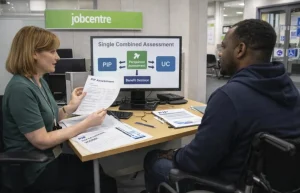
Yes, the DWP has confirmed that a unified assessment process will be introduced to streamline access to disability-related benefits across both PIP and Universal Credit.
This change is part of a broader plan to simplify the welfare system while also improving consistency in how support is awarded.
Introduction Of A Single Assessment System
The single assessment system is expected to launch in 2028/29 and will serve as the gateway to both PIP and the Universal Credit health element.
This means that individuals will no longer need to undergo separate assessments for each benefit. Instead, one revised PIP assessment will determine eligibility for both.
The current Work Capability Assessment (WCA), which is used to evaluate eligibility for the LCWRA component of Universal Credit, will be phased out.
In its place, the outcome of the PIP assessment will be used to decide whether a claimant qualifies for the UC health element.
Impact On Claimants Without PIP Eligibility
One of the most significant concerns surrounding the new approach is how it affects individuals who receive Universal Credit health-related support but do not currently qualify for PIP.
According to the government’s own data:
- Around 63% of those receiving the health element of Universal Credit or ESA also receive PIP or DLA
- Approximately 37% do not receive PIP or DLA and may therefore be at risk of losing support under the new system
As eligibility for the health element becomes dependent on the daily living component of PIP, claimants in the latter group may need to undergo reassessment or face reduced entitlements.
This aspect of the reform has yet to be clarified in detail.
Phasing Out The Work Capability Assessment (WCA)
The complete abolition of the WCA will take effect by 2028/29. From that point onward:
- Eligibility for Universal Credit health-related payments will no longer be based on a separate work capability evaluation
- Claimants will instead be assessed solely through the updated PIP framework
This change is expected to streamline the system but also introduces new challenges.
Individuals who may not qualify under the new PIP criteria, despite having limited work capacity, could be left without access to essential financial support.
Potential Implications For Policy And Delivery
While the consolidation of assessments may simplify administrative processes, the policy risks are considerable.
Advocacy groups have already raised questions about fairness, particularly for those with conditions that do not meet the PIP daily living threshold but still significantly impact employability.
In response, the government has hinted at possible transitional protection for affected claimants. However, no formal guarantees or structures have been published at this stage.
How Will Carers Be Affected By The 2026 Welfare Reforms?
Carers are likely to experience knock-on effects from the broader changes to disability benefits.
Since many carers receive support based on the recipient’s eligibility for PIP, alterations to assessment criteria or reductions in PIP awards may impact carers financially.
The reforms raise several concerns for carers:
- Reduced or removed eligibility for PIP could result in a loss of Carer’s Allowance
- New assessment criteria may change who qualifies for daily living components
- Carers may need to help navigate the new system or appeal decisions
Additionally, the Pathways to Work White Paper is expected to include provisions aimed at helping those who lose PIP entitlement.
These support mechanisms will be important in determining how carers adapt to the changes.
What Is The Right To Try Guarantee And How Does It Benefit Claimants?
The Right to Try Guarantee will be introduced in 2026/2027 and enshrined in law.
Its core purpose is to allow claimants to explore employment opportunities without the fear that doing so will lead to a reassessment of their benefits.
Under the current system, some claimants avoid work trials or short-term roles because it could trigger a reassessment. The new guarantee ensures that:
- Attempting work will not be considered a change of circumstance for PIP or UC
- No new PIP award review or WCA reassessment will be triggered solely due to trying work
- Claimants can engage in employment without risking existing benefits
This is intended to remove a significant barrier to work for disabled people and those with long-term conditions. It also reflects a shift in government policy towards encouraging voluntary re-engagement with the workforce without coercive measures.
What Does The Pathways To Work White Paper Aim To Achieve?
The upcoming White Paper will clarify many of the government’s long-term intentions. It follows the Green Paper consultation and will likely be published by late 2025 or early 2026.
Proposals expected in the White Paper include:
- Raising the minimum age to claim PIP from 16 to 18
- Delaying access to the Universal Credit health element until age 22
- Creating a new contributory Unemployment Insurance benefit
- Abolishing the WCA in favour of PIP-based eligibility
- Supporting individuals who lose PIP entitlement during transitions
These policies reflect a wider restructuring of how benefits support people with disabilities and long-term health conditions.
The reforms appear to prioritise simplicity and cross-system compatibility, though concerns remain about exclusions and reduced entitlements.
How Will Future PIP And Universal Credit Reforms Be Phased Through To 2029?
The government is implementing these reforms in a phased approach, spanning four years. This strategy allows for public consultation, pilot testing, and legislative adaptation as needed.
Table: Timeline Of PIP And UC Reforms (2025–2029)
Date Event / Reform Affected Groups
Autumn 2025 Timms Review Commences All PIP Claimants
April 2026 Universal Credit Act Becomes Law New and Existing UC Claimants
Autumn 2026 Timms Review Report Submitted All
2026/2027 Right to Try Guarantee Introduced PIP, UC, NS ESA Claimants
2027/2028 Proposed Delay to UC Health Element Until Age 22 Younger Claimants
2028/2029 Work Capability Assessment Abolished New UC Health Element Claimants
2028/2029 Single Assessment for PIP and UC Eligibility All Claimants
2028/2029 New Unemployment Insurance Replaces NS ESA/JSA Unemployed Claimants
The new contributory Unemployment Insurance benefit will replace both New Style ESA and New Style Jobseeker’s Allowance.
It will be time-limited, paid at the ESA rate (£138 per week), and tailored with easements for those with work-limiting conditions.
One concern is the method of identifying work-limiting conditions without the WCA. As the assessment structure changes, the government must ensure that people with genuine support needs are not left out of the system.
Conclusion
The 2026 reforms mark the beginning of a fundamental shift in the UK’s disability benefits landscape.
With assessment overhauls, new eligibility requirements, and a shift towards integrated systems, the changes aim to modernise and personalise support.
However, concerns remain about fairness, transparency, and unintended consequences, particularly for vulnerable groups.
The key to managing the transition lies in proactive engagement, access to reliable information, and a robust support network for claimants and carers alike.
FAQs About DWP PIP Reforms 2026
Will existing PIP claimants be reassessed under the new rules?
It is currently unclear whether the reforms will apply to existing PIP claimants. This may depend on the outcomes of the Timms review and subsequent legislation.
What will replace the Work Capability Assessment?
The WCA will be abolished and replaced with a new assessment framework based on receiving the daily living component of PIP.
How will young people be affected by the new PIP age threshold?
The minimum age for PIP claims is expected to rise to 18, potentially impacting young people with long-term conditions transitioning from childhood benefits.
What happens if I don’t attend a UC health conversation?
Claimants may be sanctioned if they fail to attend without a valid reason, though exceptions are expected for those with severe conditions or terminal illness.
Will the new Unemployment Insurance replace ESA and JSA entirely?
The new benefit is intended to replace New Style ESA and JSA, offering limited-term support with certain health condition easements.
Can I still claim UC health element without receiving PIP?
From 2028/29, eligibility for the UC health element will depend on having the daily living component of PIP, raising concerns for those who don’t qualify.
Will trying work affect my benefits after 2026?
No. Under the Right to Try Guarantee, attempting work will not trigger reassessment or be considered a change in circumstances for benefit purposes.

Leave a Reply