
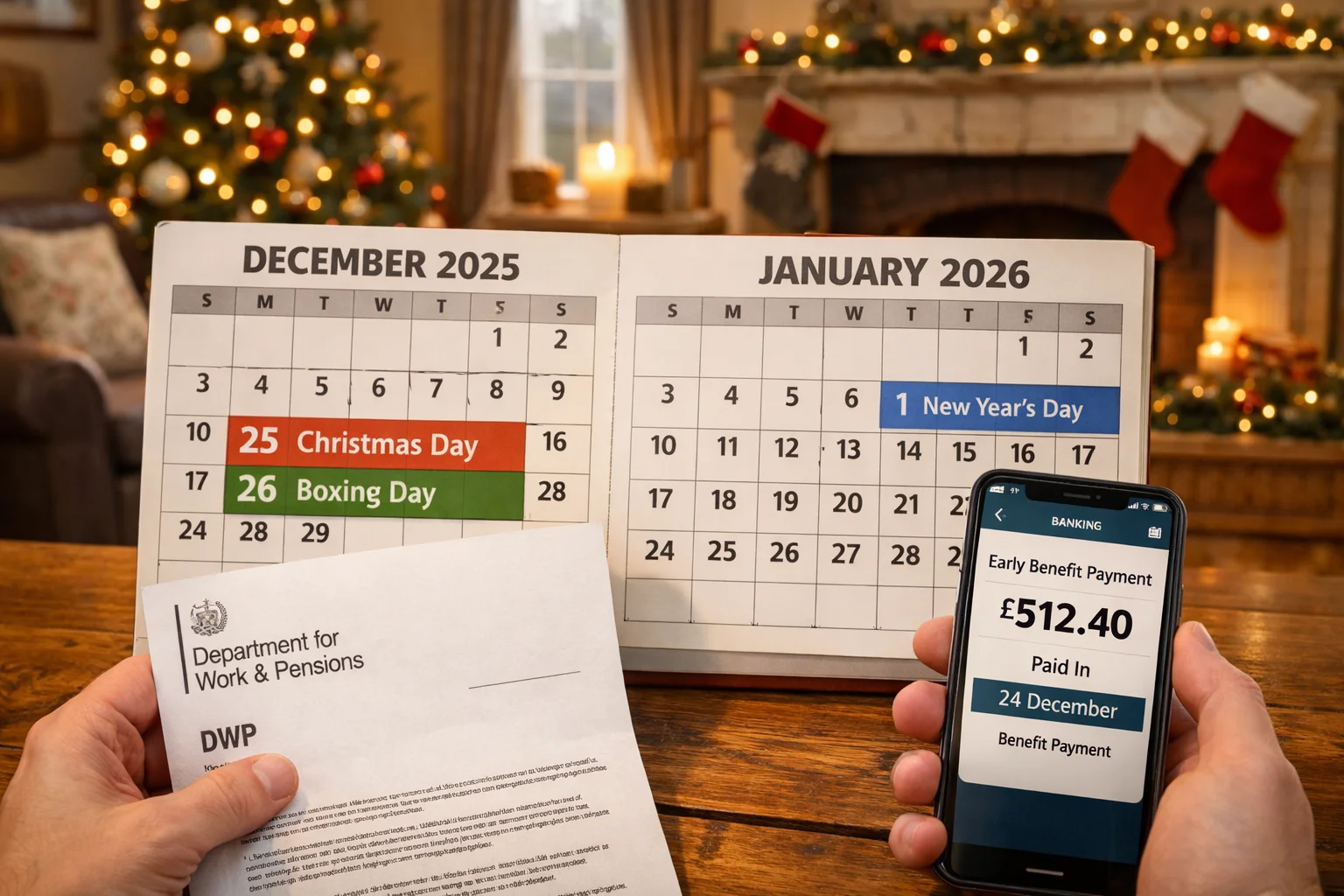
As 2025 nears its end, financial pressures continue to mount for millions of UK households. With colder temperatures, rising energy bills, and an ever-tightening cost of living crisis, many depend heavily on benefit payments to manage daily expenses.
The timing of these payments becomes especially important during the festive period, when public holidays can affect scheduled deposits.
Understanding how Department for Work and Pensions (DWP) payments are impacted by bank holidays is crucial to help families plan their finances.
This guide outlines the confirmed payment dates for Christmas 2025 and New Year 2026, explains which benefits are affected, and explores additional support available during this season.
Why Are DWP Bank Holiday Payment Dates Important During Christmas and New Year?

Bank holiday payment dates from the Department for Work and Pensions (DWP) play a crucial role for individuals and families who depend on regular benefit payments.
During the festive season, regular schedules are disrupted due to public holidays. For many, even a slight delay in receiving a payment can lead to financial difficulty, especially at a time when household expenses often rise.
Many claimants are already dealing with ongoing economic challenges, including high energy bills, food inflation, and rising rents. Even though inflation has eased, the cost of essentials remains elevated compared to pre-pandemic levels.
For those living on low incomes, knowing when payments will be made can help them better manage their money, avoid going into debt, and ensure they can pay for essentials like heating, food, and rent over the holidays.
Which DWP Benefits Are Affected by Bank Holidays in December 2025?
Several key benefits administered by the DWP may be rescheduled due to bank holidays. These include:
What Are the Main Benefits Distributed by the DWP?
- Universal Credit
- State Pension
- Pension Credit
- Child Benefit
- Personal Independence Payment (PIP)
- Disability Living Allowance (DLA)
- Attendance Allowance
- Employment and Support Allowance (ESA)
- Income Support
- Carer’s Allowance
- Jobseeker’s Allowance
Do These Payment Changes Affect Everyone Receiving Benefits?
Only those scheduled to receive payments on the affected bank holidays will experience changes. If your usual payment date does not fall on Christmas Day, Boxing Day, or New Year’s Day, you will likely receive your benefit as normal.
Bank holidays in December 2025:
- Christmas Day: Thursday, 25 December
- Boxing Day: Friday, 26 December
- New Year’s Day: Thursday, 1 January
For those whose benefit payments are due on any of the above dates, the DWP has confirmed that payments will be made early.
What Are the Confirmed DWP Payment Dates for Christmas 2025?
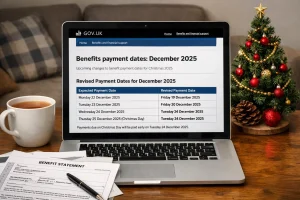
When a payment date falls on a bank holiday, it is usually made earlier. The DWP has confirmed the following schedule for December 2025:
| Scheduled Payment Date | Adjusted Payment Date | Affected Benefits |
|---|---|---|
| Thursday, 25 Dec 2025 | Wednesday, 24 Dec 2025 | All DWP benefits and State Pension |
| Friday, 26 Dec 2025 | Wednesday, 24 Dec 2025 | All DWP benefits and State Pension |
Claimants expecting payments on 25 or 26 December should ensure they budget accordingly, as the next scheduled payment will follow the regular cycle, which may result in a longer wait between deposits.
The change applies to all relevant benefit types and pensions, regardless of the payment frequency. It is also important to remember that processing times can vary slightly depending on individual banks, so funds may arrive at different times throughout the day on 24 December.
When Will DWP Benefits Be Paid Over the New Year 2026 Bank Holiday?
The DWP has also confirmed adjusted payment dates around New Year. Those due to receive benefits on Thursday, 1 January 2026 (New Year’s Day), will receive their money one day earlier.
| Scheduled Payment Date | Adjusted Payment Date | Affected Benefits |
|---|---|---|
| Thursday, 1 Jan 2026 | Wednesday, 31 Dec 2025 | All DWP benefits and State Pension |
As with the Christmas adjustments, this change affects all major benefits and applies across the UK. This early payment ensures that claimants are not left waiting over the bank holiday weekend for essential income.
How Are State Pension Payment Dates Adjusted for December 2025 Holidays?
How Is the Payment Day Determined by National Insurance Numbers?
State Pension payments are typically made every four weeks and the specific weekday depends on the last two digits of a recipient’s National Insurance (NI) number:
- 00 to 19: Monday
- 20 to 39: Tuesday
- 40 to 59: Wednesday
- 60 to 79: Thursday
- 80 to 99: Friday
What Happens if the Scheduled Payment Falls on a Holiday?
If your scheduled pension payment falls on a bank holiday such as Christmas Day or New Year’s Day, it will be paid earlier, typically on the previous working day. In 2025, this means pensions due on 25, 26 December and 1 January will be paid on 24 and 31 December respectively.
Recipients do not need to take any action. The DWP automatically adjusts the payment schedule, and the funds will appear in the bank account or building society accordingly.
Will Universal Credit and Other Benefits Increase in 2026?

April 2026 will bring a number of changes to the rates of Universal Credit and other DWP-administered benefits. This update reflects the government’s annual review based on inflation and wage growth.
Universal Credit Standard Allowance Uplift
- For single people over 25:
- Current weekly rate: £92
- New weekly rate: £98
- For couples (one or both over 25):
- Current weekly rate: £145
- New weekly rate: £154
This represents an above-inflation increase of approximately 6.2% to the standard allowance for Universal Credit.
Cuts to Health-Related Element of Universal Credit
- The payment for new claimants will drop from £105 to £50 per month
- Existing claimants will have this rate frozen until 2029
This change could significantly impact those with disabilities or long-term health conditions applying after April 2026. It is advised that individuals who believe they may be eligible for this element apply before the new rates take effect.
Uprating of Other Benefits
Other benefits that will see a 3.8% increase in April 2026 include:
- Personal Independence Payment (PIP)
- Disability Living Allowance (DLA)
- Attendance Allowance
- Employment Support Allowance (ESA)
- Carer’s Allowance
State Pension Increase
The basic State Pension will rise by 4.8%, aligned with annual wage growth, increasing the weekly payment to £241.05.
What Other Financial Support Is Available During the Festive Season?
Additional financial support is available to help households cope with winter-related pressures.
What Is a Budgeting Advance Loan and Who Can Apply?
The Budgeting Advance is an interest-free loan available to Universal Credit claimants who need help with emergency costs such as:
- Essential household items
- Unexpected travel expenses
- One-off costs
Maximum advance amounts:
- £348 for single claimants
- £464 for couples
- £812 for households with children
Starting in April 2025, deductions to repay these loans are capped at 15% of the standard allowance. This is a welcome reduction from the previous 25% cap and will help ease the repayment burden for many.
How Does the Discretionary Housing Payment Work?
Discretionary Housing Payment (DHP) is available to tenants receiving either Housing Benefit or the housing component of Universal Credit. It helps with:
- Rent shortfalls
- Rent deposits
- Rent in advance when moving to a new property
Eligibility is determined by local authorities, and applications are typically submitted via council websites. The amount and availability of funds vary by region.
Household Support Fund
The Household Support Fund (HSF), introduced by the government and distributed through local councils, offers emergency help for:
- Food
- Utility bills
- Essential household goods
- Direct cash support
Councils have the discretion to decide how HSF funds are allocated. The scheme is expected to run until March 2026, after which it will transition into a Crisis and Resilience Fund. Those seeking assistance should contact their local authority directly.
What Help Is There for Energy Bills and Essential Costs This Winter?
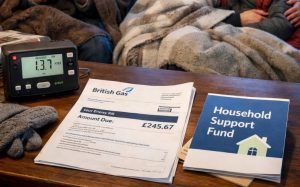
Winter puts additional strain on household budgets, especially when it comes to heating and electricity. Several support schemes are in place to help:
- Energy companies such as British Gas, E.ON, OVO, EDF, and Scottish Power offer hardship grants or energy efficiency devices like electric blankets
- Social tariffs for broadband and water bills offer lower rates for households on low incomes or certain benefits
- All water companies in the UK are required to provide social tariffs, though the level of support varies by region
Some broadband providers also offer discounted packages to individuals on Universal Credit or Pension Credit. Ofcom provides an up-to-date guide on eligible deals.
Can You Reduce Council Tax and Childcare Costs in 2025?
Local authorities offer Council Tax Reduction schemes for eligible households. The level of support can be up to 100%, depending on:
- Income
- Household size
- Residency status
For childcare, the government has introduced a significant expansion. From 1 September 2025, working parents will be entitled to up to 30 hours of free childcare per week for children aged up to four years.
To qualify, parents must:
- Be in work
- Apply online through the government portal
- Reconfirm their eligibility every three months
Tax-Free Childcare is also available, offering 20p back for every 80p paid into an approved childcare account, up to £500 every three months per child.
Will There Be Another Cost of Living Payment in 2025?
The government has not announced any additional Cost of Living Payments for 2025. The final round of payments from the existing scheme was issued between 6 and 22 February 2024. Although there has been speculation about future support, no new schemes have been confirmed as of December 2025.
Conclusion
Understanding the DWP bank holiday payment dates for Christmas 2025 and New Year 2026 is essential for anyone relying on benefits to manage their finances.
With early payment schedules confirmed, recipients can plan ahead to cover essential costs during the festive period.
Being aware of additional support options, benefit increases, and upcoming changes in 2026 can help households stay financially stable. Always check official updates or speak to your local authority for the most accurate and timely information.
Frequently Asked Questions (FAQs)
Will I be notified of an early DWP payment before the bank holiday?
Usually, no individual notification is sent. Claimants are expected to check online or through DWP communications for adjusted dates.
Can I request an earlier payment date from the DWP if I’m struggling?
Not typically. Payments are adjusted only based on the DWP’s public holiday calendar.
Are the Christmas and New Year payment changes the same every year?
Not exactly. They vary based on what day the bank holidays fall in a given year.
How do I know if my council participates in the Household Support Fund?
You can check your local authority’s website or call them directly. Each council decides how to distribute HSF.
Do benefit increases apply automatically in April 2026?
Yes, eligible benefits will be adjusted automatically by the DWP and HMRC.
Will switching to Universal Credit from legacy benefits affect payment timing?
Yes, Universal Credit has a different schedule. Once switched, you’ll receive payments monthly.
Is the 30 hours of free childcare scheme available in all regions of the UK?
Yes, it applies across England, Scotland, Wales, and Northern Ireland, but application processes may vary slightly.

Leave a Reply