
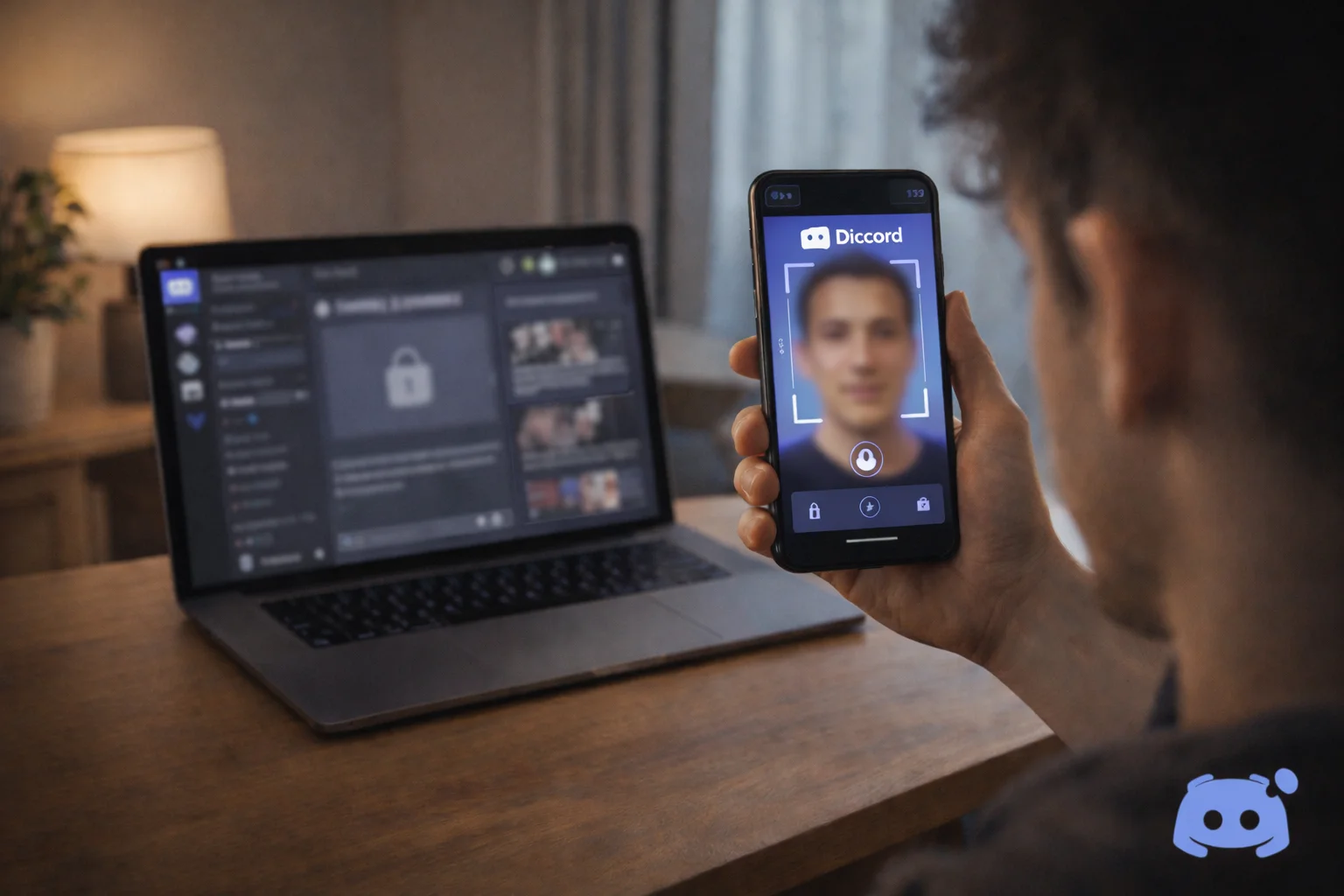
Discord will soon require users to verify their age using a face scan or official ID to access adult-only features, including 18+ servers, unblurred content, and direct messages from strangers.
This global rollout begins in March and builds on Discord’s existing teen safety architecture. The verification process uses AI-powered video selfies or government-issued ID, and data is not stored after completion.
The changes aim to protect minors, align with safety regulations, and increase platform accountability.
Below is a summary of the core updates:
| Key Update Area | Summary |
|---|---|
| Verification Methods | ID upload or AI-driven face scan (video selfie) |
| Affected Features | Adult servers, sensitive content, DMs from unknown users |
| Data Privacy | No biometric data stored, IDs deleted post-verification |
| Age Inference for Adults | Based on account history and activity, not all adults need to verify |
| Regulatory Context | Responding to UK Online Safety Act, EU DSA, and US scrutiny |
What is Discord’s New Face Scan Age Verification All About?
Discord’s upcoming global policy requires users to prove they are over 18 if they want access to certain features or communities marked as adult-only. The verification system offers two options: uploading an official ID or recording a video selfie that an AI tool will use to estimate a user’s age.
The company confirmed that this change will take effect from March and is aimed at creating a more controlled environment for teens. Once the system is in place, Discord users who want to view unblurred sensitive content, join 18+ servers or receive messages from strangers will first need to pass the age check.
The new verification structure follows earlier regional rollouts in the UK and Australia, where legal frameworks like the Online Safety Act required stricter age controls. Discord is now choosing to implement these measures globally as part of its broader commitment to platform safety.
These changes also involve automatically placing new and existing users under 18 into what Discord refers to as a “teen-by-default” experience. According to the company, this will limit access to mature features until the user completes age verification.
While some users see this as a significant restriction, Discord insists that it is a necessary move for creating a safer community for teens.
By preventing underage access to mature content, the platform aligns itself with increasing demands from regulators, lawmakers, and concerned parents.
From my experience using Discord, particularly in industry-focused communities, I’ve seen how quickly a space can veer into mature territory. It makes sense that a platform so widely used by teenagers would want to draw clearer boundaries.
How Will the ID and Face Scan Verification Process Work?
To verify their age, users will be presented with two options. The first is to upload an official, government-issued photo ID such as a passport or driving licence. The second is to record a short video selfie, which will be analysed by AI technology to determine whether the user is over 18.
Discord has partnered with Yoti, a digital identity verification company based in the UK. Yoti’s verification services are used by other major tech companies and have received data protection certifications in multiple jurisdictions.
This partnership is meant to ensure that personal data is processed securely and not retained beyond the purpose of verification.
What Technologies Are Used in the Face Scan?
The AI used in Discord’s system is based on age estimation, not facial recognition. Age estimation involves analysing facial features in the video selfie to calculate an approximate age. No biometric data is stored or matched against any database.
This type of verification process is designed to be quick and privacy-conscious. Most users can complete the check in under five minutes, after which Discord either unlocks access or maintains restrictions based on the result.
Is Discord Using Facial Recognition or Age Estimation AI?
Discord was clear in its statement:
“Discord does not use facial recognition. The process estimates your age but doesn’t compare your face to any stored image or identity profile.”
For those who choose to upload an ID instead of a selfie, the image is processed by Yoti’s platform and deleted shortly after verification. The company stated that neither Discord nor Yoti stores the image beyond what’s needed to verify the user’s date of birth.
Here’s a breakdown of the verification process:
| Method | Process Description | Data Retention | Verification Partner |
|---|---|---|---|
| ID Upload | User uploads passport or driving licence | Deleted post-verification | Yoti |
| Video Selfie | User records short selfie for AI analysis | Not stored | Yoti |
As someone who has researched identity tech in other industries, I’m always cautious with verification tools. However, I’ve tested Yoti before, and their transparency around privacy practices gives me a certain level of trust in this partnership.
Why Is Discord Introducing Global Age Verification Now?
Discord’s decision to roll out age verification globally is not a standalone action. It comes amid a wider shift in digital regulation, especially in the UK, EU, and United States. Platforms are now being held accountable for the environments they create, particularly in terms of how they affect teenagers.
In the UK, the Online Safety Act has introduced requirements for platforms to actively protect children from harmful content.
In the EU, the Digital Services Act (DSA) demands similar accountability. In the US, political pressure has increased as child protection became a focal point in social media regulation.
Savannah Badalich, Discord’s Head of Policy, summarised the company’s goal:
“Nowhere is our safety work more important than when it comes to teen users. Rolling out teen-by-default settings globally builds on Discord’s existing safety architecture, giving teens strong protections while allowing verified adults flexibility.”
This shift isn’t unique to Discord. Other platforms like Meta, TikTok and Roblox are also facing regulatory pressures. Discord’s move simply places it at the forefront of industry efforts to design platforms that protect young users by default.
I found that this particular decision wasn’t made in isolation. As someone who covers tech policy, I followed Discord CEO Jason Citron’s appearance at a US Senate hearing in 2024, where he faced tough questions about platform safety alongside Meta’s Mark Zuckerberg and TikTok’s Shou Chew.
The company clearly knew changes were coming and began preparing for a global rollout even before legislation required it.
Legal Influences Leading to Discord’s Verification Model
| Region | Legal Influence | Platform Response |
|---|---|---|
| United Kingdom | Online Safety Act | Regional age verification for minors |
| European Union | Digital Services Act (DSA) | Transparency and safety obligations |
| United States | Senate scrutiny, no federal law yet | Proactive global rollout from March |
Will Adults Be Affected by These Changes Too?

While teenagers and underage users are the focus of the update, adult users are not entirely excluded from the verification process. Discord is deploying what it calls an “age inference model” that uses various signals to estimate a user’s age.
These include:
- Account tenure (how long the user has been on Discord)
- Device type and usage patterns
- Activity data within communities
- Participation in server types (mature or teen-oriented)
If these signals suggest the user is an adult, they may not be required to upload an ID or complete the selfie scan. However, if Discord’s model cannot confidently estimate the user’s age, or if a user wants to bypass restrictions immediately, manual verification will still be necessary.
This has caused some confusion among the community. I’ve had conversations with long-time users who assumed they would have to provide documents regardless of their usage history. Discord has since clarified that most users will not need to verify unless their account is flagged or they request access to adult-only content.
Here’s a comparison of how different user types might be affected:
| User Type | Likelihood of Verification Required | Reason |
|---|---|---|
| Long-time Adult User | Low | Age inference likely successful |
| New Adult User | Medium | Fewer behavioural signals to assess age |
| Teen User | High | Will be defaulted into teen experience |
| Uncertain Profile | High | Age unclear, manual verification needed |
Are There Privacy Risks with Discord’s Face Scan Age Checks?
Privacy concerns around biometric data and ID verification are legitimate. In fact, Discord already experienced a security scare in October when a third-party age verification provider was hacked, potentially leaking the ID photos of around 70,000 users. Although Discord quickly cut ties with the affected firm, the incident heightened user scepticism.
Discord and Yoti have stated that no data will be stored permanently and that all personal information collected during the verification process will be deleted after use.
They also confirmed that private messages, activity logs, and other sensitive account content will not be used in age inference or verification.
Professional insights from the tech industry echo these concerns. Drew Benvie, founder of social media consultancy Battenhall, told the BBC:
“The sentiment behind creating a safer community for all social media users is a positive move. But implementing it across millions of communities could be fraught with issues.”
As a content writer and digital privacy researcher, I believe the sentiment is valid. Centralised verification across a platform with over 200 million users opens up risks unless managed with total transparency. The reputation of services like Yoti helps to some extent, but Discord must also ensure robust internal oversight.
To better understand the associated privacy risks, here’s a breakdown:
| Concern | Discord’s Response | Risk Level |
|---|---|---|
| Biometric data storage | Not stored at all | Low |
| ID document handling | Deleted after verification | Medium |
| Third-party data breaches | Reviewed and replaced old vendor | Medium |
| Message and content scanning | Not used in inference or checks | Low |
What Happens If You Don’t Verify Your Age on Discord?
Users who opt out of age verification will face platform restrictions.
These include:
- Inability to join adult or 18+ communities
- Blurred sensitive content with no option to unblur
- No direct messages from users who are not already connected
- Reduced visibility in server search and server discovery features
This effectively isolates unverified users from parts of the platform intended for adults. While this may feel restrictive to some, it aligns with Discord’s position that safety must come before convenience.
These restrictions are part of the broader “teen-by-default” experience that limits content, controls interactions, and blocks discoverability for users under 18 or those whose age status is uncertain.
Here is a snapshot of features based on verification status:
| Feature | Verified Adult Users | Unverified or Teen Users |
|---|---|---|
| Join 18+ servers | Yes | No |
| View unblurred sensitive media | Yes | No |
| Receive DMs from unknown users | Yes | No |
| Appear in server discovery | Yes | Limited or No |
From a design perspective, these changes suggest Discord is trying to become a safer space for teens without compromising too much of what makes it unique. For me, it’s a welcome shift, especially when considering how influential Discord has become for younger communities, including gaming, music, and online education spaces.
How Do These Changes Compare to Other Platforms Like Meta or TikTok?
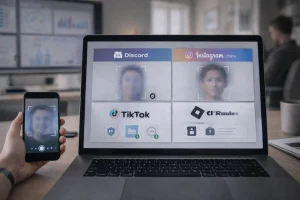
Discord is not the only platform navigating these changes. Over the last two years, several other major platforms have introduced their own forms of age verification and child safety mechanisms.
Meta, for example, has deployed facial estimation AI on Instagram to detect when teens try to falsely claim adult ages. TikTok launched Family Pairing, which allows parents to set screen time limits and content filters. Roblox introduced ID-based verification in 2022 for access to voice chat and age-gated experiences.
What sets Discord apart is the scale and method of implementation. Its combination of age inference, manual ID checks, and automatic teen restrictions is more comprehensive than many of its competitors.
Let’s compare Discord with its peers:
| Platform | Age Verification Method | Age-Restricted Features | Data Privacy Policy |
|---|---|---|---|
| Discord | ID Upload or Video Selfie AI | 18+ servers, DMs, sensitive content | Data deleted post-verification |
| Meta (Instagram/Facebook) | Facial estimation AI | Teen content filters, restricted ads | Variable depending on region |
| TikTok | Family Pairing, screen limits | Screen time, content rating, age gates | Unclear, under review |
| Roblox | ID Upload with Selfie | Voice chat, mature content | Stored for moderation purposes |
As other platforms watch Discord’s approach, it is likely that we’ll see similar models adopted across the industry. This may be the beginning of a new era in which age verification is seen not as an exception but as a standard for online community platforms.
Conclusion
Discord’s face scan age verification and new ID checks represent a major evolution in how the platform balances safety and user freedom. For verified adults, access will remain largely the same. But for teens and unverified users, the experience will be drastically limited.
The success of this global rollout will depend on transparency, trust in third-party vendors, and the platform’s ability to communicate clearly with users.
As someone who’s both a user and observer of tech policy, I believe this is a necessary move in today’s online ecosystem. But Discord must tread carefully, it’s not just about safety, but also about preserving user autonomy, especially in a space built around community and freedom of expression.
FAQs
Is Discord’s age verification mandatory for everyone?
No, not every user will need to verify their age. Only those who want to access age-restricted content or who cannot be verified through Discord’s age inference model will be required to do so.
What kind of ID does Discord accept for verification?
Acceptable IDs typically include a driver’s licence, passport, or national ID card. The ID must clearly show your date of birth and photo.
How accurate is Discord’s face scan age estimation?
Discord uses AI-powered tools that estimate age based on facial features in a video selfie. While not perfect, these tools are generally accurate enough to identify underage users.
Can teens bypass age verification on Discord?
Discord’s system is designed to make it difficult to fake age verification. It uses multiple signals, including device and activity patterns, to detect discrepancies.
Will age checks affect Discord Nitro or paid services?
No, Discord Nitro subscriptions are unaffected. However, some adult-only servers and features may be locked behind age verification.
How safe is my personal data during Discord’s verification?
Data is not stored long-term. IDs are deleted after the process, and face scans are not saved. Discord partners with trusted vendors like Yoti for added security.
Will parents be notified when a teen verifies age on Discord?
Currently, Discord does not send direct notifications to parents. However, the teen-by-default settings aim to keep the platform safe without requiring constant parental monitoring.

Leave a Reply