
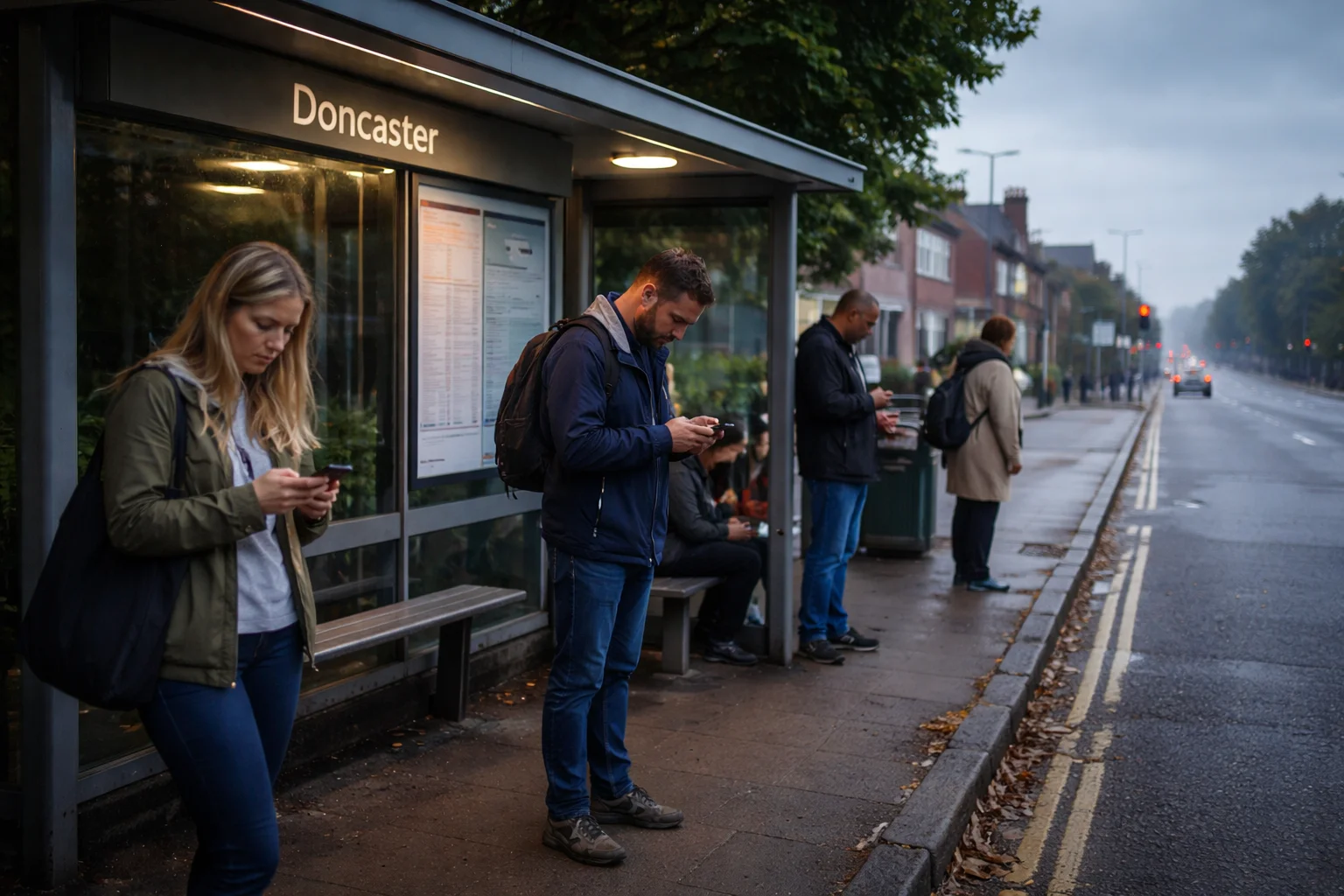
The Doncaster bus strike in March and April 2026 will take place on 28 and 30 March, and 7, 22 and 24 April, with major disruption expected across First Bus services operating from the Leger Way depot.
The strike is driven by a pay dispute, with drivers demanding parity with colleagues in Sheffield, and it is likely to affect key commuter routes, school services, and city centre travel.
Key takeaways:
- Five confirmed strike dates across March and April 2026
- First Bus services in Doncaster most affected
- Disruption centred around Leger Way depot routes
- Pay dispute linked to Sheffield wage comparison
- Travel impact during Easter holidays and major events
- Alternative transport options will be essential for commuters
What Is Happening With the Doncaster Bus Strike in March and April 2026?
The Doncaster bus strike in March and April 2026 is the result of coordinated industrial action by more than 230 drivers employed by First Bus. These drivers are based at the Leger Way depot, which plays a central role in operating a wide network of routes across Doncaster and surrounding areas.
The strike has been formally organised following a ballot in which union members voted in favour of taking action after rejecting a revised pay offer.
The disruption is not limited to isolated services. Instead, it is expected to affect a significant portion of the local public transport system, particularly routes connecting residential areas with Doncaster town centre, employment zones, and education hubs.
The timing of the strike increases its impact, as it overlaps with both seasonal travel demand and major local events.
The scale of the disruption can be better understood by examining the operational scope of the depot involved:
| Category | Details |
|---|---|
| Depot Location | Leger Way, Doncaster |
| Number of Drivers | 230 plus |
| Operator | First Bus |
| Service Coverage | City centre, suburbs, commuter routes |
| Impact Level | High on strike days |
| Key Travel Periods | Peak hours, school runs, event travel |
The strike action is structured across multiple dates rather than continuous stoppage. This creates intermittent disruption, which can be more challenging for commuters to adapt to, as normal service resumes between strike days.
The broader implication is a temporary but repeated breakdown in service reliability. This affects not only daily commuters but also businesses, schools, and local tourism activity.
Why Are Bus Drivers in Doncaster Going on Strike?
The core issue driving the Doncaster bus strike is a disagreement over pay parity. Drivers argue that their wages do not match those of colleagues in Sheffield, despite working under the same company structure and performing similar duties.
This perceived imbalance has been a key factor in the decision to reject the latest pay offer. The offer presented by First Bus included a 7 per cent wage increase, backdated to January 2026.
While this may appear competitive in isolation, union representatives have emphasised that the comparison with nearby regions is what makes the offer insufficient in the eyes of drivers.
The dispute can be summarised in the following comparison:
| Factor | Doncaster Drivers | Sheffield Drivers |
|---|---|---|
| Employer | First Bus | First Bus |
| Pay Offer | 7 percent increase | Higher existing pay baseline |
| Pay Parity Status | Not achieved | Already established |
| Union Position | Rejected offer | Benchmark reference |
What Did the Union Say About the Strike?
Unite union has taken a firm stance on the issue, stating that the current situation creates an unfair working environment.
According to union representatives, employees should not face financial disadvantage simply due to geographic location within the same company network.
The union has also pointed to the financial performance of FirstGroup, highlighting its reported revenues as evidence that improved pay is achievable without compromising business sustainability.
How Has First Bus Responded to the Pay Dispute?

First Bus has responded by defending its pay offer as one of the strongest in the industry for the current year. The company has also acknowledged the concerns raised by drivers and expressed willingness to continue discussions.
A transport operations consultant described the situation in practical terms:
“I have worked with regional bus networks for over a decade, and disputes like this often arise when internal comparisons become more visible. Drivers are not just evaluating their pay in isolation anymore. They are comparing across depots, and that creates pressure on companies to standardise wages.”
This insight highlights a broader industry trend where transparency and workforce communication play a growing role in shaping labour disputes.
What Are the Exact Doncaster Bus Strike Dates?
The strike dates have been strategically scheduled across late March and April. This staggered approach ensures continued pressure during key travel periods.
| Date | Day | Expected Impact Level | Notes |
|---|---|---|---|
| 28 March 2026 | Saturday | High | Weekend travel disruption |
| 30 March 2026 | Monday | High | Start of working week |
| 7 April 2026 | Tuesday | High | Easter holiday period |
| 22 April 2026 | Wednesday | Moderate to High | Midweek commuting |
| 24 April 2026 | Friday | High | End of week travel and events |
These dates are particularly significant because they coincide with increased travel demand. The Easter holiday period typically sees higher passenger volumes, including families, tourists, and event attendees.
The William Hill Lincoln Handicap at Doncaster Racecourse is another factor that intensifies the impact. Events of this scale rely heavily on public transport, and disruptions can affect attendance and local business activity.
Which Bus Routes Are Affected by the Doncaster Bus Strike?
The routes affected by the Doncaster bus strike are primarily those operated by First Bus from the Leger Way depot. While exact service adjustments may vary by date, several categories of routes are consistently impacted.
| Route Type | Description | Impact Level |
|---|---|---|
| City Centre Routes | High frequency services within central Doncaster | High |
| Suburban Routes | Connections between residential areas and town centre | High |
| Commuter Routes | Peak time travel to employment zones | High |
| School Services | Routes aligned with school schedules | Moderate |
| Event Routes | Services supporting local events and venues | Moderate |
Are School and Peak-Time Services Impacted?
School services and peak-time routes are among the most sensitive to disruption. These services operate within strict time windows, and even minor delays can create wider scheduling issues for families and employers.
Morning and evening peak periods are expected to see reduced service frequency, leading to overcrowding on any available buses.
Which Areas in Doncaster Will Face the Most Disruption?
The areas most affected are those with high dependency on First Bus services. These include central Doncaster and surrounding residential districts connected via the Leger Way network.
A local commuter shared their experience:
“I depend on the same route every weekday, and when it is cancelled, there is no simple alternative. It forces me to rethink my entire commute, sometimes at very short notice.”
This highlights how route-specific reliance increases the overall impact of strike action.
How Will the Bus Strike Affect Daily Commuters in Doncaster?
The disruption caused by the Doncaster bus strike extends beyond simple delays. It affects the structure of daily routines, particularly for individuals who rely exclusively on public transport.
Commuters may experience:
- Increased travel time due to limited services
- Higher costs when switching to alternative transport
- Difficulty maintaining punctuality for work or education
The cumulative effect of these challenges can lead to broader economic and social consequences. Businesses may experience reduced staff availability, while educational institutions may see attendance disruptions.
A workplace coordinator described the situation from an organisational perspective:
“We have had to adjust shift start times during previous disruptions. When a large number of employees rely on the same transport network, even a partial shutdown creates a ripple effect across operations.”
This demonstrates how transport reliability is closely tied to productivity and workforce stability.
What Alternative Transport Options Are Available in Doncaster During the Strike?
During the strike period, commuters are encouraged to explore alternative travel methods. Each option comes with its own advantages and limitations depending on distance, cost, and availability.
| Transport Option | Advantages | Limitations |
|---|---|---|
| Train Services | Reliable for longer distances | Limited coverage within local areas |
| Car Sharing | Cost effective when shared | Requires coordination |
| Cycling | Flexible and independent | Weather dependent |
| Walking | No cost | Suitable only for short distances |
| Taxi Services | Convenient and direct | Higher cost during peak demand |
A local transport planner offered practical advice:
“In situations like this, I always recommend combining options rather than relying on one. For example, using a train for the main journey and walking the final stretch can reduce both cost and uncertainty.”
Planning ahead is essential, especially during peak travel hours when demand for alternatives increases significantly.
How Can You Stay Updated on Doncaster Bus Service Changes?

Access to accurate and timely information is critical during the Doncaster bus strike. Service updates may change depending on ongoing negotiations or operational adjustments.
Key information sources include official transport providers, local news outlets, and real-time travel platforms. These channels provide updates on cancellations, delays, and temporary service changes.
| Source Type | Information Provided | Reliability Level |
|---|---|---|
| Operator Updates | Official service announcements | High |
| Local News Platforms | Regional coverage and context | High |
| Live Tracking Apps | Real-time bus locations and delays | Moderate to High |
Regularly checking these sources allows commuters to make informed decisions and adjust travel plans accordingly.
What Does This Bus Strike Mean for the Future of Transport in Doncaster?
The Doncaster bus strike reflects broader challenges within the public transport sector, particularly around wage structures and regional consistency. The outcome of this dispute may influence how similar situations are handled in the future.
If pay parity becomes a standard expectation across regions, transport operators may need to revise their compensation frameworks. This could have implications for operational costs, pricing, and service delivery.
The situation also highlights the importance of workforce satisfaction in maintaining reliable public transport systems. Disputes of this nature can lead to recurring disruptions if underlying issues are not resolved effectively.
In the long term, the strike may encourage both employers and unions to adopt more proactive negotiation strategies to prevent escalation.
Conclusion
The Doncaster bus strike across March and April 2026 is expected to cause repeated disruption, particularly on key commuter and city centre routes.
With multiple strike dates and increased travel demand during holidays and events, planning ahead is essential. Passengers should check updates regularly, consider alternative transport options, and allow extra time for journeys.
Staying informed and flexible will help minimise inconvenience and ensure more reliable travel during this period of ongoing industrial action.
FAQs
Will all bus services in Doncaster stop during the strike?
Not all services will stop, but many First Bus routes will be disrupted or cancelled. Some limited services may still operate.
Are train services affected by the Doncaster bus strike?
No, train services are not part of this industrial action and should run as normal, although they may be busier than usual.
Can school children still travel during the strike?
School transport may be affected depending on the route. Parents are advised to make alternative arrangements where necessary.
Is the strike likely to be cancelled?
At present, the strike dates are confirmed. However, ongoing negotiations could lead to changes if an agreement is reached.
How early should commuters plan their journeys on strike days?
It is recommended to plan at least a day in advance and allow extra travel time on the day.
Will taxis and ride-hailing services be more expensive?
Prices may increase due to higher demand during strike days, especially during peak hours.
Are there refunds for unused bus tickets?
Refund policies depend on the provider. Passengers should check directly with First Bus for guidance.

Leave a Reply