
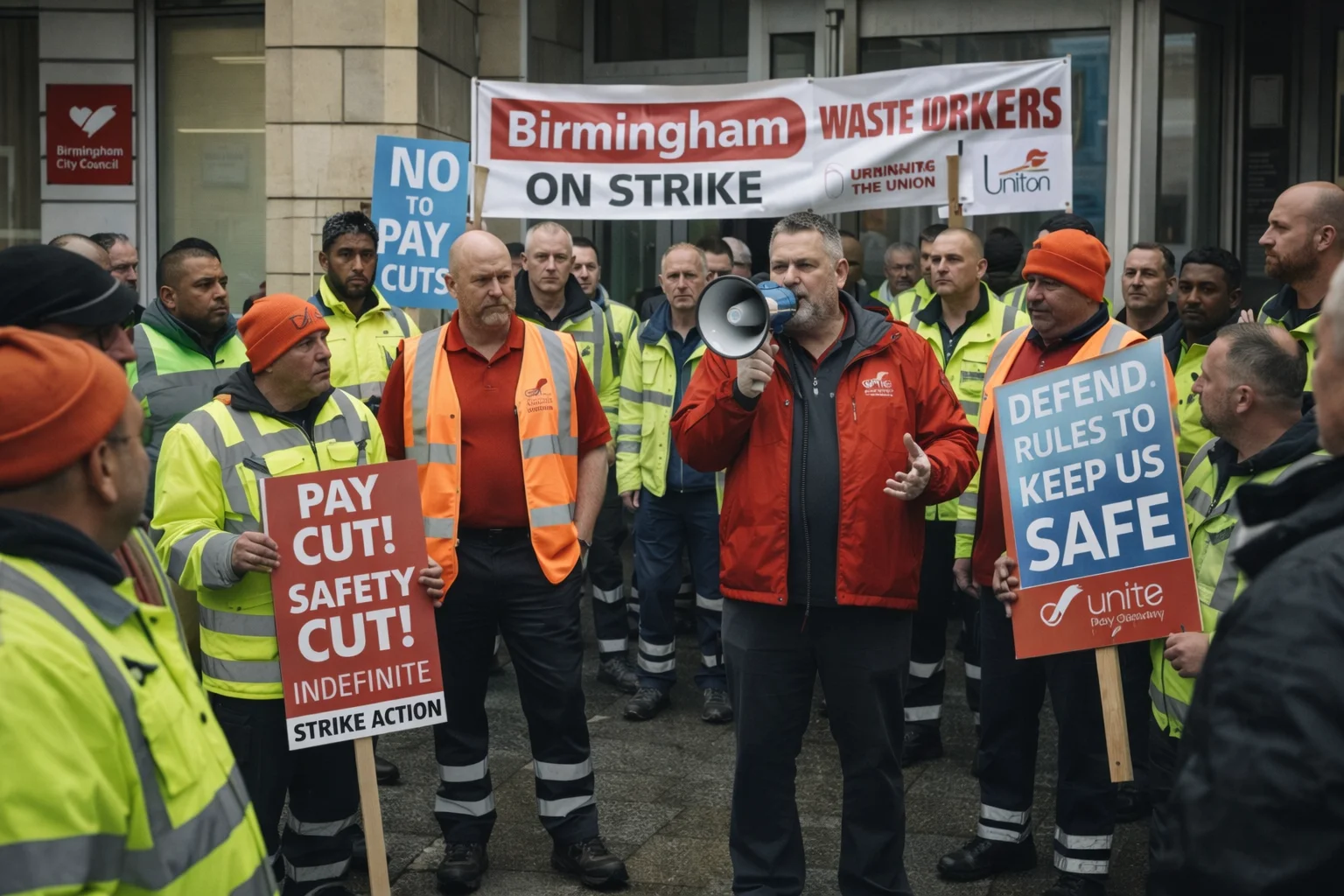
The Birmingham bin strike has entered its second year due to a prolonged dispute between Birmingham City Council and refuse workers represented by the Unite union.
The conflict began in January 2025 over proposed pay reductions and the removal of certain waste collection roles.
While the council argues the changes are necessary to avoid future equal pay claims and support financial recovery after its 2023 bankruptcy, the union says workers could lose significant income and face safety concerns.
With negotiations repeatedly breaking down, the strike has continued to disrupt waste collection services and raised public health concerns across Birmingham.
Key Takeaways:
- The strike began in January 2025.
- It escalated to an indefinite strike in March 2025.
- The dispute involves pay reductions and job restructuring.
- Unite claims workers could lose up to £8,000 per year.
- The council cites equal pay risks and financial recovery.
- Waste collection disruptions affected thousands of households.
- Around 17,000 tonnes of waste accumulated at one stage.
What Is the Birmingham Bin Strike and Why Is It Still Ongoing?

The Birmingham bin strike refers to a prolonged industrial dispute between refuse workers and Birmingham City Council that has disrupted waste collection services across the city.
What initially began as a disagreement over job restructuring and pay conditions gradually developed into one of the most visible local government disputes in the United Kingdom.
Waste collection is one of the most essential services managed by local authorities. When such services are disrupted for an extended period, the effects quickly become visible in daily life.
Streets begin to accumulate rubbish, recycling services are interrupted, and residents face difficulties disposing of household waste. In Birmingham, these issues became particularly evident as the dispute extended beyond its first year.
The strike began in early January 2025 when refuse workers represented by the Unite union voted to take industrial action following disagreements about proposed changes within the waste management workforce.
The dispute escalated further in March 2025 when workers moved to an indefinite all-out strike. Since then, negotiations between the union and the council have repeatedly stalled.
The situation has attracted national and international attention because Birmingham is the second largest city in the United Kingdom. Images showing piles of waste and overflowing bins circulating in global media outlets raised concerns about urban sanitation and the management of essential services.
Several factors explain why the strike has continued for so long. Both the council and the union have maintained strong positions regarding pay, job roles, and financial responsibility.
The council argues that structural reforms are necessary to stabilise its finances and prevent future legal risks. Meanwhile, the union insists that the proposed changes unfairly target workers and reduce their income.
The following table highlights the key characteristics of the Birmingham bin strike.
| Aspect | Details |
|---|---|
| Location | Birmingham, United Kingdom |
| Workers involved | Refuse collectors and waste service employees |
| Representing union | Unite |
| Start of industrial action | January 2025 |
| Escalation to indefinite strike | March 2025 |
| Main dispute | Pay reductions and job restructuring |
| Impact | Waste collection disruption and public health concerns |
From a waste management perspective, long-running disputes can significantly affect operational systems within cities. A local government waste policy specialist explained the broader implications of such disputes.
“I have seen several councils face labour disputes during restructuring. Waste collection is an operational system that depends heavily on teamwork and clearly defined roles. If those roles are suddenly changed without worker confidence, service disruption becomes almost inevitable.”
This observation reflects the complexity of managing large scale municipal services. When workers believe their responsibilities or compensation are changing unfairly, industrial action becomes more likely.
The ongoing Birmingham waste workers strike demonstrates how financial pressures, labour rights, and public service obligations can collide within modern local government systems.
Why Did Birmingham Bin Workers Go on Strike in the First Place?
Understanding the origins of the Birmingham bin strike requires examining the internal changes proposed within the city’s waste collection service.
The dispute emerged when Birmingham City Council introduced plans to restructure parts of its refuse workforce.
Waste collection systems rely on a combination of drivers, loaders, supervisors, and specialised operational roles. Changes to any part of that structure can alter pay grades, job responsibilities, and working conditions.
Pay Cuts and Job Role Changes Behind the Dispute
Unite, the trade union representing Birmingham’s refuse workers, stated that the restructuring proposals could significantly affect workers’ income. According to the union, some employees could lose up to £8,000 per year under the new system.
The council has disputed the scale of these reductions but confirmed that some roles would change as part of a broader effort to modernise waste management services.
Workers raised concerns that the new structure would increase responsibilities while reducing pay. In occupations such as waste collection where the work is physically demanding and involves safety risks, financial security plays a significant role in workforce morale.
A summary of the main points of disagreement regarding pay is presented below.
| Issue | Union Claim | Council Response |
|---|---|---|
| Potential pay reduction | Up to £8,000 annually | Council disputes figure |
| Job restructuring | Removes key roles | Necessary service reform |
| Worker responsibilities | Increased workload | Improved efficiency |
| Safety implications | Higher risk without supervision roles | Safety standards will remain |
For workers, the concern was not simply about pay reductions but also about the long-term stability of their roles. When restructuring affects experienced staff members, it can create anxiety across the entire workforce.
The Controversial Waste Recycling and Collection Officer Role
One of the central issues in the dispute is the removal of the Waste Recycling and Collection Officer role. This position historically played an important part in supervising and coordinating collection teams during daily operations.
The council argues that the role does not exist in many other local authorities and therefore represents an outdated structure. Removing it, according to the council, would streamline operations and reduce the risk of future legal complications.
However, workers argue that the position serves an important operational purpose. Without it, crews may lack experienced oversight during waste collection routes.
Waste collection teams often work in complex environments, including narrow residential streets, busy urban areas, and locations where traffic safety must be carefully managed. Supervisory roles help coordinate these activities and maintain safety standards.
Unite Union’s Safety and Pay Concerns
Unite has repeatedly stated that the proposed changes could undermine both financial stability and safety within the waste service.
The union argues that removing experienced supervisory roles could lead to increased pressure on remaining workers. In physically demanding jobs such as refuse collection, workload balance and operational clarity are essential.
A labour relations specialist who has studied similar disputes within UK councils commented on the issue.
“In municipal services, changes that appear administrative can have very real effects on frontline workers. If employees feel that their expertise is being removed from the system, trust between management and staff can deteriorate quickly.”
Such concerns contributed to the escalation of the dispute from limited strike action to a full indefinite strike.
Why Has the Birmingham City Council Refused the Union’s Demands?

While workers argue that the restructuring threatens their pay and safety, Birmingham City Council insists that the reforms are necessary to protect the city’s financial future.
The council declared effective bankruptcy in 2023 after facing severe financial challenges. One of the largest issues involved historic equal pay claims that cost the authority hundreds of millions of pounds.
Because of these financial difficulties, the government appointed commissioners to oversee the council’s financial recovery plan.
The council believes that maintaining certain job roles could expose it to further equal pay claims. These claims arise when employees argue that they have been paid unfairly compared with colleagues performing similar work.
The financial pressures facing the council can be better understood through the following table.
| Financial Issue | Description | Impact on Council |
|---|---|---|
| Equal pay settlements | Historic claims from employees | Hundreds of millions in liabilities |
| Budget deficits | Rising costs and reduced funding | Reduced spending flexibility |
| Bankruptcy declaration | Issued in 2023 | Government oversight introduced |
| Recovery programme | Financial restructuring plan | Strict limits on expenditure |
From the council’s perspective, maintaining a workforce structure that could trigger new legal claims would worsen the financial crisis. The council therefore argues that restructuring is necessary to avoid repeating past financial mistakes.
City officials have also stated that similar roles to the Waste Recycling and Collection Officer position do not exist in many other local authorities.
By aligning Birmingham’s waste management structure with national norms, the council believes it can reduce legal risks and improve operational efficiency.
However, such arguments have not convinced the union, which maintains that workers should not bear the burden of the council’s financial recovery plan.
Why Did Negotiations Between Unite and Birmingham City Council Collapse?
Efforts to resolve the Birmingham bin strike included several rounds of negotiations in 2025. At various points both sides appeared to move closer to a compromise.
However, talks eventually collapsed during the summer of that year.
Breakdown of Talks in Summer 2025
Negotiations intensified during the middle of 2025 as both parties attempted to reach an agreement that would allow waste collection services to return to normal operations.
The council stated that it had offered the maximum level of financial concessions possible within its recovery plan. According to council representatives, further changes would risk undermining financial stability.
Unite argued that the proposals still did not adequately protect workers’ pay.
When neither side could agree on the final terms, negotiations ended without a settlement.
Role of Government Appointed Commissioners
Another significant factor influencing negotiations was the presence of government-appointed commissioners overseeing the council’s finances.
These commissioners were tasked with ensuring that Birmingham City Council followed strict financial recovery measures.
Unite claimed that the commissioners prevented a potential compromise that could have resolved the dispute. The union suggested that financial restrictions imposed by the oversight body limited the council’s negotiating flexibility.
A local government governance adviser explained the situation in simple terms.
“When a council enters financial recovery, its freedom to negotiate employment terms becomes restricted. Commissioners must ensure that any agreement fits within the recovery plan. That can make labour negotiations much more difficult.”
This financial oversight added an additional layer of complexity to the dispute.
Political Tensions and Union Response
The dispute also created tensions within the political landscape of the city. Trade unions have traditionally maintained strong relationships with political parties involved in local government.
During the strike, Unite announced that it would reduce its ties with the Labour Party. This decision reflected growing frustration with the handling of the dispute.
Political disagreements can sometimes intensify industrial conflicts, especially when public services are involved.
From my perspective as someone who has covered local government disputes, prolonged strikes often occur when financial restructuring intersects with worker protections.
“I have followed several council disputes across the UK, and the pattern is similar. When a local authority faces financial recovery measures, negotiations with unions become extremely constrained. Even when both sides want a compromise, financial rules can limit the options available.”
This dynamic appears to have played a major role in the continuation of the Birmingham waste workers dispute.
How Has the Birmingham Bin Strike Affected Residents and Communities?

For residents of Birmingham, the most visible consequence of the strike has been disruption to everyday waste collection services.
When refuse is not collected regularly, rubbish quickly accumulates on streets and outside homes. In dense urban environments, the effects become noticeable within days.
At one stage of the dispute, the council reported that approximately 17,000 tonnes of waste had accumulated across the city. This situation prompted the council to declare a major incident due to potential public health risks.
Residents have experienced several challenges during the prolonged strike:
- Reduced frequency of waste collections
- Suspension or delay of recycling services
- Increased pressure on local waste disposal centres
- Environmental and sanitation concerns
The accumulation of waste created an unpleasant environment in some neighbourhoods. Overflowing bins and waste bags lining pavements became common sights in affected areas.
The following table summarises the major impacts on residents.
| Impact Area | Description |
|---|---|
| Household waste | Bins left uncollected for extended periods |
| Recycling | Significant disruption to recycling collections |
| Community cleanliness | Increased street litter and waste piles |
| Public frustration | Growing dissatisfaction among residents |
| Waste disposal centres | Long queues due to higher demand |
Many residents have expressed concern that the prolonged disruption damages the city’s image and affects quality of life.
Waste collection services are often taken for granted until they stop functioning properly. The Birmingham bin strike highlighted how essential these services are to urban life.
Are Some Areas of Birmingham Being Affected More Than Others?
During the strike, allegations emerged suggesting that some neighbourhoods were receiving waste collection services more frequently than others.
Reports circulated claiming that more affluent areas of Birmingham were seeing quicker rubbish removal while other communities were left with larger waste accumulations.
Although the council denied intentionally prioritising specific districts, the perception of unequal service delivery became a source of frustration among residents.
In large cities, operational challenges can sometimes create uneven service outcomes. Factors such as route logistics, traffic conditions, and resource availability can affect how quickly waste is removed from different areas.
However, when residents believe that certain communities are being favoured, public trust can decline.
Urban service distribution issues often become politically sensitive. Councillors and community leaders may face pressure from residents demanding equal access to essential services.
The debate over service distribution during the Birmingham bin strike reflects broader questions about fairness in public service management.
What Public Health and Environmental Problems Has the Strike Created?
One of the most serious concerns associated with the Birmingham bin strike is the potential impact on public health and environmental conditions.
When waste accumulates in residential areas, it can attract pests and create unpleasant living conditions.
Local reports during the strike mentioned several sanitation issues:
- Increased rodent activity
- Insects and maggots in decomposing waste
- Strong odours in areas with large waste piles
These issues become more severe during warmer months when organic waste decomposes more quickly.
The environmental consequences of prolonged waste accumulation are outlined in the following table.
| Environmental Issue | Cause | Possible Impact |
|---|---|---|
| Rodent infestations | Food waste accumulation | Health risks and property damage |
| Insect growth | Decomposing organic waste | Hygiene concerns |
| Air quality | Odours from waste piles | Reduced comfort for residents |
| Street pollution | Overflowing bins | Decline in urban cleanliness |
Public health experts often warn that sanitation systems play a critical role in preventing disease and maintaining urban living standards.
Although emergency collection measures have reduced some of the worst impacts, the prolonged disruption has still created challenges for local communities.
Is Rubbish Currently Being Cleared During the Birmingham Bin Strike?

Despite the ongoing industrial action, Birmingham City Council has implemented contingency plans to ensure that waste collection services continue at a reduced level.
The council states that every household should still receive at least one general waste collection each week.
To maintain these services, the council introduced several operational strategies.
Temporary agency workers were hired to support waste collection teams. These workers helped maintain limited services while permanent staff remained on strike.
Legal measures were also introduced to prevent blockades at waste depots that could disrupt emergency collection operations.
The council’s contingency approach includes several measures.
| Measure | Purpose |
|---|---|
| Agency workers | Maintain basic waste collection |
| Emergency collection routes | Ensure minimum service coverage |
| Legal injunctions | Prevent depot blockades |
| Operational restructuring | Adapt routes during the strike |
However, the situation became more complicated when some agency workers joined picket lines themselves after raising concerns about workplace treatment.
This development highlighted the ongoing tensions surrounding the dispute and demonstrated how difficult it can be to maintain essential services during prolonged industrial action.
As long as negotiations remain unresolved, the city’s waste management system will likely continue operating under these temporary measures rather than returning to full capacity.
Conclusion: What the Birmingham Bin Strike Means for the City’s Future?
The Birmingham bin strike has become one of the most prolonged waste collection disputes in recent UK history. What began as a disagreement over job roles and pay has developed into a complex conflict shaped by financial pressures, political tensions, and public frustration.
For residents, the consequences have included disrupted services, environmental concerns, and uncertainty about when normal waste collection will return.
The eventual resolution will likely require compromise from both the council and the union. Until that happens, the dispute serves as a reminder of how fragile essential public services can become when financial restructuring and labour relations collide.
FAQ
Why are Birmingham bin workers on strike?
Birmingham bin workers went on strike primarily due to proposed pay reductions and the removal of certain job roles within the council’s waste collection service. The Unite union argues these changes could significantly affect workers’ incomes and safety.
How long has the Birmingham bin strike lasted?
The strike began in January 2025 and escalated into an indefinite strike in March 2025. It has now continued into its second year.
Who represents the striking waste workers in Birmingham?
The striking refuse workers are represented by Unite, one of the UK’s largest trade unions.
Did Birmingham City Council declare bankruptcy?
Birmingham City Council declared effective bankruptcy in 2023 due to severe financial pressures, including large equal pay liabilities and budget deficits.
Are Birmingham residents still receiving bin collections?
The council says contingency plans ensure at least one weekly general waste collection per household, although services such as recycling collections have been heavily disrupted.
How much rubbish accumulated during the strike?
At one stage, the council reported around 17,000 tonnes of waste accumulating across the city during the dispute.
Could elections influence the end of the strike?
Yes. Local elections could potentially change the leadership of Birmingham City Council, which may lead to new negotiations with the union.

Leave a Reply