
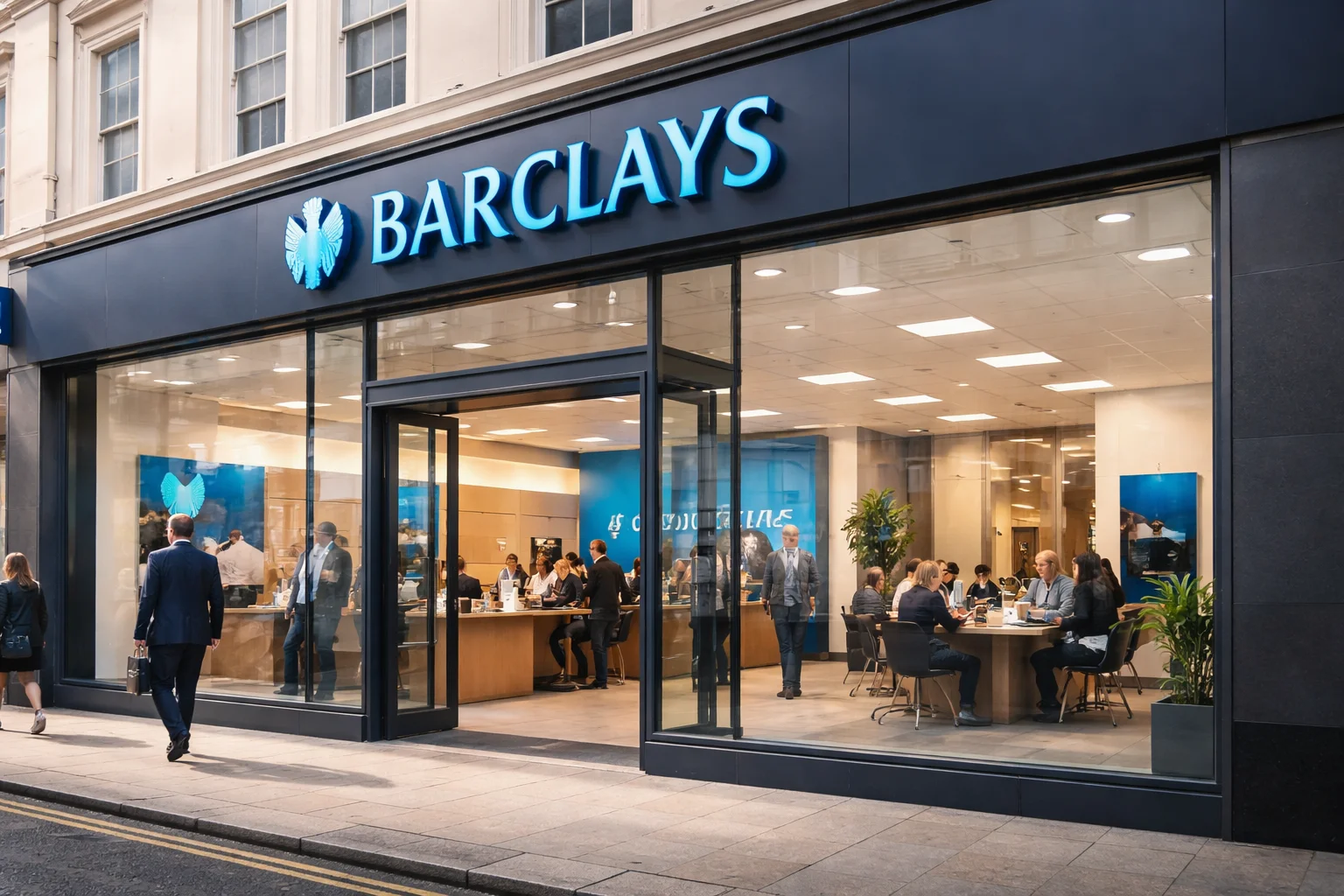
Barclays new bank branches clearly signal a strategic return to physical banking in the UK, as the bank shifts towards a hybrid model that combines digital convenience with in-person support.
After years of large-scale closures, Barclays is now focusing on reopening and investing in branches to meet customer demand for human interaction, personalised advice, and accessible services.
Key Takeaways:
- Barclays is pausing closures and planning new branch openings
- Over 800 branches were closed, with 206 currently remaining
- Customer demand for face-to-face banking is driving the shift
- Bank managers are being reintroduced to improve service quality
- The strategy focuses on a hybrid banking model
- Competition from fintech and digital banks is influencing decisions
- Physical branches remain vital for trust, complex queries, and community support
Why Is Barclays Opening New Bank Branches Again in the UK?

Barclays new bank branches reflect a calculated strategic shift rather than a sudden reversal of direction.
Over the past decade, the UK banking sector has undergone rapid digital transformation, with many institutions reducing their physical presence in favour of mobile apps and online platforms.
Barclays followed this trend by closing more than 800 branches since 2018. However, recent developments suggest that the bank now sees long term value in rebuilding its high street footprint.
The decision is closely linked to leadership changes within Barclays UK. Vim Maru, who assumed leadership of the UK division in 2024, has played a central role in reshaping the bank’s approach.
One of his earliest strategic decisions was to pause branch closures and reassess the role of physical banking in a digital-first environment.
Barclays is not abandoning digital innovation. Instead, it is aiming to create a more balanced service model. The bank recognises that while digital tools offer speed and convenience, they cannot fully replace the reassurance and clarity that comes from in-person interactions.
Several key motivations are driving this shift:
- The need to improve customer trust and satisfaction
- Increasing demand for face-to-face financial advice
- Competitive pressure from both traditional and digital banks
- The importance of maintaining a visible presence in local communities
This move signals that Barclays sees physical branches not as outdated assets but as strategic touchpoints that enhance the overall customer experience.
What Has Driven the Return to Physical Banking at Barclays?
The return of Barclays new bank branches is rooted in a combination of customer behaviour, technological limitations, and evolving expectations within the financial services sector.
Customer Demand for In-Person Banking
Despite the widespread adoption of digital banking, a significant portion of customers still prefer in-person interactions for certain types of services. This is particularly true for complex financial matters such as mortgage loans, business loans, fraud resolution, and financial planning.
Customers often seek reassurance when dealing with sensitive financial decisions. Digital interfaces, while efficient, can sometimes feel impersonal and limited in their ability to address nuanced concerns.
A retail banking consultant explained this trend clearly:
“I’ve worked with customers who are comfortable using apps for basic transactions, but the moment something becomes complicated, they want to sit down with someone who can guide them properly. That human element is still incredibly important.”
This demand is not limited to older demographics. Younger customers, while digitally savvy, also value access to expert advice when making significant financial decisions.
Evolution of Digital Banking Expectations
Digital banking has raised expectations around speed, accessibility, and convenience. However, it has also exposed certain limitations. Automated systems and chatbots, while useful for routine queries, often struggle with more complex or urgent issues.
Barclays has acknowledged that over-reliance on digital channels can lead to customer frustration. Many users find themselves navigating multiple layers of automated responses before reaching a solution.
A financial services advisor highlighted this issue:
“I’ve seen cases where customers spend a long time trying to resolve an issue through digital channels, only to realise that a five-minute conversation in a branch could have solved it immediately.”
This growing awareness has contributed to the shift towards a hybrid model, where digital and physical services complement each other rather than compete.
How Many Barclays Branches Have Closed and What Is Changing Now?
Barclays has been one of the most active banks in reducing its branch network over recent years. Since 2018, more than 800 branches have been closed across the UK.
This reflects a broader industry trend driven by declining footfall, cost pressures, and the rise of online banking.
As of the latest available data, Barclays operates approximately 206 branches. While this represents a significant reduction from previous levels, the bank is now focusing on stabilising and expanding its network.
The current strategy involves several key changes:
- Pausing further branch closures
- Identifying locations where new branches can be opened
- Relocating branches to areas with higher customer demand
- Extending opening hours to improve accessibility
Barclays has also increased in-branch availability by adding over 33,500 hours annually. This indicates a clear commitment to making physical banking more accessible and relevant.
Barclays Branch Network Overview
Category Details
Total closures since 2018 800+
Current branches 206
Strategy change year 2024
Annual added branch hours 33,500
Focus Expansion and optimisation
This shift is not about returning to the past but about adapting the branch model to modern needs. Smaller, more efficient branches in strategic locations are likely to replace larger, less utilised sites.
What Role Will Bank Managers Play in New Barclays Branches?
The reintroduction of bank managers is one of the most notable aspects of Barclays new bank branches. This role, once central to traditional banking, had become less visible during the digital transition.
Bank managers serve as key points of contact for customers, offering personalised advice and helping to resolve complex issues. Their presence enhances trust and strengthens customer relationships.
A former branch manager described the importance of this role:
“In my experience, customers don’t just come into a branch for transactions. They come in for reassurance. A conversation with a knowledgeable person can make a significant difference, especially when they are making important financial decisions.”
The responsibilities of bank managers in the new branch model include:
- Providing tailored financial advice
- Supporting small business clients
- Assisting with complex account issues
- Building long-term customer relationships
Traditional vs Modern Bank Manager Role
Aspect Traditional Role Modern Role
Customer interaction High High
Digital integration Low High
Advisory services Moderate Extensive
Community engagement Strong Strong
Technology use Limited Advanced
This updated role combines traditional relationship management with modern digital tools, making bank managers more versatile and effective.
How Does Barclays’ Strategy Compare to Other UK Banks?
Barclays new bank branches stand out in a sector where many competitors continue to reduce their physical presence. Most major UK banks have prioritised cost reduction and digital expansion, often at the expense of their branch networks.
High Street Banking Trends
Banks such as HSBC, Lloyds, and NatWest have continued to close branches in response to changing customer behaviour. While this approach has improved operational efficiency, it has also raised concerns about accessibility, particularly in rural areas.
The reduction in branches has led to increased reliance on shared banking hubs and alternative service models. However, these solutions do not always fully replace the benefits of dedicated branches.
Influence of Digital-Only Banks
Digital-only banks have significantly influenced the competitive landscape. Companies like Revolut and Monzo have attracted customers with their user-friendly apps, low fees, and innovative features.
Interestingly, some of these digital banks are now exploring physical services, including customer support centres and in-person assistance. This suggests that even digital-first institutions recognise the value of human interaction.
Comparison of Banking Models
Feature Traditional Banks Digital Banks Barclays Hybrid Model
Physical branches Yes No Yes
Mobile apps Yes Yes Yes
In-person support Yes Limited Yes
Cost efficiency Moderate High Balanced
Customer experience Mixed Digital-focused Integrated
Barclays’ hybrid approach aims to combine the strengths of both models, offering flexibility and convenience without sacrificing personal service.
What Are the Benefits of Barclays New Bank Branches for Customers?
The expansion of Barclays new bank branches provides several tangible benefits for customers across different demographics.
One of the primary advantages is improved access to banking services. Not all customers are comfortable with digital platforms, and some may lack the necessary skills or resources to use them effectively. Physical branches ensure that these individuals are not excluded.
Face-to-face interactions also improve the quality of service. Complex issues can often be resolved more quickly and effectively in person, reducing frustration and saving time.
A small business owner shared their experience:
“When I needed help with a loan application, speaking directly to someone made the process much clearer. It allowed me to ask questions and get immediate answers, which wouldn’t have been possible through an app alone.”
Additional benefits include:
- Better support for small and medium-sized enterprises
- Increased trust through personal interaction
- Enhanced problem-solving for complex financial matters
Customer Benefits of Physical Branches
Benefit Description
Accessibility Services available to all customer groups
Personal support Direct interaction with banking professionals
Faster resolution Immediate handling of complex issues
Community presence Strengthens local economies
Trust building Enhances customer confidence
These advantages highlight why physical branches remain relevant, even in an increasingly digital world.
Is Barclays Moving Towards a Hybrid Banking Model?

Barclays new bank branches are a central component of its hybrid banking strategy. This model integrates digital platforms, contact centres, and physical locations to create a seamless and flexible customer experience.
The hybrid approach allows customers to choose how they interact with the bank based on their needs. Routine tasks can be handled through mobile apps, while more complex issues can be addressed in person.
This model also enables Barclays to optimise its resources. Digital channels handle high-volume, low-complexity transactions, while branches focus on high-value interactions.
A banking strategist explained this approach:
“The future of banking isn’t about choosing between digital and physical. It’s about creating a system where both work together effectively. Customers want options, and the hybrid model provides that flexibility.”
The integration of services ensures consistency across all channels. Customers can start a process online and complete it in a branch, or vice versa, without disruption.
This strategy positions Barclays to adapt to future changes in customer behaviour while maintaining a strong foundation in both digital and physical banking.
Conclusion
Barclays new bank branches represent a significant shift in strategy, moving away from a purely digital focus towards a more balanced approach. By reintroducing physical locations and prioritising customer interaction, Barclays is addressing a key gap in modern banking.
This approach not only enhances customer experience but also positions the bank to compete effectively in an evolving financial landscape. As the UK banking sector continues to adapt, Barclays’ decision may well influence the future direction of high street banking.
FAQs About Barclays New Bank Branches
Why is Barclays reopening branches in the UK?
Barclays is reopening branches to meet customer demand for face-to-face services and to create a better balance between digital and physical banking.
How many Barclays branches are currently open?
As of recent reports, Barclays operates around 206 branches across the UK.
Are Barclays closing branches anymore?
Barclays has paused its branch closure programme and is now focusing on expanding and improving its branch network.
What services will new Barclays branches offer?
New branches will provide a range of services including account support, financial advice, loan assistance, and in-person consultations.
Will digital banking still be important for Barclays?
Yes, Barclays continues to invest in digital banking while integrating it with physical branch services through a hybrid model.
How do Barclays branches benefit local communities?
They improve access to banking services, support small businesses, and maintain a financial presence on the high street.
Are other UK banks also reopening branches?
Most UK banks are still reducing branch numbers, making Barclays’ strategy relatively unique in the current market.

Leave a Reply