
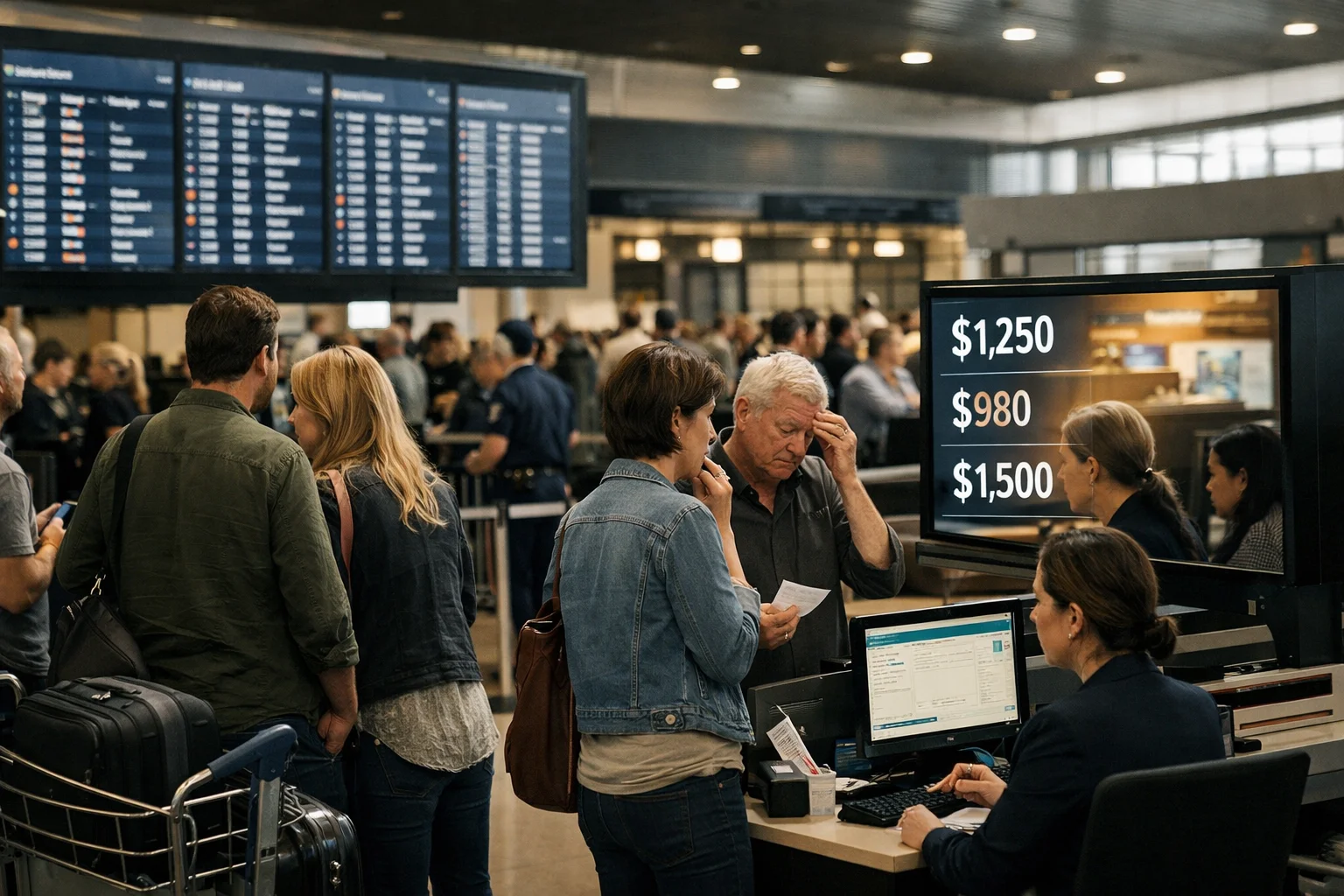
Yes, flight prices are going up on several international routes after major Gulf aviation hubs experienced disruptions and temporary closures. These hubs normally handle a large share of long-haul flights connecting Asia, Europe and the UK.
When airlines lose access to these central transit points, flight capacity decreases while travel demand remains high.
Airlines are also rerouting aircraft around restricted airspace, increasing travel distance, fuel usage and operational costs. As a result, travellers are seeing limited seat availability and higher fares on many popular routes.
The key factors affecting flight prices are outlined below.
Key Factor Impact on Global Flights
Closure of Gulf aviation hubs Reduced airline capacity between continents
Airspace restrictions Airlines forced to reroute flights
Longer travel routes Increased fuel consumption and flight time
Rising oil prices Higher airline operating costs
Strong travel demand Increased competition for limited seats
What Happened to Major Gulf Aviation Hubs and Why Were They Shut Down?
The sudden disruption of major aviation hubs in the Gulf region has had immediate consequences for global travel networks.
Airports such as Dubai International Airport, Hamad International Airport in Doha, and Abu Dhabi International Airport serve as central connection points for passengers travelling between Asia, Europe, Africa and Australia.
When geopolitical tensions escalate in the Middle East, aviation authorities often prioritise safety by restricting access to regional airspace
. In this situation, the conflict involving the United States, Israel and Iran created concerns about the safety of commercial aircraft operating across parts of the region.
Several airlines responded by suspending flights, cancelling services or rerouting aircraft away from potentially dangerous areas.
Dubai International Airport normally handles more than one thousand flights per day and is widely recognised as the busiest international airport in the world in terms of international passenger traffic.
When operations at such a hub are disrupted, the consequences extend far beyond the region itself.
The aviation industry relies heavily on a carefully coordinated global network. Airlines schedule flights months in advance, and aircraft often operate multiple routes across different continents within a single day.
When one major hub experiences disruption, airlines must rapidly adjust their operations.
The Impact of the U.S.–Israel Conflict With Iran on Regional Airspace
Airspace restrictions can occur quickly during geopolitical crises. Governments and aviation regulators often issue safety notices advising airlines to avoid certain areas.
Airlines must assess risks before flying through any region experiencing military activity. When tensions rise, the safest option is often to reroute aircraft or suspend operations entirely.
Several immediate consequences appear when airspace becomes restricted.
- Airlines must cancel or delay flights
- Aircraft must take longer alternative routes
- Airlines experience higher fuel and operational costs
- Passenger schedules become disrupted
These decisions are rarely taken lightly because airlines depend on reliable schedules to maintain profitability. However, passenger safety always takes priority.
Why Dubai and Other Gulf Airports Are Critical for Global Travel?
Airports in the Gulf region play a crucial role in international aviation because of their geographical location between major continents.
The hub model allows airlines to collect passengers from different cities and route them through a central airport before sending them to their final destinations. This system increases efficiency for long-distance travel.
The table below highlights the importance of major Gulf hubs in global aviation.
Airport Country Estimated Daily Flights Role in Global Aviation
Dubai International Airport UAE Over 1000 Largest international transit hub
Hamad International Airport Qatar Over 700 Major connection hub for Asia-Europe routes
Abu Dhabi International Airport UAE Over 500 Strategic hub linking Europe, Asia, and Africa
King Khalid International Airport Saudi Arabia Over 600 Regional and international transit point
These hubs allow passengers to travel between continents with relatively short stopovers. When they become unavailable, airlines must redesign flight networks almost immediately.
How Do Gulf Aviation Hubs Influence Global Flight Routes?
The modern aviation system relies heavily on global transit hubs. Rather than operating direct flights between every pair of cities, airlines concentrate passengers into central hubs where they transfer to connecting flights.
This model is particularly effective for long-haul travel between Asia and Europe. Gulf airlines have developed extensive route networks that connect dozens of cities across multiple continents.
For example, a traveller flying from Bangkok to London might normally connect through Dubai or Doha. The hub airport allows passengers from many different cities to join a single long-haul flight to Europe.
When these hubs are disrupted, airlines lose their ability to combine passengers efficiently. This results in several operational challenges.
Airlines must quickly determine how to maintain connections between continents. Some flights may be cancelled entirely, while others are rerouted through alternative hubs.
The following table illustrates how hub airports normally support international travel.
Route Type Typical Hub Connection Travel Pattern
Asia to Europe Dubai or Doha Passengers connect through the Gulf hub
Australia to Europe Dubai or Abu Dhabi Long-haul flights with one stop
Africa to Asia Doha or Dubai Multi-continent connections
Middle East to Europe Direct hub flights High-frequency services
When these central points are disrupted, airlines must search for new ways to maintain connectivity.
Why Are Flights Between Asia and Europe Suddenly Limited?
The reduction in available flights between Asia and Europe is largely the result of airlines losing access to the most efficient routes through the Middle East.
Many airlines depend on the region as a connecting corridor. Aircraft travelling between Asia and Europe typically pass through this airspace because it provides the shortest and most efficient route.
When airlines avoid this region, several consequences emerge.
Flights must travel longer distances, which increases journey times. Aircraft utilisation becomes less efficient because planes spend more time in the air.
Airlines may also need to reduce flight frequency because longer journeys require more crew hours and operational resources.
Another important factor is aircraft availability. Airlines operate a limited number of long-haul aircraft. When those aircraft spend more time completing each journey, fewer flights can be scheduled overall.
The table below explains how capacity changes during aviation disruptions.
Operational Factor Normal Conditions Disruption Conditions
Flight duration Shorter routes Longer rerouted flights
Aircraft utilisation High efficiency Reduced efficiency
Seat availability Large supply of seats Limited capacity
Ticket availability Consistent inventory Flights sold out quickly
This reduction in capacity creates immediate pressure on ticket availability. When demand remains strong, but available seats decrease, prices tend to increase.
Are Flight Prices Going Up on Popular Asia, Europe and UK Routes?
Airline booking systems provide clear evidence that flight prices are rising on several major routes connecting Asia and Europe. Limited seat availability has pushed travellers to compete for fewer tickets, particularly on direct routes that avoid Middle Eastern airspace.
On routes such as Hong Kong to London, airline websites have shown that economy seats were unavailable for several days. When seats became available again, ticket prices were significantly higher than usual.
Flights between Australia and the United Kingdom have also experienced unusual price fluctuations. Some airlines have temporarily removed certain routes from sale because aircraft must be redirected through different corridors.
The following table shows examples of fare increases reported on several routes.
Route Typical Economy Fare Disruption Fare Range
Hong Kong to London HKD 5000 to HKD 7000 HKD 21000 or higher
Sydney to London AUD 1500 to AUD 2000 AUD 3000 or more
Bangkok to London THB 25000 to THB 35000 THB 70000 or higher
Beijing to London CNY 10000 return Limited availability mostly business class
Higher prices are not only caused by airline decisions. The fundamental issue is that demand for international travel remains strong while the number of available flights has decreased.
A professional aviation analyst explained the situation in clear terms.
“I have studied airline pricing patterns for many years and this situation follows a familiar pattern. When a major hub suddenly stops operating, airlines lose a large portion of their available seats on critical routes. Passengers still need to travel, so demand remains high. In that environment ticket prices naturally rise because the supply of seats becomes limited.”
How Are Airlines Rerouting Flights Around Closed Middle Eastern Airspace?

Airlines have begun adjusting flight paths to avoid the affected region. Rerouting aircraft allows airlines to maintain operations while ensuring passenger safety.
These alternative routes generally fall into two categories.
Northern Alternative Routes via the Caucasus and Central Asia
Some airlines are choosing to fly north of the restricted airspace. Aircraft travel through the Caucasus region and parts of Central Asia before continuing towards Europe.
This path allows airlines to avoid the most sensitive areas but increases flight distances.
Longer routes require more fuel and often increase flight duration by several hours, depending on the aircraft type and weather conditions.
Southern Routes Through Egypt, Saudi Arabia, and Oman
Another option involves flying south of the restricted airspace. Aircraft may pass through Egypt before travelling across parts of Saudi Arabia and Oman.
Although this path remains safe, it also increases travel time.
The table below compares the typical route distance with rerouted paths.
Route Example Normal Distance Rerouted Distance Estimated Time Increase
Bangkok to London 9500 km 10500 km 1 to 2 hours
Singapore to Paris 10700 km 11800 km Up to 2 hours
Sydney to London 17000 km 18500 km 2 to 3 hours
Hong Kong to Frankfurt 9100 km 10100 km Around 1 hour
Even a small increase in distance can significantly affect airline costs because long-haul aircraft consume large amounts of fuel.
Why Do Longer Routes and Higher Fuel Prices Increase Airline Ticket Costs?
Fuel represents one of the highest operating costs for airlines. When flight distances increase, fuel consumption rises accordingly.
At the same time, geopolitical tensions often cause fluctuations in global oil markets. When oil prices increase, airlines must pay more for aviation fuel.
These combined pressures can increase operating costs across an entire airline network.
The relationship between these factors can be seen in the following table.
Cost Factor Effect on Airlines Result for Travellers
Increased flight distance Higher fuel consumption Airlines raise fares
Rising oil prices More expensive jet fuel Ticket prices increase
Reduced flight capacity Limited seats Higher demand for tickets
Operational disruption Schedule changes Fewer affordable options
Airlines attempt to manage these costs carefully. Some airlines hedge fuel prices to protect themselves from sudden increases. However, unexpected disruptions can still place significant pressure on operating budgets.
Which Airlines Are Benefiting From the Disruption?
While many airlines face operational challenges, some carriers may experience increased demand during aviation disruptions.
Airlines that operate outside the affected airspace can continue offering relatively direct routes between Asia and Europe. These airlines may attract passengers who wish to avoid transit through the Middle East.
Carriers such as Cathay Pacific, Singapore Airlines and Turkish Airlines have seen increased interest from travellers seeking alternative routes.
Passengers often prioritise reliability when choosing flights during uncertain conditions. Even if ticket prices are slightly higher, travellers prefer airlines that can provide predictable schedules.
The shift in passenger behaviour can temporarily benefit airlines that operate outside disrupted regions.
Are UK Travellers Already Feeling the Impact of Rising Airfares?
Travellers departing from the United Kingdom are already experiencing the effects of reduced global flight capacity. Travel agencies and airline booking platforms report an increase in enquiries from passengers attempting to secure alternative routes.
Flight Centre Travel Group reported a significant surge in calls to customer support teams shortly after the disruption began. Many travellers were seeking assistance with rebooking flights or finding new routes to reach Europe or Asia.
Passengers have begun choosing different transit points such as Singapore or major Chinese airports, rather than travelling through the Gulf region.
From the author’s perspective, the situation demonstrates how quickly global aviation networks respond to external shocks.
“I have observed the aviation industry for several years and this event illustrates how interconnected the system truly is. When a hub like Dubai experiences disruption, the effects spread almost immediately across multiple continents. Travellers in Europe, Asia and Australia suddenly compete for a smaller number of available flights. That shift in supply and demand often results in higher ticket prices within a very short period.”
Airlines and travel agencies are now closely monitoring the situation. If operations at major Gulf hubs return to normal, flight capacity may stabilise, and ticket prices could gradually return to typical levels.
However, until that happens, travellers may continue seeing higher fares and limited availability on several international routes.
Conclusion
The disruption of major Gulf aviation hubs has created significant ripple effects across global air travel. Reduced flight capacity, rerouted aircraft, and rising fuel costs have all contributed to higher ticket prices on several Asia-to-Europe routes.
Travellers are already experiencing limited seat availability and increased fares, particularly on routes connecting to the UK.
If the disruption continues, airlines may struggle to maintain current schedules. However, once airspace restrictions ease and hubs reopen, flight capacity could stabilise, and prices may gradually return to normal levels.
FAQ
Why do airline ticket prices rise during geopolitical conflicts?
Airline prices often increase because airspace closures force airlines to reroute flights, which increases operating costs and reduces available seats.
How do airspace restrictions affect international flight routes?
Airspace restrictions require airlines to avoid certain regions, leading to longer routes, higher fuel consumption and potential schedule changes.
Are flights to the UK usually affected by Middle East disruptions?
Yes. Many long-haul routes connecting Asia and Australia to Europe pass through the Middle East, so disruptions there can affect UK travel routes.
Why are Gulf aviation hubs so important for global travel?
Airports like Dubai and Doha act as global connection points that link passengers travelling between continents.
Can flight prices return to normal after aviation disruptions?
In many cases they do. Once airspace restrictions end and airline schedules stabilise, prices usually return to normal levels.
How do airlines choose alternative routes during airspace closures?
Airlines analyse safe airspace corridors and select routes that minimise risk while keeping flights operational.
What is the best way to find cheaper flights during travel disruptions?
Travellers often find better prices by booking early, comparing airlines and remaining flexible with travel dates.

Leave a Reply