

A Royal Mail Fee to Pay notice means Royal Mail is holding a letter or parcel because an outstanding charge must be paid before delivery or collection can take place.
The fee may relate to insufficient postage, unpaid postage, the use of an invalid stamp, or customs charges on items arriving from outside the UK.
Once the required payment has been made, recipients can usually arrange redelivery or collect the item from a Customer Service Point.
Key Takeaways:
- A Royal Mail Fee to Pay notice indicates an outstanding postage or customs charge.
- Fees may arise due to insufficient postage, no postage, counterfeit stamps, or import charges.
- Customers can pay online using a debit card, credit card, or PayPal.
- Customs charges are calculated by Border Force and HMRC, not Royal Mail.
- Royal Mail applies handling fees to customs-related items.
- Unpaid postage items are typically held for 18 days.
- Customs charge items are generally held for 21 calendar days.
- Recipients can choose redelivery or collect the item after payment.
- Valid identification is required when collecting a held parcel.
- Prompt payment helps prevent items from being returned to the sender.
What Is a Royal Mail Fee to Pay Notice?

A Royal Mail Fee to Pay notice is an official notification sent to a recipient when an item of mail cannot be delivered because there is an outstanding charge that must be paid first.
The notification may arrive as a physical card, a letter, or in some cases through an email or SMS message, depending on the service used and the information available to Royal Mail.
The purpose of the Fee to Pay system is to recover postage shortfalls or customs-related charges before an item enters the final stage of delivery.
Rather than refusing the item immediately, Royal Mail holds it securely and gives the recipient an opportunity to settle the outstanding amount.
For many people, receiving a Fee to Pay notice can be unexpected. They may assume the sender has already paid for postage or may not be aware that imported goods can attract customs charges.
However, these notices are a routine part of Royal Mail’s operations and are designed to ensure that mailing and import regulations are followed correctly.
Understanding the Fee to Pay Card
The Fee to Pay card acts as a formal notification that an item is being held. It typically contains the details needed to identify the parcel and complete payment.
Information usually included on the card includes:
- The amount due
- The reason for the charge
- A barcode or reference number
- Instructions on how to pay
- Collection or delivery options
The reference number plays an important role because it helps Royal Mail locate the specific item quickly once payment has been received.
When Is a Fee to Pay Issued?
A Fee to Pay notice can be issued under several circumstances. The most common reason is insufficient postage. This occurs when the sender has not paid enough to cover the weight, dimensions, or service level of the item being sent.
Other situations that may trigger a charge include:
- No postage being attached to the item
- Use of counterfeit stamps
- Use of non-barcoded stamps where restrictions apply
- Customs charges on imported goods
Royal Mail assesses each item according to its published pricing structure. If the postage paid does not match the item’s characteristics, a surcharge may be applied before delivery can proceed.
Why Has Royal Mail Sent a Fee to Pay Card?
When recipients receive a Fee to Pay notice, their first question is usually why the charge has been applied. Understanding the underlying reasons can help avoid confusion and ensure the issue is resolved quickly.
One of the most common causes is underpaid postage. Postal charges are determined by several factors, including weight, dimensions, destination, and the service selected by the sender. Even a small discrepancy can result in additional fees.
For example, a parcel may have been sent as a large letter but exceeded the permitted thickness. In such cases, Royal Mail may reclassify the item and apply a surcharge to cover the difference.
The charge may also arise when an international sender incorrectly completes customs documentation or when imported goods become subject to VAT or Customs Duty.
The following table outlines the most common reasons a Fee to Pay notice may be issued.
Reason Description
Insufficient postage Not enough postage was paid for the item
No postage paid The item was sent without valid postage
Counterfeit stamps Invalid or fraudulent stamps were detected
Non-barcoded stamp use A surcharge applies under Royal Mail rules
Customs charges VAT or import duties are due
Incorrect item classification Weight or dimensions exceed the paid category
A postal compliance specialist explained the issue clearly:
“During my work with postal operations, I often see recipients assume the charge is an error. In reality, most Fee to Pay notices result from simple postage miscalculations or customs assessments that were applied correctly according to current regulations.”
This highlights why recipients should review the details carefully before assuming a mistake has been made.
How Can Someone Pay a Royal Mail Fee to Pay Online?

Royal Mail has developed an online payment system that allows customers to settle charges quickly without visiting a delivery office.
The online service is designed to be straightforward and can usually be completed within a few minutes.
Information Required Before Making a Payment
Before beginning the process, customers should gather the information shown on their Fee to Pay card or notification.
The following details are commonly required:
Required Information Purpose
Fee to Pay card or letter Identifies the item
Barcode number Helps locate the parcel
Reference number Speeds up processing
Payment card or PayPal account Used to complete payment
Delivery address details Confirms recipient information
Having these details available before starting helps reduce delays during the payment process.
Steps to Pay a Royal Mail Fee Online
The online payment process follows a simple sequence.
Customers typically need to:
- Visit the Royal Mail Pay a Fee webpage.
- Select the relevant fee type.
- Enter the barcode or reference number.
- Review the amount due.
- Complete payment using an approved method.
- Arrange delivery or collection.
Payments are generally processed quickly, allowing Royal Mail to begin preparing the item for release.
Parcelforce Customs Charge Barcode Issues
Royal Mail has acknowledged that a small number of Parcelforce customers may encounter difficulties when entering barcode details for customs payments.
Where this occurs, customers can use an alternative process by selecting the customs charge option and manually entering the card details provided on their notification.
This ensures customers are still able to complete payment and receive their items without significant delays.
What Are the Current Royal Mail Fee to Pay Charges?
The amount payable depends on the type of item and the reason the charge has been applied.
Royal Mail publishes standard surcharge rates for different categories of mail.
Unpaid Postage and Surcharge Fees
Item Type Charge
Letter or Large Letter with no postage or counterfeit stamp £5.00
Letter or Large Letter with insufficient postage £1.50
Letter or Large Letter with non-barcoded stamp £2.50
Small Parcel with no postage or counterfeit stamp £7.00
Small Parcel with insufficient postage £3.50
Small Parcel with non-barcoded stamp £3.50
Medium Parcel £1.50 plus additional postage
Oversized Medium Parcel £10.00
These charges are intended to recover postage costs and administrative expenses associated with handling incorrectly paid items.
Customs Handling Fees
When customs charges apply, Royal Mail and Parcelforce may charge handling fees in addition to any taxes or duties imposed by HMRC.
Service Type Handling Fee
Royal Mail products £8
Parcelforce products £12
Goods over £900 requiring full declaration £25
These fees cover customs clearance administration and the process of advancing import charges on behalf of recipients.
How Are Customs Charges Calculated on International Deliveries?

Customs charges are among the most misunderstood aspects of international shipping.
Many recipients mistakenly believe Royal Mail creates these charges. In reality, customs fees are determined by Border Force and HM Revenue & Customs.
Royal Mail acts as an intermediary by collecting the charges before delivery.
Several factors influence customs calculations:
- Value of the goods
- Type of goods
- Country of origin
- Whether the item is a gift
- Applicable VAT rates
- Customs duty classifications
The table below provides a simplified overview.
Factor Impact on Charges
Goods value Higher values may attract additional duties
Product category Different goods attract different rates
Origin country Trade agreements may affect charges
Gift status Different thresholds may apply
VAT rate Applied based on item type
For imported goods above applicable thresholds, recipients may be required to pay VAT and Customs Duty before the item can be delivered.
Letters, postcards, and documents are generally exempt because they do not contain commercial goods.
Royal Mail pays the assessed charges to HMRC on behalf of the recipient to avoid delays in processing. The recipient then reimburses these costs through the Fee to Pay system.
How Long Does Royal Mail Hold an Item Awaiting Payment?
Royal Mail provides a specific period during which customers can settle their fees and arrange delivery.
The holding period varies depending on the nature of the charge.
Charge Type Holding Period
Unpaid postage items 18 days
Customs charge items 21 calendar days
These deadlines are important because items that remain unpaid beyond the permitted period are generally returned to the sender.
Customers should avoid leaving payment until the final day. Processing times, payment verification, and delivery scheduling can occasionally require additional time.
Where customs charges are involved, the longer holding period reflects the additional administration often associated with imported goods.
How Can Someone Receive Their Item After Paying the Fee?

Once payment has been completed successfully, Royal Mail offers several options for obtaining the item.
The most common method is redelivery. This allows recipients to select a convenient date and receive the item at their chosen address.
Redelivery is particularly useful for individuals who cannot easily visit a Customer Service Point.
Alternatively, recipients can collect the item in person.
Choosing Redelivery
The redelivery option provides flexibility and convenience.
Benefits include:
- Reduced travel requirements
- Flexible scheduling
- Faster access to held items
After payment is confirmed, customers can often select a delivery date that fits their schedule.
Collecting from a Customer Service Point
Collection may be preferred by customers who want to receive the item immediately after payment.
The collection process involves identity verification to ensure the parcel is released to the correct individual.
Royal Mail staff will check the documentation provided before handing over the item.
What Identification Is Needed to Collect a Fee to Pay Item?
Security is an important part of the collection process.
Royal Mail requires proof of identity before releasing mail held under the Fee to Pay scheme.
Accepted identification typically includes:
Accepted Identification Type
Passport Photo ID
Driving licence Photo ID
NHS medical card Supporting ID
Credit or debit card Financial ID
Bank or building society book Financial ID
Senior citizen bus pass Photo ID
Official employee identification Photo ID
Where someone is collecting on behalf of another person, additional proof may be required.
This often includes evidence of the recipient’s address and identification for the person collecting the item.
A customer services professional explained the reasoning behind the policy:
“I frequently speak with customers who are surprised by the identification checks. These requirements exist to protect recipients and ensure valuable items are only released to authorised individuals.”
These procedures help reduce fraud and prevent mail from falling into the wrong hands.
Can Someone Pay a Royal Mail Fee on Behalf of Another Person?

Royal Mail allows third parties to pay fees on behalf of recipients.
This can be particularly useful when:
- Family members are unavailable
- Elderly relatives need assistance
- Business colleagues are travelling
- Recipients lack online payment access
The key requirement is that the parcel details entered during payment match the information shown on the Fee to Pay notice.
Although another person may complete the payment, the parcel remains associated with the named recipient unless collection arrangements are made according to Royal Mail’s requirements.
What Is the Reference Number on a Royal Mail Fee to Pay Card?
The reference number serves as an important identifier within Royal Mail’s systems.
It enables staff to locate the correct item quickly and accurately.
Including the reference number when paying can:
- Speed up parcel retrieval
- Improve tracking accuracy
- Reduce administrative delays
- Help customer service teams investigate issues
Even if a card does not contain a reference number, alternative identifying information can usually be used to process payment and arrange delivery.
What Happens to Mail Entering the UK from Abroad?

Every year, millions of international items enter the UK postal network.
Before delivery, these items may pass through customs checks conducted by Border Force.
The process helps ensure:
- Taxes are collected correctly
- Restricted items are identified
- Import regulations are enforced
- Security requirements are met
Items containing goods are generally more likely to be assessed than standard correspondence.
Current customs rules mean VAT may be collected at the point of sale for lower-value purchases, while higher-value goods may generate charges upon arrival in the UK.
Where charges are due, Royal Mail will notify the recipient and hold the item until payment is received.
How Can Someone Challenge or Query a Customs Charge?
Not every customs assessment is accepted without question.
Recipients who believe charges have been applied incorrectly can challenge the decision through the appropriate government channels.
Royal Mail does not calculate customs charges and therefore cannot normally alter them.
Customers should contact:
- HM Revenue & Customs
- Border Force
Supporting evidence may include:
- Purchase invoices
- Payment confirmations
- Product descriptions
- Customs documentation
If authorities determine that an error occurred, a refund may be issued.
However, Royal Mail’s handling fee may remain payable where customs declarations were completed incorrectly by the sender.
What Are the Most Common Royal Mail Fee to Pay Mistakes to Avoid?
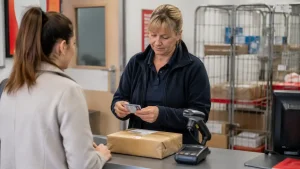
Many delivery delays occur because recipients make avoidable mistakes after receiving a Fee to Pay notice.
Common errors include ignoring the notice, misplacing the card, delaying payment, or failing to bring suitable identification when collecting an item.
Another frequent mistake is assuming that customs charges are optional. In reality, parcels cannot normally be released until all required fees have been paid.
Taking prompt action and following the instructions carefully can significantly reduce the risk of delays, returns, or additional complications.
Is Paying a Royal Mail Fee to Pay Worth Doing Quickly?
Prompt payment is generally the most practical approach.
Once a Fee to Pay notice has been issued, the item remains on hold until the outstanding amount is settled. Delays increase the likelihood of the parcel being returned to the sender, particularly when approaching the end of the holding period.
Early payment offers several advantages:
- Faster parcel release
- Greater delivery flexibility
- Reduced risk of return to sender
- Fewer administrative complications
For valuable purchases, time-sensitive documents, or important personal deliveries, responding quickly can help ensure a smoother and more predictable delivery experience.
Conclusion
A Royal Mail Fee to Pay notice indicates that an item cannot be delivered until an outstanding postage or customs charge has been settled.
Whether the fee relates to insufficient postage, unpaid postage, or import taxes, understanding the reason behind the charge is the first step towards receiving the item.
Fortunately, the process is straightforward. Recipients can pay online using a debit card, credit card, or PayPal, arrange redelivery, or collect the item from a Customer Service Point once payment has been confirmed.
Acting promptly is important, as Royal Mail only holds items for a limited period before returning them to the sender.
By paying the Royal Mail Fee to Pay charge quickly and following the correct procedures, recipients can avoid delays and receive their parcels with minimal disruption.
Frequently Asked Questions
Can a Royal Mail Fee to Pay notice be sent by email or SMS?
Yes. In addition to physical cards and letters, Royal Mail may send notifications by email or SMS, depending on the delivery service and available contact information.
What happens if the sender disputes the postage charge?
The sender may contact Royal Mail to discuss the issue. However, the recipient must normally pay the fee first if they wish to receive the item before any investigation is completed.
Can customs charges be paid after delivery?
No. In most cases, customs charges must be paid before Royal Mail releases the item for delivery or collection.
Does Royal Mail charge interest on unpaid fees?
No. Royal Mail does not normally charge interest on unpaid Fee to Pay notices. However, the item may be returned to the sender if payment is not made within the holding period.
Can a parcel be redirected after paying a Fee to Pay charge?
Redirection options depend on the delivery service used and Royal Mail’s current policies. Customers should check available options during the payment process.
Why does a parcel get held at a Customer Service Point?
Items are held when postage or customs charges remain unpaid. Royal Mail keeps the parcel secure until payment is received.
How long does redelivery take after a Fee to Pay payment?
Delivery times vary, but customers can often choose a preferred delivery date when paying online, helping to speed up the process.

Leave a Reply