
Last Updated on AUG 20, 2026
The RAC’s late-May 2026 bank holiday traffic forecast predicted the busiest late-May getaway on UK roads since 2024, with almost 19 million leisure journeys planned between Friday and Bank Holiday Monday.
Friday and Saturday were expected to be the busiest days, with around 3.8 million trips on each day, followed by 3.4 million on Sunday and 3.1 million on Monday.
Transport analysts INRIX identified the M1, M25, M5 and M6 as the main roads at risk of serious congestion.
The M25 anticlockwise between Junctions 10 and 6 was expected to be particularly busy on Friday afternoon, while the M5 southbound towards Bridgwater faced substantial delays on Saturday.
Key Takeaways:
- Nearly 19 million journeys expected across the UK
- M25, M5, M6, M1, and M4 likely to face severe congestion
- Friday and Saturday forecast as the busiest travel days
- Fuel prices remain high but travel demand continues to rise
- RAC shares essential vehicle preparation and travel advice
- Longest delays could exceed 50 minutes on major routes
Why Is the RAC Bank Holiday Traffic Forecast Predicting Heavy Congestion This Year?
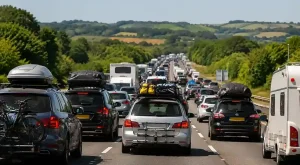
The latest RAC bank holiday traffic forecast has revealed that the UK is preparing for one of its busiest late May travel weekends in recent years.
RAC research estimated almost 19 million leisure journeys over the late-May 2026 bank holiday, around one million more than the 17.9 million trips forecast for the equivalent weekend in 2025.
The RAC described the 2026 weekend as the busiest late-May bank holiday on the roads since 2024.
Transport analysts believe the combination of warmer weather, school half-term breaks, family holidays, and increased domestic tourism is creating the perfect conditions for heavy congestion on major UK motorways.
Long weekends traditionally lead to spikes in road traffic, but this year’s increase appears significantly higher than average.
According to RAC research, nearly four in ten motorists are planning to travel over the bank holiday period. The majority of journeys are expected to be leisure related, with families heading towards coastal destinations, countryside retreats, festivals, and holiday parks.
Traffic experts have warned that motorists travelling during peak periods could face lengthy delays on several major motorway routes. Congestion is expected to build steadily from Friday afternoon and continue throughout the weekend before peaking again on Bank Holiday Monday as drivers return home.
The RAC bank holiday traffic forecast also highlights how domestic travel continues to dominate holiday choices for many Britons.
Rising airport costs, rail disruptions, and increased international travel expenses have encouraged more families to choose road trips within the UK.
The expected traffic increase is especially notable because fuel prices remain high across the country. Despite the additional costs associated with driving, millions still intend to travel to make the most of the long weekend and improving weather conditions.
Estimated UK Bank Holiday Journeys
| Day | Planned Leisure Journeys |
|---|---|
| Friday | 3.8 million |
| Saturday | 3.8 million |
| Sunday | 3.4 million |
| Bank Holiday Monday | 3.1 million |
| Day not yet decided | 4.8 million |
| Total | 18.9 million |
Industry experts suggest that traffic levels this year may rival some of the busiest pre-pandemic bank holiday weekends. Increased confidence in domestic travel and growing demand for short UK breaks continue to influence driver behaviour.
The RAC also pointed out that travel demand has been supported by favourable weather forecasts. Many drivers delayed leisure trips during colder and wetter periods earlier in the year, leading to increased enthusiasm for bank holiday travel.
RAC mobile servicing and repairs team leader Sean Kimberlin said the forecast showed that millions were planning getaway trips as the weather improved, adding that the weekend was expected to be the busiest late-May bank holiday since 2024 despite fuel prices remaining high.
Which Roads Will Be the Most Congested During the Bank Holiday?
Several major UK motorways are expected to experience significant congestion throughout the holiday weekend. Traffic analysts from INRIX have identified multiple traffic hotspots where delays are likely to become particularly severe during peak travel periods.
The M25 around Greater London is once again forecast to be one of the busiest roads in the country.
As one of the UK’s most heavily used motorways, the M25 regularly experiences delays during major holiday periods, especially when commuter traffic overlaps with holiday getaway journeys.
The M5 southbound towards the South West is also expected to become heavily congested as drivers travel towards Devon, Cornwall, Somerset, and other coastal destinations.
Holidaymakers heading towards beaches and caravan parks are expected to create long queues during Saturday afternoon.
The M6 in the West Midlands and North West England is another key congestion area. Traffic levels are expected to rise sharply due to holiday traffic, freight transport, and routine weekend travel combining together.
The M1 southbound route towards London is forecast to face serious delays on Bank Holiday Monday as travellers return home from weekend trips.
Most Congested Motorways Expected This Weekend
| Road | What the 2026 Forecast Said |
|---|---|
| M25 | Anticlockwise J10 to J6 expected to be particularly busy on Friday afternoon and again around Saturday lunchtime |
| M5 | Southbound traffic towards Bridgwater expected to experience major Saturday delays |
| M1 | Identified by INRIX as one of the motorway congestion hotspots |
| M6 | Identified by INRIX as one of the motorway congestion hotspots |
The official late-May 2026 RAC forecast specifically identified the M1, M25, M5 and M6 as roads expected to experience some of the worst congestion.
Traffic experts explained that several factors are contributing to these congestion hotspots. One of the main issues is the timing of departures.
Many people intend to leave immediately after work on Friday, creating a sharp rise in motorway usage during late afternoon and evening hours.
Weekend events and tourism activity are also increasing travel demand across key routes. Popular holiday regions are expected to experience some of the heaviest traffic conditions of the year so far.
INRIX analysts stated,
“Drivers should expect delays significantly above normal levels, particularly on routes heading towards leisure destinations.”
Another factor influencing congestion is ongoing roadworks across parts of the motorway network. Although some temporary roadworks are often suspended during bank holidays, certain restrictions and lane closures remain active.
Motorists using routes around London and travelling towards the South West were among those facing the clearest identified congestion risks, particularly on the M25 and M5.
What Are the Longest Expected Delays This Bank Holiday?
Traffic modelling data has identified several motorway sections where delays are expected to exceed forty minutes during peak periods.
The M25 anticlockwise between Junction 10 and Junction 6 is predicted to experience one of the longest delays during Friday afternoon.
This section regularly becomes heavily congested during holiday weekends due to high traffic volumes around Greater London.
The M5 southbound between Junction 15 and Junction 23 is also forecast to experience major congestion on Saturday afternoon. Drivers heading towards holiday destinations in the South West are expected to contribute heavily to traffic build-up.
On Bank Holiday Monday, return traffic is expected to create severe delays on the M1 southbound and M6 southbound routes.
Longest Predicted Delays
| eriod | Route | Verified RAC/INRIX Forecast |
|---|---|---|
| Friday afternoon | M25 anticlockwise J10 to J6 | Heaviest traffic expected around 4.45pm |
| Saturday lunchtime | M25 anticlockwise J10 to J6 | Journey times expected to be more than twice normal levels |
| Saturday around midday | M5 southbound towards J23 Bridgwater | Queues of around 45 minutes expected |
INRIX expected the M25 anticlockwise between Junctions 10 and 6 to experience particularly heavy traffic around 4.45pm on Friday, with another spike around Saturday lunchtime.
On Saturday, the M5 southbound between the RAC tower near Bristol and Junction 23 for Bridgwater was forecast to see queues of approximately 45 minutes.
Traffic conditions are expected to remain unpredictable due to weather changes, accidents, and unexpected breakdowns. Even small incidents can quickly cause major delays when roads are operating near full capacity.
Experts recommend checking live traffic updates before travelling and considering alternative routes where possible.
The RAC has also advised motorists to allow extra time for journeys throughout the weekend.
Why Are Fuel Prices Still Affecting UK Drivers?
Fuel prices remain one of the biggest concerns for UK motorists despite strong travel demand for the bank holiday weekend.
At the time RAC published its late-May 2026 traffic forecast, average UK petrol stood at 158.52p per litre and diesel at 185.92p per litre. Those figures should therefore be treated as the prices applying to the May bank-holiday forecast, rather than as current pump prices.
Rising global oil prices and international market instability have contributed to increased costs at fuel stations across the UK.
Average UK Fuel Prices at the Time of the May 2026 Forecast
Fuel Type Average Price Per Litre Average Family Car Fill Up
Petrol 158.52p £87
Diesel 185.92p £102
Fuel prices have continued to change since the May bank holiday. In its latest fuel-market update published on 19 August 2026, the RAC said petrol remained 22.7p per litre higher and diesel 29.8p higher than when the Middle East conflict began on 28 February.
The RAC also highlighted Competition and Markets Authority concerns that falling wholesale diesel costs had not always been passed on to motorists quickly enough.
Drivers now also have wider access to the Government-backed Fuel Finder system. Petrol stations are required to report price changes within 30 minutes, allowing comparison services and apps to provide much more up-to-date local pump-price information.
The cost of filling a family vehicle has risen sharply compared to the same period last year. Petrol drivers are now paying around £14 more per tank, while diesel vehicle owners are paying approximately £26 extra.
Although fuel prices are affecting household budgets, the majority of motorists still plan to travel during the bank holiday weekend. RAC research found that only a small percentage of drivers intend to cancel trips entirely because of fuel costs.
However, many drivers are changing their travel behaviour in response to rising expenses.
Some motorists are:
- Choosing shorter journeys
- Reducing non-essential driving
- Looking for cheaper fuel stations
- Travelling with family or friends to share fuel costs
Concerns over fuel affordability continue to grow among UK households, particularly as wider living costs remain high.
Industry analysts believe drivers are becoming more selective about how and when they travel, but leisure travel demand remains resilient during major holiday weekends.
The RAC has encouraged drivers to use fuel comparison tools and travel planning apps to reduce unnecessary spending.
Traffic congestion itself also contributes to increased fuel consumption. Stop start traffic conditions force engines to work harder and reduce fuel economy significantly.
How Can Drivers Avoid the Worst Bank Holiday Traffic?

Transport experts are advising motorists to prepare carefully before travelling to reduce stress and avoid the worst congestion periods.
One of the most effective ways to reduce delays is to travel outside peak traffic hours. Early morning departures are often less congested compared to late afternoon journeys.
Drivers are also encouraged to monitor traffic reports throughout the day because conditions can change rapidly.
Recommended Travel Strategies
Strategy Benefit
Leave early in the morning Avoid peak congestion
Use live navigation apps Find alternative routes
Avoid Friday afternoon travel Reduce motorway delays
Refuel before peak periods Avoid queues at stations
Plan rest stops in advance Improve journey comfort
Vehicle preparation is another important factor during busy holiday travel periods. Breakdowns can become particularly dangerous and stressful during heavy motorway congestion.
The RAC recommends carrying out essential vehicle checks before travelling long distances.
Important Vehicle Checks
- Tyre pressure and tread depth
- Oil levels
- Coolant levels
- Battery condition
- Windscreen washer fluid
- Brake performance
Drivers are also advised to carry emergency supplies in case of long delays or breakdowns.
Useful items include:
- Drinking water
- Snacks
- Mobile phone charger
- Portable battery pack
- Basic first aid kit
Sean Kimberlin stated,
“A few simple checks before setting off can make a significant difference and help drivers avoid unnecessary breakdowns during one of the busiest weekends of the year.”
Experts also recommend taking regular breaks during long journeys, particularly in warm weather conditions. Fatigue remains one of the leading causes of motorway accidents in the UK.
Which UK Regions Are Expected to Experience the Worst Congestion?
Traffic conditions are expected to vary across the country, but several regions have been identified as major congestion hotspots during the bank holiday weekend.
Greater London is likely to experience some of the heaviest traffic levels due to the concentration of motorway routes surrounding the capital.
The M25 remains particularly vulnerable to delays because it handles both commuter and long-distance traffic simultaneously.
South West England is another area expected to face severe congestion. Roads leading towards Devon, Cornwall, and Somerset traditionally become heavily congested during holiday periods as tourists travel towards coastal resorts.
Wales is also preparing for increased traffic demand, especially along the M4 westbound route towards Bridgend and other holiday destinations.
Regions Facing Heavy Congestion
Region Main Roads Affected Traffic Risk Level
Greater London M25 Very High
South West England M5 Severe
Wales M4 High
West Midlands M6 High
South East England M1 Heavy
Traffic analysts believe domestic tourism trends are playing a major role in increasing road usage across these regions.
Holiday parks, campsites, beaches, and countryside destinations are expected to attract large numbers of visitors throughout the weekend.
The overlap between local traffic, holidaymakers, freight vehicles, and day-trippers creates particularly difficult conditions on motorway networks.
Local authorities and transport agencies are expected to monitor conditions closely and provide live updates where necessary.
National Highways has also reminded motorists to remain patient and allow additional travel time throughout the weekend.
What Should Drivers Do If They Get Stuck in Traffic?

Getting caught in heavy motorway traffic can quickly become uncomfortable, especially during warm weather conditions.
Drivers are advised to remain calm and avoid risky driving behaviour when delays occur. Aggressive lane changing and speeding between traffic gaps often increase accident risks and worsen congestion.
Motorists should ensure they have enough fuel before starting journeys because prolonged delays can increase fuel usage significantly.
Hydration is also important during warmer conditions. Drivers and passengers should carry enough drinking water for the entire journey.
The RAC has advised drivers to keep mobile phones charged in case of emergencies or breakdown situations.
If traffic stops completely for extended periods, drivers should:
- Keep hazard lights ready if traffic suddenly slows
- Monitor engine temperatures
- Stay informed through traffic reports
- Avoid unnecessary distractions
- Maintain safe distances between vehicles
Experts also recommend taking regular rest breaks to reduce fatigue levels during long journeys.
Traffic congestion can create additional stress for families travelling with children, so entertainment, snacks, and planned rest stops can help improve comfort during delays.
Road safety organisations continue to remind motorists that patience and preparation remain essential during periods of exceptionally heavy traffic.
Conclusion
The RAC’s late-May 2026 bank holiday forecast predicted almost 19 million leisure journeys, making it the busiest equivalent weekend on UK roads since 2024 and around one million journeys busier than 2025. Friday and Saturday were expected to lead the getaway, with 3.8 million planned trips on each day.
The RAC’s late-May 2026 bank holiday forecast predicted almost 19 million leisure journeys, making it the busiest equivalent weekend on UK roads since 2024 and around one million journeys busier than 2025. Friday and Saturday were expected to lead the getaway, with 3.8 million planned trips on each day.
Although that bank holiday has now passed, the RAC’s advice remains useful for future peak travel periods: check the vehicle before departure, allow additional journey time, monitor live traffic conditions and compare fuel prices before filling up.
FAQs
What is the RAC bank holiday traffic forecast?
The RAC bank holiday traffic forecast predicts expected traffic levels, motorway congestion, and travel delays across the UK during busy holiday periods.
Which motorway will be busiest this bank holiday?
The M25 anticlockwise between Junction 10 and Junction 6 is forecast to experience some of the heaviest congestion.
How many people are expected to travel this bank holiday?
Around 18.8 million journeys are expected to take place over the late May bank holiday weekend.
What time should drivers avoid travelling?
Drivers are advised to avoid Friday late afternoon and Saturday lunchtime periods when congestion is expected to peak.
Are fuel prices affecting bank holiday travel plans?
Yes, although most drivers still plan to travel, many remain concerned about rising petrol and diesel costs.
Which roads are expected to face the longest delays?
The M25, M1, M5, M6, and M4 are expected to experience the longest queues and delays.
How can drivers prepare for bank holiday travel?
Motorists should check tyres, oil, coolant, battery condition, and carry emergency essentials before travelling.

Leave a Reply