

Last Updated: 05.11.2026
There is no separate maintenance loan for most Master’s students in England because the government designed postgraduate funding as a single loan covering both tuition fees and living expenses, rather than offering two separate loans as it does for undergraduate students.
The Postgraduate Master’s Loan was introduced in 2016 to make advanced education more accessible. However, the amount was intended as a contribution towards study costs, not a guarantee that all tuition fees and living expenses would be covered.
For the 2026/27 academic year, eligible students in England can borrow up to £13,206 for a Master’s degree. This funding can be used for university fees, accommodation, food, transport and other essential expenses.
However, different arrangements apply across the UK. Scotland offers a separate postgraduate living-cost loan, while some healthcare and teacher-training courses in England also qualify for maintenance support.
How Does the Postgraduate Master’s Loan Work in England?
The Postgraduate Master’s Loan is a government-backed loan administered by Student Finance England.
Unlike undergraduate student finance, it combines tuition fee and living-cost support into one payment that students manage themselves.
Undergraduate students normally receive a Tuition Fee Loan paid directly to their university and a separate Maintenance Loan to help with accommodation, food and other expenses.
Master’s students generally receive one combined amount, paid directly into their bank account.
The main features are:
- Single Loan: The funding covers both tuition fees and living expenses.
- Non-Means-Tested Funding: The maximum available loan does not depend on household income.
- Direct Payments: Money is transferred to the student’s bank account.
- Flexible Spending: Students decide how to distribute the money between fees and living costs.
- Income-Based Repayments: Repayments depend on earnings after studying, rather than the original loan amount.
For example, a student receiving £13,206 who pays £9,000 in university fees would have £4,206 remaining for other expenses.
That is why postgraduate students must calculate their full study costs before accepting a university offer.
Why Did the Government Introduce a Combined Master’s Loan Instead of Separate Maintenance Funding?
The postgraduate loan system was developed to improve access to advanced qualifications without introducing the same funding arrangements used for undergraduate degrees.
In November 2015, the government confirmed plans to introduce Master’s loans of up to £10,000 from the 2016/17 academic year.
The policy aimed to remove financial barriers to postgraduate education, encourage more people to develop advanced skills and support the UK’s competitiveness.
Rather than funding tuition and maintenance separately, the government created a single contribution-to-costs loan.
How the Funding Structure Was Introduced?
Year Development
2014 The government announced plans to expand postgraduate loan support.
2015 A consultation and government response established the proposed Master’s loan arrangements.
2016 Postgraduate Master’s Loans became available in England, initially offering up to £10,000.
2024/25 The maximum English Master’s Loan reached £12,471.
2025/26 The maximum increased to £12,858.
2026/27 The maximum increased to £13,206 for new eligible courses.
The single-loan structure provides flexibility because students can decide how much to allocate to their different expenses.
However, it also transfers responsibility for balancing tuition fees and living costs to individual students.
The system is sometimes explained as reflecting greater financial independence among postgraduate students.
However, the government’s documented policy objective was to increase access to postgraduate study through a contribution towards costs, rather than to establish that all Master’s students were financially independent.
The main difficulty is that tuition fees can consume most of the loan before students have paid for accommodation or everyday necessities.
How Much Postgraduate Master’s Loan Can Students Get in 2026/27?
Eligible students in England can receive up to £13,206 if their Master’s course starts on or after 1 August 2026.
The exact maximum depends on when the course began.
Academic Year of Course Start Maximum Master’s Loan
2024/25 £12,471
2025/26 £12,858
2026/27 £13,206
These amounts apply to the entire course rather than automatically being available each year.
For example, a student completing an eligible two-year Master’s degree and receiving the full £13,206 would normally have £6,603 allocated to each academic year.
The loan is not based on household income, but the student must meet the relevant personal, residency and course eligibility conditions.
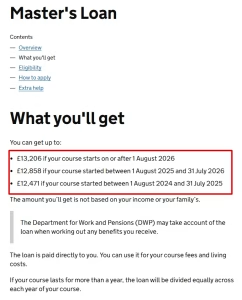
GOV.UK confirms the maximum £13,206 Postgraduate Master’s Loan for courses beginning on or after 1 August 2026 and explains how the loan covers tuition fees and living costs.
When Will Students Receive Their Loan Payments?
Student Finance England normally pays the Master’s Loan in three instalments during each academic year.
The payment proportions are:
- First Instalment: 33% of the annual allocation.
- Second Instalment: 33% of the annual allocation.
- Third Instalment: 34% of the annual allocation.
The first payment is issued after the university confirms the student’s registration.
For a one-year course receiving the maximum £13,206, the instalments would be approximately £4,358, £4,358 and £4,490.
Students should compare these payment dates against university fee deadlines and monthly rent commitments.
What Are the Differences in Master’s Funding Across the UK?
Postgraduate student finance is managed separately in England, Scotland, Wales and Northern Ireland.
Consequently, the amount available and whether maintenance funding is separate depend on the student’s eligibility under the relevant national funding system.
Postgraduate Funding Comparison for 2026/27
UK Nation Maximum Master’s Funding Maintenance Support
England £13,206 Combined loan for tuition and living costs
Wales £19,635 Combined postgraduate loan for study costs
Scotland £7,000 Tuition Loan + £6,900 Living-Cost Loan Separate living-cost loan for eligible full-time students
Northern Ireland £10,000 Postgraduate tuition fee loan without a standard separate maintenance loan
England: Students receive one combined loan and decide how to use it. The government does not provide a separate standard postgraduate maintenance payment.
Wales: Eligible students can receive up to £19,635 as a combined postgraduate loan for courses beginning in 2026/27. It is paid directly to students and is not means-tested.
Scotland: Eligible full-time postgraduate students can receive up to £7,000 towards tuition fees and £6,900 towards living costs. Part-time postgraduate students generally cannot access the separate living-cost loan.
Northern Ireland: Students starting eligible postgraduate courses in 2026/27 may receive up to £10,000 towards tuition fees. The loan is paid towards course fees rather than providing a general living-cost allowance.
Students who started earlier courses may remain subject to the funding rates applicable when their studies began.
It is also important to understand that eligibility is generally linked to ordinary residence and other funding conditions, not simply the geographical location of the chosen university.
Are There Any Master’s Courses That Qualify for a Separate Maintenance Loan?
Yes. Although ordinary taught Master’s degrees in England do not qualify for a separate maintenance loan, certain postgraduate courses have different funding arrangements.
Healthcare Master’s Degrees
Students beginning eligible full-time postgraduate pre-registration healthcare courses may qualify for undergraduate-style Tuition Fee Loans and Maintenance Loans instead of the standard Postgraduate Master’s Loan.
These arrangements can apply to qualifying healthcare programmes, including certain pre-registration nursing, midwifery and allied health professional courses.
However, eligibility depends on the particular programme and its funding designation.
Students should confirm their entitlement with Student Finance England and their university before applying.
Postgraduate Teacher Training
Eligible students taking a Postgraduate Certificate in Education (PGCE) or another qualifying initial teacher-training programme can also receive tuition fee and maintenance support.
Some teacher-training students may qualify for additional bursaries or scholarships, depending on their subject and circumstances.
Salaried teacher-training programmes have different funding rules and generally do not qualify for the same student loans.
Postgraduate Students in Scotland
Scotland provides a separate living-cost loan of up to £6,900 for eligible full-time postgraduate students in 2026/27.
This is a significant difference from England’s standard Master’s Loan system.
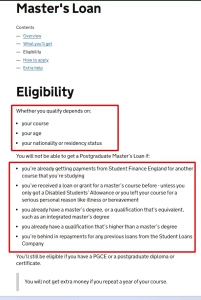
GOV.UK confirms that students starting eligible full-time postgraduate pre-registration healthcare courses may receive separate Tuition Fee Loans and Maintenance Loans instead of a standard Master’s Loan.
Who Is Eligible for a Postgraduate Master’s Loan?
Students applying through Student Finance England must satisfy requirements relating to age, residency, previous qualifications and the course they intend to study.
Main Eligibility Requirements
- Age: Applicants must be under 60 on the first day of the first academic year of their course.
- Residency: Applicants must meet the relevant nationality and residency requirements, normally including residence in England and a qualifying period of residence.
- Course Approval: The programme must be an eligible standalone Master’s degree at an approved UK institution.
- Qualification Level: The course must normally be worth at least 180 credits.
- Study Duration: Eligible full-time courses generally last one or two academic years, with qualifying part-time courses taking longer.
- Previous Qualifications: Students who already hold a Master’s degree or equivalent or higher qualification are normally excluded.
A previous undergraduate degree or undergraduate student loan does not, by itself, prevent someone from receiving a Postgraduate Master’s Loan.
However, students cannot normally receive the loan if they have already received government Master’s loan support, subject to limited exceptions such as compelling personal reasons.
Standalone postgraduate certificates and diplomas are not eligible for the standard English Master’s Loan.
Distance-learning students must also satisfy additional residence requirements.
Applications can be submitted through Student Finance England. For eligible courses, the deadline is generally within nine months of the first day of the final academic year.
How Much Money Will Master’s Students Have Left for Living Costs After Paying Tuition Fees?
The amount remaining depends on tuition fees, course duration, accommodation costs and personal spending.
For some students, tuition fees alone can absorb most of the available loan.
Consider an illustrative budget using a £9,550 course fee, similar to the published 2026/27 UK tuition fee for Edge Hill University’s MSc Computing programme.
Example Master’s Student Budget for 2026/27
Expense Estimated Annual Cost
Tuition Fees £9,550
Rent at £650 Per Month £7,800
Food, Transport and Other Essentials at £300 Per Month £3,600
Total Estimated Cost £20,950
Maximum Master’s Loan £13,206
Additional Funding Required £7,744
This is an illustrative 12-month budget. Actual living costs and tuition fees vary substantially by university, location and individual circumstances.
After paying £9,550 in tuition fees, the student would have £3,656 from the loan.
That would cover less than four months of the example’s £950 monthly living costs.
The remaining expenses would need to be funded through savings, additional income, scholarships or other eligible financial support.
Why Is the Postgraduate Master’s Loan Often Insufficient?
Several factors contribute to the funding gap.
- High Tuition Fees: Some Master’s programmes cost more than the full postgraduate loan.
- Accommodation Expenses: Rent can account for a large proportion of monthly spending.
- Everyday Living Costs: Food, utilities, transport and study materials add to overall expenses.
- Course Duration: Some Master’s degrees involve research or dissertation work across 12 months, extending living costs beyond standard teaching terms.
- Limited Additional Support: Standard postgraduate funding does not include the same maintenance and dependent-support arrangements available to many undergraduates.
Students should also evaluate the academic value and employment prospects of their chosen course.
For example, when comparing universities such as Bath with research-intensive institutions, understanding whether the University of Bath belongs to the Russell Group can form part of a wider assessment of academic reputation, course suitability and career opportunities.
However, university reputation alone does not guarantee that the extra cost of postgraduate education will result in higher earnings.
What Happens if the Master’s Loan Does Not Cover Tuition Fees and Living Expenses?
Students are responsible for meeting any costs that exceed their available loan and other funding.
If the postgraduate loan is insufficient, several alternatives may help reduce the financial shortfall.
University Scholarships and Bursaries
Universities offer financial awards to some postgraduate students based on academic achievement, financial circumstances, specific subjects or other eligibility requirements.
Some awards reduce tuition fees directly, while others provide contributions towards living expenses.
Students should check the funding arrangements for their chosen course before accepting an offer.
Hardship Funds and Charitable Grants
University hardship funds may provide financial assistance to students who experience unexpected difficulties during their studies.
Charities, trusts and charitable foundations may also offer grants for particular subjects, circumstances or career paths.
However, awards are often limited, competitive and subject to specific conditions.
Hardship support should not be treated as guaranteed funding for a foreseeable tuition or maintenance shortfall.
Employer Sponsorship and Part-Time Employment
Some employers contribute towards postgraduate study when the qualification supports an employee’s professional development.
This may include paying some tuition fees, providing paid study leave or agreeing to contribute towards training expenses.
Part-time employment can also help students fund accommodation and living costs.
Those planning to work alongside their studies should calculate their expected earnings using the current statutory wage rates.
The April 2026 UK pay rise increased the minimum hourly pay rates for different age groups, affecting the income available from many part-time jobs.
Students should also check whether paid work is compatible with their university’s attendance requirements and, where relevant, immigration conditions.
Course-Specific Financial Support
Certain programmes offer alternative sources of funding that may be more suitable than the standard Master’s Loan.
Possible examples include:
- Teacher Training Bursaries: Funding for eligible postgraduate teacher-training programmes.
- NHS-Related Support: Financial assistance available to students on qualifying healthcare courses.
- Disabled Students’ Allowance: Non-repayable help with eligible disability-related study costs.
- Research Funding: Studentships or project-specific funding for eligible research programmes.
Disabled Students’ Allowance is not a general maintenance payment. It supports additional study-related costs arising from disability or qualifying health conditions.
Students should check the exact rules for each funding source because receiving certain bursaries may affect eligibility for a standard postgraduate loan.
Can Master’s Students Receive Universal Credit?
Most full-time students cannot receive Universal Credit, but exceptions exist, including certain students with children or qualifying disabilities.
Where a postgraduate student is eligible for Universal Credit, the Department for Work and Pensions may take their Master’s Loan into account.
Under the published rules, 30% of the postgraduate loan is treated as student income for Universal Credit calculations, with the remainder disregarded.
Students should obtain an individual benefit calculation before assuming that postgraduate borrowing will not affect their existing support.
How Is the Postgraduate Master’s Loan Paid and Repaid?
Postgraduate loan repayments in England depend on income rather than the amount borrowed.
For 2026/27, graduates normally repay 6% of qualifying earnings above £21,000 annually.
Repayments generally become due from the April after completing or leaving the course, provided earnings exceed the applicable threshold.
The loan is normally collected automatically through payroll for employed graduates, while self-employed borrowers may make repayments through Self Assessment.
Postgraduate Master’s Loan Repayment Examples
Annual Salary Approximate Monthly Repayment
£20,000 £0
£25,000 £20
£30,000 £45
£35,000 £70
£40,000 £95
£50,000 £145
These figures assume regular monthly earnings and apply only to the postgraduate loan. Actual deductions may vary according to pay periods and circumstances.
Graduates with an undergraduate student loan may need to repay both loans simultaneously.
The postgraduate repayment is calculated separately, meaning the total deduction can be higher than for someone with only an undergraduate loan.
Understanding how much you must earn before repaying a student loan is therefore important when estimating take-home pay after postgraduate study.
Interest Rates and Loan Write-Off Rules
Postgraduate loans from England normally charge interest based on the Retail Price Index plus 3%, subject to any applicable government cap.
For the period from 1 September 2026 to 31 August 2027, the interest rate is capped at 6%.
Interest starts accumulating from the first loan payment, even while the student is studying.
For English postgraduate loans, the remaining balance is normally written off 30 years after the April when repayments first became due.by Student Finance England. Unlike undergraduate student finan
Understanding when a student loan gets written off can help graduates assess the long-term implications of their borrowing.
What Happens if a Student Does Not Complete the Course?
Leaving a Master’s programme does not automatically cancel the loan.
Student Finance England will reassess entitlement based on the period of study completed.
Any funding paid for a period after the student left may be treated as an overpayment that must be repaid separately.
The remaining eligible loan balance normally continues under standard income-based repayment rules.
Students who withdraw because of illness or another serious personal reason should contact Student Finance England about the support and exceptions that may apply.
Will the UK Government Introduce a Separate Maintenance Loan for Master’s Students in the Future?
As of November 2026, the government has not confirmed a nationwide replacement of England’s combined Postgraduate Master’s Loan with separate tuition fee and maintenance loans.
The existing system continues to provide one contribution towards both categories of expenditure.
However, postgraduate affordability remains an important issue because higher tuition fees and everyday expenses can create substantial financial barriers.
A possible reform could involve separate postgraduate maintenance support, increased total borrowing limits or additional targeted help for students from lower-income backgrounds.
Each approach would have different implications for public spending and graduate debt.
Supporters of expanded maintenance funding argue that it could improve access for students without substantial savings or family assistance.
Others point to the cost of increasing government-backed borrowing and the importance of assessing whether additional lending would improve affordability without creating unnecessary debt.
For now, prospective students should base their decisions on confirmed funding arrangements rather than assuming that a new maintenance loan will become available.
Conclusion
The main reason there is no separate maintenance loan for most Master’s students in England is that the government introduced postgraduate funding as a single contribution-to-costs loan rather than the two-part system used for undergraduates.
Although eligible students can receive up to £13,206 in 2026/27, this amount must cover both tuition fees and living expenses.
The arrangement differs across the UK, with Scotland offering separate living-cost support and certain postgraduate healthcare and teacher-training courses qualifying for alternative student finance.
Before beginning a Master’s degree, students should compare course fees, accommodation expenses, repayment obligations and available scholarships.
Careful planning can help identify whether the available loan is sufficient or whether additional funding is necessary to complete the qualification.
Frequently Asked Questions
Why Do Undergraduate Students Get Maintenance Loans but Master’s Students Do Not?
England funds most Master’s degrees through a single contribution-to-costs loan, whereas undergraduate students normally receive separate tuition fee and maintenance support.
Can Master’s Students Get a Maintenance Loan in Scotland?
Yes. Eligible full-time postgraduate students in Scotland can receive a separate living-cost loan of up to £6,900 for 2026/27, alongside tuition fee support.
Can You Get Universal Credit While Studying for a Master’s Degree?
Some students qualify under specific exceptions, but most full-time students cannot claim Universal Credit. Where eligible, part of the postgraduate loan may count as income.
Can You Get a Master’s Loan if You Already Have a Master’s Degree?
Generally, no. Student Finance England normally excludes applicants who already hold a Master’s degree or equivalent or higher qualification.
Does the Postgraduate Master’s Loan Cover Rent and Living Expenses?
Yes. The loan can be used towards rent, food, transport and other living expenses, but it may not be sufficient to cover every cost alongside tuition fees.
Can Part-Time Master’s Students Apply for Postgraduate Funding?
Yes. Eligible part-time students can apply, provided their course meets the relevant duration and other eligibility requirements.
Do You Have to Repay a Master’s Loan if You Do Not Finish Your Course?
Yes. The remaining eligible loan is normally repayable under standard income-based rules, while any overpayment caused by leaving early may need to be repaid separately.

Leave a Reply