
Last Updated on AUG 18, 2026
Travel insurance can protect travellers against many unexpected problems, but the continuing conflict involving Iran has made war exclusions, government travel advice and airline disruption particularly important for UK travellers.
As of 18 August 2026, the Foreign, Commonwealth and Development Office advises against all travel to Iran and warns that the wider Middle East remains unpredictable, with further attacks, flight cancellations and short-notice airspace closures possible.
The current conflict began with US and Israeli strikes on Iran on 28 February 2026, while efforts to secure a lasting settlement have since stalled.
Travel insurance should not be assumed to cover losses caused directly by war or conflict. Cover depends on the individual policy and its exclusions.
Where FCDO advice changes, some policies can cover otherwise unrecoverable cancellation costs, but travellers are generally expected to seek refunds or alternative arrangements from airlines or tour operators first.
Travelling against FCDO advice is also likely to invalidate standard travel insurance.
Key answer points:
- Most standard travel insurance policies exclude coverage for war and armed conflict
- Insurance policies still cover medical emergencies, lost luggage and some travel delays
- Government travel advisories can influence whether cancellation claims are accepted
- Passengers on flights covered by UK law can retain rights to rerouting or a refund and care during cancellations, even when extraordinary circumstances mean fixed compensation is not payable.
- Package holiday providers may arrange return flights for stranded travellers
- The timing of booking and policy purchase can affect insurance eligibility
- Specialised war risk insurance exists, but is mainly designed for professionals travelling to high-risk regions
Why Are Holidays Being Disrupted by the Iran–Israel Conflict?

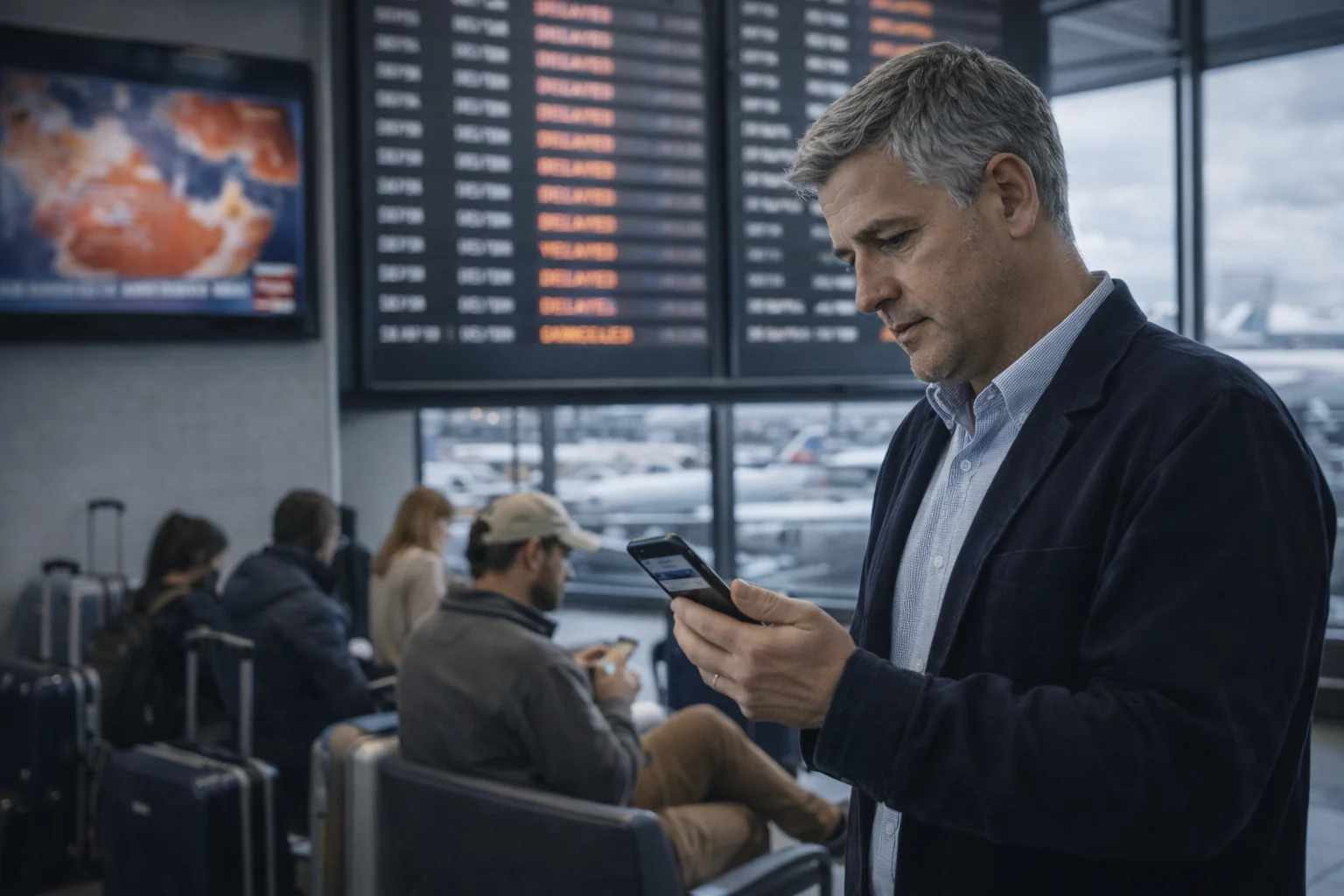
The continuing conflict involving Iran is still affecting international aviation well beyond Iran itself. UK travellers connecting through the Middle East can face cancellations, longer routings and sudden schedule changes even when their final destination is elsewhere.
As of 18 August 2026, the European Union Aviation Safety Agency has active conflict-zone advisories covering the airspace of Iran, Iraq, Lebanon and Jordan, as well as the Persian Gulf and Gulf of Oman.
The current advisories are valid until 31 August 2026, unless they are reviewed earlier.
The FCDO is also telling British nationals in the Middle East to prepare for possible flight cancellations, periodic airspace closures and other travel disruption. It warns that airports and airspace can be affected at short notice as the regional security situation changes.
This means disruption is no longer limited to passengers travelling directly to Iran or Israel. Flights using Gulf and Middle Eastern hubs can also be affected when airlines alter routes, avoid high-risk airspace or respond to temporary restrictions.
Several factors contribute to the disruption of holidays during geopolitical conflicts:
- Airspace restrictions imposed by governments
- Airlines are rerouting flights to avoid conflict zones
- Airport security concerns
- Sudden changes in international travel advisories
When these factors combine, they can affect thousands of passengers simultaneously. Travellers may find themselves stranded at international airports, unable to continue their journey or return home on schedule.
The impact is not limited to the immediate region of conflict. Because international aviation networks are interconnected, disruptions in one region can influence global flight schedules.
The following table explains common causes of travel disruption during geopolitical conflicts.
| Cause of Disruption | Description | Impact on Travellers |
|---|---|---|
| Airspace closure | Governments restrict aircraft from entering certain areas | Flights cancelled or rerouted |
| Airline safety decisions | Airlines suspend flights to high risk destinations | Holiday cancellations |
| Airport operational issues | Increased security or reduced operations | Long delays and missed connections |
| Government travel warnings | Official advisories issued to citizens | Trip cancellations or insurance complications |
Travellers often assume that travel insurance will automatically cover these disruptions. However, when the cause is related to war or armed conflict, the situation becomes more complicated.
Understanding how insurance policies respond to geopolitical risks is essential for anyone planning international travel during periods of global tension.
How Does Travel Insurance Normally Protect Your Holiday?
Travel insurance is designed to provide financial protection when unexpected events affect a trip. These policies are commonly purchased by travellers before leaving the United Kingdom to ensure support in case of emergencies abroad.
A standard travel insurance policy covers a wide range of situations that may occur before or during travel. The main objective is to reduce the financial impact of unforeseen problems such as illness, accidents or travel delays.
Most travel insurance products in the UK include several core types of protection.
- Emergency medical treatment abroad
- Trip cancellation due to illness or unforeseen circumstances
- Loss or theft of personal belongings
- Travel delays and missed connections
- Personal liability incidents
Medical coverage is often considered the most important component. Healthcare costs in some countries can be extremely high, and travel insurance helps cover hospital treatment, ambulance services and medical evacuation if necessary.
The following table summarises common coverage areas included in many travel insurance policies.
| Coverage Category | What It Covers | Typical Benefit |
|---|---|---|
| Medical emergencies | Hospital treatment and emergency care abroad | Up to several million pounds |
| Trip cancellation | Costs if a trip must be cancelled due to illness or emergencies | Refund of prepaid travel expenses |
| Lost luggage | Compensation for lost or stolen belongings | Limited financial reimbursement |
| Travel delays | Compensation when flights are delayed for several hours | Fixed payment after delay threshold |
| Personal liability | Legal costs if the traveller causes injury or damage | Coverage for legal claims |
While these protections provide valuable security for travellers, insurance companies carefully define the circumstances under which claims are accepted. Policies include detailed terms and exclusions that specify what situations are not covered.
One of the most common exclusions relates to war or armed conflict. Because such events can affect thousands of travellers simultaneously and create unpredictable financial exposure, insurers generally exclude them from standard policies.
Understanding these exclusions is important for travellers who assume that travel insurance will cover any disruption to their trip.
Why Do Most Travel Insurance Policies Exclude War and Armed Conflict?

War and armed conflict represent some of the most complex risks for insurance providers. Unlike isolated travel incidents such as illness or lost luggage, conflicts can cause widespread disruption affecting entire regions.
Insurance companies rely on risk modelling to calculate premiums and determine how likely certain claims are to occur.
Events like medical emergencies and travel delays follow patterns that can be analysed statistically. War, however, is far less predictable.
A single military escalation could lead to airport closures, large-scale evacuations and widespread cancellations.
If thousands of travellers attempted to claim compensation simultaneously, the financial impact on insurers could be extremely significant.
For this reason, most travel insurance policies contain what is known as a war exclusion clause. This clause outlines that claims directly related to war or military conflict will not be covered.
The definition of war within insurance policies often includes several related scenarios.
| Term Used in Policies | Meaning in Insurance Context |
|---|---|
| War | Armed conflict between nations |
| Civil war | Internal armed conflict within a country |
| Military invasion | Armed forces entering another country |
| Rebellion or uprising | Organised violent resistance against government |
| Hostile foreign action | Military aggression from another nation |
Because these situations carry such large scale risk, insurers typically exclude them from coverage unless travellers purchase specialised policies.
A travel insurance adviser explained the reasoning behind these exclusions clearly.
“I often explain to travellers that insurance is designed to handle personal risks rather than geopolitical crises.
When conflicts escalate, the number of potential claims becomes impossible to predict. That is why most policies include a clear war exclusion clause.”
Although this limitation may seem restrictive, insurance companies emphasise that many travel disruptions still fall outside the war exclusion category.
For example, delays caused by airline operational issues or medical emergencies abroad remain covered even during periods of geopolitical instability.
Understanding the distinction between personal travel risks and global political events helps travellers set realistic expectations about what their insurance policy can provide.
Can Travel Insurance Help If War Breaks Out After You Book Your Holiday?
Although war is usually excluded from travel insurance coverage, there are situations where travellers may still receive some level of protection. The key factor often depends on the timing of events relative to when the trip was booked.
If a traveller purchases insurance and books a holiday before any conflict escalation or government warning, the policy may still provide limited support if circumstances change later.
Insurance providers sometimes consider whether the risk was foreseeable at the time of booking. If a traveller knowingly books a trip to a region where conflict is already ongoing, insurers are unlikely to accept claims related to that conflict.
However, if a situation escalates unexpectedly after the booking is made, insurance coverage may still apply under certain conditions.
The following table illustrates how timing can affect potential insurance claims.
| Scenario | Insurance Outcome |
|---|---|
| Conflict already ongoing before booking | Claims usually rejected |
| Government warning issued before booking | Insurance unlikely to cover cancellation |
| Conflict escalates after booking | Some policies may allow claims |
| Travel advisory changes after booking | Possible cancellation coverage |
How FCDO Travel Advice Affects Insurance Claims?
In the UK, FCDO travel advice is important for insurance, but a change in government advice does not automatically guarantee a successful cancellation claim.
The Association of British Insurers says travel insurance can cover cancellation or curtailment where the FCDO advises against travel to a destination.
However, this depends on the individual policy wording and normally applies to costs that cannot first be recovered from an airline, tour operator or another travel provider.
Travellers should therefore contact their airline, travel agent or tour operator before cancelling independently and making an insurance claim. The ABI also advises that travelling against FCDO advice is likely to invalidate travel insurance.
This is particularly relevant to Iran. As of 2026, the FCDO advises against all travel to Iran and explicitly warns that travel insurance could be invalidated if someone travels against its advice.
Travellers should check both the FCDO advice that applied when the trip was booked and the current advice, then confirm directly with their insurer whether cancellation, curtailment or disruption cover applies.
When Insurance May Cover Cancellation or Repatriation?
Although coverage varies between insurers, some policies may assist travellers in situations such as:
- Emergency return travel when security risks escalate
- Cancellation if official travel warnings are issued
- Reimbursement for certain prepaid travel costs
These situations are evaluated individually, and policy wording always determines the final decision.
Travellers should review their policy documents carefully to understand how geopolitical events might affect their coverage.
What Are Your Rights If Flights Are Cancelled Due to War?

If a cancelled flight is covered by UK passenger law, travellers retain important rights even when the disruption was caused by events outside the airline’s control.
The UK Civil Aviation Authority says passengers on a covered cancelled flight must be offered a choice between a refund for the unused ticket or an alternative flight.
While passengers wait to be rerouted, the airline must also provide reasonable care and assistance, including food and drink, communication facilities and, where an overnight stay is necessary, accommodation and transport.
Crucially, the airline’s duty to provide this care continues regardless of what caused the cancellation.
If the airline cannot arrange the assistance directly during major disruption, the CAA says passengers can arrange reasonable care themselves and later seek reimbursement, provided they keep receipts and avoid excessive expenditure.
Fixed financial compensation is different. The CAA states that compensation is generally not payable where a cancellation results from extraordinary circumstances outside the airline’s responsibility.
Therefore, travellers should distinguish between their right to a refund, rerouting and care, which may remain available, and additional fixed compensation, which depends on the cause of the disruption.
Compensation rules generally apply only when the airline itself is responsible for the delay.
The following table explains the difference between airline responsibilities and passenger compensation.
| Situation | Airline Responsibility | Passenger Compensation |
|---|---|---|
| Technical fault | Provide assistance and pay compensation | Yes |
| Airline staff strike | Provide assistance and pay compensation | Often yes |
| Severe weather | Provide assistance but no compensation | No |
| War or airspace closure | Provide assistance but no compensation | No |
What Package Holiday Providers Must Do?
Travellers with qualifying package holidays can have stronger legal protection than passengers who booked each part of their trip separately.
UK government guidance states that where unavoidable and extraordinary circumstances at the destination significantly affect the package holiday or transport to the destination, travellers can have the right to cancel the package and receive a full refund.
If the package organiser itself cancels the holiday, customers are entitled to a full refund within 14 days. They do not have to accept a voucher, Refund Credit Note or alternative booking instead of a cash refund.
Travellers should therefore contact the package organiser before independently cancelling flights or accommodation. Whether conflict or regional disruption gives a particular traveller the right to cancel will depend on how seriously the circumstances affect the destination or the journey there.
What Should Travellers Do If They Are Stranded Abroad During Conflict?
Being stranded abroad during a conflict-related disruption can be stressful for travellers. However, understanding the correct steps to take can help minimise confusion and financial loss.
The first step is usually contacting the airline or travel provider responsible for the journey. Many travel insurance policies require travellers to attempt recovery from airlines before submitting insurance claims.
Travellers should also keep records of all relevant documents, including boarding passes, booking confirmations and receipts for additional expenses.
The following table outlines practical actions travellers should take when facing travel disruption abroad.
| Step | Action | Purpose |
|---|---|---|
| Contact airline | Request rebooking or alternative flights | Secure travel arrangements |
| Check travel provider | Ask about package holiday support | Confirm accommodation and transport |
| Monitor government advice | Follow safety guidance | Stay informed about risks |
| Keep receipts | Document additional expenses | Support insurance claims |
Travel journalist Simon Calder has often advised travellers to avoid rushing into refund decisions during major travel disruptions.
“If passengers accept an immediate refund from an airline, the carrier may no longer be responsible for arranging alternative travel. Keeping the ticket often provides a better chance of being re routed later.”
From the author’s perspective, travellers frequently underestimate how complex travel disruption can become during geopolitical crises.
“In my experience covering travel industry developments, the most important advice is to remain patient and informed. Airlines often take time to reorganise schedules during major disruptions, and travellers who maintain their bookings usually receive assistance once alternative routes become available.”
Staying calm and following official guidance can significantly improve a traveller’s chances of resolving travel disruptions successfully.
Can Travellers Buy Insurance That Covers War Risks?

Although most leisure travel insurance policies exclude war, specialised insurance products exist for individuals who must travel to high-risk environments.
These policies are typically designed for professionals working in challenging conditions. Examples include journalists reporting from conflict zones, humanitarian workers operating in unstable regions and contractors working with international organisations.
Specialist war risk insurance may include coverage for situations such as evacuation, injury caused by conflict or emergency extraction from dangerous areas.
The following table outlines key differences between standard travel insurance and specialised war risk coverage.
| Step | Action | Purpose |
|---|---|---|
| Contact airline | Request rebooking or alternative flights | Secure travel arrangements |
| Check travel provider | Ask about package holiday support | Confirm accommodation and transport |
| Monitor government advice | Follow safety guidance | Stay informed about risks |
| Keep receipts | Document additional expenses | Support insurance claims |
Because these policies involve greater risk, they are often expensive and require detailed risk assessments.
For most leisure travellers, the more practical approach is to avoid travelling to regions experiencing conflict and to monitor official travel guidance carefully before making travel arrangements.
Understanding the limitations of standard travel insurance helps travellers make informed decisions and prepare for unexpected disruptions during periods of global instability.
Conclusion
The question of whether travel insurance covers war has become increasingly relevant as geopolitical tensions affect international travel.
In most cases, standard travel insurance policies do not cover losses caused directly by war or armed conflict. These events are usually listed under policy exclusions due to the scale and unpredictability of the risks involved.
However, travellers may still receive support in certain situations. If government travel advice changes after a booking is made, insurance policies may allow claims for cancellation or emergency travel arrangements.
In many cases, airlines or tour operators also have responsibilities to assist stranded passengers.
For travellers planning future holidays, the key lesson is to review policy wording carefully, monitor official travel advice and understand where responsibility lies if major global events disrupt travel plans.
FAQs
Does travel insurance cover terrorism or political unrest?
Some travel insurance policies include limited coverage for terrorism, but war and large-scale armed conflict are usually excluded. The exact coverage depends on the policy wording and insurer.
Will travel insurance refund my holiday if war begins after booking?
In some cases, yes. If the UK government issues new travel advice against visiting a destination after the booking was made, insurance policies may allow cancellation claims.
What happens if the FCDO advises against travelling?
If the advisory changes after a booking, travellers may be able to cancel their trip through insurance or obtain refunds through travel providers.
Can airlines refuse compensation for war-related delays?
Yes. Airlines generally do not pay compensation for delays caused by extraordinary circumstances such as war or political instability.
What should you do if you are stranded abroad during a conflict?
Travellers should contact their airline or tour operator first, monitor official travel advice and keep receipts for any additional expenses.
Are there travel insurance policies that cover war zones?
Specialist war-risk insurance policies exist but are typically designed for professionals working in conflict areas rather than tourists.
Is it safe to travel during rising geopolitical tensions?
Safety depends on the location and current travel advisories. Travellers should always check government guidance and consider flexible travel arrangements.

Leave a Reply