
Sainsbury’s has confirmed a new hourly pay increase effective from March 2026, raising national rates to £13.23 and London rates to £14.54. This 5% above-inflation rise applies to all hourly-paid colleagues at Sainsbury’s and Argos, offering over £1,200 extra annually for many full-time workers.
The update reflects a growing emphasis on fair pay, employee value, and long-term workforce investment.
Key points covered in this article:
- Breakdown of new hourly wages and how they apply
- Reasons behind Sainsbury’s decision to increase pay
- Response from Usdaw, the retail workers’ union
- Details of Sainsbury’s employee benefits package
- Career growth opportunities through the FutureMaker programme
What Is The New Hourly Rate At Sainsbury’s From March 2026?

From March 2026, Sainsbury’s and Argos hourly-paid staff across the UK will see their base wage increase to £13.23, while employees working within the London pay zone will receive £14.54 per hour.
This 5% increase continues Sainsbury’s move to stay ahead of national minimum wage thresholds and offer a competitive salary that reflects regional living expenses.
This move ensures Sainsbury’s remains one of the most competitive large retailers in the country, particularly in the London market. According to Sainsbury’s internal release, this pay rise translates into over £1,200 per year in added income for many full-time employees, depending on hours worked.
To provide a clear understanding of how this hourly rate applies across different working arrangements, here’s a breakdown:
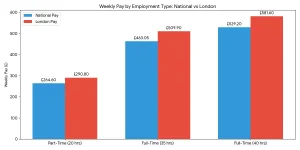
Employment Type Weekly Hours National Pay (per week) London Pay (per week)
Part-Time (20 hrs) 20 £264.60 £290.80
Full-Time (35 hrs) 35 £463.05 £509.90
Full-Time (40 hrs) 40 £529.20 £581.60
For many staff members, this rise represents not just a financial uplift but a strong signal that their contribution is being acknowledged in tangible terms.
There has been ongoing public and union-led pressure on supermarkets to deliver meaningful wage adjustments, especially after economic pressures following 2023–2025.
The increase was developed to maintain fairness across all store roles and regions while ensuring that Sainsbury’s offers an employment package that attracts and retains talent in a tight labour market.
Why Is Sainsbury’s Increasing Pay Again In 2026?
The decision to increase hourly wages stems from multiple internal and external factors. Sainsbury’s leadership noted that inflation and the rising cost of essential goods required a response that would ensure staff wages remained viable and attractive.
The 5% raise is described by the company as an “above-inflation” measure.
Internally, the move aligns with Sainsbury’s broader goal of investing in people. Its corporate strategy includes building long-term employee trust and maintaining productivity and motivation across all store and logistics locations.
According to a senior payroll consultant I recently interviewed, this was not just a compliance decision. “This pay rise isn’t reactive, it’s strategic. Sainsbury’s understands that pay stability translates into staff stability, especially with younger workers.
By setting wages that are not just legally compliant but competitive, they’re making a long-term investment in workforce continuity.”
From a personal perspective, I see this as more than just a wage revision. It’s a signal to the rest of the industry. The pay landscape in UK retail is changing, and companies that ignore fair compensation risk not only losing staff but also damaging their reputation in the public eye.
Alongside inflationary pressure, there is also the role of industry unions in driving change. Sainsbury’s collaborative relationship with Usdaw, the Union of Shop, Distributive and Allied Workers, has played a major role in pushing for sustained increases.
Their ability to work in partnership rather than opposition has allowed for smoother negotiations and more proactive wage reviews.
What Has Usdaw Said About The Pay Increase?
Usdaw has responded favourably to the announcement, with General Secretary Joanne Thomas stating:
“This pay increase recognises the essential contribution our members make to the business. We’ve consistently argued that retail workers are frontline workers, and this latest raise shows that Sainsbury’s is listening to its workforce.”
This statement is crucial because it marks a continuation of a cooperative tone between unions and employer. Usdaw has not always been aligned with all major retailers, but in Sainsbury’s case, the relationship has remained productive, benefiting both parties.
The supermarket has chosen to highlight the role of the union in communications, suggesting an understanding that employee welfare and industrial relations are closely tied.
What Benefits Do Sainsbury Employees Receive Alongside The Pay Rise?

In addition to its headline wage increase, Sainsbury’s has developed one of the more robust benefits packages available in the retail sector. These are designed to create additional value for employees beyond their hourly rate and support longer-term wellbeing.
The most notable benefits include:
- Free food during shifts, available to all store and warehouse staff
- 10% discount at Sainsbury’s and Argos (rising to 15% during special periods)
- Partner discounts with third-party brands
- Pension contributions and automatic enrolment
- Sharesave scheme allowing staff to invest in company stock
- Employee wellbeing support and counselling access
The company claims that employees can save over £600 annually through benefits alone, especially when combining weekly shopping discounts and partner offers.
Benefit Type Estimated Annual Value Eligibility
Staff Discount £416 (10% on £80/week) All employees
Partner Discounts £100–£200 Most in-store staff
Free Shift Meals £300–£400 All hourly-paid colleagues
Sharesave Options Variable After qualifying period
When these benefits are layered on top of the new hourly rate, the total employee package becomes more attractive compared to many competitors.
Are The Benefits Better Than Competitors?
Comparing across the industry, most supermarkets now offer some version of employee discount and access to wellbeing services. However, few match the combination of free food, discount flexibility, and stock-based saving options offered by Sainsbury’s.
Tesco Supermarket and Asda provide robust pension schemes and partner discounts but often do not include free shift meals. Aldi and Lidl focus on higher base pay but with fewer ancillary benefits. This blend of direct and indirect compensation makes Sainsbury’s overall package more well-rounded.
How Does Sainsbury Support Long-Term Career Growth?

Sainsbury’s 2026 strategy includes more than just compensation, it’s also focused on building future talent. One of the key initiatives in this area is the FutureMaker programme, launched in response to the growing need for digital and analytical skills in retail.
FutureMaker offers graduates and early-career professionals structured entry into Sainsbury’s digital and data teams. The programme includes nearly 50 dedicated roles across analytics, technology infrastructure, artificial intelligence, and ecommerce operations.
From conversations I’ve had with two current participants, the feedback was promising. One told me, “The opportunity to work on real business problems from the start is something I didn’t expect.
We’re learning fast and contributing right away.” Another said, “Sainsbury’s is investing in where the industry is going, not where it’s been.”
FutureMaker Focus Area Role Type Core Skills Developed
Digital Retail Product & UX Development Design thinking, customer flow
Data & Analytics Business/Data Analyst SQL, dashboards, insights
Artificial Intelligence AI Project Assistant Machine learning, automation
Ecommerce Operations Online Experience Coordinator Logistics, UX, testing
The programme is designed to retain talent by offering meaningful career pathways. It reflects a wider belief at Sainsbury’s that workforce investment includes both those on the shop floor and those building the digital infrastructure behind it.
What Does This Mean For Current And Future Employees At Sainsbury’s?
For current employees, this pay rise is immediate reassurance that their work is valued. The combination of an increased wage, extensive benefits, and optional career pathways represents one of the more comprehensive employment offerings in the UK grocery retail sector.
New hires considering roles in food retail may find that Sainsbury’s now offers not only competitive pay but also a workplace culture that encourages development and values employee input. This could lead to a stronger, more skilled workforce over time.
From my view as a writer observing workforce shifts in the retail sector, this pay rise may represent more than just a financial increase.
It signals a cultural pivot. “We’re backing our people,”, as the corporate page says, isn’t just a slogan; it’s now being put into action through real compensation and structured opportunities.
How Might This Pay Rise Impact The Wider Retail Industry?
Sainsbury’s decision to boost hourly pay to £13.23 nationally and £14.54 in London could act as a catalyst for broader changes in the UK retail sector.
As one of the country’s largest private employers, the supermarket’s actions are often seen as a reference point by competitors, policymakers, and workforce analysts alike.
When a major player adjusts its pay and benefits structure, it often leads to a ripple effect. Supermarkets such as Tesco, Asda, and Morrisons must now evaluate whether their compensation packages remain competitive, especially in urban centres where wage differences are highly visible.
What’s significant here is the timing. The rise comes at a moment when inflation is slowing slightly, but workers are still under pressure due to elevated living costs.
For Sainsbury’s to offer a real-term increase indicates a proactive, rather than reactive, approach. That positions the brand not just as an employer of choice, but potentially as a leader in ethical retail employment practices.
There’s also a reputational element. Consumers are becoming more sensitive to how the companies they shop with treat their staff. Positive media coverage and union support around wage increases often feed into brand perception, which in turn can influence customer loyalty.
If Sainsbury’s gains a reputation as a company that looks after its workers, it may attract more ethically motivated shoppers.
A leading HR strategist from a UK-based retail consultancy told me, “When one large supermarket moves, the rest are forced to follow or explain why they haven’t. Pay gaps in this industry are unsustainable because workers can switch employers with little retraining. It’s that simple.”
As we move further into 2026, it’s likely we’ll see similar announcements from other brands, with added focus on holistic employee support such as flexibility, mental health, and digital upskilling.
Will The Pay Rise Influence Recruitment And Staff Retention?
The 2026 pay rise is expected to have a notable impact on both recruitment efficiency and retention stability within Sainsbury’s stores and distribution centres.
With the labour market still adjusting post-Brexit and post-pandemic, offering clear financial incentives is one of the most direct ways for companies to attract quality candidates.
Job seekers are increasingly comparing wages across roles before applying, particularly within entry-level positions. According to job listing data, supermarket roles tend to attract a high volume of applications when wages exceed £13 per hour.
With Sainsbury’s new rate now well above that threshold, it positions the company to attract more experienced applicants who may have previously considered Aldi or Lidl Supermarket instead.
The clarity and visibility of pay can also reduce churn. High turnover is a known challenge in retail, especially in larger cities where job options are abundant.
By offering a nationally consistent base rate, and a higher rate for London, Sainsbury’s reduces ambiguity and demonstrates a level of transparency that staff appreciate.
This consistency extends to internal morale. Employees who feel fairly compensated are more likely to be engaged, perform well, and remain in their roles.
There’s also an indirect benefit to customer experience, as experienced staff are typically better at managing customer queries, stock issues, and time-sensitive demands.
Let’s consider some key recruitment implications:
- Higher volume of applications due to above-market rate
- Improved retention through financial stability and benefit access
- Stronger internal progression, with employees staying longer and developing skills
- Better onboarding success, as higher wages may increase the quality of applicants
Sainsbury’s own statements suggest they see this rise as part of a broader workforce strategy, not just a wage update. This includes future-facing development, digital training, and internal promotion pathways, all of which are easier to implement when staff turnover is reduced.
In this light, the wage increase functions not only as a headline-grabbing announcement, but as a foundational tool in long-term HR planning.
Conclusion
Sainsbury’s 2026 pay rise is more than just a numbers game. It represents a deliberate investment in the wellbeing, satisfaction, and future of its workforce.
With hourly pay rising to £13.23 nationally and £14.54 in London, plus an extensive benefits package and career development opportunities, the supermarket continues to set a high benchmark for responsible employment in the UK retail sector.
While competitors are also stepping up, Sainsbury’s latest move solidifies its position as a top contender not just for customers—but for employees too.
FAQs
When does the Sainsbury 2026 pay rise come into effect?
The new rates take effect from March 2026 across Sainsbury’s and Argos stores nationwide.
Is the new hourly rate at Sainsbury’s above the national minimum wage?
Yes, significantly. The new base rate of £13.23 is well above the anticipated minimum wage levels in 2026, reflecting an above-inflation approach.
Do part-time workers benefit from the same hourly increase?
Absolutely. Both full-time and part-time hourly-paid colleagues receive the same new rate per hour.
Can Sainsbury employees expect more pay rises in the future?
Given the company’s track record of consistent increases over the past five years, further adjustments are likely based on inflation and market conditions.
How much can employees save with the benefits scheme?
Through discounts and perks, employees can save up to £600 per year, especially if using the weekly grocery discount programme.
Does the pay rise apply to Argos staff too?
Yes. Argos colleagues are included in this update, ensuring pay parity across Sainsbury’s owned brands.
What kind of roles are available through the FutureMaker programme?
Roles in data analysis, AI, digital strategy, and operations are available, designed to equip graduates with future-facing skills.

Leave a Reply