

Dual citizenship remains legal in the UK in 2026. You can hold British nationality alongside another citizenship without being required to give either one up, as long as the other country also allows dual nationality. What has changed is how British dual citizens enter the UK.
From 25 February 2026, British citizens can no longer enter the UK using only a foreign passport, even if that passport comes from a visa-free country. You must use a British or Irish passport, or prove your right of abode with the correct documentation.
This guide clearly explains what that means in practice, who is affected, and how to stay compliant.
Key points covered in this article:
- The UK’s legal position on dual citizenship in 2026
- New passport and entry rules effective from February 2026
- Who the changes impact most, including overseas-born Britons
- Accepted documents for entering the UK as a dual citizen
- Practical options, costs, and timelines for compliance
Can You Hold Dual Citizenship in the UK in 2026?
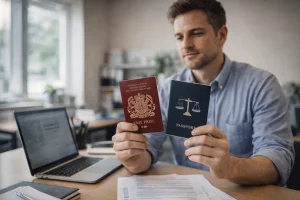
The concept of dual citizenship continues to hold legal ground in the United Kingdom. In 2026, the UK government maintains a clear and consistent stance: if you qualify as a British citizen and also meet the requirements of another country’s nationality laws, you are free to hold both citizenships without forfeiting either.
British law does not compel individuals to renounce their existing nationality when applying for British citizenship. Likewise, acquiring foreign citizenship does not automatically strip you of your British status.
This legal allowance has opened the door for many British-born individuals who live abroad or have multicultural family ties to maintain meaningful connections to more than one country.
However, being a dual citizen does not mean you’re immune from the legal responsibilities of either country. You are bound by the laws of both nations, especially when it comes to taxation, military service in certain jurisdictions, and travel requirements.
It is important to remember that while the UK is quite liberal in its policy, the same cannot be said for every country. For instance, countries like India and China do not permit dual nationality at all.
Others, such as Germany, only allow it under certain circumstances. This dual allowance must always be mutual.
If the second country does not legally permit you to retain your British nationality while becoming its citizen, you may be forced to choose.
To summarise this in a simple view:
| Aspect | UK Stance | Other Countries’ Stance |
|---|---|---|
| Allow dual citizenship? | Yes | Varies: Yes (Canada), No (India) |
| Need to renounce original? | No | Some require renunciation |
| Affects rights in UK? | No, retains full British rights | Dependent on second country’s policy |
| Travel on UK passport needed? | Yes (from 2026 rules) | May require travel on specific passport |
This mutual respect between laws is what keeps dual nationality functional in practice. If you’re considering applying for citizenship in another country, it’s vital to research their laws thoroughly.
What Does Dual Citizenship Actually Mean in Practice?
Being a dual national isn’t just about carrying two passports. It’s a legal status that grants you full citizenship rights in both countries you belong to.
That includes civil rights, tax responsibilities, and political engagement. It also offers considerable freedom of movement, particularly for individuals who maintain strong familial or economic ties across borders.
In practice, this means:
- You can vote in elections in both countries, where eligible
- You have access to public healthcare systems and social benefits
- You may be liable for taxation in both countries, depending on the residence and income source
- You can travel freely, often with simplified visa or immigration procedures
- You can work, study, and live in either country without immigration restrictions
However, it is also important to be aware of possible complications. Some countries may require military service for their citizens.
Others might impose exit taxes when giving up citizenship. In rare cases, issues may arise if you’re arrested or detained abroad and both countries claim jurisdiction.
For instance, if you’re detained in a country where you hold citizenship, British consular assistance may be limited or unavailable. This point is often misunderstood.
In my own experience, having dual Canadian and British citizenship has meant access to two entirely different healthcare systems and the ability to vote in both countries. But there were challenges when I needed to renew both passports at the same time.
The processes, documentation, and wait times were vastly different. I often had to juggle application systems that didn’t account for dual nationality, which caused delays. These nuances aren’t widely discussed but make a big difference in real life.
What’s Changing for Dual Nationals from February 2026?

While the legal status of dual citizenship in the UK has remained steady, travel documentation requirements have taken a sharp turn in 2026.
From 25 February 2026, the UK government has enforced stricter rules on how British dual nationals must enter the country.
The core rule is that if you’re a British citizen, you must enter the UK using your British or Irish passport, or provide legal proof of your right of abode.
You cannot use only your foreign passport, even if that country has a visa-free agreement with the UK. For years, many British dual citizens residing in visa-exempt countries like Canada, the United States, and Australia used only their foreign passports to travel to the UK.
This was especially common for those who didn’t renew their British passports or were born abroad to British parents and never obtained one.
Here is a clear breakdown of what is now accepted at the UK border:
| Document Type | Accepted for UK Entry (from Feb 2026) |
|---|---|
| Valid British passport | Yes |
| Valid Irish passport | Yes |
| Foreign passport only (no certificate) | No |
| Foreign passport + Certificate of Entitlement | Yes |
| ETA (Electronic Travel Authorisation) | Not valid for British citizens |
The reason for this change is tied to the UK’s Electronic Travel Authorisation (ETA) system. ETA is similar to the ESTA system used in the United States.
It’s a digital authorisation that visa-exempt foreign nationals must obtain before entering the UK. While useful for streamlining travel, it does not apply to British citizens.
A senior border policy consultant explained it clearly to me during a recent immigration webinar. He said,
“This isn’t a change in who qualifies as British. It’s about making sure people are using the correct documentation when they enter the UK. The system can’t accommodate British citizens using foreign passports alongside an ETA, because they don’t legally need one. It creates a data and identity conflict at the border.”
These adjustments aim to ensure accurate entry records and reduce loopholes in tracking arrivals.
How Will the New Entry Rules Affect You as a Dual Citizen?
The short answer: it depends on how you’ve been travelling to the UK up until now. If you hold a valid British or Irish passport and regularly use it, not much changes. But if you’ve been relying on your other nationality’s passport, you could face travel disruptions.
Many dual citizens fall into one of the following categories:
| Scenario | Impact from New Rule |
|---|---|
| Holds and uses a valid British passport | No impact |
| Holds only a foreign passport (e.g., Canadian, EU) | Cannot enter the UK unless with Certificate of Entitlement |
| British passport expired or lost | Must renew or apply for proof of right of abode |
| Born abroad to British parents, never applied for a passport | Must register and apply before travel |
Let me give a personal example. I know several UK-born individuals living long-term in Australia who allowed their British passports to lapse because they always travelled on their Australian ones.
With the ETA system in place, their last-minute holiday plans are now complicated. They have to prove British citizenship, apply for new passports, or pay the £589 fee for a Certificate of Entitlement.
This new system has particularly affected those who fall into a legal grey area, like those born abroad to British citizens, who may have never formally claimed their UK citizenship.
They now need to register their status and obtain the correct documents before even booking flights.
In many ways, this isn’t a crackdown on dual nationality but a move to enforce document consistency.
What Are Your Options for Entering the UK as a Dual Citizen?

For dual nationals, the ability to enter the UK smoothly and legally now depends heavily on how well you understand the updated documentation requirements as of February 2026.
The law remains the same regarding your citizenship status if you’re British, you’re British. But the way you prove that status at the UK border has changed significantly. You can no longer rely on your foreign passport alone if you’re also a British citizen.
As someone living overseas and holding dual nationality, I quickly realised that it’s no longer about simply being a citizen it’s about carrying the right paperwork.
Once I reviewed the official guidance and spoke with immigration professionals, it became clear that there are now five main options for dual nationals planning to enter the UK.
Let’s walk through each of them, exploring what they involve, how much they cost, who they’re best suited for, and how practical they are in real travel situations.
1. Travel with a Valid British Passport
This is by far the most straightforward and recommended method for a British dual citizen to enter the UK. If you already have a British passport, keep it valid. If yours has expired, it’s best to renew it as soon as possible.
Holding a valid British passport proves your nationality beyond dispute. It allows you to enter the UK without any additional documentation, visa, or entry authorisation. Border agents are trained to prioritise this as the gold standard.
Key details:
| Requirement | Details |
|---|---|
| Cost (within the UK) | £94.50 |
| Validity | 10 years (adult) |
| Application Time | Up to 3 weeks (longer abroad) |
| Proof Required | Identity documents, previous passport |
| Best For | British citizens living in or outside the UK |
In my case, I renewed my British passport while living in Canada. Though the process took longer and cost a bit more due to international courier fees, it was well worth the peace of mind. I now use my British passport exclusively when returning to the UK, which makes entry seamless.
If you’re planning to travel in the next year and your British passport is close to expiry, don’t wait. With the new 2026 rules in place, holding a valid British passport is the simplest way to avoid travel complications.
2. Use a Valid Irish Passport (If You’re Also an Irish Citizen)
For dual British-Irish nationals, there’s a unique exception thanks to the Common Travel Area (CTA) between the UK and Ireland.
Under this agreement, Irish citizens have the right to travel, live, and work in the UK without requiring a visa or proof of right of abode.
If you’re lucky enough to hold both British and Irish citizenship, you can enter the UK using either passport. This is especially useful if your British passport has expired but your Irish one is still valid.
Key details:
| Requirement | Details |
|---|---|
| Cost | Approx. €75 (about £65) |
| Validity | 10 years |
| Application Time | 2 to 6 weeks (depending on location) |
| Best For | British-Irish dual nationals |
| UK Entry Requirements | No visa or ETA needed |
This is an efficient workaround, though only available to a subset of dual nationals. Irish citizenship is often passed through family, particularly in Northern Ireland or for those with Irish parents or grandparents.
If you’re eligible and haven’t claimed Irish nationality, this might be an avenue worth exploring.
3. Apply for a Certificate of Entitlement to the Right of Abode
This option is designed for those who do not have a current British passport, but are still legally British citizens and need to prove their right to enter and live in the UK.
A Certificate of Entitlement (CoE) is a vignette added to a foreign passport, confirming your right of abode in the UK.
It’s legally valid, but much more expensive and far less convenient than simply renewing a British passport.
Key details:
| Requirement | Details |
|---|---|
| Application Cost | £589 |
| Validity | Matches the validity of the passport it’s attached to |
| Processing Time | 4–6 weeks (can vary) |
| Renewed Each Time Passport Expires | Yes |
| Best For | British citizens who don’t have a UK passport |
One senior immigration consultant explained the choice quite directly:
“The Certificate of Entitlement is a fallback, not a first choice. It’s often used when someone urgently needs to travel and cannot wait for a passport. But over time, renewing it becomes more costly and inconvenient than simply applying for a UK passport.”
I personally considered this route during a passport delay but ultimately decided against it. The cost, the paperwork, and the fact that it expires with your foreign passport made it impractical for my needs.
However, for some, especially those with urgent travel plans who don’t have time for a passport application, this could be the only viable short-term option.
4. Apply for an Emergency Travel Document
This is a limited-use option meant for urgent, one-time travel when a British citizen doesn’t have access to their passport. It’s not a substitute for a regular passport or a long-term solution.
The Emergency Travel Document (ETD) allows a British national to travel to the UK (and sometimes through other countries, depending on the travel route) when they’ve lost or cannot access their passport.
Key details:
| Requirement | Details |
|---|---|
| Cost | £125 |
| Valid For | One single journey |
| Issued By | British embassy, consulate, or high commission |
| Processing Time | Often within 48 hours (with documentation) |
| Best For | Urgent/emergency travel needs |
ETDs are helpful in crisis scenarios, such as stolen passports while abroad, family emergencies, or medical travel. However, you’ll still need to apply for a full passport after using the ETD, so it doesn’t replace your need for proper documentation in future trips.
5. Renounce British Citizenship (Uncommon Option)
While not a typical recommendation, some dual citizens consider renouncing their British nationality if they have no intention of ever living in or returning to the UK. This could be due to tax planning, legal obligations, or simply administrative simplicity in their country of residence.
Renunciation is permanent and should not be taken lightly. It involves a formal application, government processing, and results in a loss of rights such as voting, healthcare access, and unrestricted UK entry.
Key details:
| Requirement | Details |
|---|---|
| Application Cost | £372 |
| Processing Time | Up to 3 months |
| Eligibility to Reapply | Limited – must meet strict criteria |
| Legal Consequences | Loss of full British rights and re-entry rules |
| Best For | Citizens with no ongoing UK connection |
Some expats who acquired British nationality for work or study may later choose to renounce it if they’re fully settled elsewhere. But for most, this route is extreme and should only be considered after legal consultation.
In almost every situation, retaining British nationality and simply renewing your passport is a more secure and flexible option.
Final Considerations: Choosing the Right Option
Ultimately, the best option for you depends on your situation, urgency, budget, and access to documents. Here’s a summary table to help compare them side by side:
| Option | Best For | Estimated Cost | Convenience | Valid for Travel? |
|---|---|---|---|---|
| British passport | Most British citizens | £94.50+ | High | Yes |
| Irish passport | Dual British-Irish citizens | €75+ | High | Yes |
| Certificate of Entitlement | British citizens without UK passport | £589 | Medium | Yes |
| Emergency Travel Document | Urgent one-time travel | £125 | Low | Yes (one trip only) |
| Renounce British citizenship | No ongoing UK connection | £372 | Irreversible | No |
For me, maintaining a valid British passport was the most logical step. It offered the most flexibility, the least stress at airports, and ensured I could always prove my nationality. Even if you haven’t used your UK passport in years, now is the time to bring it up to date, especially with the new rules in force.
How Do You Apply or Prove Your British Citizenship in 2026?

If you’re a dual citizen who was born abroad or never applied for a British passport, you’ll need to establish your citizenship through a registration or naturalisation process.
This applies especially to:
- Individuals born outside the UK to British parents
- People with British grandparents but no formal registration
- Those who acquired citizenship through residence but never applied for a passport
To do this, you must submit:
- Proof of birth and parentage (birth certificate, parents’ passports)
- Proof of your parents’ British citizenship at the time of your birth
- Relevant documentation, such as naturalisation or registration certificates
Once confirmed, you can apply for a British passport.
Some cases may be more complex. For example, children born before 1983 to British mothers faced historic legal hurdles. Recent legislative changes have addressed some of these inequalities, but the application process can still be nuanced.
From a legal standpoint, the safest way to ensure re-entry into the UK is to hold a current British passport. It avoids delays, costs less over the long term than the Certificate of Entitlement, and eliminates questions at border control.
Does This Change the UK’s Dual Citizenship Policy?
No, these are entry and travel documentation changes, not a shift in the legal framework of dual citizenship.
The UK remains one of the more flexible countries when it comes to allowing and recognising multiple nationalities. You still retain all the rights and responsibilities of a British citizen. This new rule simply adds an extra layer of documentation control.
However, it does highlight the importance of keeping your British passport valid, especially if you intend to return or travel regularly.
What Should You Do Now If You’re Affected?

If you’re a British dual citizen living abroad or you plan to travel to the UK in the coming months, take these steps now:
- Check the expiry date on your British or Irish passport
- If you don’t have one, start the application process immediately
- Avoid relying on your foreign passport alone it may not be accepted for entry post-February 2026
- Explore if a Certificate of Entitlement is a better fit (though costly)
- Don’t wait until the last minute; processing delays can mean missed flights or rejected travel plans
For me personally, I’ve already renewed my British passport and encouraged several family members to do the same. With travel tightening globally, it just makes sense to stay prepared. I’d also strongly advise anyone in a similar situation not to assume their foreign passport will suffice, even if that’s worked in the past.
FAQs About UK Dual Citizenship and 2026 Passport Rules
Is it legal to hold dual citizenship in the UK and the US?
Yes. The UK and the US both allow dual citizenship. You won’t lose either unless one country requires you to renounce it.
Can I travel to the UK with only a non-British passport in 2026?
Not anymore. From 25 February 2026, you must enter using a British/Irish passport or a Certificate of Entitlement.
How can I prove my right of abode if I don’t have a UK passport?
You can apply for a Certificate of Entitlement, which attaches to your foreign passport and proves your status.
Do I need to apply for an ETA as a British dual national?
No. British citizens are not eligible for ETA. You must travel with your British or Irish passport.
What happens if I travel without the correct documents?
You may be denied boarding by airlines or refused entry at the UK border.
Can I get an emergency passport if mine is expired?
Yes, under certain urgent circumstances. It costs £125 and is valid for one trip only.
What’s the fastest way to make sure I’m compliant?
Apply for a UK passport now or renew your current one if it’s nearing expiration.

Leave a Reply