
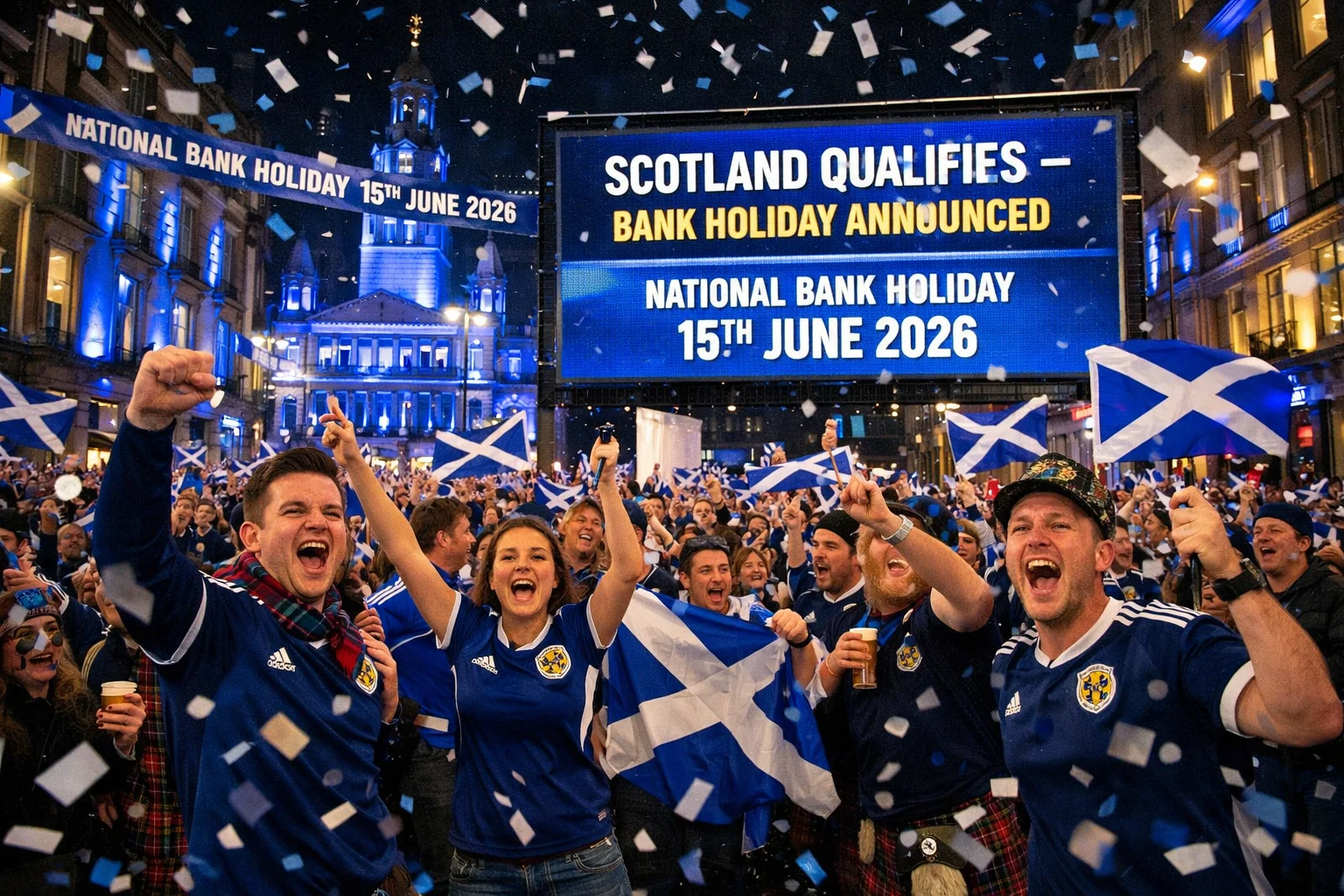
Scotland has officially declared Monday, 15th June 2026 a national bank holiday, following the national football team’s return to the FIFA World Cup after 28 years.
The announcement, made by First Minister John Swinney, allows fans to recover and celebrate after the team’s 2am kick-off against Haiti the night before.
This historic move reflects more than football – it’s a celebration of national pride and cultural identity.
Key points covered in this blog:
- The official reason for the 15th June bank holiday
- Scotland’s qualification journey and its significance
- Impact on workers, businesses, and public services
- Government and fan reactions
- Plans for extended hospitality hours and fan zones
- Economic and global cultural impact
- Upcoming World Cup fixtures for Scotland
Why Has 15th June Been Declared a National Bank Holiday in Scotland?

The decision to declare 15th June 2026 as a national bank holiday in Scotland wasn’t made lightly. It reflects a deep understanding of how significant this moment is for the Scottish people.
For the first time since 1998, the Scotland men’s national football team has qualified for the FIFA World Cup, and the energy across the country is undeniable.
On Sunday, 14th June, Scotland will play its opening match against Haiti, with a 2am UK kick-off.
The timing is a result of the tournament being hosted across North America. This schedule raised immediate concerns for fans and workers alike who would be staying up through the night to support their team and then facing the typical demands of a Monday morning.
The response from the Scottish Government was decisive and heartfelt.
As First Minister John Swinney announced publicly, the government is taking steps to officially make Monday, 15th June a national bank holiday.
His statement made it clear that this wasn’t just about a football match; it was about recognising the unifying power of sport and giving Scots across the nation the space to come together and celebrate.
In Scotland, a national bank holiday can be created by royal proclamation. This process involves the First Minister advising the Privy Council, which then makes a formal recommendation to the King.
Once approved, it becomes official for the public sector. Private employers are given the discretion to follow suit, and historically many do, especially when the holiday reflects widespread national sentiment.
The fact that such a proclamation was initiated for a sporting event speaks volumes about how important this World Cup return is for Scotland.
It also sets the tone for how the country plans to treat this occasion: not as a standard tournament appearance, but as a landmark event that deserves official recognition and shared celebration.
What Does Scotland’s Return to the World Cup Mean for the Nation?
A Historic Return After 28 Years
It’s difficult to overstate the emotional impact of Scotland’s return to the World Cup stage. For nearly three decades, we’ve watched from the sidelines while other nations took the spotlight.
Generations of fans have grown up hearing stories about the 1998 campaign and wondering when they’d finally see Scotland compete on football’s biggest platform once again.
Now that day has come. The qualification journey was filled with drama, resilience and unforgettable moments. The standout match, of course, was the 4-2 win over Denmark in November 2025.
Hampden Park was electric that night, and as someone who was in Glasgow during the game, I can say it felt like a turning point in our footballing story.
People poured into the streets, singing, waving flags, and embracing complete strangers.
The buzz was about more than just the scoreline. It was about belief. That moment cemented a sense of national pride and hope we hadn’t felt in years.
The Journey to Qualification
The group stage leading up to qualification wasn’t easy. Scotland had to overcome tough competition, including higher-ranked teams. But something was different this time.
Under the steady leadership of manager Steve Clarke, the team developed a strong identity — disciplined, focused, and unafraid of the spotlight.
A few key aspects defined the journey:
- Consistent performance in home matches, where fan support played a crucial role
- Tactical maturity from Clarke, especially in defensive organisation and quick transitions
- Emergence of young talent like Ben Doak, complementing experienced players such as Andy Robertson and Scott McTominay
- A united dressing room culture that radiated confidence
The Denmark match wasn’t just a win, it was a message. Scotland wasn’t lucky to be going to the World Cup. We earned it.
How Will the 15th June Bank Holiday Affect Workers and Employers?

Declaring a public holiday, especially one tied to a specific event, brings with it a mix of logistical questions and workplace considerations. While the 15th June bank holiday will be widely celebrated, its implementation isn’t automatically uniform across all sectors in Scotland.
Here’s a breakdown of how it is expected to affect different groups:
| Sector | Impact of Bank Holiday |
|---|---|
| Public Sector (Scottish Government workers) | Official day off |
| Local Government and Schools | Likely to follow closure guidance |
| Private Sector | Employer discretion applies |
| Healthcare & Emergency Services | Continue operating with rota adjustments |
| Retail & Hospitality | High demand expected; staff policies vary |
For public sector workers, the holiday is straightforward.
If your job falls under the Scottish Government, you’re entitled to the day off. Schools are also expected to close, although some local authorities may adjust timetables depending on regional needs.
For the private sector, things are more nuanced. Businesses are encouraged to accommodate employees where possible, either through flexible working arrangements or allowing time off.
In sectors such as retail, transport, and hospitality, the expectation is quite different.
These industries anticipate a surge in demand, particularly from fans celebrating in public spaces or recovering the day after a long night of festivities.
A key consideration for employers is the morale boost this holiday represents.
Allowing staff to participate in a national moment of pride and unity may result in improved engagement and goodwill, especially in the long run.
What Are the Reactions from Fans, Officials, and the Public?
There’s a unique kind of electricity in Scotland right now.
From high streets to households, everyone’s talking about the match. Social media is filled with countdown posts, retro jersey photos, and predictions for the group stage.
And everywhere you turn, there’s the unmistakable energy of a country coming together.
As someone who lives and breathes Scottish football culture, I can tell you this isn’t just sports talk. It’s a deep-rooted cultural resurgence. When I heard First Minister Swinney say, “This year, we want to make the most of this huge opportunity for Scotland,” it resonated personally. Because we all feel it in this sense that we’re about to reintroduce ourselves to the world.
I’ve had conversations with friends in the hospitality industry who are preparing for an overwhelming few days around the match. One manager in Edinburgh told me they’re expecting nearly triple their usual customer volume.
Not because of promotions or advertising, but simply because people want to be together. They want to sing, cheer, cry, and belong.
Professionals in the sports management space have echoed similar sentiments. A football development officer I spoke with described the bank holiday as “a once-in-a-generation gesture that honours the emotional power of the game.” And I couldn’t agree more.
Will There Be Extended Opening Hours and Fan Zones for Matches?
Due to the awkward kick-off times especially the 2am start against Haiti there’s increasing demand for changes to hospitality laws and local event permits. The industry is lobbying for extended opening hours on match nights, allowing pubs and venues to legally serve patrons throughout the game and a short time after.
This is currently under discussion with local authorities. The police, licensing boards, and public health officials are involved in reviewing the impact, particularly in larger cities such as Glasgow, Aberdeen and Dundee.
Fan zones are another popular proposal, and they’re expected to feature in major urban centres. These spaces would likely include:
- Large outdoor screens
- Security and safety measures
- Food and drink vendors
- Family-friendly areas with early evening programming
These zones help spread the crowd and give people of all ages a place to safely watch and celebrate. It’s also a way to bring in tourism and showcase our culture to visiting fans and media crews covering the tournament.
The Scottish Government is currently in talks with key stakeholders to formalise these plans in advance of the tournament start. While there’s no final decision at the time of writing, early signs point toward support for expanded hospitality options and regulated public celebrations.
How Could This Bank Holiday Boost Scotland’s Economy and Global Image?
One of the most compelling arguments in favour of the 15th June bank holiday is its potential economic and cultural impact. When national attention converges on a major sporting event, the ripple effects extend far beyond the pitch.
Economic Opportunities
Scotland is poised to benefit in several direct and indirect ways:
- Increased foot traffic in pubs, restaurants, and retail during match days
- Merchandise sales surging in both local shops and online platforms
- Boost in domestic tourism, with fans travelling across cities to attend fan zones and gatherings
- Short-term job creation in event management, security, and hospitality
We can already see early signs of this impact. T-shirt vendors have reported early sell-outs of 1998 replica kits. Travel companies are offering Scotland-themed packages tied to the tournament, and many cities are preparing for record hotel bookings over the match weekend.
Cultural and Diplomatic Value
Football provides a powerful platform for nations to showcase their identity. For Scotland, the 2026 World Cup is a rare opportunity to do exactly that.
With global broadcasters covering our team and fans on an international stage, this is a chance to demonstrate the warmth, spirit, and pride of Scottish people.
Moreover, cultural initiatives tied to the tournament, such as Scottish music showcases and traditional food stalls at fan zones, could deepen the nation’s global footprint in ways that go beyond sport.
The First Minister acknowledged this in his remarks, stating that the tournament allows Scotland to “attract business development, create tourism interest… and make cultural and sporting connections.” It’s a strategic vision that combines passion with planning.
What’s Next for Scotland in the World Cup 2026 Fixtures?
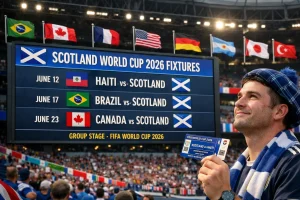
The journey doesn’t stop with Haiti. Scotland’s group stage in the 2026 FIFA World Cup includes three challenging fixtures, all with late-night kick-offs for UK viewers.
| Match | Date | Time (UK) | Location |
|---|---|---|---|
| Scotland vs Haiti | 14 June | 2:00am | Houston |
| Scotland vs Brazil | 18 June | 11:00pm | Los Angeles |
| Scotland vs Canada | 22 June | 11:00pm | Toronto |
Each of these games presents a different kind of challenge. The Haiti match is a high-pressure opener that Scotland will be expected to win.
Brazil is, of course, a football powerhouse and evokes memories of the 1998 opener, which also featured these two teams.
Canada brings a technical style and home advantage, given the North American setting.
What’s unique here is how Scotland plans to manage both performance on the field and engagement at home.
The Scottish FA is reportedly working with media partners and government bodies to ensure maximum access to coverage, while also promoting responsible and inclusive fan experiences.
Final Thoughts
This holiday isn’t just about convenience. It’s about meaning.
It’s about those of us who remember 1998 and have waited ever since. It’s for the kids painting flags on their cheeks before school. It’s for the pubs that keep the lights on at 2am and the workers who’ll finally get to celebrate without worry the next day.
As both a football fan and a Scottish writer, I’ll be waking up on the 15th regardless of the match outcome proud. Not just of our team, but of what we’re building together. A culture that values celebration, community, and pride.
FAQs About the 15th June Bank Holiday and Scotland’s World Cup Return
Is the 15th June 2026 bank holiday applicable only in Scotland?
Yes, the bank holiday has been declared only for Scotland. Other parts of the UK will not observe this as a public holiday.
Will schools and offices be closed on 15th June in Scotland?
Public sector organisations are expected to close, while private sector closures depend on individual employers. Schools will likely close, subject to local authority decisions.
Why is the Scotland vs Haiti match scheduled at 2am UK time?
The match is being held in the USA, and the local fixture time translates to 2am BST due to the time difference.
Will the 15th June bank holiday become a recurring event?
Currently, it’s a one-off holiday specifically to mark the historic return to the World Cup. There are no plans to make it annual.
How can fans celebrate if they can’t travel to the match?
Fans can attend local fan zones, watch from pubs (where opening hours permit), or enjoy home celebrations with family and friends.
Are there any other countries planning similar football-related holidays?
While rare, a few nations have declared holidays for football wins in the past, particularly in Latin America and Africa. Scotland’s move is unusual for a pre-match holiday.
How has the Scottish government justified this national holiday?
The government cited national morale, economic opportunity, and cultural significance as reasons. It reflects Scotland’s collective excitement and the scale of the occasion.

Leave a Reply