
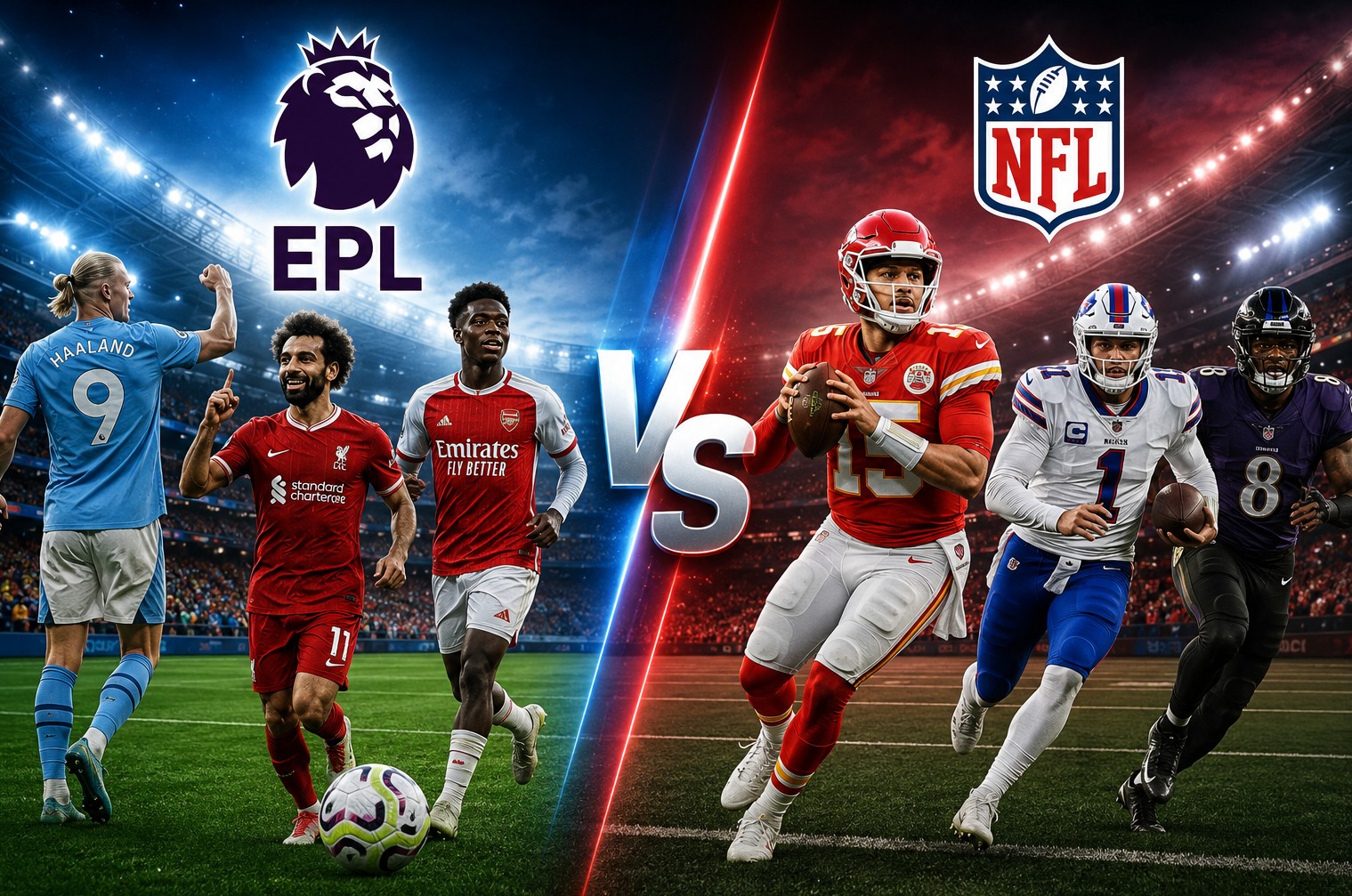
The English Premier League and the NFL are two of the most powerful sports properties in the world, but they are built on very different foundations.
The EPL sells global football culture, tradition, promotion and relegation, international stars, historic clubs, and constant drama across a long season.
The NFL sells scarcity, structure, competitive balance, and the commercial power of the American sports machine.
Both leagues are enormous. But the way they create, distribute, and protect value could hardly be more different.
How Do EPL and NFL Business Models Differ?
The NFL’s Betting-Driven Attention Economy

One of the clearest examples of the NFL’s commercial strength is the betting ecosystem around it. Sportsbooks like DraftKings have a huge range of markets, that range matters because NFL betting is not limited to game day.
It stretches across the offseason, draft, training camp, preseason, regular season, playoffs, and awards races. For sportsbooks, the NFL is a year-round engagement product.
For the league, betting interest helps deepen fan attention around matchups, injuries, player performance, and statistical storylines.
The EPL has a mature betting culture too, but the NFL’s compressed schedule makes every game feel like a high-stakes event. Scarcity turns each matchup into a premium commercial moment.
The NFL Model: Centralization and Control
The NFL is a closed league. There is no promotion or relegation. The same 32 franchises return every season, and that stability underpins the entire business model.
Revenue sharing is central to the league’s power. National media rights, sponsorships, licensing, and other league-level income are distributed across all teams, helping small-market franchises compete financially with larger-market teams.
The salary cap adds another layer of control, limiting how much teams can spend on players and preserving competitive balance.
This structure makes the NFL unusually efficient. It plays far fewer games than most major leagues, yet each game carries huge broadcast, sponsorship, and advertising value. The product is scarce, predictable, and built for television.
The EPL Model: Openness and Inequality
The Premier League is part of an open football pyramid. Clubs can be promoted into it or relegated out of it.
That creates drama the NFL cannot replicate. A club’s entire financial future can change with one season, one run of form, or one final-day result.
But openness also creates risk. Relegation can remove access to Premier League broadcast income almost overnight.
Parachute payments help soften that fall, but they also create controversy because relegated clubs often retain a financial advantage over Championship rivals.
At the top of the EPL, global club brands drive huge commercial income. Manchester United, Liverpool, Arsenal, Chelsea, Manchester City, and Tottenham do not just compete as teams.
They operate as global media and lifestyle businesses. That creates enormous upside, but also deep financial separation between elite clubs and the rest.
Broadcast Power: Scarcity vs Volume

The NFL’s media model is built around scarcity. A 17-game regular season means every broadcast matters.
Networks and streaming platforms pay heavily because NFL games consistently deliver massive live audiences.
The Premier League’s media model is built around volume and global reach. It has more teams, more matches, and a worldwide audience that follows clubs across time zones.
Its international appeal is stronger than the NFL’s, but the value of any single regular-season match is usually less concentrated than an NFL game.
In short, the NFL monetizes fewer games more aggressively. The EPL monetizes a global calendar built around constant narrative.
Cost Control vs Spending Pressure
The NFL’s salary cap gives owners cost certainty. Teams can still make bad decisions, but they cannot simply spend without limit. That protects profitability and helps maintain competitive balance.
The EPL operates in a more fluid labor market. Clubs compete domestically and internationally for players, and transfer fees add another layer of cost.
Even with financial regulations, wage growth and transfer spending can quickly absorb revenue gains.
This is why Premier League revenues can hit record levels while clubs still face major losses. Growth is strong, but the pressure to spend is relentless.
Franchise Value vs Club Identity
NFL teams are franchises in a closed system. Their value is protected by scarcity: there are only 32 of them, and entry into the league is almost impossible. That makes NFL ownership one of the most attractive assets in sports.
Premier League clubs are different. Their value is tied to history, fanbase, stadium, brand strength, league status, and European competition.
A club can become more valuable through success, but it can also lose value quickly through relegation or poor management.
The NFL protects owners from existential sporting failure. The EPL exposes owners to it.
Which Model Is Stronger?

The NFL is the stronger controlled business model. It is centralized, profitable, media-driven, and structurally protected.
The EPL is the stronger global cultural model. It has deeper international roots, more organic fan identity, and the drama of an open pyramid.
That is the real contrast. The NFL is engineered for commercial efficiency. The Premier League is powered by football’s global emotion.
Both are empires. But one is a tightly managed entertainment machine, while the other is a high-risk, high-reward global football marketplace.

Leave a Reply