

Andy Burnham’s immigration bill stance is broadly supportive of Home Secretary Shabana Mahmood’s proposed asylum reforms.
He voted in favour of the Immigration and Asylum Bill at its Second Reading on 13 July 2026, helping it pass by 264 votes to 90.
However, three separate policy areas must not be confused:
- Burnham voted for the overall Immigration and Asylum Bill.
- The government has promised a future amendment concerning serious criminals protected by section 7 of the Immigration Act 1971.
- Proposed changes to indefinite leave to remain, including a longer route to settlement, are being considered separately and are not currently part of the Bill.
Burnham therefore supports stronger border enforcement, faster decisions, changes to asylum appeals and the removal of serious foreign offenders.
At the same time, reports suggest he may seek protections for migrants already progressing towards permanent settlement under existing expectations.
Andy Burnham’s immigration position at a glance
| Policy point | Current position as of 14 July 2026 |
|---|---|
| Immigration and Asylum Bill introduced | 30 June 2026 |
| Second Reading vote | 13 July 2026 |
| Commons result | 264 votes for, 90 against |
| Andy Burnham’s vote | Voted in favour |
| Labour MPs voting against | 14 |
| Serious-criminal amendment | Announced but not yet separately voted on |
| Proposed settlement baseline | 10 years for most migrants |
| Current general settlement route | Commonly five years on qualifying routes |
| Settlement policy included in Bill? | No, it is being considered separately |
| People forecast to reach settlement between 2026 and 2030 | Approximately 1.6 million |
| New refugee protection period | 30 months before review for relevant claims |
| Proposed asylum support contribution | Around £10,000 for people able to pay |
| Public Bill Committee deadline | 3 November 2026 |
The Bill completed its Second Reading on 13 July and has been committed to a Public Bill Committee. Committee proceedings are scheduled to conclude by 3 November 2026.
It must still complete further Commons stages, pass through the House of Lords and receive Royal Assent before becoming law.
What is Andy Burnham’s Immigration Bill Stance?

Burnham’s position can best be described as support for a stricter but managed immigration and asylum system.
The Financial Times reported that Burnham had backed the broad direction of Mahmood’s reforms while calling for an asylum system that was “both compassionate and credible”.
Its analysis suggested that he was attempting to combine stronger border controls with continued support for lawful migration, refugee protection and integration.
Readers can view the original analysis in the Financial Times report on Andy Burnham’s immigration position.
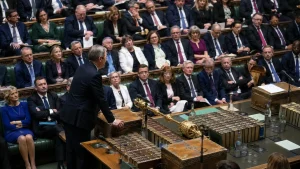
The clearest confirmed evidence of Burnham’s position is his parliamentary vote. The official Commons record lists Andy Burnham, Labour MP for Makerfield, among the MPs who voted “Aye” at the Bill’s Second Reading.
That vote indicates support for the Bill’s general principles. It does not necessarily mean that Burnham accepts every clause, regulation or future amendment without change.
His apparent priorities include:
- Reducing dangerous small-boat crossings;
- Disrupting people-smuggling networks;
- Accelerating asylum decisions and appeals;
- Removing people who have no lawful right to remain;
- Maintaining controlled safe and legal refugee routes;
- Reducing reliance on asylum hotels;
- Giving local communities more influence over asylum accommodation;
- Reconsidering retrospective changes affecting people already on a settlement route.
This places Burnham broadly alongside Mahmood on enforcement, but potentially closer to Labour critics on how new settlement rules should affect existing migrants.
Did Andy Burnham Support Shabana Mahmood’s Amendment?
Burnham supported the Bill at Second Reading, but there has not yet been a separate parliamentary vote on the specific amendment associated with the Rochdale grooming gang case.
During the Commons debate, Mahmood announced that the government intended to table an amendment giving the Home Secretary a power to disapply section 7 of the Immigration Act 1971 in cases involving serious criminals.
What Does Section 7 of the Immigration Act 1971 Do?

Section 7 provides particular protections from deportation for certain Commonwealth citizens who were ordinarily resident in the UK when the Immigration Act 1971 came into force and who had been ordinarily resident for at least five years.
The provision was designed to protect long-standing Commonwealth residents whose lives had become established in Britain.
The government argues that it should not prevent the deportation of people convicted of exceptionally serious crimes.
Mahmood told Parliament that the proposed amendment would allow the Home Secretary to remove this protection in serious cases.
The announcement followed debate over the position of Shabir Ahmed, who was convicted for his role in the Rochdale grooming gang.
Would the Amendment Automatically Result in Deportation?
No. Removing a statutory protection would not necessarily guarantee that a person could immediately be deported.
The Home Office could still face:
- disputes over the individual’s nationality;
- refusal by another country to accept the person;
- outstanding legal proceedings;
- human rights or protection claims;
- administrative and diplomatic barriers.
The proposed amendment would remove one potential legal obstacle. It would not remove every legal or practical requirement associated with deportation.
Has the Amendment Become Law?
No. As of 14 July 2026, the government had announced its intention to table the amendment. The Bill remains at an early parliamentary stage and has not received Royal Assent.
The most accurate description is therefore that Burnham has backed a Bill to which Mahmood intends to add the serious-criminal provision.
It would be inaccurate to say that Burnham voted separately on the final wording of that amendment.
What Does the Immigration and Asylum Bill Propose?
The Immigration and Asylum Bill is a government Bill covering asylum, immigration appeals, human rights claims, modern slavery and asylum support. It was introduced in the Commons on 30 June 2026.
A New Immigration Appeals Authority
The Bill would establish an Independent Immigration Appeals Authority, known as the IIAA.
The government says the new authority would create a more streamlined appeal process, allow high-priority cases to be heard faster and reduce repeated claims that delay removals.
Home Office figures published with the proposal said more than 150,000 immigration and asylum appeals were waiting to be heard, with an average clearance time of 61 weeks.
The authority is expected to begin hearing cases in stages from late 2027, subject to Parliament approving the legislation.
Critics have questioned whether the proposed authority would have sufficient judicial independence and whether replacing existing tribunal arrangements would produce fairer or faster decisions.
Those concerns are likely to receive further scrutiny during the Committee and Report stages.
Changes to Article 8 Deportation Cases
Article 8 of the European Convention on Human Rights protects private and family life. It is a qualified right, meaning interference may be permitted when it is lawful, necessary and proportionate.
The Bill would change how Article 8 is considered in deportation cases. It states that the public interest generally requires the deportation of someone liable to deportation unless the effect on that person or their family would be disproportionate.
The seriousness of the offence, its circumstances and its effect on society would be relevant when the public interest is assessed.
The Bill also identifies exceptional circumstances involving long residence, integration, partners, children and other compelling factors.
The proposals do not abolish Article 8, remove the UK from the European Convention on Human Rights or prevent every family-life claim.
Temporary Refugee Protection
For adults and accompanied children making asylum claims from 2 March 2026, successful protection is generally granted for 30 months before review.
Protection should be renewed where the person continues to face danger.
Where conditions in the country of origin have changed sufficiently, the government may expect the person to return or move onto another qualifying immigration route.
This is different from indefinite leave to remain. Refugee protection, work visas and permanent settlement are legally distinct parts of the immigration system.
Contributions Towards Asylum Support
The Bill would give the Home Office powers to recover some asylum accommodation and support costs from people who later have sufficient funds.
The government has indicated that the planned total contribution could be around £10,000. However, thresholds, payment arrangements and safeguards would need to be set through detailed rules.
The Home Office says payments should only be required from people able to contribute and should not force anyone into destitution.
Is the Longer Indefinite Leave to Remain Route Part of the Bill?

No. This is one of the most important distinctions in the debate.
During the Second Reading, Mahmood explicitly told MPs that indefinite leave to remain and earned settlement were not subjects of the Immigration and Asylum Bill.
She said the government would settle that policy separately after responding to its earned-settlement consultation.
The government’s consultation proposes increasing the starting point for settlement from five years to ten years for most migrants. Additional conditions could either shorten or extend that period.
Proposals include requirements relating to:
- Criminal records;
- English-language ability;
- National Insurance contributions;
- Economic participation;
- Public debt;
- Public-service employment;
- Volunteering;
- Income and tax contributions.
Under the consultation model, some high earners, Global Talent visa holders and qualifying public-service workers could potentially reach settlement earlier.
Other applicants could face a longer route. Partners of British citizens and British National Overseas status holders from Hong Kong were proposed to remain on five-year routes.
Why is Retrospective Application Controversial?
The original consultation proposed applying the new settlement framework to people already in the UK who had not yet received indefinite leave to remain.
This created concern among migrants who entered under rules that appeared to provide a five-year route to settlement.
It also raised questions for employers that had recruited and sponsored workers on the expectation that they could settle after five qualifying years.
The government forecasts that approximately 1.6 million people could otherwise qualify for settlement between 2026 and 2030.
Reports suggest Burnham may support a compromise that protects some existing expectations, changes transitional arrangements or separates settlement rights from immediate access to certain benefits.
However, no final compromise had been formally adopted as of 14 July 2026.
Why is Burnham’s Position Politically Significant?
Burnham is expected to become Labour leader and prime minister in July 2026 following Keir Starmer’s resignation.
His approach to immigration therefore offers an early indication of how his government may handle one of Labour’s most divisive policy areas.
His stance attempts to address two competing pressures.
One side of the debate wants stronger enforcement, fewer irregular crossings, quicker removals and clearer limits on settlement.
The other is concerned about refugee protection, family unity, human rights and retrospective changes for lawful migrants.
Burnham appears to be positioning himself between these groups. He has not rejected Mahmood’s enforcement agenda, but he may be more open to transitional protections and locally managed asylum policies.
That approach could allow him to argue that immigration control and compassion are not mutually exclusive.
Whether it succeeds will depend on the final legislation, detailed Immigration Rules and the government’s ability to deliver faster decisions in practice.
What Could Burnham’s Stance Mean for Migrants and Employers?

For Skilled Worker Visa Holders
A person who entered the UK on a qualifying work route in 2021 or 2022 may have expected to apply for settlement after five years.
The Bill itself does not change that route. However, separate earned-settlement rules could affect the person if the government applies the new framework to existing visa holders.
Until final Immigration Rules and transitional arrangements are published, an affected worker should not assume either that the five-year route is protected or that it has already been removed.
For Health and Care Employers
Employers in health, social care and other public services may be concerned about staff retention if sponsored workers face substantially longer routes to settlement.
The consultation has considered accelerated routes for some public-service workers. Reports have also discussed possible exemptions for health and care staff, but the final categories and eligibility requirements remain uncertain.
Businesses should distinguish between confirmed visa rules and proposals that are still under consultation.
For Asylum Applicants
A person claiming asylum after 2 March 2026 may receive 30 months of protection if successful, followed by a review.
The person may also be affected by future appeal reforms and, if later able to pay, rules requiring a contribution towards the cost of accommodation or support.
Individual outcomes will still depend on the person’s circumstances, country conditions and applicable law.
For Long-term Commonwealth Residents Convicted of Serious Offences
The proposed section 7 amendment could allow the Home Secretary to remove an existing protection against deportation in exceptionally serious cases.
This would not automatically establish nationality, secure acceptance by another country or dispose of every possible legal claim. Those issues would still need to be resolved individually.
What Happens Next?
The Immigration and Asylum Bill will move into detailed examination by a Public Bill Committee.
During that stage, MPs can examine evidence, debate individual clauses and consider amendments. The promised section 7 amendment is expected to be considered as the Bill progresses.
The likely sequence is:
- Public Bill Committee scrutiny.
- Report stage in the House of Commons.
- Third Reading in the Commons.
- Consideration by the House of Lords.
- Resolution of any disagreements between the two Houses.
- Royal Assent.
- Commencement regulations and secondary legislation.
Separately, the government must respond to the earned-settlement consultation and publish final rules on indefinite leave to remain.
Those rules may be introduced through changes to the Immigration Rules rather than through this Bill.
Final Takeaway
Andy Burnham’s immigration bill stance supports the main direction of Shabana Mahmood’s asylum reforms without necessarily endorsing every detail.
His Commons vote confirms support for tougher appeal rules, stronger deportation provisions, temporary protection and greater emphasis on enforcement and contribution.
However, the proposed extension of the route to indefinite leave to remain is a separate policy, and Burnham may seek fairer transitional arrangements for migrants already living and working in Britain.
The central point is that the Bill, the serious-criminal amendment and the earned-settlement proposals remain legally distinct.
None should be treated as final until Parliament completes its scrutiny and the government publishes the relevant legislation and Immigration Rules.
Frequently Asked Questions
Did Andy Burnham vote for the Immigration and Asylum Bill?
Yes. The official parliamentary division record shows that Burnham voted in favour at Second Reading on 13 July 2026.
What is Andy Burnham’s position on immigration?
He supports stronger border enforcement, faster asylum decisions, action against smuggling gangs and the removal of serious foreign criminals.
He also appears to support safe legal routes and may reconsider retrospective settlement changes affecting existing migrants.
Does Burnham support Shabana Mahmood?
On immigration, he has supported the broad direction of Mahmood’s reforms and voted for her Bill. That does not prevent him from changing individual policies after taking office.
What is Shabana Mahmood’s proposed amendment?
The government intends to amend the Bill so that the Home Secretary can disapply section 7 of the Immigration Act 1971 in serious criminal cases. This could remove a deportation protection available to certain long-term Commonwealth residents.
Is indefinite leave to remain changing to ten years?
The government has proposed a ten-year starting point for most settlement routes, with possible reductions or additions based on contribution and other criteria. The final policy and transitional arrangements have not yet been confirmed.
Will the new settlement rules affect people already in Britain?
The consultation proposed applying the framework to people who had not yet received settlement, including some already in the UK. However, transitional arrangements are still under consideration.
Has refugee status become temporary?
For relevant adults and accompanied children claiming asylum from 2 March 2026, protection is generally granted for 30 months before review. Protection should continue where the need for sanctuary remains.
Can the Bill still be changed?
Yes. MPs and peers can propose amendments during later parliamentary stages. The final Act may therefore differ substantially from the Bill introduced on 30 June 2026.
Important Note:
Editorial Note: This article has been reviewed against UK Parliament, Home Office and GOV.UK guidance.
Disclaimer: This article provides general political and legal information based on available information. It does not constitute immigration or legal advice. Immigration rules and proposed legislation can change quickly.
Anyone whose status may be affected should check current GOV.UK guidance or seek advice from a regulated immigration adviser or qualified solicitor.

Leave a Reply